Ginny (Friday the 13th)
Ginny Field is a fictional character from the Friday the 13th series of slasher films. She first appeared in 1981 in Steve Miner's Friday the 13th Part 2 as a child psychology student working at a counselor training center over the summer who encounters the legend of Jason Voorhees. Ginny is portrayed by Amy Steel in her first leading role. Writer Ron Kurtz created the character, and Miner intended to utilize Ginny in later films. Miner's plans changed when Steel declined to reprise the role. Steel's negative experience with the night shoots and the persuasion of her agent influenced her decision.
| Ginny Field | |
|---|---|
| Friday the 13th character | |
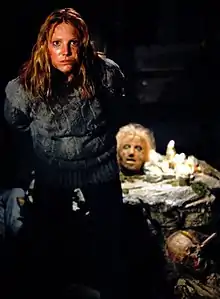 Steel portraying Ginny | |
| First appearance | Friday the 13th Part 2 |
| Created by |
|
| Portrayed by | Amy Steel |
| In-universe information | |
| Full name | Virginia "Ginny" Field |
| Occupation | Camp counselor (former) Psychologist |
| Status | Alive |
Besides film, the literary works of the franchise prominently feature the character. Ginny has various depictions in fan labor of the franchise—ranging from fan films to fan art. Ginny is referenced in Carol J. Clover's Men, Women, and Chainsaws (1992) as an example of Clover's theory and has been referred to as being the franchise's "ultimate final girl."[1]
Appearances
Film
Ginny made her first appearance in Friday the 13th Part 2 (1981). A child psychology major, Ginny is assisting her boyfriend Paul (John Fury) in his new endeavor—running a counselor training center to train upcoming summer camp counselors. The facility is on the shores of Crystal Lake, which is infamous for the legend of Jason Voorhees (Steve Dash). Ginny believes it and deduces that Jason kills as vengeance for his mother. Ginny faces Jason and retreats to his makeshift hut in the woods. She discovers the shrine of Pamela Voorhees and Alice and decides to put on Pamela's deteriorating sweater—to impersonate Jason's mother. While it initially works, Jason realizes her tactic, and after a brief altercation with Paul, Ginny slices his shoulder with a machete. Ginny has a nightmare sequence of Jason attacking her through a window. The film ends ambiguously with her being pulled away on a stretcher with Paul missing.[2]
In the opening of Friday the 13th Part III (1982), Ginny impersonates Pamela and temporarily defeats Jason. She is later briefly seen on a news report detailing her survival.[3]
Literature
Ginny makes her first literary appearance in the novelization of Friday the 13th Part 3 (1982), which states that she is in "serious condition" and is suffering from "severe hysterical shock" because of her battle with Jason Voorhees. She subsequently appears as the lead protagonist in Friday the 13th Part II: A Novel, a novelization of the 1981 film Friday the 13th Part 2, which was released seven years after the film premiered in February 1988. The novel was written by Simon Hawke and based on Ron Kurz's screenplay.[4] The aftermath of her encounter with Jason is once again referenced in the novel Friday the 13th: Carnival of Maniacs, which states that her claims of finding Jason's shack in the woods went ignored, due to the authorities doubting her sanity. Ginny is a prominent recurring character featured in the designs of the apparel company Fright-Rags.[5][6] Artist Matthew Therrien featured Ginny in his "Final Girl and Cinema Survivors" digital series.[7]
Development
Victor Miller, the writer of Friday the 13th (1980), declined to write the sequel as the idea of Jason being the villain was illogical to him. Ginny, instead, was conceptualized by writer Ron Kurtz. Once Kurtz joined the production, one of his goals was to kill off the protagonist of the first film, Alice (Adrienne King). Kurtz had a misconception that King's agent was trying to bribe the production for more money. Kurtz created a new group of counselors and wanted them to be believable and likable characters.
Kurtz's vision for Ginny was to have her embody "every intelligent, free-spirited" girl he had met in his life. Newcomer Amy Steel was living in Florida but moved with her friend to New York for a modeling agency. During her stint in television commercials, she got an audition for Part 2. She described the audition process for Ginny as being typecasting with her fitting the part of the "outdoorsy, strong girl with blonde hair." Both Kurtz and casting director Meg Simon liked Steel, with the latter saying that her charismatic personality helped make Ginny into a fully developed character.
Steve Miner wanted Ginny to be the main character in Friday the 13th Part III (1982), with the film having a psychological element to it. Miner spent the most time with Martin Kitrosser developing a story that had Ginny under pursuit by a vengeful Jason in a psych ward. Additionally, Steel recollects reading a script outline that had Ginny and prior supporting character Ted (Stu Charno) in a leading role. The story focused on a post-traumatic Ginny returning to university and becoming an outcast amongst her peers. She took martial arts training as a means of coping with her trauma. Jason Voorhees tracks her down and places Paul's (whose fate is left ambiguous in Part 2) corpse in her dormitory. Ginny joins Ted and begins a dedicated hunt to find Voorhees.
Both versions of Part III were scrapped when Steel declined Miner's offer due to pressure from her agent. Nearly 30 years after turning it down, her mother found the script in her attic and returned it to her. After rereading it, Steel has expressed regret for her decision. She describes Part III's Ginny as a "bad-ass, Linda Hamilton-in-the-Terminator kind of character. She was traumatized but fought and was strong and knew karate and all this martial-arts stuff. She was so cool."[8]
Characteristics
The Friday the 13th Part 2 script describes Ginny as an aspiring child psychologist working as a camp counselor over the summer. Steel describes liking the character as she wasn't scripted as "total bimbo" and highlighting Ginny for having intelligence and confidence.[9] Writer Jason Norman describes Ginny as being likable to the viewers and having a charismatic personality.[9] Scholar Bruce F. Kawin notes Ginny's major in child psychology and writes her empathy towards Jason Voorhees and understanding children's emotions as attributing to her survival.[10] Critic Barry Keith Grant questions the morality of Ginny impersonating Pamela Voorhees as means of survival and writes that the film's ending undermines Ginny's independence.[11] Conversely, literary critic John Kenneth Muir commended Ginny for being "resourceful" during the film's climax and writes that she upstages Alice (Adrienne King) and Laurie Strode (Jamie Lee Curtis) during her impersonation of Pamela.[12] Writer Richard Nowell praised the character's "self-confident" entrance and "combining masculine traits with feminine attributes."[13] Writer J. A. Kerswell characterizes Ginny as "warm, resourceful, and plucky."[14] Similarily, writer Jon O'Brien (Inverse) describes the character as tenacious and states that she is the franchise's "ultimate final girl."[1] Adam Charles Hart states that Ginny is a shift in 1980's horror heroines due to her intelligence.[15]
In 2016, Paste ranked Ginny 17th on their list of The 20 Best "Final Girls" in Horror Movie History, calling her "a realistic girl of her time period who, at the same time, has the guts and resolve to face off against Jason and come out on top."[16]
See also
References
- O'Brien, Jon. "How 'Friday the 13th Part 2' accidentally created horror's biggest franchise ever". Inverse. Retrieved 26 July 2021.
- Steve Miner (Director) (1981). Friday the 13th Part 2 (DVD). United States: Paramount Pictures.
- Steve Miner (Director) (1982). Friday the 13th Part 3 (DVD). United States: Paramount Pictures.
- Hawke, Simon (1988). Friday the 13th Part II: A Novel. New American Library. ISBN 0-451-15337-5.
- Parker, Jason (September 15, 2014). "Fright-Rags Releases 'Ginny's Revenge' Part 2 Themed T-Shirt". Friday the 13th The Franchise. Retrieved October 15, 2016.
- Galluzzo, Rob (January 11, 2017). "MOTEL HELL, The FRIDAY THE 13TH Victims & Alfred Hitchcock Get Their Due In New FRIGHT-RAGS Line!". Blumhouse Productions. Retrieved January 24, 2017.
- Sprague, Mike (May 4, 2017). "Exclusive: Artist Matthew Therrien Talks Final Girls & Cinema Survivors". JoBlo.com. Retrieved 26 July 2021.
- Volmers, Eric. "Friday the 13th: How a real-life stalker, Greek mask theory and child psychology helped shape the history of horror's most enduring franchise". Calgary Herald. Retrieved 10 March 2021.
- Norman, Jason (November 11, 2014). Welcome to Our Nightmares. McFarland. p. 88. ISBN 978-0-78-647986-3.
- Kawin, Bruce (2012). Horror and the Horror Film. Anthem Press. ISBN 0857284509.
- Grant, Barry (2015). The Dread of Difference: Gender and the Horror Film. University of Texas Press. ISBN 0292772459.
- Muir, John Kenneth (2012). Horror Films of the 1980s, Volume 1. MacFarland. ISBN 0786455012.
- Nowell, Richard (2010). Blood Money: A History of the First Teen Slasher Film Cycle. Bloomsbury Publishing USA. p. 210. ISBN 1441188509.
- Kerswell, J. A. (2018). The Teenage Slasher Movie Book. CompanionHouse Books. p. 210. ISBN 9781620083086.
- Hart, Adam Charles (2019). Monstrous Forms. Oxford University Press. p. 49. ISBN 9780190916251.
- Vorel, Jim (October 4, 2016). "The 20 Best "Final Girls" in Horror Movie History". Paste. Retrieved February 18, 2020.
External links
- Ginny Field on IMDb
| Films | |
|---|---|
| Television | |
| Characters | |
| Comics | |
| Soundtracks |
|
| Video games | |
| Related | |
| |
