Glogonj
Glogonj (Serbian Cyrillic: Глогоњ,  listen ) is a village in Serbia, situated in the South Banat District of the province of Vojvodina. It is located on the banks of the Tamiš River, about 20 kilometers northwest of Pančevo, and about 20 kilometers direct north of Belgrade. It has a Serb ethnic majority, numbering 3,012 people as of 2011. Its neighboring villages are Sefkerin to the north and Jabuka to the south. All of them lie on the Tamiš.
Glogonj
Глогоњ | |
|---|---|
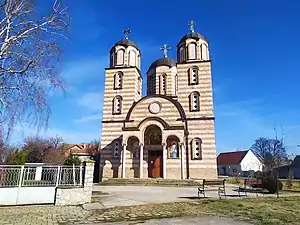 Orthodox Church located in Glogonj | |
 Coat of arms | |
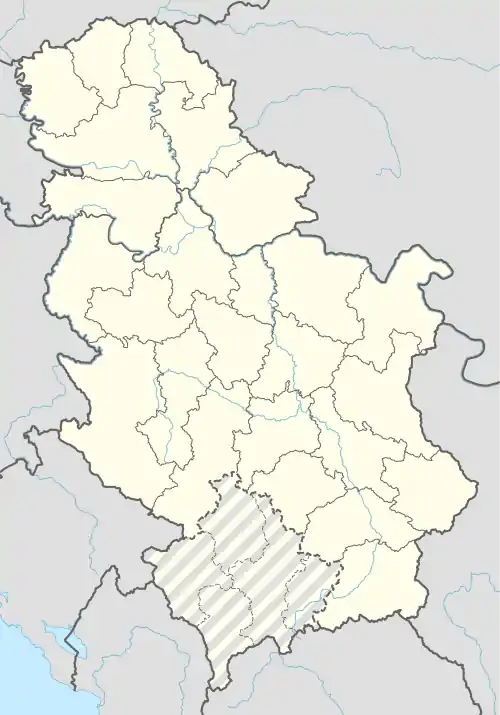  Glogonj Location of Glogonj within Serbia | |
| Coordinates: 44°59′N 20°32′E | |
| Country | Serbia |
| Province | Vojvodina |
| District | South Banat |
| Area | |
| • Total | 42.77 km2 (16.51 sq mi) |
| Population (2011) | |
| • Total | 3,012 |
| • Density | 70/km2 (180/sq mi) |
| Time zone | UTC+1 (CET) |
| • Summer (DST) | UTC+2 (CEST) |
| Area code(s) | +381(0)13 |
| Car plates | PA |
Name
The name 'Glogonj' refers to the shrubs of the Hawthorn tree, (Crataegus) that was prevalent in the settlement during ancient times.[2]
The name was first mentioned as a settlement in 1586.[3]
History
Early history
Throughout its history, Glogonj was colonized during several different periods.[3] The first of these occurred during Austro-Hungarian rule with the arrival of German inhabitants.[4] In 1718 the Habsburg Monarchy had captured much of the Banat Region from the Ottomans and by the 1760s, they were fortifying the border regions of the Banat with German-speaking colonists from all over Central Europe, (Danube Swabians). The Danube River became the natural border between the Austrian Empire and Turkish-occupied Serbia. German-speaking Catholics began to settle in and around Glogon in the 1770s and 1780s to farm the land. A Catholic church (St. Anna) was first built during this era.[5]
19th and early 20th Century
Romanian settlers arrived in the early 19th century. In 1806 an Orthodox Church was built. In 1812, a nursery of fruit trees was established in Glogon.[5]
The population of Glogon for most of the 19th century was about a couple thousand people and most of the people spoke German. There was also a Romanian minority living there. After the formation of Austria-Hungary in 1867, Glogon and the neighboring villages fell under Hungarian jurisdiction. The Hungarian name of the village was 'Galagonyás'.[6]
By the late 1890s and early 1900s, many young men and their families from Glogon, and the neighboring villages, left their homes to migrate to the United States and Canada to start a new life.[7]
After the end of WWI, with the in 1920, Glogon and the surrounding areas of the Banat become part of the newly established Kingdom of Serbs, Croats and Slovenes with Belgrade as its capital. German-speaking villages, such as Glogon, kept their autonomy [8]
In 1935, the village founded an amateur Football/Soccer Team, FK Glogonj.[9]
Second World War
In April 1941, Nazi Germany Invaded Yugoslavia. The Panzer-Grenadier-Division 'Grossdeutschland' occupied Glogon and other surrounding villages as they captured Belgrade. Ethnic German men in the Banat were recruited by force to join the German 'Wehrmacht', while others wilfully joined the 'Waffen-SS'.
Between 1941 and 1944, at an execution site near the village of Jabuka (south of Glogon), more than 600 Serbs, Jews and Roma were killed by German forces.[10]
On October 1944, the Soviet Red Army and Yugoslav Partisans captured Glogon and the surrounding villages during the 'Belgrade Offensive'. Many of the ethnic Germans in Glogon were shot, the local Catholic priest was hung in the bell tower and some of the women were raped and found dead. The new communist Yugoslav regime began reprisals and deprived all ethnic Germans their citizenship and civil rights. On October 30, 1944, special detachments of the Yugoslav People's Liberation Committee shot 128 residents from Glogon on site. The surviving ethnic Germans were taken to labor camps in nearby areas, (such as Rudolfsgnad) where most would die of disease, starvation and the cold. The empty villages were fenced off, houses boarded up and remained abandoned for years.[11][12]
Yugoslav Era
After the war, the village was repopulated with Serbs. Many Serbian citizens from undeveloped mountainous villages from the south of Serbia came to Glogonj, because of its fertile agricultural land and electrification.[4] They inhabited "Swabian houses" and were given possession of several square meters of land. These Swabian houses were built prior to 1940 by the German settlers.[4] During the Yugoslav era, some memorable scenes in Yugoslav films were shot in the village.[4]
Post-Yugoslav Era
After the fall of communism in Eastern Europe in 1989, and the break-up of Yugoslavia in 1991, Glogonj was unaffected during the Yugoslav Wars. After the wars, ethnic German historians began to visit the Banat areas of their Danube-Swabian ancestors, such as in Glogonj. In the early 2000s a project was underway to renovate and repair the old German Roman Catholic cemetery outside of Glogonj. In June 2009, historian Anton Nahm, whose ancestors lived in Glogon, along with other political and church leaders, officially rededicated the cemetery and its new chapel.[13]
Historical Population
- 1910: 2,669 (1,745 Germans, 756 Romanians, 72 Hungarians, 61 Croats, 13 Serbs, 22 others[14]
- 1961: 3,230
- 1971: 3,257
- 1981: 3,605
- 1991: 3,475
- 2002: 3,178 (2,400 Serbs, 927 Romanians, 367 Macedonians and 255 Others)
Notable Citizens
- Adolf Schagar, Julius Jelić and Béla Bazarabić, young members of Theresian Military Academy since 1836, 1878 and 1884.[15]
- Mathias Benrád and Nikola Zseravić, exhibitors of agricultural products (seeds of papaver and cereal) at the World Exposition of 1873.[16]
- Franz Lang became appointed leader of the national socialist local echelon Deutsche Mannschaft of regional Einsatzstaffel (operation echelon Hermann Göring) of Schwäbisch-Deutscher Kulturbund in 1936.[17][18]
- Franz Lischitz (Serbian: Франц Лишиц), member (horse keeper) of the SS Freiwilligen Gebirgsjäger Division Prinz Eugen, refused to participate in a reprisal shooting against civilians (including children and adolescents) in the area around Sarajevo during World War II. He was executed by the SS because of his insubordination.[11]
- Rudolf Büchler, teacher and politician.[19]
References
- "Насеља општине Панчево" (PDF). stat.gov.rs (in Serbian). Statistical Office of Serbia. Retrieved 24 October 2019.
- "Глогоњ". pancevo.rs. City of Pančevo.
- Vujović, Sreten (2008). Društvo rizika: promene, nejednakosti i socijalni problemi u današnjoj Srbiji. University of Belgrade, Institute for Sociological Research. p. 356. ISBN 978-8-68656-356-9.
Glogonj Glogonj je kao naselje prvi put pomenut 1586. godine i zanimljiv je pošto je » doživeo « nekoliko masovnih kolonizacija. Godine 1765. u naselje su došli Nemci, a nakon toga i Rumuni ..
- Cvetković, Goran (4 November 2019). "Glogonj: Kroz banatsku ravnicu". Danas.
- Roth, Erik (1988). Die planmässig angelegten Siedlungen im Deutsch-Banater Militärgrenzbezirk 1765-1821 (in German). R. Oldenbourg. pp. 48–50, 138–140, 145-163. ISBN 978-3-48654-741-2.
- Verordnungsblatt für das Kaiserlich-Königliche Heer: Band 14. Bavarian State Library. 1873. p. 285.
- Dreyer, David; Kraemer, Anton (2002). "Pre World War I Migration Patterns of Banat Germans to North America". Federation of East European Family History Societies.
- Felix Milleker: Geschichte der Stadt Pančevo. Wittigschlager, Pančevo 1925, p. 229.
- "srbijasport.net - FK Glogonj - Glogonj - Lična karta". www.srbijasport.net.
- Walter Manoschek: „Serbien ist judenfrei“ - Militärische Besatzungspolitik und Judenvernichtung in Serbien 1941/42. Oldenbourg, München 1993, ISBN 3-486-55974-5, p. 91, 98–101.
- Lang, Franz (1990). Mit uns in Glogonj 1767-1945. Eigenverl.
- Völkermord der Tito-Partisanen 1944-1948, Österreichische Historiker-Arbeitsgemeinschaft für Kärnten und Steiermark, Graz, 1990, ISBN 3-925921-08-7, p. 169.
- "20 Jahre Donauschwabenhaus in Frankenthal". Donaudeutsche Nachrichten. October 2009.
- "1910. ÉVI NÉPSZÁMLÁLÁS 1. A népesség főbb adatai községek és népesebb puszták, telepek szerint (1912) | Könyvtár | Hungaricana". library.hungaricana.hu.
- Svoboda, Johann (1893). Die Theresianische Militär-Akademie Zu Wiener-Neustadt: Und Ihre Zöglinge Von Der Gründung Der Anstalt Bis Auf Unsere Tage; Volume 2. Hof- und Staatsdruckerei. pp. 90, 735, 792.
- Officieller General-Catalog der Weltausstellung, Wien 1873, p. 169 on Google Books.
- Bundesleitung des Schwäbisch-Deutschen Kulturbundes, Die Arbeit des Kulturbundes 1938: Liste aller regionalen Ortsgruppen als Beilage (Enclosing list of all new regional local groups), Tätigkeitsbericht vom 20 November 1937 – 1 December 1938, Druckerei- und Verlags-A.G., Neusatz 1938.
- Ortssippenbuch Glogau-Glogon, Schriftenreihe zur donauschwäbischen Herkunftsforschung (Nazism and race, Ariernachweis), edited by Michael and Elfriede Adelhardt, Karlsruhe 2007.
- "Rudolf Büchler, Biografie". www.parliament.gv.at. Parliament of Austria.
External links
 Media related to Glogonj at Wikimedia Commons
- Glogonj on the Official Website by the municipality of Pančevo (Serbian)
Authority control  |
|---|