Gonabad
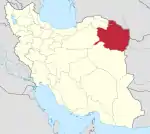
Gonabad (Persian: گناباد, also Romanized as Gonābād; also known as Gūnābād; formerly Janābaz)[2] is a city and capital of Gonabad County, in Razavi Khorasan Province, Iran. At the 2011 census, its population was 36,367, in 10,389 families.[3] It is mostly well known because of the Gonabadi Dervishes and for its qanats, also known as kareez. It is one of the most important producers of saffron in Iran. Other agricultural products include: Grape, Pistachio and pomegranate. The city contains the cemetery for the Ni'matullāhī Gonabadi dervish order located in Beydokht.[4]
Gonabad
گناباد | |
|---|---|
City | |
 | |
  Gonabad | |
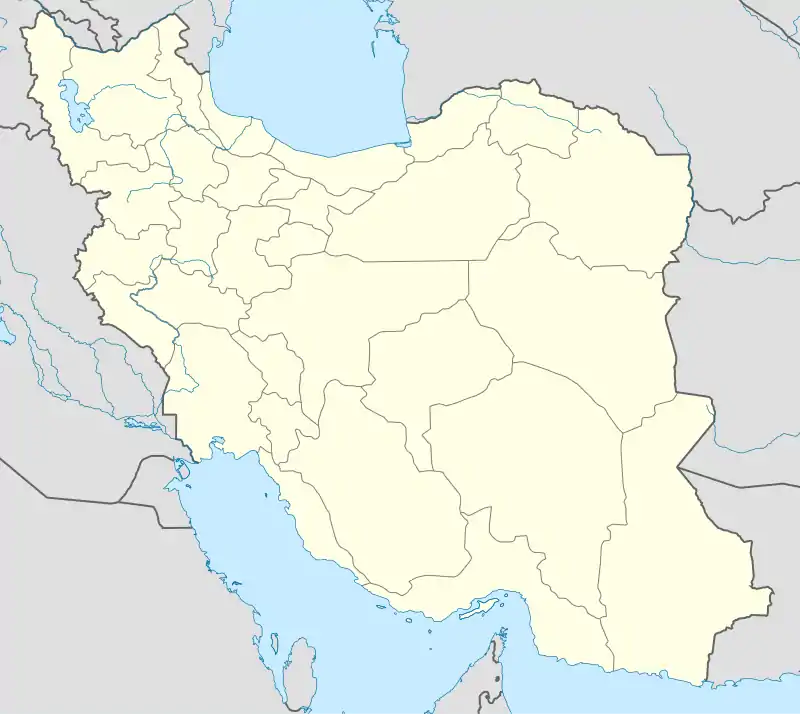
| Coordinates: 34°21′10″N 58°41′01″E | |
| Country |  Iran Iran |
| Province | Razavi Khorasan |
| County | Gonabad |
| Bakhsh | Central |
| Population (2016 Census) | |
| • Total | 40,773 [1] |
| Time zone | UTC+3:30 (IRST) |
| • Summer (DST) | UTC+4:30 (IRDT) |
| Gonabad at GEOnet Names Server | |
History
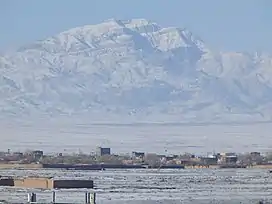
The famous ancient war of Davazdah Rokh had happened between Iran and Turan (Central Asia) in this city on the Zibad Castle.
The construction of this city is attributed to the Achaemenid kings and during the Seljuk Empire and Khwarazmian dynasty periods (fifth to seventh centuries AH) it was Shahrabadi.[5]
Historical sites, ancient artifacts and tourism
Forud Castle
Forud Castle is a historical castle located in Gonabad County in Razavi Khorasan Province, The longevity of this fortress dates back to the Parthian Empire.
Zibad Castle
Zibad Castle is one of the four historical monuments of Zibad, Iran. In 2001, the castle was registered as a national property in Iran, which is related to the history of pre-Islamic Iran, and is located in Gonabad city, Kakhk district, in the residential area of Zibad. It has been registered as national heritage. In addition to the castle of Zibad, there are also the royal castle of Zibad nationally registered under the name of Shahab Castle in 2002.
Jameh Mosque of Gonabad
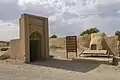
The Jameh Mosque of Gonabad is related to Khwarazmian dynasty and is located in Gonabad.[6][7]
Qanats of Gonabad
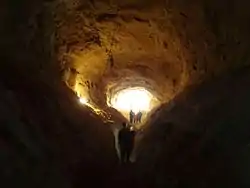
The Qanats of Ghasabeh, also called Kariz Kai Khosrow, is one of the world's oldest and largest networks of qanats (underground aqueducts). Built between 700 and 500 BCE by the Achaemenid Empire in what is now Gonabad, Razavi Khorasan Province, Iran, the complex contains 427 water wells with a total length of 33,113 metres (20.575 mi).[8] The site was first added to UNESCO's list of tentative World Heritage Sites in 2007, then officially inscribed in 2016, collectively with several other qanats, as "The Persian Qanat".[9]
Gallery
 Qanats of Gonabad
 Qanats of Gonabad
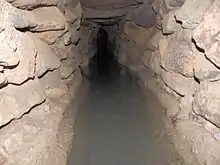 Qanats of Gonabad
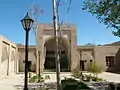 Anthropological Museum
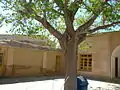 Anthropological Museum
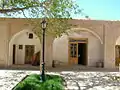 Anthropological Museum
 Anthropological Museum
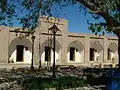 Anthropological Museum
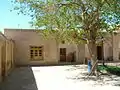 Anthropological Museum
 Anthropological Museum
 Anthropological Museum
 Anthropological Museum
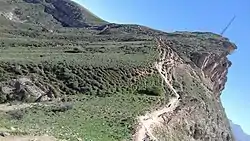 Forud Castle
 Forud Castle
 Zibad Castle
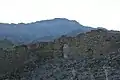 Zibad Castle
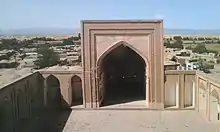 Jameh Mosque of Gonabad
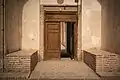 Jameh Mosque of Gonabad
References
- "Statistical Center of Iran > Home".
- Gonabad can be found at GEOnet Names Server, at this link, by opening the Advanced Search box, entering "-3064774" in the "Unique Feature Id" form, and clicking on "Search Database".
- "Census of the Islamic Republic of Iran, 1385 (2006)" (Excel). Statistical Center of Iran. Archived from the original on 2011-11-11.
- Esfandiari, Golnaz (12 October 2006) "Iran: Local Authorities Try To Evict Sufi Leader" Radio Free Europe
- ""گناباد" نگین گردشگری خراسان رضوی؛ از قنات تاریخی تا روستاهای بومگردی+فیلم". Tasnim News Agency. Retrieved 8 March 2021.
- "Jameh Mosque – Gonabad". travital.com. Retrieved 31 July 2019.
- "Jameh Mosque, Gonabad". en.tripyar.com. Retrieved 31 July 2019.
- Qanats of Gonabad-World Heritage
- The Persian Qanat
| Capital | |||||||||||||||||||||
|---|---|---|---|---|---|---|---|---|---|---|---|---|---|---|---|---|---|---|---|---|---|
| Districts |
| ||||||||||||||||||||
Authority control  |
|---|