Graciosa and Percinet
Graciosa and Percinet is a French literary fairy tale by Madame d'Aulnoy. Andrew Lang included it in The Red Fairy Book.

Synopsis
A king and queen had a beautiful daughter, Graciosa, and an ugly duchess hated her. One day, the queen died. The king grieved so much that his doctors ordered him to hunt. Weary, he stopped at the duchess's castle and discovered how rich she was. He agreed to marry her even though she demanded control of her stepdaughter.
The princess was reasoned into behaving well by her nurse. A handsome young page, Percinet, appeared. He was a rich young prince with a fairy gift, and he was in her service. He gave her a horse to ride to greet the duchess. It made the duchess's look ugly, and she demanded it, and that Percinet led it as he led it for Graciosa. Nevertheless, the horse ran away, and her disarray made her look even uglier. The duchess had Graciosa beaten with rods, except that the rods were turned into peacock feathers, and she suffered no harm.
The wedding went on, and the king arranged a tournament to flatter the queen. The king's knights overthrew all the challengers, for all the ugliness of the queen, until a young challenger overthrew them and showed the portrait of the princess as the most beautiful woman in the world. The queen had her abandoned in the woods. Percinet rescued her, but she wished to return to her father, and when Percinet showed her how the queen had claimed her dead and buried a log of wood in her place, she insisted. He told her that she would never see his castle again until she was buried.
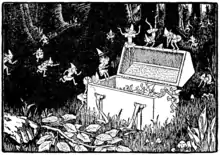
The king was glad to see her, but when the queen returned and insisted, he seemed convinced that Graciosa was an imposter. The queen imprisoned her, and with the aid of a wicked fairy, set her to disentangle a skein, on pain of her life. Graciosa thought Percinet would not aid her, but finally in despair called on him, and he disentangled it. The outraged queen set her to sort a room filled with feathers, and Percinet did that as well. Then the queen set her to bring a box to her own castle, and forbade her to open it. Curiosity got the better of her, and Graciosa freed a swarm of little men and women whom she could not get back in. Percinet helped her. The servants would not admit Graciosa, but gave her a letter telling they would not let her in.
The queen suggested that they lift a stone in the garden, which covered a well, on the grounds she had heard it covered a treasure. When it was up, she pushed Graciosa in, and dropped the stone. Percinet and his mother rescued her, and this time, Graciosa agreed to marry him.
Excerpt
- "Once upon a time there was a king and a queen who had an only daughter. Her beauty, her sweet temper, and her wit, which were incomparable, caused them to name her Gracieuse. She was the sole joy of her mother, who sent her every day a beautiful new dress, either of gold brocade, or of velvet, or of satin. She was always magnificently attired, without being in the least proud, or vain of her fine clothes. She passed the morning in the company of learned persons, who taught her all sorts of sciences, and in the afternoon she worked beside the queen. At luncheon time they served up to her basins full of sugar-plums, and more than twenty pots of preserves; so that she was universally considered the happiest princess in the world!"
Legacy
The tale was one of many from d'Aulnoy's pen to be adapted to the stage by James Planché, as part of his Fairy Extravaganza.[1][2][3]
Analysis
This literary tale can be classified in the Aarne-Thompson-Uther Index as type ATU 425, "The Search for the Lost Husband".[4] Scholar Jacques Barchilon stated that the tale was one of the occurrences of the Animal as Bridegroom cycle of stories (types ATU 425, ATU 425A, ATU 425B and ATU 425C) in d'Aulnoy's works.[5]
French scholars Paul Delarue and Marie-Louise Thèneze, establishers of the French folktale catalogue, follow Jan-Öjvind Swahn's classification: French type 425A follows Cupid and Psyche with the tasks; type 425B is the one with the gifts and the three nights.[6]
See also
References
- Feipel, Louis N. "Dramatizations of Popular Tales." The English Journal 7, no. 7 (1918): p. 444. Accessed June 25, 2020. doi:10.2307/801356.
- Buczkowski, Paul. "J. R. Planché, Frederick Robson, and the Fairy Extravaganza." Marvels & Tales 15, no. 1 (2001): 42-65. Accessed June 25, 2020. http://www.jstor.org/stable/41388579.
- MacMillan, Dougald. "Planché's Fairy Extravaganzas." Studies in Philology 28, no. 4 (1931): 790-98. Accessed June 25, 2020. http://www.jstor.org/stable/4172137.
- Trinquet, Charlotte. Le conte de fées français (1690-1700): Traditions italiennes et origines aristocratiques. Narr Verlag. 2012. pp. 218-219. ISBN 978-3-8233-6692-8.
- Barchilon, Jacques. “Adaptations of Folktales and Motifs in Madame d’Aulnoy’s ‘Contes’: A Brief Survey of Influence and Diffusion”. In: Marvels & Tales 23, no. 2 (2009): 354. http://www.jstor.org/stable/41388930.
- Delarue, Paul. Le conte populaire français: catalogue raisonné des versions de France et des pays de langue française d'outre-mer: Canada, Louisiane, îlots français des États-Unis, Antilles françaises, Haïti, Ile Maurice, La Réunion. Érasme, 1957. pp. 113, 114.
Further reading
- Trost, Caroline. ""Gracieuse Et Percinet": A Tale of Mme D'Aulnoy in a New Translation by Caroline Trost". In: Merveilles & Contes 6, no. 1 (1992): 117-39. Accessed June 25, 2020. www.jstor.org/stable/41390339.
External links
 |
Wikisource has original text related to this article: |