Animal as Bridegroom
In folkloristics, "The Animal as Bridegroom" refers to a group of folk and fairy tales about a human woman marrying or being betrothed to an animal.[1] The animal is revealed to be a human prince in disguise or under a curse. Most of these tales are grouped in the international system of Aarne-Thompson-Uther Index under type ATU 425, "The Search for the Lost Husband". Some subtypes exist in the international classification as independent stories, but they sometimes don't adhere to a fixed typing.
Overview
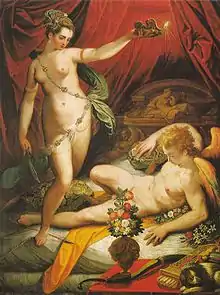
As consequence of the surge in folktale collecting and the beginnings of folkloristics as a discipline in the 19th century, scholars and folktale collectors compared many versions of "The Animal as Bridegroom" to the tale of Cupid and Psyche.[2][3][4]
Folklore scholar Stith Thompson clarified that the animal bridegroom may have been born due to its parents' wishes, or alternates between human and animal shapes.[5]
In some versions, the father surrenders his daughter as his ransom.[6] In others, it is the mother who delivers or promises her daughter(s) to the monster, and it is also by the mother's insistence that the heroine breaks the taboo on her husband.[7]
Interpretations
The theme invites all sorts of scholarly and literary interpretations.[8]
Scholar Jack Zipes describes these tale types as a mate selection wherein the human maiden is forced to marry an animal bridegroom as per the insistence of her family or due to her fate.[9]
Researcher Barbara Fass Leavy cited that these tales are interpreted under a feminist reading, which "applauds" the will of the main heroine, in contrast to passive heroines like Snow White and Sleeping Beauty.[10] She also stated that the "Animal Bridegroom" is the male counterpart of the "Swan Maiden" - both types referring to a marriage between a human person and a mythical being.[11]
Richard MacGillivray Dawkins suggested that its endurance as a myth and a folktale was due to the story "reflect[ing] ... much of the relations of man and wife."[12]
To Donald Ward, type 425 is, on the one hand, an erotic story, the union between divine male sexuality and mortal female virginity, but, on the other hand, also a tale of "love, devotion, and willingness to sacrifice".[13]
James M. Taggart stated that these tales underlie a "metaphorical [...] gender division of labor in courtship and marriage": while men take the active role in courtship, and women assume a more passive role, the latter are slotted into a role with "more responsibility" in maintaining the marital status (represented by the trials and ordeals they suffer in these tales).[14]
Charles Fillingham Coxwell associated human-animal marriages to ancient totem ancestry.[15]
Tale types
ATU 425: The Search for the Lost Husband
Folklorist D. L. Ashliman associated this general type with stories wherein the heroine crafts an artificial husband out of raw materials, who becomes a real man and a foreign queen falls in love with him. However, he noted that, among the tales he listed under this classification, some may also fall under type 425A, "Animal as Bridegroom".[16]
- Pintosmalto
- Master Semolina
- Fairer-than-a-Fairy
- Prince Swan (de)[17][18]
ATU 425A: The Animal (Monster) as Bridegroom
In folktales classified as tale type ATU 425A, "The Animal as Bridegroom", the maiden breaks a taboo or burns the husband's animal skin and, to atone, she must wear down a numbered pair of metal shoes. On her way to her husband, she asks for the help of the Sun, the Moon and the Wind,[19][20] a sequence that researcher Annamaria Zesi suggests is more typical of Northern European tales.[21] In other stories (from Europe, mostly), her helpers may be three old crones, or her husband's relatives.[22]
In some tales, before the separation from her supernatural husband, the wife's children are taken from her and hidden elsewhere. Scholarship locates this motif across Celtic and Germanic speaking areas.[23][24]
Thomas Frederick Crane also noted that, at the end of her journey, she finds her husband at the mercy of a second wife. She bribes this person with items she acquired on the way (given by the personifications of the elements, or from her helpers) to spend a night with him. Only on the third night the heroine manages to talk to her husband and he recognizes her.[25][26]
According to Hans-Jörg Uther, the main feature of tale type ATU 425A is "bribing the false bride for three nights with the husband".[27][lower-alpha 1][lower-alpha 2] In fact, when he developed his revision of Aarne-Thompson's system, Uther remarked that an "essential" trait of the tale type ATU 425A was the "wife's quest and gifts" and "nights bought".[30]
- Black Bull of Norroway
- The Brown Bear of Norway
- The Daughter of the Skies
- The Tale of the Hoodie
- The Three Daughters of King O'Hara
- The Sprig of Rosemary
- The Enchanted Snake
- White-Bear-King-Valemon
- East of the Sun and West of the Moon
- Prince Hat under the Ground
- The Iron Stove
- The Enchanted Pig (ATU 441 and ATU 425A)
- The Ram (fairy tale)
- Whitebear Whittington
ATU 425B: Son of the Witch (The Witch's Tasks)
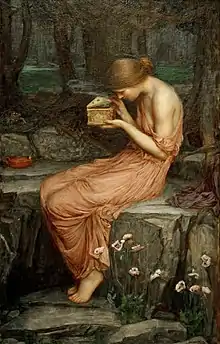
This category of tales involves the heroine performing difficult tasks for her husband's family (more specifically, her mother-in-law).[31][32] In this type, the heroine reaches the house of a witch (sometimes, her mother-in-law; sometimes, a female relative of his), where she works as her servant. One of the tasks is to go to another witch's house,[33] and fetch from there a box, a casket, a bag, a sack of something that her husband warns not to open, but she does.[34]
Richard MacGillivray Dawkins also noted that, in some tales, the mother-in-law, to further humiliate the heroine, betrothes her son to another bride and sends her on errands to get materials for the upcoming wedding.[35] Jack Zipes emphasizes that the heroine must perform the tasks before she has a chance to free her husband.[36]
In some tales, the heroine is forced to carry torches to her husband's marriage cortège[37] - a practice that Zipes relates to an ancient Roman custom mentioned by Plautus.[38] According to Donald Ward, Jan-Öjvind Swahn stated that his type A, "the oldest" (see below), contains the motif of the heroine holding a torch to her husband's second marriage to the false bride - a trap set by the witch or her daughter with the intent to kill the heroine. However, she is saved when her husband takes the torch and drops into the false bride's hands.[39]
This type may be conflated with the previous one. However, Uther argues that the distinction between both categories lies in "the quest for the casket" and the visit to the second witch.[40] Researcher Annamaria Zesi suggests that the motif of obtaining the box from the witch occurs in Eastern Mediterranean variants.[41] As for the motif of the "visit to the second witch", Catalan scholarship locates its distribution in variants from Latvia, Finland, Germany, Iceland, France, Italy, Turkey, and Serbia.[42]
According to Christine Goldberg, some variants of this type show as a closing episode the "The Magic Flight" sequence, a combination that appears "sporadically in Europe", but "traditionally in Turkey".[43] This episode also appears in the Bulgarian type 425B, "Момъкът с конската глава" ("Boy With the Horse's Head").[44]
- Cupid and Psyche[45]
- Graciosa and Percinet
- The Green Serpent
- The King of Love
- Ulv Kongesøn (Prince Wolf)
- The Golden Root
- The Horse-Devil and the Witch
- Tulisa, the Wood-Cutter's Daughter
- Khastakhumar and Bibinagar
- Habrmani
ATU 425C: Beauty and the Beast
Zipes summarized the tale thus: the third or youngest daughter asks her father (a merchant or king) for a gift (bird or flower). The only place he can find such a trifle is the garden of the beast or monster, who demands the merchant/king's daughter in return.[46] Richard MacGillivray Dawkins, in turn, remarked that the heroine's sisters asked their father for material possessions (e.g., dresses), whereas she asks for a simple token that will lead her to the enchanted prince.[47]
Uther remarks that this type contains the "presents for the daughters", lacking, however, a quest for the lost spouse.[48]
- Beauty and the Beast
- The Singing, Springing Lark (ATU 425C and ATU 425A)
- The Small-tooth Dog
- The Scarlet Flower
ATU 425D: The Vanished Husband
In this tale type, the husband disappears and the human wife builds an inn (alternatively, a hostel, bath house, or hospital) to receive strangers. Every guest must share a story with her. She then listens to a story told by the stranger and recognizes it is about where she can find her husband.[49][50]
Greek folklorist Georgios A. Megas argued for a transmission of the story from the East to the West by the Crusaders.[51]
ATU 425E: Enchanted Husband Sings Lullaby
In this tale type, the heroine is pregnant when her husband disappears and goes on a quest for him. She arrives at a castle, whose owner, a queen, lets her stay in. The heroine gives birth to her child. One night, someone comes in and sings a lullaby to the baby. The heroine recognizes this person as her husband.[52]
Related types
Academic Thomas Frederick Crane noted another set of tales which he called "The Animal Children": sometimes, the inhuman/animal suitor is born out of a hasty wish of their parents, or adopted by a human couple in their current beastly form.[53][54] When the animal suitor grows up, he wishes for his parents to find a woman of marriageable age. In some variants, the animal groom is given a different bride or marries other women before the heroine, and he devours, hurts or kills these brides while still in animal form.[lower-alpha 3] It is only the third wife that burns the animal skin and disenchants him.[56]
This narrative may appear in the following tale types:[57]
- ATU 430, "Donkey as Bridegroom" (prince as a donkey)
- ATU 433B, "King Lindworm" (prince as a lindworm)
- ATU 441, "In Enchanted Skin" or "Hans My Hedgehog" (prince as pig or hedgehog)
Other fiction
- The Sleeping Prince (fairy tale) (AaTh 425G)
- Eglė the Queen of Serpents (ATU 425M)
- Snow-White and Rose-Red (ATU 426)
- The Hut in the Forest (ATU 431)
- Prince as Bird (ATU 432)
- The Frog Prince (ATU 440)
- The Old Woman in the Wood (ATU 442)
- The Crow (fairy tale)
- Princess Himal and Nagaray
- The Snake Prince
- Monyohe (Sotho)
- Umamba (Zulu folktale)
- Baemsillang (The Serpent Husband)
- Amewakahiko soshi
Distribution
According to Karen Bamford, more than 1,500 variants of the tale have been collected from Europe, Asia, Africa and North America (in the latter, derived from European traditions).[58] Israeli professor Dov Noy (de) reported 580 variants across six European countries: Sweden, Norway, Ireland, Germany, France and Italy.[59]
Possible developments
According to Jan-Ojvind Swahn's monograph, the main tale type (Cupid and Psyche)[lower-alpha 4][lower-alpha 5][lower-alpha 6] is "commonest in Scandinavia and eastern Mediterranean", but also appears in Europe, Asia Minor, Persia, India, Indonesia and in Africa ("among the Berbers and Hausa").[64] Megas complements Swahn's analysis and locates type A across the Mediterranean, and even in China.[65] Swahn hypothesized that the original tale of Cupid and Psyche might have developed in the Eastern Mediterranean, an area that encapsulates Southern Italy, Sicily, Greece and Turkey.[66]
In regards to the type of "buying three nights", Swahn's suggested that this sequence was an "innovation" on the main type (Cupid and Psyche), and "belongs to France",[67] because it either developed among the Bretons or in France proper under influence of Breton motifs.[68] From there it diffused to the whole of Europe and Asia Minor, appearing "particularly" in Ireland, Denmark and Norway.[69] The type with the three nights, Swahn acknowledged, was the one to spread far and wide.[70] Later scholarship corroborates Swahn's assessment: "Animal as Bridegroom" tales with the "buying three nights" episode are very popular in Germanic-, Celtic-, Slavic- and Romance-speaking areas.[71]
Swahn supposed that his type B, which involves the "three nights" and "the artificial husband", must have developed in Italy.[72] An opposite view is held by Greek folklorist Georgios A. Megas, to whom the two motifs have been merged in Greek tradition.[73]
Footnotes
- On a related note, Stith Thompson commented that the episode of the heroine bribing the false bride for three nights with her husband occurs in variants of types ATU 425 and ATU 408.[28]
- A similar assessment was made by scholar Andreas John: "The episode of 'buying three nights' in order to recover a spouse is more commonly developed in tales about female heroines who search for their husbands (AT 425, 430, and 432) ..."[29]
- Barbara Leavy interprets this event as a "brutal defloration" of these women.[55]
- For clarification, Swahn, in his system, classified type 425A as the "oldest".[60] In Stith Thompson's system, Swahn's typing is indexed as type AaTh 425B.[61]
- French scholars Paul Delarue and Marie-Louise Thèneze, establishers of the French folktale catalogue, also follow Swahn's classification: French type 425A follows Cupid and Psyche with the tasks; type 425B is the one with the gifts and the three nights.[62]
- Greek folktale scholars Georgios A. Megas, Anna Angelopoulou and Aigle Brouskou follow Swahn and treat subtype A as "Cupid and Psyche".[63]
References
- Thompson, Stith (1977). The Folktale. University of California Press. p. 98. ISBN 0-520-03537-2.
- Friedländer, Ludwig. Roman life and manners under the early Empire. Vol. IV. London: Routledge. 1913. pp. 88-123.
- Zinzow, Adolf. Psyche und Eros: ein milesisches märchen in der darstellung und auffassung des Apulejus beleuchtet und auf seinen mythologischen zusammenhang, gehalt und ursprung zurückgeführt. Buchhandlung des Waisenhauses. 1888.
- Bolte, Johannes; Polívka, Jiri. Anmerkungen zu den Kinder- u. hausmärchen der brüder Grimm. Zweiter Band (NR. 61-120). Germany, Leipzig: Dieterich'sche Verlagsbuchhandlung. 1913. pp. 259-260.
- Thompson, Stith (1977). The Folktale. University of California Press. p. 98. ISBN 0-520-03537-2.
- Thompson, Stith (1977). The Folktale. University of California Press. p. 98. ISBN 0-520-03537-2.
- "The Animal Groom". Leavy, Barbara Fass. In Search of the Swan Maiden: A Narrative on Folklore and Gender. NEW YORK; LONDON: NYU Press, 1994. pp. 114-116. Accessed August 17, 2021. http://www.jstor.org/stable/j.ctt9qg995.7.
- Silver, Carole G. "Animal Brides and Grooms: Marriage of Person to Animal Motif B600, and Animal Paramour, Motif B610". In: Jane Garry and Hasan El-Shamy (eds.). Archetypes and Motifs in Folklore and Literature. A Handbook. Armonk / London: M.E. Sharpe, 2005. p. 94.
- Zipes, Jack. The Enchanted Screen: The Unknown History of Fairy-Tale Films. London and New York: Routledge. 2011. pp. 224-226. ISBN 9780203927496.
- "The Animal Groom". Leavy, Barbara Fass. In Search of the Swan Maiden: A Narrative on Folklore and Gender. NEW YORK; LONDON: NYU Press, 1994. p. 102. Accessed August 17, 2021. http://www.jstor.org/stable/j.ctt9qg995.7.
- "The Animal Groom". Leavy, Barbara Fass. In Search of the Swan Maiden: A Narrative on Folklore and Gender. NEW YORK; LONDON: NYU Press, 1994. pp. 103, 120-121. Accessed August 17, 2021. http://www.jstor.org/stable/j.ctt9qg995.7.
- Dawkins, Richard McGillivray. Modern Greek folktales. Oxford: Clarendon Press. 1953. p. 55.
- Ward, Donald. "'Beauty and the Beast': Fact and Fancy, Past and Present". In: Midwestern Folklore Vol. 15, Number 2, Fall 1989, pp. 120-122.
- Taggart, James M. Enchanted Maidens: Gender Relations in Spanish Folktales of Courtship and Marriage. Princeton University Press, 2021. p. 164. ISBN 9780691226927.
- Coxwell, C. F. Siberian And Other Folk Tales. London: The C. W. Daniel Company, 1925. p. 252.
- Ashliman, D. L. A Guide to Folktales in the English Language: Based on the Aarne-Thompson Classification System. Bibliographies and Indexes in World Literature, vol. 11. Westport, Connecticut: Greenwood Press, 1987. pp. 86-87. ISBN 0-313-25961-5.
- Grimm, Jacob, Wilhelm Grimm, JACK ZIPES, and ANDREA DEZSÖ. “PRINCE SWAN.” In: The Original Folk and Fairy Tales of the Brothers Grimm: The Complete First Edition. Princeton University Press, 2014. pp. 194-197. http://www.jstor.org/stable/j.ctt6wq18v.66.
- Grimm, Jacob, Wilhelm Grimm, JACK ZIPES, and ANDREA DEZSÖ. “NOTES TO VOLUMES I AND II.” In: The Original Folk and Fairy Tales of the Brothers Grimm: The Complete First Edition. Princeton University Press, 2014. p. 497. http://www.jstor.org/stable/j.ctt6wq18v.166.
- Thompson, Stith (1977). The Folktale. University of California Press. pp. 97-98. ISBN 0-520-03537-2.
- Ursache, Otilia. "Chipul tăinuit în basmele populare europene". In: Philologica Jassyensia, XI (1). 2015. pp. 269, 271-273. ISSN 2247-8353.
- Storie di Amore e Psiche. A cura di Annamaria Zesi. Roma: L'Asino d'Oro Edizioni. 2010. p. 223. ISBN 978-88-6443-052-2.
- Bamford, Karen. "Quest for the Vanished Husband/Lover, Motifs H1385.4 and H1385.5". In: Jane Garry and Hasan El-Shamy (eds.). Archetypes and Motifs in Folklore and Literature. A Handbook. Armonk / London: M.E. Sharpe, 2005. p. 254.
- Bronfman, Judith. Chaucer's Clerk's Tale: The Griselda Story Received, Rewritten, Illustrated. Routledge, 2021 [1994]. p. 313. ISBN 9780367357443.
- Storie di Amore e Psiche. A cura di Annamaria Zesi. Roma: L'Asino d'Oro Edizioni. 2010. pp. 220-221. ISBN 978-88-6443-052-2.
- Crane, Thomas Frederick. Italian Popular Tales. Boston: Houghton Mifflin and Company. 1885. p. 322.
- Bamford, Karen. "Quest for the Vanished Husband/Lover, Motifs H1385.4 and H1385.5". In: Jane Garry and Hasan El-Shamy (eds.). Archetypes and Motifs in Folklore and Literature. A Handbook. Armonk / London: M.E. Sharpe, 2005. p. 254.
- Hurbánková, Šárka. (2018). "G. B. Basile and Apuleius: First literary tales. morphological analysis of three fairytales". In: Graeco-Latina Brunensia. 23: 81 (footnote nr. 37). 10.5817/GLB2018-2-6.
- Thompson, Stith (1977). The Folktale. University of California Press. p. 117. ISBN 0-520-03537-2.
- Johns, Andreas. Baba Yaga: The Ambiguous Mother and Witch of the Russian Folktale. New York: Peter Lang. 2010 [2004]. p. 148. ISBN 978-0-8204-6769-6.
- Uther, Hans-Jörg. The types of International Folktales. A Classification and Bibliography, based on the System of Antti Aarne and Stith Thompson. Volume 1: Animal tales, tales of magic, religious tales, and realistic tales, with an introduction. Helsinki: Suomalainen Tiedeakatemia-Academia Scientiarum Fennica, 2004. p. 249. ISBN 9789514109560.
- The Collected Sicilian Folk and Fairy Tales of Giuseppe Pitrè. Edited and translated by Jack Zipes and Joseph Russo. Illustrated by Carmelo Lettere. New York: Rouledge: 2009. p. 823.
- Wright, James R. G. “Folk-Tale and Literary Technique in Cupid and Psyche”. In: The Classical Quarterly 21, no. 1 (1971): 277-279. http://www.jstor.org/stable/637841.
- Fitzgerald, Robert P. “‘The Wife’s Lament’ and ‘The Search for the Lost Husband’.”. In: The Journal of English and Germanic Philology 62, no. 4 (1963): 774. http://www.jstor.org/stable/27727179.
- Hoevels, Fritz Erik. Märchen und Magie in den Metamorphosen des Apuleius von Madaura. Rodopi, 1979. p. 215. ISBN 9789062038428.
- Dawkins, Richard McGillivray. Modern Greek folktales. Oxford: Clarendon Press. 1953. p. 61.
- Pitrè, Giuseppe; Zipes, Jack David; Russo, Joseph. The collected Sicilian folk and fairy tales of Giuseppe Pitrè. New York: Routledge, 2013 [2009]. p. 823. ISBN 9781136094347.
- Hansen, William P. Ariadne's Thread: A Guide to International Tales Found in Classical Literature. Cornell University Press, 2002. p. 100. ISBN 9780801436703.
- Pitrè, Giuseppe; Zipes, Jack David; Russo, Joseph. The collected Sicilian folk and fairy tales of Giuseppe Pitrè. New York: Routledge, 2013 [2009]. p. 823. ISBN 9781136094347.
- Ward, Donald. "'Beauty and the Beast': Fact and Fancy, Past and Present". In: Midwestern Folklore Vol. 15, Number 2, Fall 1989, p. 120.
- Uther, Hans-Jörg. The types of International Folktales. A Classification and Bibliography, based on the System of Antti Aarne and Stith Thompson. Volume 1: Animal tales, tales of magic, religious tales, and realistic tales, with an introduction. Helsinki: Suomalainen Tiedeakatemia-Academia Scientiarum Fennica, 2004. p. 251. ISBN 9789514109560.
- Storie di Amore e Psiche. A cura di Annamaria Zesi. Roma: L'Asino d'Oro Edizioni. 2010. p. 223. ISBN 978-88-6443-052-2.
- Poveda, Jaume Albero. "Rondalla «El castell d'entorn i no entorn» d'Enric Valor. Anàlisi hermenèutic i folklòrica". In: Miscel·lània Joan Veny. Volume 7. Estudis de llengua i literatura catalanes/LI. L'Abadia de Montserrat, 2005. p. 229. ISBN 9788484157373.
- Goldberg, Christine. (2000). "Gretel's Duck: The Escape from the Ogre in AaTh 327". In: Fabula 41: 47 (footnote nr. 20). 10.1515/fabl.2000.41.1-2.42.
- Даскалова-Перковска, Лиляна et al. "Български фолклорни приказки: каталог". Университетско издателство "Св. Климент Охридски", 1994. pp. 147-148. ISBN 9789540701561.
- Francisco Vaz da Silva. “The Invention of Fairy Tales”. In: The Journal of American Folklore 123, no. 490 (2010): 411. https://doi.org/10.5406/jamerfolk.123.490.0398.
- Zipes, Jack. The Enchanted Screen: The Unknown History of Fairy-Tale Films. London and New York: Routledge. 2011. p. 224. ISBN 9780203927496.
- Dawkins, Richard McGillivray. Modern Greek folktales. Oxford: Clarendon Press. 1953. pp. 81-82.
- Uther, Hans-Jörg. The types of International Folktales. A Classification and Bibliography, based on the System of Antti Aarne and Stith Thompson. Volume 1: Animal tales, tales of magic, religious tales, and realistic tales, with an introduction. Helsinki: Suomalainen Tiedeakatemia-Academia Scientiarum Fennica, 2004. p. 252. ISBN 9789514109560.
- Aarne, Antti; Thompson, Stith. The types of the folktale: a classification and bibliography. Third Printing. Folklore Fellows Communications FFC no. 184. Helsinki: Academia Scientiarum Fennica, 1973 [1961]. p. 143.
- Mitakidou, Soula; Manna, Anthony L.; Kanatsouli, Melpomeni. Folktales of Greece: A Treasury of Delights. Greenwood Press/Libraries Unlimited, 2002. p. 38. ISBN 1-56308-908-4.
- Megas, Geōrgios A. Folktales of Greece. Chicago: University of Chicago Press. 1970. pp. 226-227.
- Swahn, Jan Öjvind. The Tale of Cupid and Psyche. Lund, C.W.K. Gleerup. 1955. p. 32.
- "The Animal Groom". Leavy, Barbara Fass. In Search of the Swan Maiden: A Narrative on Folklore and Gender. NEW YORK; LONDON: NYU Press, 1994. p. 101. Accessed August 17, 2021. http://www.jstor.org/stable/j.ctt9qg995.7.
- Crane, Thomas Frederick. Italian Popular Tales. Boston: Houghton Mifflin and Company. 1885. p. 324.
- "The Animal Groom". Leavy, Barbara Fass. In Search of the Swan Maiden: A Narrative on Folklore and Gender. NEW YORK; LONDON: NYU Press, 1994. pp. 113-114. Accessed August 17, 2021. http://www.jstor.org/stable/j.ctt9qg995.7.
- Crane, Thomas Frederick. Italian Popular Tales. Boston: Houghton Mifflin and Company. 1885. pp. 324-325.
- Jan M. Ziolkowski. "Straparola and the Fairy Tale: Between Literary and Oral Traditions". In: The Journal of American Folklore 123, no. 490 (2010): 383. Accessed September 5, 2021. doi:10.5406/jamerfolk.123.490.0377.
- Bamford, Karen. "Quest for the Vanished Husband/Lover, Motifs H1385.4 and H1385.5". In: Jane Garry and Hasan El-Shamy (eds.). Archetypes and Motifs in Folklore and Literature. A Handbook. Armonk / London: M.E. Sharpe, 2005. p. 254.
- Noy, Dov. Folktales of Israel. University of Chicago Press. 1963. p. 161.
- Roberts, W. E. (1956). [Review of The Tale of Cupid and Psyche (Aarne-Thompson 425 and 428), by J.-Ö. Swahn]. In: Midwest Folklore, 6(3), 183, 184–185. http://www.jstor.org/stable/4317592
- Aarne, Antti; Thompson, Stith. The types of the folktale: a classification and bibliography. Third Printing. Folklore Fellows Communications FFC no. 184. Helsinki: Academia Scientiarum Fennica, 1973 [1961]. p. 142 (footnote nr. 1).
- Delarue, Paul. Le conte populaire français: catalogue raisonné des versions de France et des pays de langue française d'outre-mer: Canada, Louisiane, îlots français des États-Unis, Antilles françaises, Haïti, Ile Maurice, La Réunion. Érasme, 1957. pp. 113, 114.
- Angelopoulou, Anna; Brouskou, Aígle. "ΚΑΤΑΛΟΓΟΣ ΕΛΛΗΝΙΚΩΝ ΠΑΡΑΜΥΘΙΩΝ". Vol. 3: ΕΠΕΞΕΡΓΑΣΙΑ ΤΥΠΩΝ ΚΑΙ ΠΑΡΑΛΛΑΓΩΝ AT 300-499. Athens: ΚΕΝΤΡΟ ΝΕΟΕΛΛΗΝΙΚΩΝ ΕΡΕΥΝΩΝ Ε.Ι.Ε, 1999. pp. 661, 697 (footnote nr. 1). ISBN 960-7138-22-8.
- Wright, James R. G. “Folk-Tale and Literary Technique in Cupid and Psyche”. In: The Classical Quarterly 21, no. 1 (1971): 273. http://www.jstor.org/stable/637841.
- Angelopoulou, Anna; Brouskou, Aígle. "ΚΑΤΑΛΟΓΟΣ ΕΛΛΗΝΙΚΩΝ ΠΑΡΑΜΥΘΙΩΝ". Vol. 3: ΕΠΕΞΕΡΓΑΣΙΑ ΤΥΠΩΝ ΚΑΙ ΠΑΡΑΛΛΑΓΩΝ AT 300-499. Athens: ΚΕΝΤΡΟ ΝΕΟΕΛΛΗΝΙΚΩΝ ΕΡΕΥΝΩΝ Ε.Ι.Ε, 1999. p. 769. ISBN 960-7138-22-8.
- Megas, Georgios A.. "Amor und Psyche (AaTh 425)". In: Enzyklopädie des Märchens Online: Band 1: Aarne – Bayerischer Hiasl. Edited by Rolf Wilhelm Brednich, Heidrun Alzheimer, Hermann Bausinger, Wolfgang Brückner, Daniel Drascek, Helge Gerndt, Ines Köhler-Zülch, Klaus Roth and Hans-Jörg Uther. Berlin, Boston: De Gruyter, 2016 [1977]. p. 468. https://www.degruyter.com/database/EMO/entry/emo.1.110/html
- Megas, Geōrgios A. Folktales of Greece. Chicago: University of Chicago Press. 1970. p. 226.
- M L T. (1959). [Review of The tale of Cupid and Psyche (Aarne-Thompson 425 and 428), by J.-O. SWAHN]. Arts et Traditions Populaires, 7: 149. http://www.jstor.org/stable/41002760
- Megas, Geōrgios A. Folktales of Greece. Chicago: University of Chicago Press. 1970. p. 226.
- Swahn, Jan Öjvind. The Tale of Cupid and Psyche. Lund, C.W.K. Gleerup. 1955. p. 436.
- Gulyás Judit. "Henszlmann Imre bírálata Arany János Rózsa és Ibolya című művéről" [The Critical Reception of János Arany’s Epic Poem Entitled "The Tale of Rose and Violet” in 1847]. In: Ethno-Lore. XXVIII. Budapest: Magyar Tudományos Akadémia Néprajzi Kutatóintézete, 2011. p. 235. ISSN 1787-9396.
- Swahn, Jan Öjvind. The Tale of Cupid and Psyche. Lund, C.W.K. Gleerup. 1955. p. 295.
- Merakles, Michales G. Studien zum griechischen Märchen. Eingeleitet, übers, und bearb. von Walter Puchner. (Raabser Märchen-Reihe, Bd. 9. Wien: Österr. Museum für Volkskunde, 1992. pp. 145-146. ISBN 3-900359-52-0.
Bibliography
- Aarne, Antti; Thompson, Stith. The types of the folktale: a classification and bibliography. Third Printing. Folklore Fellows Communications FFC no. 184. Helsinki: Academia Scientiarum Fennica, 1973 [1961]. pp. 140–151.
- "The Animal Groom". Leavy, Barbara Fass. In: In Search of the Swan Maiden: A Narrative on Folklore and Gender. NEW YORK; LONDON: NYU Press, 1994. pp. 101–155. Accessed August 17, 2021. http://www.jstor.org/stable/j.ctt9qg995.7.
- Swahn, Jan Öjvind. The Tale of Cupid and Psyche. Lund, C.W.K. Gleerup. 1955.
- "Choosing the Right Mate: Why Beasts and Frogs Make for Ideal Husbands". In: Zipes, Jack. The Enchanted Screen: The Unknown History of Fairy-Tale Films. London and New York: Routledge. 2011. pp. 224–251. ISBN 9780203927496.
Further reading
- Baker, Ronald L. "Xenophobia in 'Beauty and the Beast' and Other Animal/Monster-Groom Tales". In: Midwestern Folklore Vol. 15, Number 2, Fall 1989, pp. 71-78.
- Heiner, Heidi Anne (editor). Beauty and the Beast Tales From Around the World. Surlalune Fairy Tale. CreateSpace Independent Publishing Platform; Annotated edition (October 8, 2013). ISBN 978-1469970448.
External links
- Other tales of type ATU 425A on Surlalune Fairy Tales (by Heidi Anne Heiner)
- Other tales of type ATU 425C by D. L. Ashliman
- Other tales of type ATU 425C on Surlalune Fairy Tales (by Heidi Anne Heiner)