Great Officers of State (United Kingdom)
In the United Kingdom, the Great Officers of State are traditional ministers of The Crown who either inherit their positions or are appointed to exercise certain largely ceremonial functions or to operate as members of the government.[1] Separate Great Officers exist for England and Scotland, and formerly for Ireland, though some exist for Great Britain and the United Kingdom as a whole.
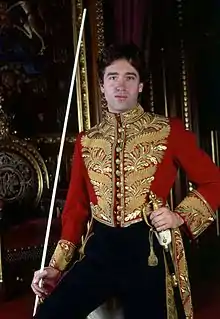
England
History
Initially after the Norman Conquest, England adopted the officers from the Normandy Ducal court (which was modelled after the French court) with a steward, chamberlain and constable. Initially having household and governmental duties, some of these officers later split into two counterparts in Great Officer of the State and officer of the royal household, while other officers were superseded by new officers or absorbed by existing officers. This was due to many of the officers becoming hereditary due to feudalistic practices, and thus removed from the practical operation of either the state or the Royal Household.[3]
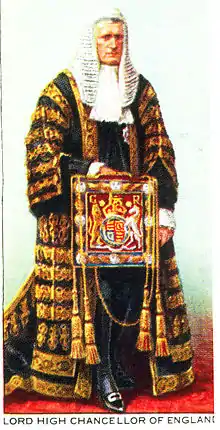
The Lord High Steward and Lord Great Chamberlain were superseded in their political functions by the Justiciar and Lord High Treasurer, and in their domestic functions by household offices with similar titles. The marshal of England assumed the place of the constable of England in the royal palace in the command of the royal armies.[3] The Chief Justiciar was once ranked above the Lord High Chancellor in power, influence and dignity until 1231 when the position lost its standing in the Kingdom.[8] With the Constitutional Reform Act 2005, the Lord High Chancellor has been replaced in some roles by Lord Chief Justice of England and Wales as head of the judiciary[9] and Lord Speaker as chair of the House of Lords.[10]
While most of the offices became hereditary at an early stage, currently some officers are appointed, while others inherit their positions.[1] The Lord High Stewardship was held by the Earls of Leicester until 1399 when the holder became the Sovereign; and since 1421, a Lord High Steward has generally only been appointed temporarily for special occasions such as a coronation or, before 1948, for the trials of peers.[11] The office of Lord Great Chamberlain is also hereditary, originally being held by the Earls of Oxford. Later, however, the Chamberlainship came to be inherited by the Earl of Lindsey and then his multiple heirs, each holding a fraction of the office. One of the holders, chosen by rotation, exercises the office as a Deputy.[12] The post of Lord High Constable was originally inherited by the Earls of Hereford, until when one holder was attainted and executed in 1521, the office reverted to the Crown, only to be reinstated for the day of a coronation.[13] The final inheritable office is that of Earl Marshal, held by the Dukes of Norfolk. During the many periods in which the Dukes were attainted, another individual was appointed to the post. Furthermore, prior to 1824, the Earl Marshal had to appoint a Protestant Deputy if he was a Roman Catholic.[14]
Some offices are put into ‘commission’; that is, multiple commissioners are appointed to collectively exercise the office. The office of Lord High Treasurer has been in commission since 1612, although not filled continuously until 1714:[15] the First Lord of the Treasury is the Prime Minister, the Second Lord is the Chancellor of the Exchequer, and the remaining Lords Commissioners are Government Whips.[16] The office of Lord High Admiral was for many years also in commission,[1] but merged with the crown in 1964 and is now an honorary appointment in the gift of the reigning monarch. Prince Philip, Duke of Edinburgh (consort of the current monarch) was granted the title on his 90th birthday. After his death, the title was subsumed back into the Crown. The remaining officers became governmental officers: Lord Chancellor, Lord President and Lord Privy Seal are appointed by the Crown on the advice of the Prime Minister.[6] The Lord Chancellor is Secretary of State for Justice; the posts of Lord President and Lord Privy Seal are normally each combined with a cabinet post[1]—currently Leader of the House of Commons and Leader of the House of Lords, respectively — they are a device by which cabinet members with these (or other) unpaid posts are paid a salary and given precedence.
The Great Officers had and have varying duties. The Lord High Steward was originally a holder of significant political power, but the office gradually became ceremonial, as have those of the Lord Great Chamberlain, Lord High Constable, and the Earl Marshal, all of them traditionally hereditary.[1] The Lord High Treasurer, Lord High Constable, and Lord High Admiral were originally responsible for monetary, military, and naval matters respectively.[15][13][17] The Lord President of the Council is responsible for presiding over the meetings of the Privy Council.[18] The office of Lord Privy Seal is a sinecure, though he is technically the Keeper of the Privy Seal. The Lord Chancellor is the most important of the Great Officers: he is the cabinet minister responsible for the Ministry of Justice (formerly the Lord Chancellor's Department and the Department for Constitutional Affairs) and formally Keeper of the Great Seal.
The Lord Keeper of the Great Seal was generally a temporary position to handle the great seal until the appointment of a new high chancellor or for a non-noble appointment. Eventually, the keeper was granted the same status as the high chancellor. By the late 1700s, the lord keeper's role was merged into the chancellorship itself.[19]
Relation with Parliament
The House of Lords Act 1999 removed the automatic right of hereditary peers to sit in the House of Lords, but the Act provided that the Lord Great Chamberlain and Earl Marshal be exempt from such a rule, so that they may continue to carry out their ceremonial functions in the House of Lords.[6]
Scotland
The term "officer of state" is sometimes used loosely of any great office under the Crown. As in England, many offices are hereditary. A number of historical offices ended at or soon after the Treaty of Union 1707. There are also a number of Officers of the Crown and Great Officers of the Royal Household. These Officers of State were also called "Officers of the Crown" despite there being a separate group of officers so named that are not officers of state,[20] and unlike the officers of state, did not sit or vote in meetings.[20]
Officers of State
| Order | Office[20] | Holder during 1707 | Current holder | Notes[20][21] |
|---|---|---|---|---|
| Greater Officers of State | ||||
| 1 | Lord High Chancellor of Scotland | James Ogilvy 1st Earl of Seafield |
Dominic Raab MP for Esher and Walton as Lord High Chancellor of Great Britain |
Merged with Lord High Chancellor of England in 1701 to form the office of Lord High Chancellor of Great Britain. |
| 2 | Lord High Treasurer of Scotland (Lord High Treasurer, Comptroller, Collector-General, and Treasurer of the New Augmentation) |
In commission: Commissioners of the Treasury of Scotland — James Ogilvy David Boyle The Honourable |
—[lower-alpha 2] | Merged with Lord High Treasurer of England in 1701 to form the office of Lord High Treasurer of Great Britain. |
| 3 | Lord Keeper of the Privy Seal of Scotland | James Douglas 2nd Duke of Queensberry |
— | Vacant since the death of Gavin Campbell, 1st Marquess of Breadalbane in 1921. |
| 4 | Lord Secretary of Scotland (Secretary of State for Scotland) |
Hugh Campbell 3rd Earl of Loudoun |
— | Office abolished in 1709. |
| Lesser Officers of State | ||||
| 5 | Lord Clerk Register | David Boyle 1st Earl of Glasgow |
James Mackay The Lord Mackay of Clashfern |
Since 1817, also Keeper of the Signet in Scotland.[22] |
| 6 | Lord Advocate (Her Majesty's Advocate) |
Sir James Stewart | Dorothy Bain | — |
| 7 | Lord Treasurer-depute | David Boyle 1st Earl of Glasgow |
— | Office abolished by the Acts of Union 1707. |
| 8 | Lord Justice Clerk | Adam Bockburn Lord Ormiston |
Leeona Dorrian Lady Dorrian |
— |
| Abolished Officers of State | ||||
| n/a | Comptroller of Scotland | — | — | Merged into the office of Lord High Treasurer of Scotland. |
| n/a | Master of the Requests for Scotland | — | — | Merged into the office of Lord Secretary of Scotland. |
Officers of the Crown
History
After the abolition of the Mayor of the Palace, France established seven officers of the crown (ordered by rank): the high constable, the high admiral, the high or great chancellor, the great justiciar, the great chamberlain, the great protonotary, and the great steward or seneschal. These offices were duplicated in the Kingdom of Scotland. By the time of King Malcolm II, the great protonotary was extinct and the great justiciar was replaced by the lord justice general.[25]

The post of High Constable is held by the Earls of Erroll. Originally, the heads of the Keith family held the office of Earl Marischal, but in 1716, the holder was attainted for treason, and the office has not been regranted. The Dukes of Argyll are the Hereditary Masters of the Household. All other officers are Crown appointees. Many of these offices, though originally associated with political power, are only ceremonial now.
The remaining officers are related to Scotland's judiciary. The Lord Justice General was originally an important noble, though in the 19th century, the office was combined with that of Lord President of the Court of Session. Now, the Lord Justice General is the head of Scotland's judiciary. The Lord Clerk Register is an officer with miscellaneous functions that included conducting the elections of representative peers and registering births and deaths. The Lord Advocate is at the head of the law offices of Scotland; all prosecutors act in his name. The Lord Justice Clerk serves as a deputy of the Lord Justice General. Finally, the Lord Lyon King of Arms is the sole judge in the Lyon Court, which determines cases relating to heraldry.
Previous to the Union of 1707 there were eight total officers of state, four great officers and four lesser officers. This limited by an act of parliament, such that the 2 officers of state, Comptroller and Master of the Requests, were merged with Lord High Treasurer and Lord Secretary respectively.[29] The greater officers were the Lord High Chancellor, Lord High Treasurer, Lord Privy Seal, the Lord Secretary. The lesser officers were the Lord Register, the Lord Advocate, the Lord Treasurer-depute, and the Lord Justice Clerk with the Lord Register the only one fixed in precedency.[20]
A number of offices ended at or soon after the Union of 1707. These include the High Chancellor, the High Treasurer, the Treasurer-depute of Scotland, the Secretary of State, Scotland, the Master of Requests and the President of the Privy Council.
Notes
- These roles are now permanently vacant, except for brief appointments during coronations, where they performs certain functions in the ceremony.
- Strictly speaking, the Lord High Treasurer of the United Kingdom is the person holding the offices of Treasurer of the Exchequer of Great Britain and Lord High Treasurer of Ireland. When no person is appointed to the said offices, both offices maybe be put into commission (as they have been since 1714 through the Lords Commissioners of Her Majesty's Treasury), in which case, contrary to popular belief, the office of Lord High Treasurer of the United Kingdom is left vacant.[4][5]
- There is a debate over whether the office reverts back to the Crown upon the death of the grantee. The office is believed to be held by Her Majesty in right of the Crown, or is otherwise vacant.
- Number is unknown; sources are unclear on the matter.
References
- Chisholm, Hugh, ed. (1911). . Encyclopædia Britannica. 25 (11th ed.). Cambridge University Press. p. 801. This cites:
* Stubbs, Constitutional History, ch. xi.
* Freeman, Norman Conquest, ch. xxiv.
* Gneist, Constitution of England, ch. xvi., xxv. and liv. - Archives, The National. "Great Offices of State". www.nationalarchives.gov.uk. Retrieved 11 December 2021.
- Chisholm, Hugh, ed. (1911). . Encyclopædia Britannica. 13 (11th ed.). Cambridge University Press. pp. 813–814.
- "Consolidated Fund Act 1816, section 2". www.legislation.gov.uk.
[...] whenever there shall not be any [Lord High Treasurer of the United Kingdom], it shall and may be lawful for [Her] Majesty by leters patent under the great of Great Britain to appoint commissioners for executing the offices of treasurer of the Exchequer of Great Britain and lord high treasurer of Ireland; and such commissioners shall be called commissioners of his Majesty’s Treasury of the United Kingdom of Great Britain and Ireland; and the said commissioners shall have all such powers and authorities in and through the whole of the said United Kingdom with respect to the collection, issuing, and application of the whole revenues of the United Kingdom [...]
- Sainty, John Christopher (1972). Office-Holders in Modern Britain: Volume 1, Treasury Officials 1660–1870. London: University of London. pp. 16–25. ISBN 0485171414. Retrieved 19 October 2021.
- Great Officers of State: The Lord Great Chamberlain and The Earl Marshal Archived 6 January 2014 at the Wayback Machine. The Royal Family. debretts.com. Debrett's Limited. Accessed 17 September 2013.
- "Lord High Admiral - a Freedom of Information request to Royal Navy". WhatDoTheyKnow. 2021-06-15. Retrieved 2021-08-05.
As the title of Lord High Admiral is not hereditary and was resumed by the sovereign personally in 1964, upon the Death of HRH The Duke of Edinburgh it will have been subsumed back into the Crown. As this title is personally held by Her Majesty, it is within her gift to decide if it remains with the Crown or if it will be awarded to another individual.
- Chisholm, Hugh, ed. (1911). . Encyclopædia Britannica. 15 (11th ed.). Cambridge University Press. p. 595.
- Rozenberg, Joshua (30 January 2013). "Lord chief justice: changes to judiciary 'eroding something important'". The Guardian. Retrieved 17 July 2014.
- "Lord Speaker". BBC.co.uk. 1 October 2008. Retrieved 17 July 2014.
- Chisholm, Hugh, ed. (1911). . Encyclopædia Britannica. 17 (11th ed.). Cambridge University Press. p. 3.
- Chisholm, Hugh, ed. (1911). . Encyclopædia Britannica. 17 (11th ed.). Cambridge University Press. p. 2.
- Chisholm, Hugh, ed. (1911). . Encyclopædia Britannica. 17 (11th ed.). Cambridge University Press. p. 3.
- Chisholm, Hugh, ed. (1911). . Encyclopædia Britannica. 8 (11th ed.). Cambridge University Press. pp. 796–797.
- Chisholm, Hugh, ed. (1911). . Encyclopædia Britannica. 17 (11th ed.). Cambridge University Press. pp. 4–5.
- Chisholm, Hugh, ed. (1911). . Encyclopædia Britannica. 27 (11th ed.). Cambridge University Press. pp. 228–229.
- Chisholm, Hugh, ed. (1911). . Encyclopædia Britannica. 1 (11th ed.). Cambridge University Press. p. 195.
- Chisholm, Hugh, ed. (1911). . Encyclopædia Britannica. 17 (11th ed.). Cambridge University Press. p. 5.
- Chisholm, Hugh, ed. (1911). . Encyclopædia Britannica. 17 (11th ed.). Cambridge University Press. p. 5.
- Chamberlayne, Edward; Chamberlayne, John (1718). Magnae Britanniae notitia, or, The present state of Great-Britain: with divers remarks upon the ancient state thereof. Printed for T. Godwin. p. 396.
- "The Officers of State in Scotland". Juridical Review. 23: 152–170. 1911–1912. Retrieved 22 April 2017.
- "Public Offices (Scotland) Act 1817, section 5". www.legislation.gov.uk.
The duties of keeper of the signet in Scotland shall be discharged by the lord register [...]
- Chamberlayne & Chamberlayne 1718, p. 399
- Hanks, Patrick; Coates, Richard; McClure, Peter (2016). The Oxford Dictionary of Family Names in Britain and Ireland. Oxford University Press. p. 2550. ISBN 9780192527479. Retrieved 2 December 2018.
- Walter Goodal (1872). A Short Account of the Officers of State, and other Great Officers in Scotland. Transactions of the Royal Historical Society, 1, pp 415–426. doi:10.1017/S008044010000075X.
- Chamberlayne & Chamberlayne 1718, p. 410
- "Secretary for Scotland Act 1885, section 8". www.legislation.gov.uk.
The Secretary shall have the place, trust, and office of Keeper of Her Majesty's Seal, appointed by the Treaty of Union to be kept and made use of in Scotland in place of the Great Seal of Scotland [...]
- "Scotland Act 1998, section 45(7)". www.legislation.gov.uk.
The First Minister shall be the Keeper of the [Great Seal of Scotland].
- Chamberlayne & Chamberlayne 1718, Chapter V. pp. 400-401
| Great Officers of State of England |
| .svg.png.webp)
 | |||||||||||||||||||
|---|---|---|---|---|---|---|---|---|---|---|---|---|---|---|---|---|---|---|---|---|---|
| Officers of State of England |
| ||||||||||||||||||||
| Officers of the Crown of Scotland |
| ||||||||||||||||||||
1 Office is either vested in the Crown, or vacant. Status is currently debated.
2 There is debate around whether these offices constitute Officers of the Crown. | |||||||||||||||||||||