Great Offices of State
The Great Offices of State are senior offices in the UK government. They are the Prime Minister, Chancellor of the Exchequer, Foreign Secretary and Home Secretary, respectively.[1][2][3] or, alternatively, three of those offices excluding the Prime Minister.[4][5]
.svg.png.webp)
.svg.png.webp)
.svg.png.webp)






Current
.jpg.webp)
.jpg.webp)

History
The Great Offices of State are derived from the most senior positions in the Royal Household – the Great Officers of State. These eventually became hereditary and honorary titles, while the substantive duties of the Officers passed to individuals who were appointed on behalf of the Crown.[11] The medieval origins of the Chancellorship of the Exchequer make it the oldest surviving Great Office of State, while the position of Secretary of State came into being in the late 16th century and the office of Prime Minister evolved gradually in the 18th and 19th centuries.
James Callaghan is the first and to date only person to have served in all four positions.[1][12] In the past hundred years, several other people have come close to achieving this distinction: H. H. Asquith and Winston Churchill both served as Prime Minister, Chancellor and Home Secretary while Harold Macmillan and John Major served as Prime Minister, Chancellor and Foreign Secretary; Rab Butler and Sir John Simon served as Chancellor of the Exchequer, Foreign Secretary and Home Secretary. Two of the Great Offices of State have often been held simultaneously by one person, most recently by Ramsay MacDonald, Prime Minister and Foreign Secretary in 1924; the Duke of Wellington is the only person to have held three of the Great Offices simultaneously, serving as Prime Minister, Foreign Secretary and Home Secretary in the Wellington caretaker ministry.
Commons-only nature in modern times
Owing to the political constitution of the United Kingdom, in which the House of Commons retains most of the power, it is accepted that it is no longer practical for holders of the Great Offices of State to be members of the House of Lords. The House of Lords has traditionally been restrained in the passage of financial bills, meaning that the office of Chancellor is effectively limited to the House of Commons. The last holders of the other positions to have been peers were:
- Prime Minister: Conservative The Earl of Home (20–23 October 1963): The Earl of Home renounced his peerage and was elected as an MP after his appointment as Prime Minister. The last holder to remain a peer throughout his term as Prime Minister was the Conservative The Marquess of Salisbury (25 June 1895 – 11 July 1902).
- Chancellor of the Exchequer: Whig Lord Denman (14 November – 15 December 1834): Denman only held the post on an acting basis as an ex officio duty of his role as Lord Chief Justice, as did the peer before him, Tory Lord Tenterden (8 August–3 September 1827); the last member of the House of Lords to hold the office substantively was Whig Viscount Stanhope (15 April 1717 – 20 March 1718).
- Foreign Secretary: Conservative Lord Carrington (5 May 1979 – 5 April 1982): The Lord Carrington is the most recent peer to hold one of the Great Offices of State.
- Home Secretary: Conservative Viscount Cave (14 November 1918 – 14 January 1919): Sir George Cave was ennobled as The Viscount Cave while serving as Home Secretary in 1918. The last holder to remain a peer throughout his term as Home Secretary was the Whig Viscount Palmerston (28 December 1852 – 6 February 1855). However, he was an Irish peer, meaning that he was not entitled to a seat in the Lords; the last holder to remain a member of the Lords was the Whig The Marquess of Normanby (30 August 1839 – 30 August 1841).
It is most exceptional that a holder of a Great Office of State should not hold a seat in Parliament at all, neither in the Commons nor in the Lords. It occurred briefly in 1963, when Alec Douglas-Home was appointed Prime Minister: he disclaimed his peerage on 23 October, and was not returned to the Commons until a by-election on 7 November. More substantially, Patrick Gordon Walker was appointed Foreign Secretary in 1964 despite not holding a Parliamentary seat, having been defeated in his Smethwick constituency seat in the 1964 general election; he held the post for three months until his resignation in January 1965.
Women
Margaret Thatcher became the first woman to hold one of the Great Offices of State when she was elected Prime Minister in 1979.[13] Eight women have held one or more Great Offices of State since then, with six of them being members of the Conservative Party. Due to her ascension to the office of Prime Minister in 2016, Theresa May became the first female to serve on two different Great Offices; while the appointment of her successor Amber Rudd as Home Secretary resulting in the first period in which more than one of the Offices were held by women simultaneously. Priti Patel became the first woman of ethnic minority serving in any of Great Offices of State when appointed in position of Home Secretary in 2019.
Out of the four Offices, three have been held by women; Chancellor of the Exchequer is the only position that has not. The Home Office has had the most female officeholders with four.
Prime Minister:
- Margaret Thatcher (1979–1990) (Conservative)
- Theresa May (2016–2019) (Conservative)
Chancellor of the Exchequer:
No woman has yet served as Chancellor of the Exchequer.
Foreign Secretary:
- Margaret Beckett (2006–2007) (Labour)
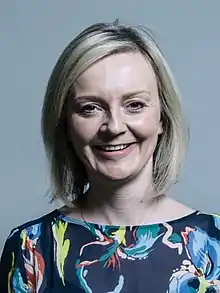
- Liz Truss (2021-present) (Conservative)
Home Secretary:
- Jacqui Smith (2007–2009) (Labour)
- Theresa May (2010–2016) (Conservative)
- Amber Rudd (2016–2018) (Conservative)
- Priti Patel (2019–present) (Conservative)
Ethnic minorities
Benjamin Disraeli became the first person of an ethnic minority to attain one of the Great Offices of State when he was appointed Chancellor of the Exchequer in 1852. Following the resignation of The Earl of Derby in 1868, he also became the first ethnic minority to hold two different Great Offices; as well as the first and to date the only person of Jewish heritage to become Prime Minister. Eleven ethnic minority individuals have held one or more Great Offices of State since then, with nine of them being members of the Conservative Party.
Sajid Javid became the first person of Pakistani descent to hold a Great Office of State as Home Secretary in 2018 and Chancellor of the Exchequer the next year.[14][15] Priti Patel became the first person of Indian descent and first female of any ethnic minority to take the position within Great Offices when she has been appointed Home Secretary in 2019.
Prime Minister:
- Benjamin Disraeli (1868, 1874–1880; Jewish heritage) (Conservative)
Chancellor of the Exchequer:
- Benjamin Disraeli (1852, 1858–1859, 1866–1868; Jewish heritage) (Conservative)
- Nigel Lawson (1983–1989; Jewish heritage) (Conservative)
- Sajid Javid (2019–2020; Pakistani heritage) (Conservative)
- Rishi Sunak (2020–present; Indian heritage) (Conservative)
Foreign Secretary:
- Rufus Isaacs, 1st Marquess of Reading (1931; Jewish heritage) (Liberal)
- Malcolm Rifkind (1995–1997; Jewish heritage) (Conservative)
- David Miliband (2007–2010; Jewish heritage) (Labour)
- Dominic Raab (2019–21; Jewish heritage) (Conservative)
Home Secretary:
- Frank Soskice (1964–1965; Jewish heritage) (Labour)
- Leon Brittan (1983–1985; Jewish heritage) (Conservative)
- Michael Howard (1993–1997; Jewish heritage) (Conservative)
- Sajid Javid (2018–2019; Pakistani heritage) (Conservative)
- Priti Patel (2019–present; Indian heritage) (Conservative)
References
- McKie, David (28 March 2005). "Lord Callaghan". politics.guardian.co.uk. London: Guardian Unlimited. Archived from the original on 3 November 2007. Retrieved 10 June 2008.
He had held all four of the great offices of state
- Eason, Gary (27 March 2005). "Callaghan's great education debate". BBC News. Archived from the original on 15 January 2009. Retrieved 10 September 2010.
- "The Conservative Party | People | Members of Parliament | Kenneth Clarke". 10 February 2010. Archived from the original on 10 February 2010. Retrieved 20 January 2021.
- "The Cabinet - Cabinet and the Great Offices of State". Britpolitics. Archived from the original on 3 March 2021. Retrieved 20 January 2021.
- "The Great Offices of State". bbc.co.uk. Archived from the original on 29 October 2020. Retrieved 20 January 2021.
- "Ministers". gov.uk. Archived from the original on 2 June 2015. Retrieved 5 August 2021.
- "The Rt Hon Boris Johnson MP". gov.uk. Archived from the original on 11 August 2021. Retrieved 5 August 2021.
- "The Rt Hon Rishi Sunak MP". gov.uk. Archived from the original on 31 July 2021. Retrieved 5 August 2021.
- "The Rt Hon Dominic Raab MP". gov.uk. Archived from the original on 20 February 2020. Retrieved 5 August 2021.
- "The Rt Hon Priti Patel MP". gov.uk. Archived from the original on 1 February 2021. Retrieved 5 August 2021.
- Phillips, Owen Hood; Chalmers, Dalzell (1952). The constitutional law of Great Britain and the Commonwealth. Sweet & Maxwell. p. 240. Archived from the original on 8 November 2021. Retrieved 8 August 2019.
- "Lady Callaghan of Cardiff". The Independent. London. 30 March 2005.
- "1979: Election victory for Margaret Thatcher". BBC. 4 May 1979. Retrieved 4 May 2021.
- "Who is Sajid Javid, the new home secretary?". BBC News. 30 April 2018. Archived from the original on 13 May 2018. Retrieved 30 April 2018.
- Philpot, Robert (13 May 2018). "Meet Sajid Javid, UK's top Muslim, pro-Israel politician, who just may become PM". The Times of Israel. Archived from the original on 11 July 2018. Retrieved 11 July 2018.