Group of Nine
The Group of Nine (G9) was a group of nine European nations that would meet occasionally to discuss matters of mutual pan-European interest.[1] The alliance came to be in 1965, when the nine nations were lobbying and presenting a case study in the UN.[2] They co-sponsored UN Resolution 2129 promoting East-West cooperation in Europe, unanimously adopted by the UN General Assembly in December 1965.[3][4] They became the Group of Ten when the Netherlands joined the group by parliamentary decision in 1967.[5][6][7] Following the 1968 invasion of Czechoslovakia,[8] the group attempted to reconcile its differences at a meeting held at the UN in October 1969, but failed and subsequently dissolved.[9][10]
Group of Nine | |
|---|---|
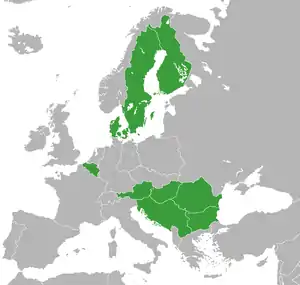 Group of Nine countries | |
| Membership | |
| Establishment | 1965 |
| Area | |
• Total | 1,644,475 km2 (634,935 sq mi) |
| Today part of | |

.svg.png.webp)
.svg.png.webp)

.svg.png.webp)
.svg.png.webp)
Notes and references
Notes
- Kosovo is the subject of a territorial dispute between the Republic of Kosovo and the Republic of Serbia. The Republic of Kosovo unilaterally declared independence on 17 February 2008. Serbia continues to claim it as part of its own sovereign territory. The two governments began to normalise relations in 2013, as part of the 2013 Brussels Agreement. Kosovo is currently recognised as an independent state by 97 out of the 193 United Nations member states. In total, 112 UN member states have recognised Kosovo at some point, of which 15 later withdrew their recognition.
References
- Laux, Jeanne Kirk (1972). "Small States and Inter-European Relations: An Analysis of the Group of Nine". Journal of Peace Research. SAGE Publications. 9 (2): 147–160. doi:10.1177/002234337200900204. ISSN 0022-3433. S2CID 143059477.
- Weiner, R. (1984). Romanian Foreign Policy and the United Nations. Praeger scientific. Praeger. p. 63. ISBN 978-0-03-071594-5. Retrieved 6 May 2021.
- Makko, A. (2016). Ambassadors of Realpolitik: Sweden, the CSCE and the Cold War. Contemporary European History. Berghahn Books. p. 93. ISBN 978-1-78533-285-2. Retrieved 6 May 2021.
- Staff Memorandum on United States Investment of Military Assistance Funds in Military Installations Located in France. U.S. Government Printing Office. 1967. p. 6-PA28. Retrieved 6 May 2021.
- Voorhoeve, J.J.C. (1979). Peace, Profits and Principles :: A Study of Dutch Foreign Policy. Springer Netherlands. p. 133. ISBN 978-90-247-2203-7. Retrieved 6 May 2021.
- "The idea of a pan-European security conference". CVCE.EU by UNI.LU. 21 December 2005. Retrieved 6 May 2021.
- Palmer, M. (1971). The Prospects for a European Security Conference. Chatham House, P.E.P. European Series. Chatham House:PEP. p. 10. ISBN 978-0-85374-037-7. Retrieved 6 May 2021.
The Group of Nine / Ten met several times to explore initiatives that could be taken to achieve a greater degree of European détente. ... held at the U.N. in October 1969, the experiment of the Group of Ten appeared to have come to an end, at least for the time being . ... over the course of 1966 were Austria, Belgium, Bulgaria, Denmark, Finland, Hungary, Rumania, Sweden, and Yugoslavia.
- Conference on European Security: Hearings, Ninety-second Congress, Second Session. U.S. Government Printing Office. 1972. p. 2. Retrieved 6 May 2021.
Invasion of Czechoslovakia by Warsaw Pact countries disrupts efforts of Group of Ten for CES planning.
- Due-Nielsen, C.; Petersen, N. (1995). Adaptation and Activism: The Foreign Policy of Denmark, 1967–1993. Dansk udenrigspolitisk institut. p. 136. ISBN 978-87-574-3022-6. Retrieved 6 May 2021.
- Leatherman, J. (2003). From Cold War to Democratic Peace: Third Parties, Peaceful Change, and the OSCE. Syracuse Studies on Peace and Conflict Resolution. Syracuse University Press. p. 72 ff. ISBN 978-0-8156-3032-6. Retrieved 6 May 2021.
- "The World Factbook 1991". United States Central Intelligence Agency. 1991. Retrieved September 26, 2009.
- "The World Factbook 1998". United States Central Intelligence Agency. 1998. Retrieved September 26, 2009.
Serbia and Montenegro has self-proclaimed itself the "Federal Republic of Yugoslavia," but the US view is that the Socialist Federal Republic of Yugoslavia (SFRY) has dissolved and that none of the successor republics represents its continuation
| Africa |  .svg.png.webp) | ||||||||
|---|---|---|---|---|---|---|---|---|---|
| Americas | |||||||||
| Asia | |||||||||
| Europe | |||||||||
| Oceania | |||||||||
| Multilateral | |||||||||
| Related topics |
| ||||||||
 Category Category
Foreign relations of successor states: ●  Kosovo (status) ● Kosovo (status) ●  Montenegro Montenegro | |||||||||
.svg.png.webp)
%253B_Flag_of_Serbia_and_Montenegro_(2003%E2%80%932006).svg.png.webp)