Foreign relations of Yugoslavia
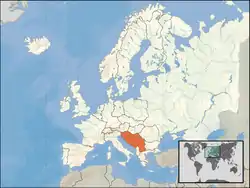
Foreign relations of Yugoslavia were international relations of the interwar Kingdom of Yugoslavia and the Cold War Socialist Federal Republic of Yugoslavia.
.svg.png.webp) |
|---|
| Administrative divisions |
The Kingdom of Yugoslavia, ruled by the Serbian Karađorđević dynasty, was formed in 1918 by the merger of the provisional State of Slovenes, Croats and Serbs (itself formed from territories of the former Austria-Hungary, encompassing Bosnia and Herzegovina and most of Croatia and Slovenia) and Banat, Bačka and Baranja (that had been part of the Kingdom of Hungary within Austria-Hungary) with the formerly independent Kingdom of Serbia. In the same year, the Kingdom of Montenegro also proclaimed its unification with Serbia, whereas the regions of Kosovo and Vardar Macedonia had become parts of Serbia prior to the unification.[1] The first country in the world to officially recognize the new state was the United States.[2] After the creation of Yugoslavia the newly formed state was a status quo state in Europe which was opposed to revisionist states.[3] In this situation the country prominently was a part of the Little Entente and the first Balkan Pact. Yugoslav accession to the Tripartite Pact resulted in Yugoslav coup d'état and ultimately the Invasion of Yugoslavia.
During the World War II in Yugoslavia the country was formally represented by the Yugoslav government-in-exile while Yugoslav Partisans headed by Josip Broz Tito progressively gained support of the Allies.
During the first post-war years new Yugoslav state was closely aligned with the Soviet Union and involved into dispute over the Free Territory of Trieste and the Greek Civil War. In May 1945, 4,650 Greek refugees, mostly male members of ELAS, settled in the village of Maglić with the help of Yugoslav government. From 1945 to 1948, it was a sui generis case of Greek extraterritorial jurisdiction.[4] This period was sharply ended in 1948 after the Tito–Stalin split.
Yugoslavia initially pursued development of relations among non-bloc neutral European states as a way to avoid isolation and preserve certain level of independence without alienating major powers. In this period Yugoslavia joined the Second Balkan Pact. Belgrade however perceived that in deeply divided Europe there was shrinking maneuvering space for neutral countries and followed the development of what will be called process of Finlandization with great concern. In 1956 the Belgrade declaration ended the period of significant dependence on the Western bloc. The Declaration guaranteed noninterference in Yugoslavia’s internal affairs and legitimized right to different forms of socialist development in different countries.[5] While declaration failed in achieving lasting rapprochement between the two countries (result of the Yugoslav anxiety over the Hungarian Revolution of 1956) it had an effect on Yugoslav disengagement from the Balkan Pact with NATO member states of Turkey and Greece.[6]
Yugoslavia subsequently discovered new allies among former colonies and mandate territories beyond Europe.[7] Yugoslavia supported Egypt during the Suez Crisis. Yugoslavia developed its relations with India beginning with the time of their concurrent mandate at the UN Security Council from the end of 1949 onward.[8] Yugoslavia was one of the founding members of the Non-Aligned Movement which enabled this comparatively small and underdeveloped country to play one of the most prominent diplomatic role during the Cold War.
Yugoslav crisis which escalated into breakup of the country and Yugoslav Wars turned into one of the major policy and security issues in the first decade after the end of the Cold War.
Foreign relations
Africa
| Country | Independence | Formal Relations Began | Notes |
|---|---|---|---|
 Algeria Algeria | 5 July 1962[9] | 2 July 1962[9] | |
 Angola Angola | 11 November 1975[9] | 1975[9] | |
 Benin Benin | 1 August 1960[9] | 1962[9] | |
 Botswana Botswana | 30 September 1966[9] | 1970[9] | |
 Burkina Faso Burkina Faso | 5 August 1960[9] | 1968[9] | |
 Burundi Burundi | 1 July 1962[9] | 1962[9] | |
 Gabon Gabon | 17 August 1960[9] | 1960[9] | |
 Gambia Gambia | 18 February 1965[9] | 1965[9] | |
 Ghana Ghana | 6 March 1957[9] | 1959[9] | |
 Guinea Guinea | 2 October 1958[9] | 1958[9] | |
 Guinea-Bissau Guinea-Bissau | 10 September 1974[9] | 1975[9] | |
 Egypt Egypt | 28 February 1922[9] | 1 February 1908 (continued relations of the Kingdom of Serbia)[9] | |
 Equatorial Guinea Equatorial Guinea | 12 October 1968[9] | 1970[9] | |
 Ethiopia Ethiopia | never colonized in a classical sense (temporary Italian occupation)[9] | 1952[9] | |
 Zambia Zambia | 24 October 1964[9] | 1964[9] | |
 Zimbabwe Zimbabwe | 18 April 1980[9] | 1980[9] | |
 Cameroon Cameroon | 1 January 1960[9] | 1960[9] | |
 Cape Verde Cape Verde | 5 July 1975[9] | 1975[9] | |
 Kenya Kenya | 12/20 December 1963[9] | 1963[9] | |
 Democratic Republic of the Congo Democratic Republic of the Congo | 30 June 1960[9] | 1961[9] | |
 Republic of the Congo Republic of the Congo | 15 August 1960[9] | 1964[9] | |
 Lesotho Lesotho | 4 October 1966[9] | 1972[9] | |
 Liberia Liberia | 26 July 1847[9] | 1959[9] | |
 Libya Libya | 24 December 1951[9] | 1955[9] | |
 Madagascar Madagascar | 26 June 1960[9] | 1960[9] | |
 Mali Mali | 22 September 1960[9] | 1961[9] | |
 Morocco Morocco | 2 March 1956[9] | 2 March 1957[9] | |
 Mauritius Mauritius | 12 March 1968[9] | 1969[9] | |
 Mozambique Mozambique | 25 June 1975[9] | 1975[9] | |
 Namibia Namibia | 21 March 1990[9] | 1990[9] | |
 Nigeria Nigeria | 1 October 1960[9] | 1960[9] | |
 Ivory Coast Ivory Coast | 7 August 1960[9] | 1968[9] | |
 Rwanda Rwanda | 1 July 1962[9] | 1971[9] | |
 Sao Tome and Principe Sao Tome and Principe | 12 July 1975[9] | 1977[9] | |
 Seychelles Seychelles | 29 June 1976[9] | 1977[9] | |
 Senegal Senegal | 20 August 1960[9] | 1961[9] | |
 Sierra Leone Sierra Leone | 27 April 1961[9] | 1961[9] | |
 Swaziland Swaziland | 6 September 1968[9] | 1968[9] | |
 Somalia Somalia | 1 July 1960[9] | 1960[9] | |
 Sudan Sudan | 1 January 1956[9] | 1956[9] | |
 Tanzania Tanzania | 1961, 26 April 1964 (unification)[9] | 1961[9] | |
 Togo Togo | 27 April 1960[9] | 1960[9] | |
 Tunisia Tunisia | 20 March 1956[9] | 1957[9] | |
 Uganda Uganda | 9 October 1962[9] | 1963[9] | |
 Central African Republic Central African Republic | 13 August 1960[9] | 1960[9] | |
 Chad Chad | 11 August 1960[9] | 1966[9] | |
 Djibouti Djibouti | 27 June 1977[9] | 1978[9] |
.svg.png.webp)
.svg.png.webp)


See also
References
- "Yugoslavia from a Historical Perspective" (PDF). YU Historija. Retrieved 7 December 2020.
- Steiner, Zara (2005). The lights that failed : European international history, 1919-1933. Oxford: Oxford University Press. ISBN 978-0-19-151881-2. OCLC 86068902.
- Sheperd, David (1968). Relations between Yugoslavia and Bulgaria, 1918-1941 (Master Thesis). Durham University. Retrieved 9 January 2021.
- Nemanja Mitrović (3 August 2020). "Tito, Jugoslavija i Grčka: Buljkes, „država u državi" kod Novog Sada". BBC. Retrieved 2 February 2021.
- Milorad Lazić (4 December 2017). "The Soviet Intervention that Never Happened". Wilson Center. Retrieved 26 August 2021.
- Petar Žarković (n.d.). "Yugoslavia and the USSR 1945 - 1980: The History of a Cold War Relationship". YU historija. Retrieved 26 August 2021.
- Trültzsch, Arno. "An Almost Forgotten Legacy: Non-Aligned Yugoslavia in the United Nations and in the Making of Contemporary International Law".
- Mišković, Nataša (2009). "The Pre-history of the Non-Aligned Movement: India's First Contacts with the Communist Yugoslavia, 1948–50" (PDF). India Quarterly. 65 (2): 185–200. doi:10.1177/097492840906500206. S2CID 154101021.
- Radina Vučetić; Pol Bets; Radovan Cukić; Ana Sladojević (2017). Tito u Africi: slike solidarnosti (PDF). Museum of Yugoslavia. ISBN 978-86-84811-45-7.
- Teodosić, Dragan (2019). БЕОГРАД – БРАЗИЛИЈА 80 година дипломатских односа/BELGRADE – BRASÍLIA 80 years of diplomatic relations (in Serbian and English). Belgrade: Archives of Yugoslavia. ISBN 978-86-80099-77-4.
- DeLong, Linwood (2020). "A Guide to Canadian Diplomatic Relations 1925-2019". Canadian Global Affairs Institute. Retrieved 25 September 2020.
- Marina Perović. "Izlaganje ambasadora Marine Perović Petrović povodom 70. godišnjice uspostavljanja diplomatskih odnosa Srbije i Kube, augusta 1943". The Embassy of the Republic of Serbia in Havana. Retrieved 23 February 2021.
- Foreign Assistance and Related Agencies Appropriations for 1972: Hearings Before a Subcommittee of the Committee on Appropriations, House of Representatives, Ninety-second Congress, First Session. U.S. Government Printing Office. 1971. p. 840.
- "MANUAL DE ORGANIZACIÓN DE LA EMBAJADA DE MÉXICO EN LA REPÚBLICA DE SERBIA" (PDF). Director General de Programación, Organización y Presupuesto. Retrieved 13 November 2020.
- Glassner, Martin Ira (1970). "The Foreign Relations of Jamaica and Trinidad and Tobago, 1960-1965". Caribbean Studies (UPR). 10 (3): 116–153. Retrieved 1 November 2020.
| Africa |  | ||||||||
|---|---|---|---|---|---|---|---|---|---|
| Americas | |||||||||
| Asia | |||||||||
| Europe | |||||||||
| Oceania | |||||||||
| Multilateral | |||||||||
| Related topics |
| ||||||||
 Category Category
Foreign relations of successor states: ●  Kosovo (status) ● Kosovo (status) ●  Montenegro Montenegro | |||||||||
.svg.png.webp)
.svg.png.webp)

%253B_Flag_of_Serbia_and_Montenegro_(2003%E2%80%932006).svg.png.webp)
| Africa |  | |
|---|---|---|
| Americas | ||
| Asia | ||
| Europe |
| |
| Oceania | ||
| Former |
| |
| Multilateral relations | ||
| Disputes | ||
| Diplomacy | ||
| Africa |  | |
|---|---|---|
| Americas | ||
| Asia | ||
| Europe | ||
| Oceania | ||
| Multilateral | ||
| Related topics | ||
| Africa |  | |
|---|---|---|
| Americas | ||
| Asia | ||
| Europe | ||
| Diplomacy | ||
| Americas |  | |
|---|---|---|
| Asia | ||
| Europe | ||
| Multilateral relations | ||
| Diplomatic missions | ||
| Americas |  | |
|---|---|---|
| Asia | ||
| Europe | ||
| Oceania | ||
| Multilateral relations | ||
| Disputes | ||
| Diplomatic missions | ||
| Related | ||
| Africa |  | |
|---|---|---|
| Americas | ||
| Asia | ||
| Europe | ||
| Oceania | ||
| Multilateral | ||
| Missions | ||