Gymnopilus purpuratus
Gymnopilus purpuratus is a mushroom which grows in clusters on dead wood, tree stumps and wood chip mulch. It is widely distributed and has been recorded in Argentina, Australia, Chile, New Zealand, the UK and Germany. It has a rusty orange spore print and contains the psychoactive compounds psilocin and psilocybin.
| Gymnopilus purpuratus | |
|---|---|
_Singer_414307.jpg.webp) | |
| Gymnopilus purpuratus | |
| Scientific classification | |
| Kingdom: | |
| Division: | |
| Class: | |
| Order: | |
| Family: | |
| Genus: | |
| Species: | G. purpuratus |
| Binomial name | |
| Gymnopilus purpuratus (Cooke & Massee) Singer | |
Gymnopilus purpuratus | |
|---|---|
 | gills on hymenium |
 | cap is convex |
 | hymenium is adnexed |
 | stipe has a ring |
 | spore print is yellow-orange |
 | ecology is saprotrophic |
 | edibility: psychoactive |
A chemical analysis done by Jochen Gartz found that this species contains 0.34% psilocybin, 0.29% psilocin and 0.05% baeocystin.
Description
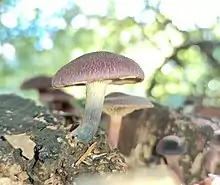
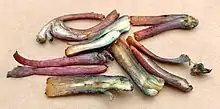
The cap ranges from 1.5 to 6 cm across, is convex to obtuse, and is reddish brown with a dry scaly surface which is sometimes cracked in age. The stem is brown-red and covered by fibers and has blue-green spots where the stem is damaged. The gills are crowded, yellow to orange, and adnexed. The stem is dusted with rusty orange spores and has a cottony scanty partial veil.
References
- Guzmán-Dávalos, Laura; Mueller, Gregory M.; Cifuentes, Joaquín; Miller, Andrew N.; Santerre, Anne (Nov–Dec 2003). "Traditional infrageneric classification of Gymnopilus is not supported by ribosomal DNA sequence data" (PDF). Mycologia. 95 (6): 1204–1214. doi:10.2307/3761920. JSTOR 3761920. PMID 21149021.
- Mushroom Observer: Name: Gymnopilus purpuratus (Cooke & Massee) Singer
- Hesler, L. R. (1969). North American species of Gymnopilus. New York: Hafner. 117 pp.
External links
 Media related to Gymnopilus purpuratus at Wikimedia Commons
- Gymnopilus purpuratus chemical analysis
- Painting of Cooke's type specimen, Agaricus purpuratus, collected in Kew Gardens; in his Illustrations of British Fungi (Hymenomycetes), to serve as an atlas to the "Handbook of British Fungi", vol. 8 - Biodiversity Heritage Library