HAT-P-19
HAT-P-19 is a K-type main-sequence star about 650 light-years away. The star is old yet metal enriched, having amount of heavy elements 250% of solar abundance.[4] The survey in 2012 have failed to find any stellar companions to HAT-P-19.[5]
| Observation data Epoch J2000 Equinox J2000 | |
|---|---|
| Constellation | Andromeda |
| Right ascension | 00h 38m 04.0136s[1] |
| Declination | +34° 42′ 41.5523″[1] |
| Apparent magnitude (V) | 12.901[2] |
| Characteristics | |
| Spectral type | K1V |
| Astrometry | |
| Radial velocity (Rv) | -20.27 km/s |
| Proper motion (μ) | RA: -26.775 mas/yr Dec.: -32.478 mas/yr |
| Parallax (π) | 4.92 ± 0.0355[1] mas |
| Distance | 663 ± 5 ly (203 ± 1 pc) |
| Details[3] | |
| Mass | 0.863+0.029 −0.025 M☉ |
| Radius | 0.851±0.013 R☉ |
| Luminosity | 0.37+0.08 −0.06[4] L☉ |
| Surface gravity (log g) | 4.514+0.019 −0.017 cgs |
| Temperature | 5049+42 −65 K |
| Metallicity | 0.283+0.081 −0.079 |
| Rotation | 14.66±0.03 d[4] |
| Rotational velocity (v sin i) | 0.7±0.5[4] km/s |
| Age | 8.8±5.2[4] Gyr |
| Other designations | |
| Database references | |
| SIMBAD | data |
Planetary system
In 2010 a transiting hot Saturn-sized planet was detected.[2] Its equilibrium temperature is 984±10 K,[6] and it is grey in color.[7]
The transit-timing variation measurements in 2015 and 2018 did not detect additional planets in the system.[8][9]
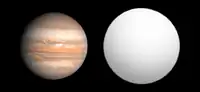
Size comparison of HAT-P-19 b and Jupiter
| Companion (in order from star) |
Mass | Semimajor axis (AU) |
Orbital period (days) |
Eccentricity | Inclination | Radius |
|---|---|---|---|---|---|---|
| b | 0.290±0.016 MJ | 0.04649± | 4.00878236+0.00000050 −0.00000049 |
0.084±0.041 | 88.67+0.41 −0.25° |
1.089±0.018 RJ |
References
- HAT-P-19 -- Star
- Hartman, J. D.; Bakos, G. Á.; Sato, B.; Torres, G.; Noyes, R. W.; Latham, D. W.; Kovács, G.; Fischer, D. A.; Howard, A. W.; Johnson, J. A.; Marcy, G. W.; Buchhave, L. A.; Füresz, G.; Perumpilly, G.; Béky, B.; Stefanik, R. P.; Sasselov, D. D.; Esquerdo, G. A.; Everett, M.; Csubry, Z.; Lázár, J.; Papp, I.; Sári, P. (2010), "HAT-P-18b and HAT-P-19b: Two Low-Density Saturn-Mass Planets Transiting Metal-Rich K Stars", The Astrophysical Journal, 726: 52, arXiv:1007.4850, doi:10.1088/0004-637X/726/1/52, S2CID 10896305
- Wang, Xian-Yu; Wang, Yong-Hao; Wang, Songhu; Wu, Zhen-Yu; Rice, Malena; Zhou, Xu; Hinse, Tobias C.; Liu, Hui-Gen; Ma, Bo; Peng, Xiyan; Zhang, Hui; Yu, Cong; Zhou, Ji-Lin; Laughlin, Gregory (2021), Transiting Exoplanet Monitoring Project (TEMP). VI. The Homogeneous Refinement of System Parameters for 39 Transiting Hot Jupiters with 127 New Light Curves, arXiv:2105.14851
- Everett, Mark E.; Howell, Steve B.; Silva, David R.; Szkody, Paula (2013), "Spectroscopy of Faint Kepler Mission Exoplanet Candidate Host Stars", The Astrophysical Journal, 771 (2): 107, arXiv:1305.0578, Bibcode:2013ApJ...771..107E, doi:10.1088/0004-637X/771/2/107, S2CID 119270620
- Ginski, C.; Mugrauer, M.; Seeliger, M.; Eisenbeiss, T. (2012), "A lucky imaging multiplicity study of exoplanet host stars", Monthly Notices of the Royal Astronomical Society, 421 (3): 2498–2509, arXiv:1202.4586, Bibcode:2012MNRAS.421.2498G, doi:10.1111/j.1365-2966.2012.20485.x, S2CID 118573795
- Basturk, Ozgur; Yalcinkaya, Selcuk; Esmer, Ekrem M.; Tanriverdi, Taner; Keten, Burak (2019), A Holistic and Probabilistic Approach to the Ground-based Data of HAT-P-19 System, arXiv:1911.07903, doi:10.1093/mnras/staa1758, S2CID 208158330
- Mallonn, M.; von Essen, C.; Weingrill, J.; Strassmeier, K. G.; Ribas, I.; Carroll, T. A.; Herrero, E.; Granzer, T.; Claret, A.; Schwope, A. (2015), "Transmission spectroscopy of the inflated exo-Saturn HAT-P-19b", Astronomy & Astrophysics, 580: A60, arXiv:1506.05685, Bibcode:2015A&A...580A..60M, doi:10.1051/0004-6361/201423778, S2CID 91175943
- Seeliger, M.; Kitze, M.; Errmann, R.; Richter, S.; Ohlert, J. M.; Chen, W. P.; Guo, J. K.; Göğüş, E.; Güver, T.; Aydın, B.; Mottola, S.; Hellmich, S.; Fernandez, M.; Aceituno, F. J.; Dimitrov, D.; Kjurkchieva, D.; Jensen, E.; Cohen, D.; Kundra, E.; Pribulla, T.; Vaňko, M.; Budaj, J.; Mallonn, M.; Wu, Z.-Y.; Zhou, X.; Raetz, St.; Adam, C.; Schmidt, T. O. B.; Ide, A.; et al. (2015), "Ground-based transit observations of the HAT-P-18, HAT-P-19, HAT-P-27/WASP40 and WASP-21 systems", Monthly Notices of the Royal Astronomical Society, 451 (4): 4060–4072, arXiv:1508.06215, doi:10.1093/mnras/stv1187, S2CID 56034663
- MacIejewski, G.; Stangret, M.; Ohlert, J.; Basaran, Ç.S.; MacIejczak, J.; Puciata-Mroczynska, M.; Boulanger, E. (2018), "New transit timing observations for GJ 436 b, HAT-P-3 b, HAT-P-19 b, WASP-3 b, and XO-2 B", Information Bulletin on Variable Stars, 6243 (6243): 1, arXiv:1808.03306, Bibcode:2018IBVS.6243....1M, doi:10.22444/IBVS.6243, S2CID 118872603
| Stars |
| ||||||||||
|---|---|---|---|---|---|---|---|---|---|---|---|
| |||||||||||
| |||||||||||
| |||||||||||
| Galaxies |
| ||||||||||
| |||||||||||
| |||||||||||
 Category Category | |||||||||||
This article is issued from Wikipedia. The text is licensed under Creative Commons - Attribution - Sharealike. Additional terms may apply for the media files.