HD 129116
HD 129116 is a binary star[10] in the northeastern part of Centaurus, east of Menkent. It is also known by its Bayer designation of b Centauri, while HD 129116 is the star's identifier in the Henry Draper catalogue. This object has a blue-white hue and is faintly visible to the naked eye with an apparent visual magnitude of +4.01.[2] It is located at a distance of approximately 325 light years[11][5] from the Sun based on parallax, and has an absolute magnitude of −1.07.[2] The star is a probable (93% chance) member of the Sco OB2 moving group of stars.[12]
| Observation data Epoch J2000.0 Equinox J2000.0 | |
|---|---|
| Constellation | Centaurus |
| Right ascension | 14h 41m 57.59068s[1] |
| Declination | −37° 47′ 36.5940″[1] |
| Apparent magnitude (V) | +4.01[2] |
| Characteristics | |
| Evolutionary stage | Main sequence |
| Spectral type | B3V[3] |
| B−V color index | −0.157±0.002[2] |
| Variable type | Constant[4] |
| Astrometry | |
| Radial velocity (Rv) | +2.6±1.5[2] km/s |
| Proper motion (μ) | RA: −29.828±0.369[5] mas/yr Dec.: −31.914±0.518[5] mas/yr |
| Parallax (π) | 10.0339 ± 0.3143[5] mas |
| Distance | 323.37±7.93 ly (99.193±2.432 pc) |
| Absolute magnitude (MV) | −1.07[2] |
| Details | |
| Mass | 6.3±0.1[6] M☉ |
| Radius | 2.93±0.12[7] R☉ |
| Luminosity | 637.01[2] L☉ |
| Surface gravity (log g) | 4.23±0.03[7] cgs |
| Temperature | 18,445±344[7] K |
| Rotational velocity (v sin i) | 129[8] km/s |
| Age | 18.4±1.5[6] Myr |
| Other designations | |
| Database references | |
| SIMBAD | data |
This is a B-type main-sequence star with a stellar classification of B3V,[3] which indicates it is engaged in core hydrogen fusion to generate energy. The object has been used as a "standard star" in several photometric systems, and it appears to be non-variable.[4] It is an estimated 18[6] million years old with a high rate of spin, showing a projected rotational velocity of 129 km/s.[8] The star has 6.3[6] times the mass of the Sun and 2.9[7] times the Sun's radius. It is radiating 637[2] times the luminosity of the Sun from its photosphere at an effective temperature of 18,445 K.[7]
Planetary system
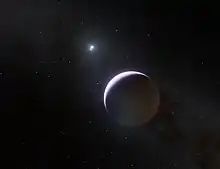
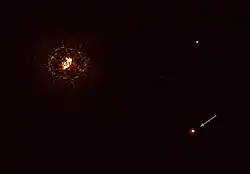
In 2021, an exoplanet with a mass of 10.9 MJ was directly imaged in orbit around b Centauri by VLT/SPHERE.[10]
| Companion (in order from star) |
Mass | Semimajor axis (AU) |
Orbital period (years) |
Eccentricity | Inclination | Radius |
|---|---|---|---|---|---|---|
| b | 10.9±1.6 MJ | 556±17 | 2650–7170 | <0.40 | 128–157° | — |
References
- van Leeuwen, F. (November 2007), "Validation of the new Hipparcos reduction", Astronomy and Astrophysics, 474 (2): 653–664, arXiv:0708.1752, Bibcode:2007A&A...474..653V, doi:10.1051/0004-6361:20078357, S2CID 18759600.
- Anderson, E.; Francis, Ch. (2012), "XHIP: An extended hipparcos compilation", Astronomy Letters, 38 (5): 331, arXiv:1108.4971, Bibcode:2012AstL...38..331A, doi:10.1134/S1063773712050015, S2CID 119257644.
- Hiltner, W. A.; et al. (July 1969), "MK Spectral Types for Bright Southern OB Stars", Astrophysical Journal, 157: 313–326, Bibcode:1969ApJ...157..313H, doi:10.1086/150069.
- Paunzen, E.; Rode-Paunzen, M. (2017). "BRITE photometry of seven B-type stars". Second Brite-Constellation Science Conference: Small Satellites – Big Science. 5: 180. arXiv:1612.04714. Bibcode:2017sbcs.conf..180P.
- European Space Agency. "Gaia EDR3". doi:10.5270/esa-1ugzkg7. Cite journal requires
|journal=(help) - Tetzlaff, N.; Neuhäuser, R.; Hohle, M. M. (January 2011), "A catalogue of young runaway Hipparcos stars within 3 kpc from the Sun", Monthly Notices of the Royal Astronomical Society, 410 (1): 190–200, arXiv:1007.4883, Bibcode:2011MNRAS.410..190T, doi:10.1111/j.1365-2966.2010.17434.x, S2CID 118629873.
- Fitzpatrick, E. L.; Massa, D. (March 2005), "Determining the Physical Properties of the B Stars. II. Calibration of Synthetic Photometry", The Astronomical Journal, 129 (3): 1642–1662, arXiv:astro-ph/0412542, Bibcode:2005AJ....129.1642F, doi:10.1086/427855, S2CID 119512018.
- Wolff, S. C.; Strom, S. E.; Dror, D.; Venn, K. (2007), "Rotational Velocities for B0-B3 Stars in Seven Young Clusters: Further Study of the Relationship between Rotation Speed and Density in Star-Forming Regions", The Astronomical Journal, 133 (3): 1092–1103, arXiv:astro-ph/0702133, Bibcode:2007AJ....133.1092W, doi:10.1086/511002, S2CID 119074863.
- "b Cen". SIMBAD. Centre de données astronomiques de Strasbourg. Retrieved 2020-03-05.
- "ESO telescope images planet around most massive star pair to date". European Southern Observatory. 8 December 2021. Retrieved 8 December 2021. See also attached research paper.
- Bailer-Jones, C. A. L.; Rybizki, J.; Fouesneau, M.; Demleitner, M.; Andrae, R. (2021-03-01). "Estimating Distances from Parallaxes. V. Geometric and Photogeometric Distances to 1.47 Billion Stars in Gaia Early Data Release 3". The Astronomical Journal. 161 (3): 147. doi:10.3847/1538-3881/abd806. ISSN 0004-6256.CS1 maint: date and year (link)
- Rizzuto, Aaron; et al. (October 2011), "Multidimensional Bayesian membership analysis of the Sco OB2 moving group", Monthly Notices of the Royal Astronomical Society, 416 (4): 3108–3117, arXiv:1106.2857, Bibcode:2011MNRAS.416.3108R, doi:10.1111/j.1365-2966.2011.19256.x, S2CID 54510608.
