HMS Elgin (J39)
HMS Elgin was a Hunt-class minesweeper of the Aberdare sub-class built for the Royal Navy during World War I. She was not finished in time to participate in the First World War. A mine badly damaged her in 1944; she was sold for scrap in 1945.
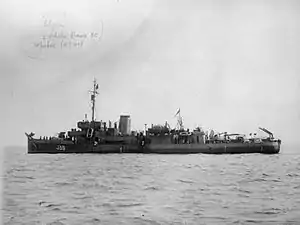 | |
| History | |
|---|---|
 United Kingdom United Kingdom | |
| Builder | William Simons & Company, Renfrew |
| Launched | 3 March 1919 |
| Fate | Sold 20 March 1945, broken up King, Gateshead |
| Notes | Pennant number J39 |
| General characteristics | |
| Class and type | Hunt-class minesweeper, Aberdare sub-class |
| Displacement | 800 long tons (813 t) |
| Length | 213 ft (65 m) o/a |
| Beam | 28 ft 6 in (8.69 m) |
| Draught | 7 ft 6 in (2.29 m) |
| Installed power |
|
| Propulsion |
|
| Speed | 16 knots (30 km/h; 18 mph) |
| Range | 1,500 nmi (2,800 km; 1,700 mi) at 15 knots (28 km/h; 17 mph) |
| Complement | 74 |
| Armament |
|
Design and description
The Aberdare sub-class were enlarged versions of the original Hunt-class ships and carried more powerful armament. The ships displaced 800 long tons (810 t) at normal load. They had a length between perpendiculars of 220 feet (67.1 m),[1] and measured 231 feet (70.4 m) long overall. The Aberdares had a beam of 26 feet 6 inches (8.1 m) and a draught of 7 feet 6 inches (2.3 m). The ships' complement consisted of 74 officers and ratings.[2]
The ships had two vertical triple-expansion steam engines, each driving one shaft, using steam provided by two Yarrow boilers. The engines produced a total of 2,200 indicated horsepower (1,600 kW) and gave a maximum speed of 16 knots (30 km/h; 18 mph). They carried a maximum of 185 long tons (188 t) of coal[2] which gave them a range of 1,500 nautical miles (2,800 km; 1,700 mi) at 15 knots (28 km/h; 17 mph).[1]
The Aberdare sub-class was armed with a quick-firing (QF) four-inch (102 mm) gun forward of the bridge and a QF twelve-pounder (76.2 mm) anti-aircraft gun aft.[2] Some ships were fitted with six- or three-pounder guns in lieu of the twelve-pounder.[1]
Construction and career
HMS Elgin was built by the William Simons & Company at their shipyard in Renfrew. She was originally to be named Troon, but was renamed before launch to avoid possible misunderstandings of having vessels named after coastal locations. On 4 May 1944, Elgin was nine miles east of the Isle of Portland, when she triggered a acoustic mine that damaged her severely. She was towed to Portsmouth where she was scrapped in 1945.
See also
- Elgin, Moray, Scotland
Notes
- Cocker, p. 76
- Gardiner & Gray, p. 98
References
- Cocker, M. P. (1993). Mine Warfare Vessels of the Royal Navy: 1908 to Date. Shrewsbury, England: Airlife Publishing. ISBN 1-85310-328-4.
- Colledge, J. J.; Warlow, Ben (2006) [1969]. Ships of the Royal Navy: The Complete Record of all Fighting Ships of the Royal Navy (Rev. ed.). London: Chatham Publishing. ISBN 978-1-86176-281-8.
- Gardiner, Robert & Gray, Randal, eds. (1985). Conway's All the World's Fighting Ships: 1906–1921. Annapolis, Maryland: Naval Institute Press. ISBN 0-85177-245-5.
Shipwrecks and maritime incidents in May 1944 | |
|---|---|
| Shipwrecks |
|
| Other incidents |
|
1943  1944 1944  1945 1945 April 1944 June 1944 | |