Haiyuan Fault
The Haiyuan Fault is a major active intracontinental strike-slip (sinistral) fault in Central Asia.[1]
| Haiyuan Fault | |
|---|---|
| Location | Tibet |
| Country | China |
| Characteristics | |
| Length | 1000km |
| Tectonics | |
| Plate | Eurasian Plate |
| Status | Active |
| Earthquakes | ~174-374 AD, 1092 AD, 1920 Haiyuan earthquake, 1927 Gulang earthquake |
| Type | sinistral strike-slip fault |
Tectonic setting
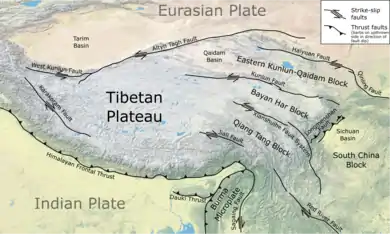
The Haiyuan Fault forms part of the northeastern boundary of the Tibetan Plateau, which is an area of continental crust that has been thickened by the ongoing collision between the Indian Plate and the Eurasian Plate. The Haiyuan Fault extends for approximately 1000 km from the central Qilian Shan in the west, to the Liupan Shan, in the east. It is one of the group of structures that accommodates the overall eastward spreading of the plateau, that also includes the Altyn Tagh Fault, Kunlun Fault and the Xianshuihe fault system.[2][1]
Geology
It is characterized by left-lateral strike-slip motion along its length, the motion transits to thrust at the eastern end, accommodated by the Liupanshan Fault. The average slip rate along the Haiyuan Fault is 3.2-9 mm/yr.[3][1]
Tianzhu seismic gap
The Tianzhu seismic gap is a 260 km long, unruptured segment on the western end of the fault. It has not seen any major earthquakes for the past 1000 years and was identified as a seismic gap. It poses a high risk for the capacity of large earthquakes.[4] An earthquake recurrence period of roughly 1000 years has been suggested, with the last earthquakes on that section dated at 1092 AD and 174 or 374 AD. Locking depth of the fault range from 7.1 to 21.8 km.[1][3]
Creeping Section
At the western end of the 1920 earthquake surface rupture, and between the Tianzhu seismic gap (from 37.11° N, 103.68° E to 37.00° N, 104.15° E) lies a 30-40 km section of the fault that displays a phenomenon known as an aseismic creep at shallow depths.[5]
Seismicity
December 16, 1920
On the evening of December 16 1920, the a M7.8-8.5 earthquake struck Haiyuan County, killing over 270,000 people. Shaking intensity reached a maximum of XII (Extreme), the uppermost limit on the Modified Mercalli Intensity Scale. The fault ruptured for a length of nearly 240 km in this event.[6]
May 22, 1927
A magnitude 8.3 quake struck Gansu Province on the morning of May 22, 1927, the earthquake occurred on a different segment from the one involved in the 1920 quake. This earthquake caused the deaths of more than 40,000 people, and deaths amongst livestock of 200,000.[2]
References
- Jolivet, R.; Lasserre, C.; Doin, M.–P.; Guillaso, S.; Peltzer, G.; Dailu, R.; Sun, J.; Shen, Z.–K.; Xu, X. (2012). "Shallow creep on the Haiyuan Fault (Gansu, China) revealed by SAR Interferometry". Journal of Geophysical Research: Solid Earth. 117 (B6): n/a. Bibcode:2012JGRB..117.6401J. doi:10.1029/2011JB008732.
- Gaudemer, Y.; Tapponnier, P.; Meyer, B.; Peltzer, G.; Shunmin, G.; Zhitai, C.; Huagung, D.; Cifuentes, I. (1995). "Partitioning of crustal slip between linked, active faults in the eastern Qilian Shan, and evidence for a major seismic gap, the 'Tianzhu gap', on the western Haiyuan Fault, Gansu (China)". Geophysical Journal International. 120 (3): 599–645. Bibcode:1995GeoJI.120..599G. doi:10.1111/j.1365-246X.1995.tb01842.x.
- Li, Y.; Qu, C.; Shan, X.; Song, X.; Zhang, G.; Gan, W.; Wen, S.; Wang, Z. (2015). "Deformation of the Haiyuan-Liupanshan fault zone inferred from the denser GPS observations". Earthquake Science. 28 (5–6): 319–331. Bibcode:2015EaSci..28..319L. doi:10.1007/s11589-015-0134-z.
- Cavalié, O.; Lasserre, C.; Doin, M.–P.; Peltzer, G.; Sun, J.; Shen, Z.–K. (2008). "Measurement of interseismic strain across the Haiyuan fault (Gansu, China), by InSAR". Earth and Planetary Science Letters. 275 (3–4): 246–257. Bibcode:2008E&PSL.275..246C. CiteSeerX 10.1.1.457.4262. doi:10.1016/j.epsl.2008.07.057.
- Jolivet, R.; Candela, T.; Lasserre, C.; Renard, F.; Klinger, Y.; Doin, M.–P. (2015). "The Burst-Like Behavior of Aseismic Slip on a Rough Fault: The Creeping Section of the Haiyuan Fault, China" (PDF). Bulletin of the Seismological Society of America. 105 (1): 480–488. Bibcode:2015BuSSA.105..480J. doi:10.1785/0120140237.
- Wang, Y.; Ran, Y. (2001). "The 1920 Haiyuan Earthquake Rupture and the Paleoearthquakes Feature of the Haiyuan Fault in China". AGU Fall Meeting Abstracts. AGU, Fall Meeting 2001, abstract id. S52D-0664. American Geophysical Union. 2001: S52D–0664. Bibcode:2001AGUFM.S52D0664W – via The SAO/NASA Astrophysics Data System.