Harald Poelchau
Harald Poelchau (5 October 1903 in Potsdam; 29 April 1972 in West Berlin) a German prison chaplain, religious socialist and resistance fighter against the Nazis.[1][2]
Harald Poelchau | |
|---|---|
.jpg.webp) Dorothee and Harald Poelchau | |
| Personal | |
| Born | Harald Poelchau 5 October 1903 |
| Died | 29 April 1972 (aged 69) |
| Religion | Protestant |
Life
Poelchau was the son of Harald (1866-1938) and Elisabeth Poelchau (née Riem, 1871-1945) and was brought up in the Silesian village of Brauchitschdorf.[2] His father was a Lutheran pastor in the village.[2] Poelchau attended the Ritterakademie (knights academy) in Liegnitz, where he participated in school Bible classes and became involved in the German Youth Movement, that resulted in him turning away from a village conservative piety.
At the University of Tübingen, Harald Poelchau met the librarian Dorothee Ziegele (1902-1977).[3] The couple married on 12 April 1928, lived in Berlin and cultivated a large group of acquaintances, which was to prove its worth even after the handover of power to the Nazis. In 1938 the couple's son, also baptised Harald, was born,[3] and in 1945 the couple's daughter Andrea Siemsen.[4]
Education
After graduating from the Ritterakademie in 1921, he studied Protestant theology in Kirchliche Hochschule Bethel, the University of Tübingen and the University of Marburg from 1922. This was followed by social work at the Free University of Berlin at the Berlin College of Political Science. In Tübingen he was secretary of the Köngener Bund. The Christian existentialist philosopher Paul Tillich, who taught in Marburg in 1924, was the decisive, intellectual influence on him, particulalry in the study of religious socialism.[5] Tillich became a lifelong friend and mentor.[5] As a working student at Robert Bosch company in Stuttgart, he gained an insight into the world of work and industry. After his first theological examination in 1927 in Breslau, he studied welfare and state welfare policy at the German Academy for Politics in Berlin.[6]
Career
_Harald_Poelchau.JPG.webp)
_Harald_Poelchau.jpg.webp)
Poelchau served as executive director of the German Association for Juvenile Courts and Juvenile Court Assistance in Berlin and assistant to Paul Tillich at Frankfurt University.[2] In 1931, he passed his second state examination in Berlin and wrote his doctoral thesis under Tillich. His doctoral thesis was titled: Die sozialphilosophischen Anschauungen der deutschen Wohlfahrtsgesetzgebung (The Social Philosophical Views of German Welfare Legislation).[2] The paper was published in 1932, as a book titled Das Menschenbild des Fürsorgerechtes: Eine ethisch-soziologische Untersuchung (The Image of Man in the Law of Welfare: An Ethical-Sociological Investigation).[7]
Poelchau applied for a position as a prison chaplain at the end of 1932 and took up his post on 1 April 1933[8] as the first clergyman appointed by the Nazi regime in a prison. The judicial officer worked at Tegel Prison in Berlin as well as at various other prisons such as Plötzensee and Moabit.[9] Opposed to the Nazis from the beginning, he joined Confessing Church.[10][11]
World War II
With the beginning of the World War II in 1939, death sentences against opposition members increased. Poelchau accompanied about one thousand people to execution[2] as spiritual advisor to those sentenced to death.[9] After 20 July 1944, many of his close friends were sent for execution.[2] To help the families of the executed, in despair, he would illegally smuggle letters and messages out of the prisons he worked in.[2]
In October 1941, the deportation of Jews from Germany began. Poelchau knew early on that only an escape into hiding would ensure survival. The refugees were supposed to call him at his office in Tegel and only talk if he answered with the code word "Tegel". But the actual conversation took place in his office, that could only be reached through several locked doors. Supported by his wife, he arranged accommodation among his large group of acquaintances. These included Gertie Siemsen, a long-time friend from his student days, Willi Kranz, canteen worker in the Tegel and Plötzensee prisons, and his partner Auguste Leißner, Hermann Sietmann and Otto Horstmeier, two former political prisoners, the couple Hans Reinhold Schneider and Hildegard Schneider, parents of the later political scientist Gesine Schwan, who worked in the welfare and school sectors respectively. The pastor's wife Agnes Wendland who is also Righteous Among the Nations for hiding Jews, and her daughter Ruth Wendland, the prison doctor Hilde Westrick, and the physicist Carl-Friedrich Weiss and his wife Hildegard.[12]
Only a few of Poelchau supporters are known by name. One Jewish couple, Manfred and Margarete Latte with their son Konrad, fled from Breslau after they learned they were to be deported, to Berlin where they went into hiding.[10] Through a family friend, Ursula Teichmann,[10] they made contact with Poelchau in late February 1943 and turned to him for help.[13][14] He provided them with ration cards, cash and found accommodation for the family.[10] He also found work for Manfred Latte, who became a cleaner.[10] As Konrad Latte was a typical age to be conscripted[10] Poelchau filled in a registration card, for the Volkssturm, a German militia that was independent of the German army, to provide camouflage.[10]
Through Konrad Latte, contact was made with Ruth Andreas-Friedrich[10]the co-founder of the resistance group Onkel Emil, after their warning cry. along with the conductor Leo Borchard.[15][16] The resistance group was motivated more by humanitarian concerns, rather than ideology and was made up on middle-class professionals. They began to work with Poelchau, who provided them with accommodation, forged identity papers and food ration stamps.
The Gestapo apprehended the Latte family in October 1943. Manfred and Margarete Latte were immediately deported to the Auschwitz concentration camp,[17] Konrad Latte managed to escape the Great Hamburg Street collection camp [14] and went back into hiding again. Rita Neumann[18] and her mother Leontine Cohn had been in hiding with the resistance fighter and Protestant pastor wifes Agnes Wendland since August 1943.[19] Her brother Ralph Neumann joined Wendland.[18] The siblings worked as bicycle couriers for Poelchau. In February 1945, the siblings were arrested along with Wendland. The siblings managed to escape the Große Hamburger Straße deportation collection camp and make their way back to Poelchau's door.[20][21]
Other people Poelchau helped were Ilse Schwarz and her daughter Evelyne, a young stenographer Ursula Reuber, Anna Drach, Edith Bruck,[22] Charlotte Paech, part of the Baum group[23] and Charlotte Bischoff. From 1941, Poelchau belonged to a group of people around Helmuth James Graf von Moltke known as the Kreisau Circle resistance group[24] and also took part in the first meeting of the group.[1] After the attempted coup of 20 July 1944, the prison chaplain cared for many of those involved in the assassination. Harald Poelchau's extensive opposition work remained undiscovered until the end of the war.
After the war
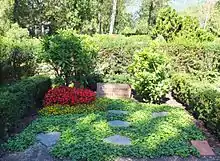
In 1945, he co-founded the Aid Organisation of the Protestant Churches in Stuttgart, together with the theologian Eugen Gerstenmaier[25] and became its General Secretary. The Aid Organisation took care of the problems of refugees, the construction of apartments (settlement work), the construction of old people's, apprentice homes and emergency churches. After returning to Berlin in 1946, Poelchau became involved in the prison system of the Central Administration of Justice in the Soviet occupation zone. This was connected with a teaching assignment for criminology and prison science at the Humboldt University of Berlin. Along with Ottomar Geschke and Heinrich Grüber he sat on the central board of the Union of Persecutees of the Nazi Regime for the Soviet Occupation Zone.[26] When Poelchau was unable to push through his ideas in the east, he moved to West Germany. From 1949 to 1951, he was again appointed as the prison chaplain at Tegel Prison.[27] In 1951, Bishop Otto Dibelius appointed him the first social and industrial pastor of the Protestant Church in Berlin-Brandenburg.[28] Harald Poelchau dedicated himself to this task until his death in 1972.[26] He is buried in the Zehlendorf cemetery.
Awards and honours
- On 30 November 1971, Harald and Dorothee Poelchau were recognised by the Yad Vashem memorial as Righteous Among the Nations.[5]
- In 1973, an elite sports school bearing the Poelchau name, the Poelchau-Oberschule was opened in the Charlottenburg-Nord district of Berlin.[29][30]
- By resolution of the Senate of Berlin on 6 October 1987, the couples burial place at the Zehlendorf cemetery was converted into an honorary grave of the State of Berlin.[31]
- On 17 November 1988, a Berlin memorial plaque was affixed to the house at Afrikanische Straße 140b in Wedding in Berlin, where the couple lived from 1933 to 1945.[32]
- On 31 January 1992, Karl-Maron-Straße in the Marzahn district of Berlin, was given the name Poelchaustraße, as was the Berlin S-Bahn named after the street.[32]
- On 29 April 1992, an asteroid discovered by Freimut Börngen at the Karl Schwarzschild Observatory was named Poelchau (10348) in honour of the couple.[33][34]
- On 18 September 2017, a memorial stele for Harald and Dorothee Poelchau was handed over at the corner of Poelchaustraße, Märkische Allee in the Marzahn district of Berlin.[35][36]
- On 5 October 2018, a memorial created by the artist Katrin Hattenhauer and the inmates of Tegel Prison, was inaugurated for Harald Poelchau.[37]
Bibliography
- Poelchau, Harald (1932). Das Menschenbild des Fürsorgerechts. Eine ethisch-soziologische Untersuchung. Potsdam: Alfred Protte.
Literature
- Bitter, Stephan (2005). "Harald Poelchau als Theologe des 20. Jahrhunderts". In Angermann, Norbert; Garleff, Michael; Lenz, Wilhelm (eds.). Ostseeprovinzen, Baltische Staaten und das Nationale. 14. Munich: LIT-Verlag. pp. 513–534.
- Harpprecht, Klaus (2004). Harald Poelchau : ein Leben im Widerstand (in German) (1st ed.). Reinbek bei Hamburg: Rowohlt. ISBN 3-498-02969-X. OCLC 54777865.
- Harpprecht, Klaus (1 October 2003). "Ein stiller Kämpfer" (41). Zeit-Verlag Gerd Bucerius GmbH & Co. KG. Die Zeit. Retrieved 26 November 2021.
- Mehlhorn, Ludwig, ed. (2004). Ohr der Kirche, Mund der Stummen : Harald Poelchau : eine Tagung zu seinem 100. Geburtstag (in German). Berlin: Wichern-Verlag. ISBN 3-88981-166-3. OCLC 250024383.
- Siegfried Mielke; Marion Goers; Gedenkstätte Deutscher Widerstand (Berlin, Germany); Freie Universität Berlin (2008). "German". Einzigartig : Dozenten, Studierende und Repräsentanten der Deutschen Hochschule für Politik (1920-1933) im Widerstand gegen den Nationalsozialismus : Begleitband zur Ausstellung (1st ed.). Berlin: Lukas Verlag. pp. 302–309. ISBN 978-3-86732-032-0. OCLC 314107425.
- Biographisch-bibliographisches Kirchenlexikon / 7 Patočka, Jan bis Remachus (in German). 7. Hamm: Bautz. 1994. pp. 769–775. ISBN 3-88309-048-4. OCLC 873794573.
- Schuppener, Henriette; Brakelmann, Günter (2006). "Nichts war umsonst" : Harald Poelchau und der deutsche Widerstand (in German). Munich: Lit. ISBN 3-8258-9315-4. OCLC 494666960.
- Maier, Hugo (1998). Who is who der sozialen Arbeit. Freiburg: Lambertus. pp. 473–475. ISBN 9783784110363. OCLC 40933946.
References
- "Harald Poelchau". German Resistance Memorial Center. Berlin: Gedenkstätte Deutscher Widerstand. Retrieved 26 November 2021.
- Hammerstein, Franz v. (2001). Neue deutsche Biographie. 20. Berlin: Duncker & Humblot. p. 561. ISBN 3-428-00201-6.
- "Dorothee Poelchau". German Resistance Memorial Center. Berlin: Gedenkstätte Deutscher Widerstand. Retrieved 27 November 2021.
- Schuppener, Henriette (2006). "Nichts war umsonst": Harald Poelchau und der deutsche Widerstand (in German). LIT Verlag Münster. p. 120. ISBN 978-3-8258-9315-6.
- "Poelchau Harald & Dorothee". Yad Vashem. The Authority in Memory of the Martyrs and Heroes of the Holocaust. 30 November 1971. Retrieved 26 November 2021.
- "Wer war ... ... Harald Poelchau ?". Suhne Christian Church (in German). Berlin. 29 April 1972. Archived from the original on 1 July 2009. Retrieved 26 November 2021.
- Schie, Gerhard (1933). "Poelchau, Harald, Das Menschenbild des Fürsorgerechts. Al/red Protte. Potsdam 1932. Book review". Zeitschrift für Sozialforschung (PDF). Deutscher Taschenbuch Verlag. p. 130. Retrieved 28 November 2021.
- Beck, Verlag C. H. (1988). Der Aquädukt 1763-1988: ein Almanach aus dem Verlag C.H. Beck im 225. Jahr seines Bestehens (in German). C.H.Beck. pp. 149–158. ISBN 978-3-406-33197-8. OCLC 873358963.
- "Harald Poelchau (1903-1972)". Kreisau-Initiative e. V. (in German). Berlin: Allianz AG. Retrieved 27 November 2021.
- Schneider, Peter (13 February 2000). "Saving Konrad Latte". Arthur Ochs Sulzberger Jr. The New York Times Magazine. Retrieved 2 December 2021.
- Kellenbach, Katharina von (1 May 2013). The Mark of Cain: Guilt and Denial in the Post-War Lives of Nazi Perpetrators. Oxford: Oxford University Press. p. 80. ISBN 978-0-19-932375-3.
- Johannes Tuchel; Gedenkst©Þtte Stille Helden in der Stiftung Gedenkst©Þtte Deutscher Widerstand (2009). Gedenkstätte Stille Helden Widerstand gegen die Judenverfolgung 1933 bis 1945 (in German) (2nd ed.). Berlin: Gedenkstaette Stille Helden in der Stiftung Gedenkstaette Deutscher Widerstand. pp. 17–18. ISBN 9783926082367. OCLC 970986725.
- Benz, Wolfgang (2003). Überleben im Dritten Reich: Juden im Untergrund und ihre Helfer (in German). C.H.Beck. p. 117. ISBN 978-3-406-51029-8.
- "Konrad Latte". German Resistance Memorial Center. Berlin: Gedenkstätte Deutscher Widerstand. Retrieved 2 December 2021.
- Westerfield, Lillian Leigh (2004). 'This Anguish, Like a Kind of Intimate Song': Resistance in Women's Literature of World War II. Rodopi. p. 82. ISBN 978-90-420-1148-9.
- Kleibert, Kristin (1 January 2010). Die Juristische Fakultät der Humboldt-Universität zu Berlin im Umbruch: die Jahre 1948 bis 1951 (in German). BWV Verlag. p. 158. ISBN 978-3-8305-1824-2.
- Heim, Susanne (4 June 2019). German Reich 1938–August 1939. Walter de Gruyter GmbH & Co KG. p. 1327. ISBN 978-3-11-052390-4.
- "Ralph Neumann". German Resistance Memorial Center. Berlin: Gedenkstätte Deutscher Widerstand. Retrieved 26 November 2021.
- Gutman, Israel; Fraenkel, Daniel; Borut, Jacob (2005). Lexikon der Gerechten unter den Völkern: Deutsche und Österreicher (in German). Wallstein Verlag. p. 284. ISBN 978-3-89244-900-3.
- Paldiel, Mordecai (2006). Churches and the Holocaust: Unholy Teaching, Good Samaritans, and Reconciliation. Jersey City, N.J: KTAV Publishing House, Inc. p. 62. ISBN 978-0-88125-908-7.
- Tuchel, Johannes (2009). "Verlangen sie „Tegel". Gedenkstaette Stille Helden : Widerstand gegen die Judenverfolgung 1933 bis 1945 (in German) (2nd Revised ed.). Berlin: Gedenkstaette Stille Helden in der Stiftung Gedenkstaette Deutscher Widerstand. pp. 17–18. ISBN 978-3-926082-36-7.
- "Edith Fürst". German Resistance Memorial Center. Berlin: Gedenkstätte Deutscher Widerstand. Retrieved 26 November 2021.
- Brothers, Eric (2012). Berlin ghetto : Herbert Baum and the anti-fascist resistance. Stroud, Gloucestershire [England]: Spellmount. ISBN 978-0752476865.
- Roon, Ger van; Ludlow, Peter (1971). German resistance to Hitler: Count von Moltke and the Kreisau Circle. London: Van Nostrand Reinhold Co. ISBN 0-442-08975-9.
- Scholtyseck, Joachim (2005). Die Überlebenden des deutschen Widerstandes und ihre Bedeutung für Nachkriegsdeutschland. Schriftenreihe der Forschungsgemeinschaft 20. July 1944 e.V., (in German). 6. Munich: LIT Verlag. p. 79. ISBN 978-3-8258-8317-1. OCLC 905014378.CS1 maint: extra punctuation (link)
- Schneider, Ulrich (19 March 2012). "Was wollte und was tat die Gründungsgeneration der VVN?". Vereinigung der Verfolgten des Naziregimes – Bund der Antifaschistinnen und Antifaschisten e. V (in German). Retrieved 11 December 2021.
- Benz, Wolfgang; Pehle, Walter H; Garmer, Lance W (1997). Encyclopedia of German resistance to the Nazi movement. New York: Continuum. p. 308. ISBN 9780826409454. OCLC 895192195.
- Schuppener, Henriette (2006). "Nichts war umsonst": Harald Poelchau und der deutsche Widerstand (in German). LIT Verlag Münster. p. 147. ISBN 978-3-8258-9315-6.
- "Sportschule im Olympiapark-Poelchau-Schule". Bezirksamt Charlottenburg-Wilmersdorf (in German). BerlinOnline Stadtportal GmbH & Co. KG betrieben.A. 4 November 2021. Retrieved 26 November 2021.
- "Eliteschule des Sports - Eliteschule des Fußballs". Sportschule im Olympiapark - Poelchau-Schule (in German). Berlin: Senatsverwaltung für Bildung, Jugend und Wissenschaft. Retrieved 26 November 2021.
- "Friedhöfe und Begräbnisstätten". Senatsverwaltung für Umwelt, Verkehr und Klimaschutz (in German). Berlin: BerlinOnline Stadtportal GmbH & Co. KG betrieben.A. 2 August 2021. p. 65. Retrieved 26 November 2021.
- "Poelchaustraße". Kaupert (in German). Berlin: Luisenstädt Education Association. Retrieved 26 November 2021.
- "Discovery Circumstances: Numbered Minor Planets (10001)-(15000)". Minor Planet Center. International Astronomical Association. Retrieved 26 November 2021.
- "Citation for (10348)". Minor Planet Center. International Astronomical Association. Retrieved 26 November 2021.
- "Übergabe der Poelchau-Erinnerungsstele in Marzahn". Berzirksamt Marzahn-Hellersdorf (in German). BerlinOnline Stadtportal GmbH & Co. KG betrieben.A. 28 August 2017. Retrieved 26 November 2021.
- "Stele erinnert an Eheleute Poelchau". Neues Deutschland (in German). Berlin: Neues Deutschland Druckerei und Verlags GmbH. 19 September 2017. Retrieved 26 November 2021.
- "Denkmal für Widerstandskämpfer Harald Poelchau eingeweiht". Senatsverwaltung für Justiz, Verbraucherschutz und Antidiskriminierung (in German). Berlin: BerlinOnline Stadtportal GmbH & Co. KG betrieben.A. 27 January 2020. Retrieved 26 November 2021.
External links
Authority control  | |
|---|---|
| General | |
| National libraries | |
| Scientific databases | |
| Other | |