Harrat Khaybar
Ḥarrat Khaybar (Arabic: حَرَّة خَيْبَر) is a volcanic field located north of Medina in the Hejaz, Saudi Arabia. It covers approximately 12,000 km2. The most recent eruption occurred between 600 and 700 CE.
| Harrat Khaybar حرة خيبر | |
|---|---|
 Harrat Khaybar seen from the International Space Station (North to the right of the picture) | |
| Highest point | |
| Elevation | 2,093 m (6,867 ft) |
| Coordinates | 25°43′10″N 39°56′34″E |
| Geography | |
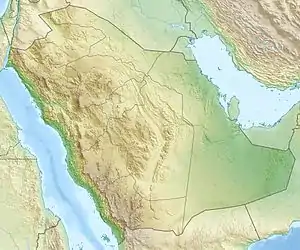  Harrat Khaybar حرة خيبر | |
| Geology | |
| Mountain type | Volcanic field |
| Last eruption | 650 CE ± 50 years |
Researchers using satellite imagery have discovered evidence of man-made structures (for example, 25°40′38″N 39°57′52″E) which may date from 7,000 years ago or earlier in the lava fields.[1]
Umm Jirsan lava tube
Within the lava fiend is the Umm Jirsan lava tube, with a length of 1,481 metres (4,859 ft) in three sections including two pieces of collapsed roof. It is Saudi Arabia's longest lava tube system.[2] In August 2021, the analysis of many thousands of animal and human bones from the cave system revealed that Striped Hyenas (Hyaena hyaena) had used this as a den for around 7,000 years.[3]
Sources
- Sean Martin (October 18, 2017). "GATES TO HELL? Hundreds of ancient structures found on edge of VOLCANOES in Saudi Arabia". Daily Express. Retrieved October 18, 2017.
- Umm Jirsan: Arabia's Longest Lava Tube System, John Pint, Saudi Geological Syrvey, January 2021, accessed 2021-08-29
- Taphonomy of an excavated striped hyena (Hyaena hyaena) den in Arabia: implications for paleoecology and prehistory, Stewart, M., Andrieux, E., Clark-Wilson, R. et al. Taphonomy of an excavated striped hyena (Hyaena hyaena) den in Arabia: implications for paleoecology and prehistory. Archaeol Anthropol Sci 13, 139 (2021).
- "Harrat Khaybar". Global Volcanism Program. Smithsonian Institution.
- "Harrat Khybar". NASA. Retrieved 20 May 2013.
Hills and mountains on the Arabian Peninsula | ||
|---|---|---|
.jpg.webp)
 | ||
Note: Mountains are sorted in alphabetical order, unless where it concerns ranges. The highest confirmed mountains in each country are indicated with 'HP', and those with the highest peak are indicated with 'HP', bearing in mind that in the UAE, the highest mountain and the mountain with the highest peak are different. Outcrops are indicated with 'OC', and outliers with 'OL', and anticlines with 'AC'. Volcanoes are indicated with 'V', volcanic craters with 'VC', lava fields with 'LF', and volcanic fields with 'VF'.
Other notes:
| ||