He-Man
He-Man is a superhero and the main character of the sword and sorcery Masters of the Universe franchise, which includes a toy line, several animated television series, comic books and a feature film. He-Man is characterized by his superhuman strength and in most variations, is the alter ego of Prince Adam. He-Man and his friends attempt to defend the realm of Eternia and the secrets of Castle Grayskull from the evil forces of Skeletor.
| He-Man | |
|---|---|
| Masters of the Universe character | |
.png.webp) Art by Alex Ross | |
| First appearance | He-Man and the Power Sword (1981) |
| Created by | Roger Sweet |
| Portrayed by | Dolph Lundgren |
| Voiced by |
|
| Real name | Adam[1] |
| Eye color | Blue |
| In-universe information | |
| Nickname | The Most Powerful Man in the Universe |
| Species | Human |
| Gender | Male |
| Title | Prince |
| Family |
|
The character was created by designer Roger Sweet, who intentionally created the character in such a way for him to be abstract and generic enough to be applied into any context and genre; Sweet also chose the name He-Man for being generic. Presenting three different versions of the figure to Mattel—including a soldier and a spaceman—the barbarian version of the character was chosen and developed into the character's current form.
He-Man has been singled out for the homoeroticism and gay subtext surrounding his character. Many critics have taken note of his queer-coded nature and perceived homosexuality, especially in his relationships with other male characters; particularly with Skeletor. Furthermore, since his creation He-Man has achieved gay icon status and amassed an LGBT following—specifically amongst gay men. Moreover, the character has been noted for his sex appeal towards gay men. The queer reading of He-Man's character and his relationship with Skeletor has also been utilized in advertisement and for charity. According to various insiders and employees, Mattel is aware of He-Man's gay icon status and following, and his perception as a gay man; something which the company is receptive to.
Development
Origin
In 1976, Mattel's CEO Ray Wagner declined a deal to produce a toyline of action figures based on the characters from Star Wars, due to the $750,000 license ($3,645,724.96 in 2021 dollars) required up front.[2][3] Following the commercial success of the original Star Wars trilogy and its related merchandise, Mattel launched several successful competing toylines which captured the public's imagination and significantly influenced the toy market.[2] In the race to design the next popular action figure, Roger Sweet—a lead designer for Mattel's Preliminary Design Department—realized that simplicity was the key to success.[2][3] According to his 2005 book Mastering the Universe: He-Man and the Rise and Fall of a Billion-Dollar Idea, Sweet knew that if he gave the marketing department something it could sell, he had won 90 percent of the battle.[2][4] Sweet stated that "to sell this [to Wagner]", he glued a Big Jim figure—another Mattel toy line—into a battle action pose, added clay to its body, and had plaster casts made. These three prototypes, would later go on to become He-Man. Furthermore, to sell this toy, Sweet stated that as a powerful figure, it could be applied into any context because the character had the generic name of He-Man.[2][3]
Originally, He-Man was presented to Mattel executives not as drawings and wax models, but in the form of the He-Man Trio: three figures of three-dimensional prototype models depicting He-Man as a barbarian, a soldier and a spaceman. Out of the three concepts, the barbarian version was chosen to be the basis for the toyline.[5] Considering that the Conan character was created almost 50 years before the development of the He-Man franchise, it is possible that the Masters of the Universe borrowed many aspects from Conan; however, it was not intended to be a toyline for the film after legal agreements were dissolved.[6] Additionally, Roger Sweet has also claimed that he was "really impressed" by the paintings of fantasy artist Frank Frazetta when creating He-Man.[3] Expanding further on the barbarian theme, Mattel hired comic-book writers and artists such as Donald F. Glut and even Earl Norem and Alfredo Alcala (who were both still working on the Savage Sword of Conan comics since the mid-1970s) to create additional characters (along with their back stories), posters, package inlays, box art and mini-comics for distribution with the action figures. According to Roger Sweet:
Of the three original He-Man Trio prototype models, the barbarian themed He-Man was black haired with a deeply tanned Eastern European or Middle Eastern appearance. His helmet had no horns. Later, at the direction of Tom Kalinske, then in Mattel's upper management, He-Man was made more clean-cut and changed to a blond... Plus, He-Man's skin was lightened, though definitely still tanned.[2][3]
According to toy designer Mark Taylor, He-Man original design was inspired by Cro-Magnon men and Vikings.[7]
Conan controversy
During the 1980s, rumors claimed that Conan the Barbarian was a source of inspiration for He-Man.[8] According to this rumor, Mattel had a licensing agreement to make action figures associated with the 1982 film of the same name starring Arnold Schwarzenegger, but modified the figures to avoid objections from parents concerned that a toyline for children was promoting a film containing nudity and brutal, graphic violence.
Sweet has refuted the rumor, saying that he conceptualized and developed the character and franchise in late 1980—before the release of the Universal Pictures film—beginning production in 1981 and marketing in 1982. At that time, Mattel did not have a license with Universal to make toys for the film, which resulted in Conan Properties International suing Mattel over copyright infringement, due to He-Man's similarities to Conan.[6] Mattel won the lawsuit against Conan Properties, retaining the rights over He-Man and the Masters of the Universe.[6]
Portrayers
In the Filmation series He-Man and the Masters of the Universe as well as in She-Ra: Princess of Power, He-Man and Prince Adam were voiced by John Erwin. Erwin alternated between two distinct deliveries, though in the show's intro he spoke with his He-Man voice as both characters. According to executive producer Lou Scheimer, Erwin did not think his own voice was heroic enough which is why a reverb was added to it in sound-editing. After retiring from professional voice-work, Erwin has not done official publicity appearances due to his shy nature. He-Man also appeared in a Streets commercial advertising branded ice cream of the franchise in Australia with Australian actor Paul Johnstone (best known for his role in Mad Max) voicing him.
In the 1987 live-action feature film, He-Man was played by Dolph Lundgren. He never transforms into Prince Adam but does deliver the franchise catchphrase "I have the power" late in the film. Garry Chalk provided the voice of He-Man for the 1990 series The New Adventures of He-Man while Prince Adam was voiced by Doug Parker. Chalk voiced Man-at-Arms in the 2002 series. In the 2002 series, both characters were voiced by Cam Clarke.
He-Man will appear in the upcoming live action film.[9] Mike O'Hearn expressed a desire to play the character, though he denied rumors that he had been cast.[10][11] Noah Centineo confirmed on April 29, 2019 that he will be playing He-Man in the upcoming Masters of the Universe live action reboot film.[12]
Powers and abilities
He-Man possesses super speed, indestructible skin, and superhuman strength, having been able to hoist Castle Grayskull and throw it through an interdimensional portal, as well as lift mountains and icebergs and hurl them toward a desired target. In the episode "She-Demon of Phantos", he was the only person to break Photanium; claimed by Man-At-Arms to be the strongest metal in the universe. On the original action figure's packaging and in the introductory sequence of the 1980s cartoon series, He-Man is claimed to be "the most powerful man in the universe". In the original series episode "Eternal Darkness",[13] He-Man was shown pushing a moon of Eternia into a specific orbit, and then later returning it to its original position by hand.[14]
While Adam can remain as He-Man for as long as he wants, if he takes too much damage or uses too much raw force, he will revert to his original form. In the 2002 series, He-Man endures the brunt of at least two large explosions, which he survives, but reverts to Adam in the process, suggesting that He-Man has a limit to how much abuse he can endure before his strength and stamina are exhausted. He-Man is depicted as being extremely quick and acrobatic, managing to outrun massive explosions and moving his arms fast enough to counteract the winds of a tornado, or leaping great heights and landing safely on his feet. It is also suggested that He-Man possesses telepathic powers as well, as in the original series He-Man is able to communicate and sense the presence of the Sorceress by telepathy, or communicate with his sister She-Ra across great distances.
He-Man as a character is largely non-violent, only resorting to combat as a last resort.[1] He used his intellect more often, preferring to outsmart his adversaries; most violent actions typically consisted of body-throws. In accordance with broadcast standards of the period, in the Filmation cartoon, He-Man could not use his sword as an offensive weapon or punch or kick anyone. He was only allowed to destroy robotic enemies. The 1987 film and 2002 series, however, showed him fighting more aggressively.
He-Man's primary weapon was his sword, which is apparently indestructible, could deflect bolts of energy. The sword gave him the ability to transform from Prince Adam into He-Man by utilizing the powers of Castle Grayskull, also uses it to transform Cringer into Battle Cat. In the first four minicomics He-Man's primary weapon was an axe, because the sword was intended to serve as a plot device that would only be used in order to gain entry into Castle Grayskull. The breastplate on his power harness was made of an Eternian mineral (corodite) which helped add to his physical strength. The origin of the power harness was explained in the episode "Evil-Lyn's Plot".
Appearances
Comics
In the illustrated books released with the first series of toys,[15] He-Man is a barbarian from an Eternian tribe. The planet's inhabitants were dealing with the aftermath of the Great Wars, which devastated the civilizations which once ruled supreme. The wars left behind advanced machinery and weaponry, known only to select people. The Sorceress of Castle Grayskull gave He-Man some of these weapons, and he set out to defend the secrets of Castle Grayskull from the evil Skeletor. He-Man possessed one-half of the Power Sword; Skeletor had the second half, and used it as his main weapon. When joined, the two halves provide the key to Castle Grayskull. In one early illustrated story, He-Man and Skeletor united their two Power Sword halves to form the true Power Sword, defeating Trap Jaw.[16]
He-Man and the Masters of the Universe (2012)
In June 2012, DC Comics began publishing a six-issue limited series, He-Man and the Masters of the Universe, alongside the weekly digital first series Masters of the Universe.[17][18][19] The series was followed by three more, lasting a total of just over two years and ending in June 2015.
He-Man and the Masters of the Universe (1983)
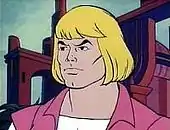
In the animated series He-Man's origins had been revised: his true identity was Prince Adam of Eternia, son of King Randor and Queen Marlena (an earthling), who ruled the Kingdom of Eternia on the planet of the same name.[20] The Sorceress of Castle Grayskull endowed Prince Adam with the power to transform into He-Man, which Adam did by raising his Power Sword and proclaiming, "By the power of Grayskull..." Once the transformation was complete, he would continue, "...I have the power!".[21] The differences between Prince Adam and He-Man were minimal; He-Man had a slightly deeper voice, a different wardrobe, and slightly darker skin and hair.
Prince Adam's pet was a cowardly green tiger named Cringer. When Adam became He-Man, he transformed Cringer into a brave armored green tiger named Battle Cat by pointing his sword at him – an ability Adam discovered accidentally during one of his transformations into He-Man. Cringer, naturally, cowered in fear at seeing what Adam had become; while reassuring him that nothing had really changed, Adam pointed the sword of power at Cringer, which sent a bolt of energy toward the tiger and transformed him. Battle Cat served as He-Man's steed and fierce fighting companion ever since.[22]
Adam was friendly with Teela who, unbeknownst to her, was the daughter of the Sorceress and was adopted by Prince Adam's mentor; Duncan / Man-At-Arms. Adam and Teela grew up together and now, as Captain of the Guard, she was entrusted to protect him. Unaware of his identity as He-Man, she saw Adam as lazy and cowardly, an act he keeps up to prevent people from discovering his secret identity.[23]
Man-At-Arms was He-Man's closest companion and the Eternian royal family's innovator of technology and weapons. He often unveiled new weapons or devices to help He-Man. Castle Grayskull was the source of He-Man's powers, where the Sorceress lived, who granted Adam his transformative abilities and communicated telepathically with him. To protect his family He-Man kept his double identity a secret, sharing it only with Orko, Man-At-Arms, Cringer and the Sorceress. He-Man's archenemy was Skeletor, a blue-skinned sorcerer with a yellow skull for a head.[21] He was skilled in black magic and all forms of combat, being extremely cunning and intelligent. Skeletor was accompanied by a group of henchmen who aided his evil schemes.
The spin-off series She-Ra: Princess of Power revealed that Adam had a twin sister: Princess Adora, a leader of the Great Rebellion against Hordak on the planet Etheria. Adora, like Adam, was given the gift of the power of Grayskull and had her own sword which she used to transform into She-Ra, Princess of Power.[24] He-Man made a number of appearances in the series.[25][26]
He-Man & She-Ra: A Christmas Special (1985)
At the height of the conjoined popularity of the He-Man and She-Ra cartoons, Filmation produced a television Christmas movie, aired it in syndication during the 1985 Christmas Holiday season. The Christmas special reunited twins He-Man and She-Ra in their biggest joint adventure since the Secret of The Sword. It commences with Queen Marlena reflecting nostalgically about Christmases on Earth and, after a series of misadventures set in motion by Orko, climaxes with a confrontation that pits He-Man, She-Ra and Skeletor—whose personality briefly softened by a pair of Earthling children, a pup, and "Christmas Spirit"—against Hordak and Horde-Prime.
The New Adventures of He-Man (1990)
After the end of the Masters of the Universe toy line, Mattel attempted to revive interest in He-Man by producing a new toy line, entitled He-Man.[27] The storyline in the minicomics packaged with the figures explained that He-Man had left Eternia and pursued Skeletor into the depths of space, who had set his sights on conquering the distant world of Primus; a planet with great technological resources. He-Man was shown to have relinquished the identity of Prince Adam altogether, basing himself on Primus where he led a team of defenders known as the Galactic Guardians. He-Man's appearance was retooled for the new toy line, with a space helmet and golden armor added to his attire to give him a more futuristic appearance; his sword was also redesigned.
A cartoon series was produced by Jetlag Productions to accompany the toy line, entitled The New Adventures of He-Man. Although generally following the story line from the minicomics, this series maintained the double identity of Prince Adam and He-Man. On the planet Primus, Prince Adam posed as a traveling merchant and the nephew of Master Sebrian to disguise his secret identity. His transformation oath was altered slightly, to become "By the power of Eternia...".[28][29]
He-Man and the Masters of the Universe (2002)
To tie in with a new line of action figures based upon the original toyline, a new He-Man cartoon series was produced in 2002-03 by Mike Young Productions, titled He-Man and the Masters of the Universe and given the marketing subtitle "vs. the Snake Men" in its second season.[30][31] This series retold the Masters of the Universe story from the beginning. He-Man's origin was told in a 90-minute series premiere, in which the 16-year-old Prince Adam was summoned to Castle Grayskull by the Sorceress to assume the identity of He-Man and his role as Eternia's defender.[32] The portrayal of his character in this series was consistent with Filmation's portrayal, although the character of Prince Adam was brasher and more youthfully energetic than his 1980s counterpart (conveying the image of a teenage boy saddled with the responsibility of defending a planet from evil).[33] The Adam/He-Man character was redesigned, to make the character's secret identity more credible.[34] The second-season episode "The Power of Grayskull" revealed Adam/He-Man to be a descendant of King Grayskull (a powerful barbarian and a hero from Eternia's ancient past), who sacrificed his life in order to save Eternia from the Evil Horde and originally wielded the Sword of Power. He was the original owner of Castle Grayskull; his sword was concealed in the castle for centuries before being given to Prince Adam, who inherited his ancestor's own power channeled through the sword (thus giving added meaning to the phrase "By the power of Grayskull...").
Masters of the Universe: Revelation (2021)
Masters of the Universe (CGI reboot, 2021)
In December 2019, it was announced that in addition to their other series, Netflix would also be developing a new Masters of the Universe series using CGI animation. With Rob David developing the series, producing it alongside Adam Bonnett, Christopher Keenan, Jeff Matsuda and Susan Corbin. Bryan Q. Miller serves as story editor on the series. Animation services are being provided by House of Cool and CGCG Inc.[35]
He-Man and She-Ra:The Secret of the Sword (1985 animated film)
In 1985, Filmation, released the full-length feature film He-Man and She-Ra: The Secret of the Sword. The movie introduced Adam's twin sister Adora, who was abducted as an infant by Hordak and Skeletor. Hordak absconded with Adora to the planet Etheria, where he raised Adora to be a warrior and captain for his Evil Horde, and hid her true heritage from her. The film reveals that He-Man's power sword has a twin, the Sword of Protection, which, when wielded by Adora to summon the power of Grayskull, transforms her into She-Ra; He-Man's female counterpart.
Masters of the Universe (1987 film)
In 1987, Cannon Films produced a live-action film directed by Gary Goddard, Masters of the Universe, which featured Dolph Lundgren in the role of He-Man; it was a commercial failure.[21] In this film, the Prince Adam does not exist, with only He-Man appearing. He is more aggressive than his cartoon counterpart, attacking with lasers, his sword and bare fists several times throughout the film. The film ended with a spectacular and violent clash with Skeletor, in which Skeletor was flung deep beneath Castle Grayskull into a pit filled with steaming liquid.
Reboot film
On April 29, 2019, actor Noah Centineo confirmed in an appearance on The Tonight Show Starring Jimmy Fallon that he would be playing He-Man in the Masters of the Universe film, which was due to begin production in July 2019 and set for a 2020 release.[12] However, due to the ongoing COVID-19 pandemic he pulled out of casting two years later. The production's date and crew will be unknown until further notice.[36]
Masters of the Universe Classics (2008)
This action-figure line combined elements from the He-Man universe into a cohesive storyline with biographies on the figures' packaging.[37] These biographies suggested that several "He-Men" have come into existence – such as Vikor (based on an early concept design for the vintage He-Man), Oo-Larr (based on the jungle He-Man from the first minicomic.[38] His figure still had the blonde hair but featured a more textured fur loincloth, no boots and came with a primitive stone spear), and Wun-Dar (based on the so-called "Wonder Bread" He-Man figure. This figure had brown hair, brown loincloth and wears a black version of Zodac's armor. He came packaged with a black and silver power sword and black pistol) – but Prince Adam was the only one who actually wielded the Power Sword and transformed into the true He-Man.
Feminist / gender analysis
According to a book by Michael G. Cornelius, He-Man is considered a narrow definition of masculinity. Cornelius cited He-Man as the literal "strongest man in the universe" and says that his chief adversary Skeletor's primary weapon is his intellect; mirroring a Superman/Lex Luthor dichotomy.[39]
Queer analysis
Background and homosexual reading
According to Syfy writer Jordan Zakarin, the original cartoon was "the gayest show that has ever been on TV",[40] despite airing during the Reagan era, in which, as Jake Pitre notes, producers attempted to "defuse any possible queer readings" of their cartoons.[41] Anthony Gramuglia of Comic Book Resources (CBR) points out that because censors often prevented the outright representation of LGBT characters, creators often had to rely on queer coding, giving characters camp qualities to indicate their LGBT status.[42] Discussing how cartoons are "unusually amenable to subtexts that hint at or even celebrate same-sex desire",[43] author and professor Jeffery P. Dennis argues that cartoons "often produce a tacit validation of same-sex romantic or domestic relationships, even when the animators have no such interest".[43] Regarding this, Dennis notes how even when cartoons lack a same-sex pairing, it is still possible to see a queer sexual identity being applied to a character; something which occurred with He-Man, as he "was muscular and never dated girls".[44] Professor and author Jes Battis also asserts that the series "dealt in themes of queerness and secrecy".[45] This is reiterated by Medium writer John DeVore who—describing He-Man as his personal icon and a male role model growing up—acknowledged the original series as being "full of queer energy."[46]
Queer-coded nature and gay subtext
Appearance and character
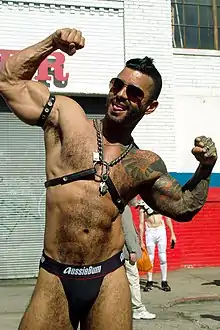
David Chlopecki argues that He-Man and Skeletor's bodies were "indicative of the AIDS epidemic that ravaged the LGBTQ community" at the time of the show's production, with Skeletor's face resembling the facial wasting of gay men succumbing to AIDS,[40] and that given the time period, the show's gay subtext was either unintentional, or the result of queer coding.[40] Furthermore, Chlopecki argues that Prince Adam's appearance conforms to gay stereotypes, such as his pink spandex,[40] while NewNowNext also singles out his pageboy haircut.[48] NPR also found the character's appearance as adding to the show's gay subtext, given He-Man's outfit resembeling those of leather subculture,[47] and including a bondage harness,[40] which was considered in the 80s to be homoerotic imagery.[42] Attention has also been paid to Adam's transformation into He-Man through his "fabulous powers"[49] and phallic sword.[42] Moreover, Adam's transformation into He-Man in Masters of the Universe: Revelation (2021–present) has been compared to those of magical girls like Sailor Moon.[50] The transformation includes a rainbow color scheme, which Matt McGloin of Cosmic Book News argues alludes to the rainbow flag used by the LGBT community and is connected to LGBT movements.[51]
Attention has also been afforded to the character's double life,[52] with Battis arguing that Adam having to "hide his true identity as [He-Man]" was one of the key queer aspects of the show.[45] Highsnobiety's Sophia Atkinson noting how his double life as Prince Adam and He-Man reflects the "difficulties of living as a gay man", further noting how across various media in the franchise He-Man never shows romantic interest in any woman.[53] British newspaper The Daily Telegraph also acknowledges how the character's dual identity is representative of a man's struggle in coming to terms with his sexuality; Prince Adam being closeted and having a secret, while He-Man is "out-and-proud".[54] Writing for The Johns Hopkins News-Letter, Matt Johnson described the series' depiction of He-Man as a "thinly veiled treatise on the state of gay male sexuality in the eighties".[55] Johnson views He-Man as a sexually repressed and closeted gay man, whose transformation from Adam into He-Man represents his pent-up frustrations reaching their peak and needing to being released.[55]
With other men
Entertainment Weekly's Adam B. Vary refers to the original cartoon as containing gay subtext, arguing that the live-action movie Masters of the Universe turned it into explicit text.[56] Writing for BuzzFeed, Vary argues that the gay subtext present in the live-action movie is a "tragic unrequited romance between He-Man and Skeletor",[57] singling out Skeletor's "warped obsession" with He-Man and how, despite being surrounded by attractive women, He-Man never shows an interest in them;[57] this echoes Atkinson's[53] and Dennis' statement.[44] The character's relationship with Man-at-Arms has also been acknowledged for being homoerotic.[58]
Gay icon, fandom, and sex appeal
He-Man's homoeroticism and implied homosexuality resulted in the character and show drawing a queer audience when the cartoon first aired,[42] with the character being now viewed as a gay icon.[59][52] Men's Health revealed that one of the core three groups that made up the consumers of He-Man toys were gay men.[59] Noelle Stevenson, the creator, showrunner, and executive producer of She-Ra and the Princesses of Power (2018–20) has also stated that He-Man—alongside She-Ra—is a gay icon,[60] and the character's LGBT fanbase has been credited as helping pave the way for the for the reboot to feature openly queer characters.[42]
When development on a live-action remake of the film was first-announced, LGBT lifestyle magazine Out also described the original series as "one of the gayest [...] cartoons of all time", and that the 1987 film "turn[ed] an entire generation of boys at least a little gay".[61] Similarly, Instinct magazine's Gerald Biggerstaff described the original cartoon as being quite popular with gay men that grew up in the 1980s and 90s and that for many of them He-Man "prompted [their] gay awakenings".[62] In 2003 HX Magazine editors compiled a list of must-see television series with attractive male leads,[63] with He-Man—as himself and based on his appearance in the 2002 reboot—the only animated character to make the list, being described as the "object of all our childhood wet dreams".[63] British Gay Times magazine compiled a list of cartoon characters their editors were attracted to growing up, with He-Man making the top of the list, taking note of Dolph Lundgren's depiction of him in the live-action film.[64] In the same publication, actor Andrew Hayden-Smith revealed in 2016 that he realized he was gay while playing with his He-Man figure as a child, being attracted to the character's physique; particularly his pecs.[65]
Queer reading in other media
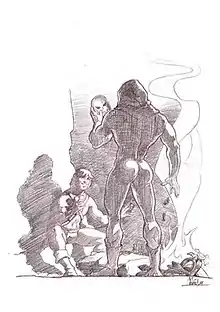
In 2004, He-Man appeared in the second season of ILL-ustrated, an adult animated sketch comedy series airing on VH1.[68] In the sketch, He-Man is visited by the cast of Queer Eye for the Straight Guy, who attempt to give him a makeover but come to the conclusion that he is "already pretty gay" without their assistance.[68] In Dan Fishback's Thirtynothing (2011) play focusing on gay artists that have died and the AIDS crisis,[69] Fishback discusses watching the cartoon in his childhood and the show's opening credits is featured. The credits are followed by footage of a 1989 ACT UP protest at the Food and Drug Administration (FDA) headquarters, where activists demanded an "accelerated approval process for HIV treatments".[70] Jayson A. Morrison discusses how in doing so, Fishback connected Prince Adam's transformation into the powerful He-Man—occurring by holding up a sword and reciting a phrase—to LGBT individuals "who [gain] extraordinary powers as activists".[70]
In April 2011, David Mason, Brian Moylan, and fashion writer and artist Bradford Shellhammer held the "Skeletor Saves" charity art-auction event,[66] with the proceeds going to the Ali Forney Center; an LGBT community centre helping homeless LGBT youth.[71] The event was inspired by Mason's love for the franchise growing up—with Skeletor being one of his personal heroes—and even attracted the attention of fashion designers Helmut Lang and Marc Jacobs.[71] Writing for Canadian LGBT-focused Xtra Magazine, Helen Whithead stated that the art show allowed for artists to "explore the sexy, camp side of the homoerotic He-Man muscle fest".[72] Many of the works submitted to the event included portrayals of He-Man in LGBT and NSFW situations, including depictions of Skeletor seducing him[71] or featuring the two characters having sex.[66]
The gay reading of He-Man's character and his relationship with Skeletor was utilized by British company Moneysupermarket.com in 2017, with one of their advertisements—which featured the two men embracing and dancing—being described by Bleeding Cool as "on the homoerotic side".[67] Following the release of Brokeback Mountain in 2005, which focuses on the emotional and sexual relationship between two cowboys, multiple parodies of the film's trailer were created and uploaded on YouTube.[58] Jennifer Malkowski indicates how these fake trailers tended to "amplif[y] queer subtext" found within works, with one such video titled "Brokeback Snake Mountain" focusing on the romance between He-Man and Man-at-Arms.[58]
Response from Mattel and insiders
According to He-Man and the Masters of the Universe voice actress Erika Scheimer—who is openly lesbian, and the daughter of Filmation co-founder Lou Scheimer—the company was welcoming of gay artists, with many members of the studio "long[ing] to see themselves onscreen" and joking that He-Man is gay.[59] According to Mark Morse, Mattel's director of global marketing from 2008 to 2017, the question of He-Man's sexuality and whether a future installment in the franchise should have him be openly gay has not been discussed at the company by the release of the Laughing Prince Adam action figure in 2018.[59] However, Morse did state that Mattel wanted to ensure the figure would not be viewed as offensive to the LGBT community.[59]
In an interview with gay lifestyle online magazine Queerty, Rob David and Tim Sheridan, who work on the Masters of the Universe: Revelation, discussed the character's homoeroticism and gay fanbase.[73] Sheridan, who is one of the show's writers and a gay man himself, believes that He-Man managed to foster a gay fanbase, despite not being openly gay, because of the original show's themes.[73] He also clarified that He-Man is coded in such a way in Revelation that his character can be interpreted in various ways, which Sheridan believes can bring people together.[73] According to David, who is an executive producer of Revelation and Mattel's Vice President of Creative Content, Mattel is "very comfortable" with He-Man's gay fanbase and his perception as a gay man.[73]
References
- "He-man really a marshmallow superhero". The Milwaukee Journal. April 26, 1985. Retrieved October 15, 2020.
- Levisohn, Benjamin (September 25, 2005). "Mastering the Universe: He-Man and the Rise and Fall of a Billion-Dollar Idea by Roger Sweet and David Wecker". Pop Matters. Retrieved October 15, 2020.
- "The Birth of He-Man". The Sneeze (blog). April 18, 2006. Retrieved October 15, 2020.
- Sweet, Roger; David, Wecker Mastering the Universe : He-Man and the Rise and Fall of a Billion-Dollar Idea, Emmis Books July 11, 2005, ISBN 1-57860-223-8
- Smallwood, Karl (August 4, 2016). "He-Man Was Almost a Spaceman". FactFiend. Retrieved October 27, 2021.
- "Conan The He-Man - The REH Forum". Archived from the original on 2011-09-28. Retrieved May 5, 2011.
- Archived at Ghostarchive and the Wayback Machine: Toy Designer Mark Taylor On The Creation of He-Man. RealistikkVideos. 30 September 2015. Retrieved October 15, 2020 – via YouTube.
- Interview with Roger Sweet (September 2005), ToyFare, via "Conan" at An International Catalogue of Superheroes
- Murphy, Charles (May 1, 2018). "EXCLUSIVE: He-Man: Masters of the Universe Character Breakdowns Revealed". That Hastag Show. Retrieved October 15, 2020.
- Russ Burlingame (November 12, 2015). "Mike O'Hearn Has Not Been Cast As He-Man, But Wants The Role". Comicbook.com. Retrieved October 15, 2020.
- mikeohearn (November 9, 2015). "My Goal: Take off 30 pounds of lean muscle and get a whole new physique so I'll be ready to get the movie #HeMan!!". Instagram. Retrieved October 15, 2020.
- Seemayer, Zach (April 29, 2019). "Noah Centineo Confirms He's Playing He-Man in 'Masters of the Universe': 'I Am Very Excited'". Entertainment Tonight.
- "Eternal Darkness"
- Kit, Borys (April 12, 2010). "Scribes take on "Masters of the Universe"". Reuters. Retrieved October 15, 2020.
- Glut, Donald F. (September 5, 2020). "He-man and the Power Sword". Mattel. Retrieved October 15, 2020.
- Manning, Shaun (July 28, 2011). "CCI EXCLUSIVE: Seeley Scripts New Adventures of He-Man". Comic Book Resources. Retrieved October 15, 2020.
- Zalbenal (April 6, 2012). "EXCLUSIVE! DC Comics Launches Brand New 'He-Man and the Masters of The Universe' Comic From Writer James Robinson". MTV.com. Retrieved January 4, 2017.
- "Philip Tan Calls on Power of Grayskull for New HE-MAN Design". Newsarama. May 17, 2012.
- Zawisza, Doug (July 5, 2012). "He-Man and the Masters of the Universe #1". Comic Book Resources. Retrieved 2012-07-19.
- "Video: A He Man for All Seasons". Time. January 7, 1985. Archived from the original on May 19, 2008.
- "Panda director 'for He-Man movie". BBC News. January 30, 2009. Retrieved October 15, 2020.
- "He-Man and the Masters of the Universe - Season One, Volume One". IGN. October 19, 2005. Retrieved October 15, 2020.
- Hart, Hugh (August 11, 2002). "Who da man? 'He-Man'". San Francisco Chronicle. Archived from the original on April 24, 2010. Retrieved March 7, 2010.
- Villarreal, Phil (August 4, 2006). "Phil Villarreal's Review: Still a surefire hit with 6-year-olds". Arizona Daily Star. Retrieved October 15, 2020.
- Hendrickson, Dale (November 7, 2006). "Remembering She-Ra and He-Man: Interview with Lou Scheimer". Animation World Network. Retrieved October 15, 2020.
- "The Best of She-Ra: Princess of Power Review". IGN. August 4, 2006. Retrieved October 15, 2020.
- "Masters Cast - Episode 25". Masters Cast. Retrieved October 15, 2020.
- "DVD Review: The New Adventures of He-Man - Volume 1". The Trades. Archived from the original on October 25, 2007. Retrieved October 15, 2009.
- Douglass, Todd (December 26, 2006). "DVD Review: The New Adventures of He-Man - Volume 1". DVD Talk. Retrieved October 15, 2020.
- Owen, Rob (August 16, 2002). "On the Tube: Cartoon Network brings He-Man, the Masters back for 20th anniversary". Pittsburgh Post-Gazette. Retrieved October 15, 2020.
- Shaffer, R.L. (October 15, 2009). "He-Man and the Masters of the Universe: The Complete Series (2002) DVD Review". IGN. Retrieved October 15, 2020.
- Mowatt, Raoul V (August 16, 2002). "Improved 'He-Man' series heads to Cartoon Network". Chicago Tribune. Retrieved October 15, 2020.
- Siwek, Daniel (February 19, 2008). "He-Man and the Masters of the Universe: Season One, Volume One". DVD Talk. Retrieved October 15, 2020.
- "Masters of the Universe 2002": The Power Returns, In Style". Toon Zone. Retrieved October 15, 2020.
- Boucher, Geoff (December 16, 2019). "'He-Man & The Masters Of The Universe': Netflix And Mattel Return To Greyskull For CG Series". Deadline.
- Verhoeven, Beatrice (April 29, 2021). "Noah Centineo No Longer Playing He-Man in 'Masters of the Universe'". TheWrap. Retrieved November 10, 2021.
- "There's No Disguising That MOTUC Preternia Disguise He-Man Is A Great Action Figure!". MTV. February 24, 2011. Archived from the original on February 27, 2011. Retrieved February 28, 2011.
- "Masters of the Universe: Revelation Part 2 Review – Until Next Time!". SuperHeroHype. 2021-11-23. Retrieved 2021-12-03.
- Michael G. Cornelius (August 19, 2011). Of Muscles and Men: Essays on the Sword and Sandal Film. ISBN 9780786489022.
- Zakarin, Jordan (January 29, 2018). "Why one expert says He-Man is the 'gayest show ever'". Syfy Wire. Syfy. Archived from the original on March 3, 2021. Retrieved July 25, 2021.
- Richards & Ziegler 2020, pp. 23.
- Gramuglia, Anthony (May 18, 2020). "Fabulous Secret Powers: Masters of the Universe's LGBTQ Fandom". Comic Book Resources. Valnet Inc. Archived from the original on March 18, 2021. Retrieved July 27, 2021.
- Sears 2005, pp. 135.
- Sears 2005, pp. 136.
- Battis 2021, pp. 63.
- DeVore, John (August 9, 2020). "He-Man Is My Gender Icon". Medium. A Medium Corporation. Archived from the original on October 28, 2021. Retrieved October 30, 2021.
- "Show, Don't Mattel: 'Masters Of The Universe: Revelation' Is Toying With You". NPR. July 24, 2021. Archived from the original on October 2, 2021. Retrieved October 2, 2021.
- Brathwaite, Lester Fabian (May 16, 2019). "18 Childhood Cartoon Characters Who Were Totally Queer". NewNowNext. Logo TV. Archived from the original on July 16, 2019. Retrieved July 27, 2021.
- Rodriquez, Matthew (May 20, 2019). "25 Cartoon Characters Who Should Just Come Out Already". Out. Pride Media. Archived from the original on June 12, 2021. Retrieved October 2, 2021.
- Valdez, Nick (July 27, 2021). "Masters of the Universe Celebrates He-Man's Magical Girl Makeover". ComicBook.com. ViacomCBS. Archived from the original on October 3, 2021. Retrieved October 25, 2021.
- McGloin, Matt (June 10, 2021). "Kevin Smith He-Man 'Very LGBT'; Lots of Dialogue, No Action". Cosmic Book News. Archived from the original on June 23, 2021. Retrieved October 25, 2021.
- Collins, Hannah (October 10, 2017). "Queer Heroes: 15 Superheroes Who Are Gay Icons". Comic Book Resources. Valnet Inc. Archived from the original on January 25, 2021. Retrieved July 27, 2021.
- Atkinson, Sophia (November 10, 2015). "The Complete History of Queer Characters in Cartoon Shows". Highsnobiety. Archived from the original on March 28, 2020. Retrieved July 26, 2021.
- "The long and speculative history of gay characters on children's TV shows - He-Man". The Daily Telegraph. January 28, 2016. Archived from the original on May 9, 2016. Retrieved July 27, 2021.
- Johnson, Matt (October 4, 2001). "How man is He-Man?". The Johns Hopkins News-Letter. Archived from the original on July 29, 2021. Retrieved September 29, 2021.
- Vary, Adam B. (June 21, 2011). "Who is the coolest 'He-Man' character?". Entertainment Weekly. Meredith Corporation. Archived from the original on February 11, 2021. Retrieved July 26, 2021.
- Vary, Adam B. (October 22, 2013). ""Masters Of The Universe" Is Actually A Tragic Gay Love Story Between He-Man And Skeletor". BuzzFeed. Archived from the original on November 11, 2020. Retrieved July 27, 2021.
- Elledge 2010, pp. 140.
- Huls, Alexander (September 21, 2020). "Why He-Man Is a Gay Icon". Men's Health. Hearst Communications. Archived from the original on May 15, 2021. Retrieved July 25, 2021.
- Archived at Ghostarchive and the Wayback Machine: Comic-Con International (July 26, 2020). Out In Comics 33: Virtually Yours - Comic-Con@Home 2020. Retrieved July 27, 2021 – via YouTube.
- Brathwaite, Les Fabian (June 28, 2016). "Kellan Lutz in Talks to Play He-Man in Masters of the Universe Reboot". Out. Pride Media. Archived from the original on January 18, 2021. Retrieved July 27, 2021.
- Biggerstaff, Gerald (May 14, 2021). "Netflix Sets Date For Sequel Series of Eighties Cartoon, 'He-Man'". Instinct. Juki Media. Archived from the original on September 15, 2021. Retrieved October 3, 2021.
- "Homo Must See TV". HX Magazine (599): 24–25. February 28, 2003. ISSN 1524-0339. Retrieved October 17, 2021.
- "Cartoons We've Fancied". Gay Times. No. 382. Millivres Prowler Group Ltd. 2010. pp. 52–54. ISSN 0950-6101. Retrieved October 17, 2021.
- Hayden-Smith, Andrew (November 2016). Scott, Darren (ed.). "My Gay Life". Gay Times. Millivres Prowler Limited. pp. 158–159. ISSN 0950-6101. Retrieved October 17, 2021.
- Lamar, Cyriaque (March 30, 2011). "Check out Skeletor Saves, a He-Man-themed art show for a good cause (NSFW)". Gizmodo. G/O Media. Archived from the original on July 25, 2021. Retrieved October 15, 2021.
- Glass, Joe (September 5, 2017). "Skeletor And He-Man Are Back With MoneySuperMarket And It Is Epic(ally Gay)!". Bleeding Cool. Avatar Press. Archived from the original on January 26, 2021. Retrieved July 27, 2021.
- Mochizuki, Alison; Herron, Toni (May 17, 2003). "He-Man Gets a Make-Over and Gollum Has His Own Talk Show on VH1's Animated Series 'ILL-ustrated' Returning for Its Second Season on Monday, May 17th at 11:30 PM ET/PT*". PR Newswire. Archived from the original on October 23, 2021. Retrieved October 23, 2021.
- Campbell & Gindt 2018, pp. 183.
- Campbell & Gindt 2018, pp. 184.
- Mathias, Christopher (April 5, 2011). "He-Man Inspired 'Skeletor Saves!' Event To Raise Money For The Ali Forney Center (PHOTOS)". HuffPost. BuzzFeed. Archived from the original on October 3, 2021. Retrieved October 15, 2021.
- Whitehead, Helen (April 21, 2011). "By the Power of Gayskull". Xtra Magazine. No. 691. Pink Triangle Press. p. 8. ISSN 0829-3384. Retrieved October 17, 2021.
- Reddish, David (July 23, 2021). "'He-Man' writers on character's enduring homoeroticism in 'Masters of the Universe: Revelation'". Queerty. Q.Digital. Archived from the original on July 25, 2021. Retrieved July 27, 2021.
Bibliography
- Battis, Jes (2021). Thinking Queerly. Medieval Institute Publications. ISBN 9781501515330.
- Campbell, Alyson; Gindt, Dirk, eds. (2018). Viral Dramaturgies: HIV and AIDS in Performance in the Twenty-First Century. Palgrave Macmillan. ISBN 9783319703176.
- Elledge, Jim, ed. (2010). Queers in American Popular Culture. 1. ABC-Clio. ISBN 9780313354571.
- Richards, Leah; Ziegler, John R., eds. (2020). Representation in Steven Universe. Springer Nature. ISBN 9783030318819.
- Sears, James Thomas, ed. (2005). Youth, Education, and Sexualities — Volume One: A–J. Greenwood Publishing Group. ISBN 9780313327544.
External links
 |
Wikimedia Commons has media related to He-Man. |
- He-Man at IMDb (1983–1985 series)
- He-Man at IMDb (1987 live action film)
- He-Man at IMDb (1990–1991 series)
- He-Man at IMDb (2002 series)
| He-Man series | |
|---|---|
| She-Ra series | |
| Films | |
| Characters |
|
| Video games | |
| Miscellaneous | |
| |
