Time in Finland
Time in Finland, including the Åland Islands, is denoted by Eastern European Time (EET) during the winter as standard time,[1] which is two hours ahead of coordinated universal time (UTC+02:00), and Eastern European Summer Time (EEST) during the summer as daylight saving time, which is three hours ahead of coordinated universal time (UTC+03:00).[2] Finland adopted EET on 30 April 1921, and has observed daylight saving time since 1981. Since 1983 – in-line the EU directive – daylight saving time has been observed by advancing the clock forward one hour at 03:00 EET on the last Sunday in March and back at 04:00 EET on the last Sunday in October.[3][4] Public opinion in Finland has been keen to end the practice of daylight saving time, with a 2018 survey conducted by the Ministry of Justice revealing a small majority in favour of observing permanent winter time. A year earlier, the Finnish parliament voted in favour of proposals calling on the European Union to reconsider daylight saving time.[5][6]
| Time in Finland | |
|---|---|
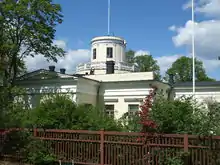 The Helsinki University Observatory, on which Finland's local mean time was based | |
| Time zone | Eastern European Time |
| Initials | EET |
| UTC offset | UTC+02:00 |
| Central meridian | 30th meridian east[1] |
| Time notation | 24-hour clock |
| Adopted | 30 April 1921 |
| Daylight saving time | |
| Name | Eastern European Summer Time |
| Initials | EEST |
| UTC offset | UTC+03:00 |
| Start | 03:00 EET on the last Sunday in March |
| End | 04:00 EET on the last Sunday in October |
| tz database | |
| Europe/Helsinki | |
History
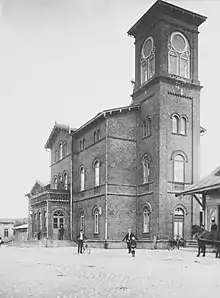
Before the 19th century, there was no need for a standard time zone across the country. This changed with the advent of the railway, which would follow precise timetables – sailing ships and stage-coaches could not – and with the telegraph, which allowed near real-time communication.[7][8]
The first railway line in Finland – Hämeenlinna railway station – was inaugurated in 1862, and got timetables noted in a common mean time, measured at the Helsinki University Observatory from the mean time of UTC+01:39:49.2, known as "Helsinki time".[7][9] A ball was released at noon and its falling was noted optically at the railway station and the clock adjusted accordingly. If there was fog impairing the ball from being seen from that far away, noon would additionally be announced by a shot from a cannon. The correct time was then relayed to the other stations via telegraph. On the Riihimäki–Saint Petersburg railway – which was inaugurated in 1870 – Helsinki time was used until Kaipiainen, just east of Kouvola.[10]
An international agreement on time zones was reached in Washington in October 1884, but was not immediately implemented in Finland. In 1888, the Diet (legislative assembly) asked the Emperor Alexander III of Russia (as Finland was at this time an autonomous part of the Russian Empire) for Helsinki time to be established as standard throughout all of Finland, however he thought it was enough that the railways had their standard time.[11] A second motion for a standard time was proposed in the Diet in 1897, but again without success.[12] Nevertheless, the standard railway time spread to common usage throughout the country.[13] Finland became independent in 1917 and was free to choose its timezone. By decision of the government on 30 April 1921 at midnight of the Walpurgis Night, the official time was advanced 20 minutes and 10.9 seconds to Eastern European Time (UTC+02:00), to become the standard time zone for the country.[13]
Introduction of daylight saving time
Daylight saving time (DST) was first attempted on 2 April 1942, by moving forward one hour at 00:00 and back again on 4 October at 01:00, but this was found less useful, and DST was not used in the following decades.[14] In 1980, the other Nordic countries introduced DST, as did the Soviet Union in 1981. In order to avoid the disturbance of changing time differences with the rest of Europe, DST was introduced again in Finland in 1981[15] and has been observed since, from the last Sunday in March to the last Sunday in October.[16] The time is moved forward by one hour at 03:00 EET on the last Sunday in March and back at 04:00 EET on the last Sunday in October, in-line with the EU directive. However, for 1981 and 1982, the adjustment was made one hour earlier than this.[14]
Daylight saving time
In-line with the EU directive, Finland observes daylight saving time yearly by advancing the clock forward one hour from Eastern European Time (EET; UTC+02:00) to Eastern European Summer Time (EEST; UTC+03:00) at 03:00 EET on the last Sunday in March and back at 04:00 EET on the last Sunday in October.[3][4] Finland has observed daylight saving time since 1981,[15] and followed the EU directive since 1983, with the adjustment made one hour earlier for the first two years.[14] As Finland is located far north, there is little change in daylight hours and ultimately little need for the observance of daylight saving time. It is only observed in order to make travelling and communication between the Nordics and Russia easier.[17]
Future
In 2017, the Finnish parliament voted in favour of proposals calling on the European Union to reconsider daylight saving time, and a citizen's petition that same year asking the state to give up the practice received 70,000 signatories.[18] At the time, the European Commission was reviewing the practice.[19] On 8 February 2018, the European Parliament voted to ask the European Commission to re-evaluate daylight saving time in Europe, and on 12 September 2018 the European Commission decided to propose an end to daylight saving time, which would thus repeal Directive 2000/84/EC.[20] Though in order for this to be valid, the standard European Union legislative procedure must be followed, including that the Council of the European Union and the European Parliament must both approve the proposal.[20][21]
On 4 March 2019, the European Parliament Transport and Tourism Committee approved the Commission's proposal, with a start date planned to be postponed until 2021 at the earliest in order to ensure a smooth transition.[22] This decision was later confirmed by the European Parliament on 26 March,[23][24] however as of November 2021 the approval from the Council of the European Union has yet to be obtained, and the EU has also been preoccupied with the COVID-19 pandemic.[5] Despite this decision from the EU, the public opinion in Finland has remained keen to end the practice.[5] It is not yet known whether or not Finland will decide to remain on permanent winter time (UTC+02:00) or summer time (UTC+03:00). According to Yle, the government is likely to collect the opinions of experts in the field as well as those of the public before making a decision.[5] A 2018 survey conducted by the Ministry of Justice which received over 120,000 responses within 24 hours[6] revealed a small majority were in favour of observing permanent winter time.[5]
Geography and solar time
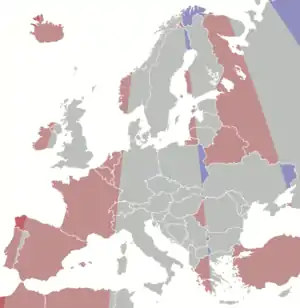
Most of Finland lies within the geographical UTC+02:00 offset, but there are some exceptions to this: the southwestern coast of Finland, including the city of Turku, the northwestern most part of Finland, including Kilpisjärvi and Kaaresuvanto, and the Åland islands are all located outside of 22°30' East, and thus lie within the geographical offset of UTC+01:00.[25][26] Daylight hours differentiate significantly in northernmost Finland. In winter, the localities of northernmost Finland have a polar night lasting 51 days, and in summer a polar day lasting 73 days,[27] giving no local utility to daylight saving time,[17] which is only observed to make travelling and communication between the Nordics and Russia easier.[17] The difference of longitude between the western (19°07′54″E) and easternmost points (31°35′12″E) of Finland results in a difference of approximately 48 minutes of solar time. At Muotkavaara – a tripoint border between Finland, Norway and Russia – three time zones meet during Finland's winter time; Central European Time (UTC+01:00) in Norway, Eastern European Time (UTC+02:00) in Finland, and Moscow Time (UTC+03:00) in Nikel, Russia.[28]
Maintenance
The VTT Technical Research Centre of Finland and Centre for Metrology and Accreditation are responsible for implementing leap seconds to Finland's time zone, following the International Bureau of Weights and Measures.[29] VTT also maintains a radio transmitter in Espoo that transmits a high-precision time signal produced by an atomic clock and hydrogen monitors that maintain Finland's official time zone at a frequency of 25 megahertz; this is so that the official timekeeping devices in Finland do not fall behind.[30]
Notation
Finland uses the 24-hour clock notation, but the 12-hour clock is also used in some contexts. In writing, a period is used as the standardised and recommended separator between the hour and the minute (e.g. "15.07" or "8.27"). The use of semicolon is also common especially in relation to telecommunications and digital clocks. Hours can be marked with leading zeros especially for the early hours of the night where necessary for clarity (e.g. "21-04", but also "9.00").[31]
IANA time zone database
In the IANA time zone database, Finland is given two zones in the file zone.tab – Europe/Helsinki and Europe/Mariehamn for the Åland Islands. "AX" and "FI" refer to the country's ISO 3166-1 alpha-2 country codes, the former being for Åland and the latter for the country in general. Data for Finland directly from zone.tab of the IANA time zone database; columns marked with * are the columns from zone.tab itself:[32]
| c.c.* | coordinates* | TZ* | Comments | UTC offset | DST |
|---|---|---|---|---|---|
| FI | +6010+02458 | Europe/Helsinki | +02:00 | +03:00 | |
| AX | +6006+01957 | Europe/Mariehamn | +02:00 | +03:00 |
Computers which do not support "Europe/Helsinki" or "Europe/Mariehamn" may use the older POSIX syntax: TZ="EET-2EEST,M3.5.0/3,M10.5.0/4".[33] However, on Microsoft Windows, Finland's time zone is known as FLE Standard Time (for Finland, Lithuania and Estonia) for Eastern European Time.[34]
References
- Gould 1935, p. 17.
- Heikki 2013, p. 104.
- "Finland". The World Factbook. Central Intelligence Agency (CIA). Retrieved 6 May 2021.
daylight saving time: +1hr, begins last Sunday in March; ends last Sunday in October
- "Directive 2000/84/EC on summer time arrangements". EUR-Lex. European Commission. Retrieved 30 November 2021.
- "Clocks go back as Covid crisis delays EU decision". Yle. 30 November 2021. Retrieved 1 December 2021.
- Teivainen, Aleksi (28 September 2018). "Over 120,000 Finns respond to time zone survey in little over 24 hours". Helsinki Times. Retrieved 1 December 2021.
- Heikki 1999, p. 81.
- Lehti & Markkanen 2010, p. 191–192.
- Milne, John (1899). "Civil Time". The Geographical Journal. 13 (2): 185. doi:10.2307/1774359. Retrieved 30 November 2021.
- Heikki 1999, p. 82–83.
- Heikki 1999, p. 83.
- Lehti & Markkanen 2010, p. 192.
- Heikki 1999, p. 87.
- Heikki 2013, p. 104–105.
- Yli-Ojanperä, Elina (15 March 2007). "Suomi siirtyi kesäaikaan" [Finland moved to summer time] (in Finnish). Yle. Retrieved 20 May 2021.
- Heikki 2007, p. 105.
- Heikki 2013, p. 105.
- Forsell, Tuomas (26 October 2017). "Finland wants EU to give up daylight saving time". Reuters. Retrieved 1 December 2021.
- H., A. M. (30 October 2017). "Why Finland wants the EU to abolish daylight saving time". The Economist. Retrieved 1 December 2021. (subscription required)
- "State of the Union 2018: Q&A on the Commission's proposal to put an end to seasonal clock changes". European Commission. European Union. Retrieved 1 December 2021.
- "Procedure File: 2018/0332(COD)". oeil.secure.europarl.europa.eu. European Union. Retrieved 1 December 2021.
- "Could switching between summer and winter time end in 2021?". European Parliament News Press Releases. 4 March 2019. Retrieved 1 December 2021.
- "EU Parliament votes to end seasonal clock changes". Yle. 26 March 2019. Retrieved 1 December 2021.
- "European MPs vote to end summer time clock changes". BBC News. 26 March 2019. Retrieved 1 December 2021.
- "World Time Zone Map, corrected to August 2017". HM Nautical Almanac Office. United Kingdom Hydrographic Office. Archived from the original on 18 April 2019. Retrieved 30 November 2021.
- "TIME ZONES and "Z" TIME (UNIVERSAL TIME)". Department of Atmospheric and Oceanic Sciences. U.S. Naval Observatory. Retrieved 30 November 2021.
- OECD (2005). OECD Territorial Reviews: Finland 2005. OECD Publishing. p. 20. Retrieved 30 November 2021.
- Brownstone, Andy (travel host) (23 March 2011). About Time: Where three time zones meet (Video). BBC News. Retrieved 30 November 2021.
- "1015/2014". Finlex (in Finnish). Finnish Government. Retrieved 30 November 2021.
- "Metrologia: VTT MIKES" (in Finnish). VTT Technical Research Centre of Finland. Retrieved 30 November 2021.
- "Ajanilmaukset: kellonajat (merkintä ja taivutus)" [Temporal expressions: (notation and inflection)] (in Finnish). Institute for the Languages of Finland. n.d. Retrieved 1 December 2021.
- Europe (2020 edition) at the tz database. Internet Assigned Numbers Authority (IANA). Retrieved 20 May 2021.
- Olson, Arthur David (22 April 2016). "[tz] Time zone selection". tz database. ICANN. Retrieved 1 December 2021.
- "TimeZone". Microsoft. 25 July 2008. Retrieved 1 December 2021.
Bibliography
- Heikki, Oja (1999). Aikakirja (PDF) (in Finnish) (2 ed.). Almanac Office of the University of Helsinki.
- Heikki, Oja (2007). Aikakirja 2007 (in Finnish). Almanac Office of the University of Helsinki. ISBN 952-10-3221-9. Retrieved 20 May 2021.
- Heikki, Oja (2013). Aikakirja 2013 (PDF) (in Finnish). Almanac Office of the University of Helsinki. Retrieved 20 May 2021.
- Lehti, Raimo; Markkanen, Tapio (2010). History of Astronomy in Finland 1828-1918. Societas Scientiarum Fennica. ISBN 9789516533790.
- Gould, Ralph Edgar (1935). Standard Time Throughout the World. United States National Bureau of Standards.
External links
 |
Wikimedia Commons has media related to Time in Finland. |
- Current time in Finland at Time.is
- Current time in Finland at SuomenAika.fi (in Finnish)
- Time in Finland at TimeAndDate.com