Hertfordshire Yeomanry
The Hertfordshire Yeomanry was a Yeomanry Cavalry regiment of the British Army that could trace its formation to the late 18th century. First seeing mounted service in the Second Boer War and World War I, it subsequently converted to artillery. Three regiments saw service in World War II, one of which was captured at the fall of Singapore. It continued through various postwar amalgamations and its lineage was maintained by 201 (Hertfordshire and Bedfordshire Yeomanry) Battery, 100th (Yeomanry) Regiment Royal Artillery until that unit was placed in suspended animation in 2014.
| Hertfordshire Yeomanry | |
|---|---|
 | |
| Active | 1794–1824 1831–2014 |
| Country | .svg.png.webp) Kingdom of Great Britain (1794–1800) Kingdom of Great Britain (1794–1800) United Kingdom (1801–2014) United Kingdom (1801–2014) |
| Branch |  Territorial Army Territorial Army |
| Type | Yeomanry |
| Role | Boer War Yeomanry World War I Yeomanry World War II Artillery Postwar Artillery |
| Size | Boer War One Regiment World War I Three Regiments World War II Three Regiments Postwar Part of one Battery |
| Engagements | Second Boer War World War I |
| Battle honours | See Battle Honours below |
French Revolutionary and Napoleonic Wars
After Britain was drawn into the French Revolutionary Wars, Prime Minister William Pitt the Younger proposed on 14 March 1794 that the counties should form a force of Volunteer Yeoman Cavalry (Yeomanry) that could be called on by the King to defend the country against invasion or by the Lord Lieutenant to subdue any civil disorder within the county. By the end of the year 27 counties had raised Yeomanry, including Hertfordshire.[1]
On 7 May 1794 the Lord Lieutenant of Hertfordshire, the Marquess of Salisbury, called a meeting at Hertford that opened a subscription list to provide arms and uniforms, and resolved to raise a force of yeomanry that could be embodied in defence of the county. The first were recruited on 21 June and by the end of the year five independent troops of 50 sbares had been raised:[2][3][4][5]
- Northern Troop, commanded by Captain W. Hale of King's Walden
- Western Troop, commanded by Capt the Hon George Villiers of The Grove, Watford
- Southern Troop, commanded by Capt Sir George Prescott, 1st Baronet, of Theobalds Park, Cheshunt
- Eastern Troop, commanded by Capt John Calvert of Albury
- Centre Troop, commanded by Capt the Hon Penistone Lamb of Brocket Hall
In the spring of 1798 the threat of invasion seemed more acute, and the government encouraged the formation of local armed associations of cavalry and infantry for purely local defence. The following Volunteer Cavalry units were formed in Hertfordshire:[2]
- Beechwood Troop, commanded by Capt Sir John Sebright, 7th Baronet, of Beechwood Park
- Sawbridgeworth Troop. commanded by Capt M. Hankin
- A Troop was raised in the parishes of Layston, Wyddial and Throcking under Capt J.G. Franklin with the Rev John Hull as Lieutenant, but this was shortlived.
- In addition a Troop of horse of 'flying' artillery was formed to support the Yeomanry, commanded by Sir Abraham Hume, 2nd Baronet, of Wormleybury
There was little difference between the Yeomanry and the Volunteer Cavalry, and they were treated similarly. All seven Troops were on parade at Hatfield Park (the Marquess of Salisbury's country house) when the Militia, Yeomanry and Volunteers of the county were reviewed by King George III on 13 June 1800.[2]
All the Volunteer Cavalry were disbanded after the Treaty of Amiens, but the peace was shortlived, and on the resumption of war the Hertfordshire units were reformed in August 1803 with an additional Troop, giving the county the following Yeomanry and Volunteer Cavalry:[2]
- Horse Artillery and Southern Troop, Capt Sir Abraham Hume, 135 men
- Northern Troop, Capt A. Meetkirke of Rushden, 70 men
- Eastern Troop, Capt J. Calvert, 70 men
- Beechwood Troop, Capt Sir John Sebright, 70 men
- Sawbridgeworth Troop, Capt M. Hankin
- Ashridge Troop, Lt-Gen the Earl of Bridgewater, 50 men
- Centre Troop, Capt the Hon Penistone Lamb, 120 men
- Western Troop, Capt the Hon G. Villiers, 80 men
19th Century
The Yeomanry declined in importance and strength after the end of the French wars,[6] and by 1824 all the Hertfordshire Troops had been disbanded.[4][5] However, a wave of civil unrest across Britain from 1830 led to a revival of the Yeomanry and new independent Troops were formed in Hertfordshire, shortly afterwards being formed into two regiments:[3][5]
North Hertfordshire Yeomanry Cavalry
- Baldock Troop of Yeomanry Cavalry
- North Hertfordshire Troop of Yeomanry Cavalry, formed at St Albans 16 February 1831, later four Troops
South Hertfordshire Yeomanry Cavalry
- South Hertfordshire Troop of Yeomanry Cavalry, formed 4 December 1830
- Cashio Troop of Yeomanry Cavalry, formed 23 December 1830 or 1 March 1831, redesignated D Troop by 1850
- Dacorum Troop, formed 16 February 1831
- Gilston Troop of Yeomanry Cavalry, formed 9 March 1831, disbanded 1843
The North Hertfordshire Yeomanry had been reduced to single Troop by 1850. Both regiments were designated as Hussars during the 1850s. They were amalgamated as the Hertfordshire Yeomanry in August 1870, with regimental headquarters (RHQ) at St Albans, and became Dragoons in 1874.[3][4][5][7] Following the Cardwell Reforms a mobilisation scheme began to appear in the Army List from December 1875. This assigned Yeomanry units places in an order of battle of corps, divisions and brigades for the 'Active Army', even though these formations were entirely theoretical, with no staff or services assigned. The Hertfordshire Yeomanry were assigned as 'divisional troops' to 2nd Division of I Corps based at Chelmsford, alongside Regular Army units of infantry, artillery and engineers stationed in Eastern England.[8] This was never more than a paper organisation, but from April 1893 the Army List showed the Yeomanry regiments grouped into brigades for collective training. They were commanded by the senior regimental commanding officer (CO) but they did have a Regular Army Brigade major. The Hertfordshire Yeomanry together with the Suffolk Yeomanry formed the 7th Yeomanry Brigade. The Yeomanry brigades disappeared from the Army List after the Second Boer War.[8]The troops were grouped into squadrons on 1 April 1893.[5]
Imperial Yeomanry
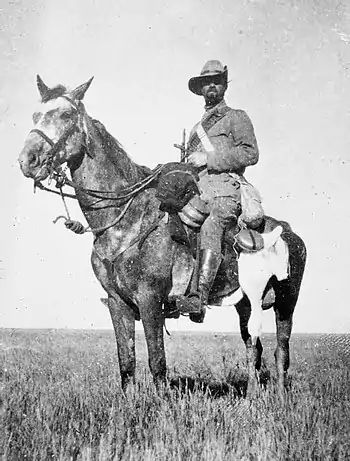
Following a string of defeats during Black Week in early December 1899, the British government realised that it would need more troops than just the regular army to fight the Second Boer War. On 13 December, the decision to allow volunteer forces to serve in South Africa was made, and a Royal Warrant was issued on 24 December. This officially created the Imperial Yeomanry (IY). The force was organised as county service companies of approximately 115 men signed up for one year, and volunteers from the Yeomanry and civilians (usually middle and upper class) quickly filled the new force, which was equipped to operate as Mounted infantry.[9][10][11][12] The Hertfordshire Yeomanry raised the 42nd (Hertfordshire) Company, which landed in South Africa on 28 March and served in 12th Battalion, IY.[3][4][5][13][12][14][15]
In May and June the 12th Bn IY was serving as Corps Troops with Lord Roberts' main army north of the Orange River.[16] The First Contingent of the Imperial Yeomanry completed their year's term of service in 1901 and 42nd Company went home in May, having earned the regiment its first Battle honour: South Africa 1900–01.[4][5][8][17]
The Imperial Yeomanry were trained and equipped as mounted infantry. The concept was considered a success and before the war ended the existing Yeomanry regiments at home (including the Hertfordshires) were converted into Imperial Yeomanry, with an establishment of RHQ and four squadrons with a machine gun section.[5][8][7]
Territorial Force
The Imperial Yeomanry were subsumed into the new Territorial Force (TF) under the Haldane Reforms of 1908.[18][19][20] The Hertfordshire Yeomanry, which also recruited from North London suburbs, were organised as follows:[3][4][5][8][21]
.jpg.webp)
- RHQ at St Albans; moved into Yeomanry House, 23 St Andrew's Street, Hertford, in 1910[22]
- A Squadron at 32 Market Street, Watford,[23] with detachments at Berkhamsted and St John's Wood[24]
- B Squadron at 24 Raynham Road, Hertford,[25] then to Yeomanry House, with detachments at Broxbourne,[24] Enfield Lock and Sawbridgeworth[24]
- C Squadron at 23 Prospect Road, St Albans, moved to Ramsbury Road by 1914,[26] with detachments at Hendon,[27][28] Harpenden, Davies Street, London, Islington and Hemel Hempstead
- D Squadron at 51 Salisbury Road, High Barnet,[29] with detachments at Enfield, Harringay, Hitchin and Islington
The Hertfordshire Yeomanry was attached for training to the TF's Eastern Mounted Brigade.[8][21][30][31][32][33]
World War I
| Eastern Mounted Brigade |
|---|
|
Organisation on 4 August 1914 |
|
In accordance with the Territorial and Reserve Forces Act 1907 (7 Edw. 7, c.9) which brought the Territorial Force into being, the TF was intended to be a home defence force for service during wartime and members could not be compelled to serve outside the country. However, on the outbreak of war on 4 August 1914, many members volunteered for Imperial Service. Therefore, TF units were split in August and September 1914 into 1st Line (liable for overseas service) and 2nd Line (home service for those unable or unwilling to serve overseas) units. Later, a 3rd Line was formed to act as a reserve, providing trained replacements for the 1st and 2nd Line regiments.[34]
1/1st Hertfordshire Yeomanry
The 1/1st was mobilised in August 1914 and attached to the Eastern Mounted Brigade, they later moved to Egypt in January 1915 and joined the Yeomanry Mounted Brigade.[21] The Yeomanry Mounted Brigade moved to Gallipoli as dismounted troops attached to the 2nd Mounted Division and redesignated as the 5th Mounted Brigade.[21] After the evacuation of Gallipoli they returned to Egypt in December 1915, and were remounted and moved to the Western Frontier Force.[21] In March 1916 the Regiment was split up, RHQ with A Squadron were attached to the 54th Division, later A Squadron joined XXI Corps, Cavalry in Palestine.[21] B Squadron was attached to the 11th Division, in England until on 12 July 1916 joined VI Corps Cavalry, until early in 1917 when it moved to join XVIII Corps, Cavalry. In May 1917 it became GHQ Troops. In July 1917 it returned to Egypt and in May 1918 joined XXI Corps Cavalry in Palestine.[21] D Squadron moved to Mesopotamia, initially on Lines of Communication duties and in July 1916 it was attached to the 13th Division, until December of that year when they moved to III (Tigris) Corps Cavalry.[21] In August 1917 they were attached to the 15th Indian Infantry Division, and in May 1918 they were tasked with Lines of Communication duties with the North Persia Force.[21]
2/1st Hertfordshire Yeomanry
The 2nd Line regiment was formed at Hertford on 1 September 1914. In August 1915, it was attached to the 69th (2nd East Anglian) Division at Huntingdon. On 28 April 1916 it joined the 16th Mounted Brigade of the 4th Mounted Division in the Manningtree area. It moved to West Malling in October 1916 and to the Sevenoaks area in March 1917.[31]
In September 1917, the regiment was converted to cyclists and joined the 13th Cyclist Brigade of The Cyclist Division. On 26 October it transferred to the 214th Brigade in 71st Division at Colchester. This brigade was intended to serve at Murmansk. On 12 February 1918, the brigade joined the 67th Division, still at Colchester. In March, all fit men were posted to France and the Murmansk operation was cancelled. The regiment remained in East Anglia for the rest of the war.[31][21]
3/1st Hertfordshire Yeomanry
The 3rd Line regiment was formed at Hertford in December 1914. In March 1915 it was affiliated to the 13th Reserve Cavalry Regiment at Colchester, moving to Maresfield later in the year. In February 1917 it was absorbed into the 6th Reserve Cavalry Regiment at Tidworth.[31]
Interwar
When the TF reformed as the Territorial Army (TA) in 1920, the 14 senior Yeomanry regiments remained as horsed cavalry (6 forming the 5th and 6th Cavalry Brigades) but the remaining regiments were re-roled as Royal Artillery (RA). In 1921 the regiment absorbed two batteries from the former 4th East Anglian Brigade, Royal Field Artillery (RFA) and became 86th (East Anglian) (Hertfordshire Yeomanry) Brigade, RFA, with 341–4 (Herts) Field Batteries, in 54th (East Anglian) Division.[35][36][37][38]
World War II
During World War II there were four regiments associated with the Hertfordshire Yeomanry: the pre-war 86th (East Anglian) (Herts Yeo) Field Regiment RA (TA) and its 2nd Line unit, the 135th (East Anglian) (Herts Yeo) Field Regiment RA (TA).[39] 79th (Hertfordshire Yeomanry) Heavy Anti-Aircraft Regiment, Royal Artillery was also formed in 1939.[40]
86th (East Anglian) (Hertfordshire Yeomanry) Field Regiment

The 86th (East Anglian) (Hertfordshire Yeomanry) Field Regiment, Royal Artillery was mobilised in September 1939, its batteries were:[39][41]
- 341 (St Albans) Battery
- 342 (Hertford) Battery
- 462 Battery – formed 18 November 1940 as 343 Bty, renumbered 18 January 1941
In 1940 the regiment was equipped with 8 x 4.5 inch Howitzers & 4 x 18/25 pounder guns,[39] it remained in the United Kingdom until 1944 being attached to various formations: 54th (East Anglian) Infantry Division from mobilisation until 9 June 1942, then 42nd Armoured Division until 3 May 1943.[39][42] When 21st Army Group was formed in July 1943 to prepare for the Allied invasion of Normandy (Operation Overlord), 86th Fd Rgt was assigned to I Corps as a self-propelled field artillery regiment.[43] During this time it used a number of new self-propelled artillery vehicles including the Bishop, Priest and the Sexton self-propelled guns. The regiment trained in amphibious assault techniques for Overlord as part of Second Army Troops, assigned to support 50th (Northumbrian) Infantry Division on D-Day (6 June 1944).[39][44][45] It later participated in the following battles: Normandy, Antwerp, Nijmegen, Ardennes, Rhine Crossing, Bremen.[39][46]
135th (East Anglian) (Hertfordshire Yeomanry) Field Regiment
The 135th (East Anglian) (Hertfordshire Yeomanry) Field Regiment, Royal Artillery was formed in September 1939 it consisted of three batteries:[5]
- 344 (Hitchin) Battery
- 336 (Northampton) Battery
- 499 Battery
The Regiment remained in the United Kingdom until 1941 when it was sent to India and joined the 18th (East Anglian) Infantry Division and deployed to Fortress Singapore it was still serving with the 18th Division when Singapore was captured by the Japanese.[47]
Bridge on the River Kwai
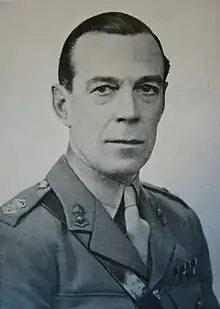
Lieutenant Colonel Philip Toosey, was promoted from second-in-command of 59th (4th West Lancashire) Medium Regiment to command 135th (East Anglian) (Hertfordshire Yeomanry) Field Regiment in 1941.[47][48] In October 1941, his unit was shipped to the Far East. He was awarded the Distinguished Service Order for heroism during the defence of Singapore.[47] Because of his qualities of leadership, his superiors ordered him on 12 February 1942 to join the evacuation of Singapore, but Toosey refused so that he could remain with his men during their captivity.[47] He was the senior Allied officer in the Japanese prisoner-of-war camp at Tha Maa Kham (known as Tamarkan) in Thailand during World War II. The men at this camp built the Bridge on the River Kwai which was described in a book by Pierre Boulle and later in an Oscar-winning film in which Alec Guinness played the senior British officer. Both the book and film outraged former prisoners because Toosey did not collaborate, unlike the fictional Colonel Nicholson.[47]
191st (Hertfordshire and Essex Yeomanry) Field Regiment
In 1942 both 86th (East Anglian) (Herts Yeomanry) and 147th (Essex Yeomanry) Field Regiments supplied cadres to help form 191st (Hertfordshire and Essex Yeomanry) Field Regiment, Royal Artillery.[49]
79th (Hertfordshire Yeomanry) Heavy Anti-Aircraft Regiment
79th (Hertfordshire Yeomanry) Heavy Anti-Aircraft Regiment, Royal Artillery was formed in 1939 with headquarters at Watford.It served in the Battle of France, The Blitz, Operation Torch and the Italian Campaign before being placed in suspended animation in early 1945.[40][50][51]
Postwar
The regiment was reconstituted as 286 (Hertfordshire Yeomanry) Field Regiment (later Medium Regiment) in 1947 and absorbed 479 (Hertfordshire Yeomanry) Heavy Anti-Aircraft Regiment in 1955.[5][51][52] The regiment amalgamated with the 305th (Bedfordshire Yeomanry) Light Regiment to form the 286th (Hertfordshire and Bedfordshire Yeomanry) Field Regiment in 1961.[5] The unit was disbanded in 1967 but reformed as 201 (Hertfordshire and Bedfordshire Yeomanry) Battery, 100th (Yeomanry) Regiment Royal Artillery in 1971.[53] Under Army 2020, this unit was placed in suspended animation in 2014.[54]
Heritage & Ceremonial
Uniforms & Insignia
In 1795 at Theobald's Park, Lady Prescott presented her husband's Southern Troop of Yeomanry with a standard bearing the arms of Hertfordshire.[2]
At the time of the Royal Review in 1800, the five Yeomanry Troops wore blue coats with red cuffs and collars and buff wiastcoats. They wore helmets (probably the Tarleton) with a feather. The Western and Centre Troops were distinguished by having lace on the chest of their coats. The Beechwood Troop of Volunteers had green coats with buff waistcoats, the Sawbridgeworth Troop blue jackets with red facings.[2]
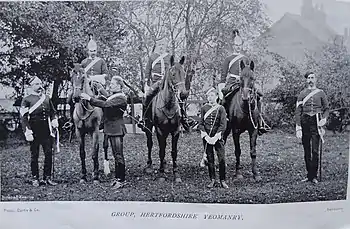
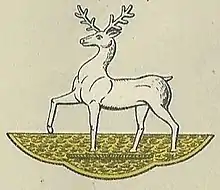
In the later 19th Century the Hertfordshire Yeomanry wore a scarlet tunic with white facings; officers' lace was silver. The headgear was a white metal Dragoon helmet carrying the county badge of a hart (male deer) – a pun on 'Hertfordshire', pronounced 'Hartfordshire'. For parade the Hertfordshire wore a black plume, which was removed in the field, leaving the helmet with a spike. All the Yeomanry adopted blue riding pantaloons and 'butcher boots' in 1873 in place of the old booted overalls, which were retained for dismounted parades; the Hertfordshires wore red stripes on the pantaloons. Other ranks wore a white shoulder-belt over the left shoulder; in marching order a white leather Bandolier was also worn, across the right shoulder. The cloak was blue, lined red. The horse furniture included a throat plume to match the helmet plume, and a black sheepskin saddle cover until 1896. Most Yeomanry regiments adopted white head-ropes in 1898, but the Hertfordshires retained the old steel collar chains.[7]
After 1903 a less elaborate uniform of peaked cap, scarlet patrol jacket with white facings plus silver shoulder chains was adopted for wear by other ranks for parade and off-duty wear. Officers (who paid for their own tailor-made uniforms) retained the earlier full dress, including plumed helmets and silver braided pouch belts. All ranks wore dark blue overalls (cavalry trousers) with double red stripes.[55]
After 1914 the Hertfordshire Hussars wore the standard khaki service dress of the British Army with regimental insignia, for nearly all occasions. This included leather bandoliers during the regiment's remaining years as a mounted unit. After 1938 khaki battle dress was adopted.[56]
Battle Honours
The Hertfordshire Yeomanry was awarded the following Battle Honours:[8]
- Second Boer War: South Africa 1900–01
- World War I: Suvla, Scimitar Hill, Gallipoli 1915, Suez Canal, Egypt, 1915–16, Megiddo, Sharon, Damascus, Palestine, 1918
- World War II: Battle honours are not awarded to the Royal Artillery; by tradition the guns are regarded as the unit's colours.
Memorials
There are three stone tablets in the War Memorial Chapel of St Albans Cathedral commemorating the dead of the Hertfordshire Yeomanry:
- The first was erected by the regiment to the nine members of 42nd (Hertfordshire) Company, IY, who died on service during the Second Boer War.[57]
- A second was unveiled on 31 July to the 64 men of the regiment who died in World War I.[58]
- The third, to the men of all four Hertfordshire Yeomanry artillery regiments who died during World War II, was unveiled on 19 September 1954.[59][60]
See also
 |
Wikimedia Commons has media related to Hertfordshire Yeomanry. |
Notes
- Rogers, p. 145.
- Busby.
- Frederick, pp. 30–1.
- Mileham, pp 88–9.
- "Hertfordshire Yeomanry at regiments.org by T.F.Mills". Archived from the original on 15 July 2007. Retrieved 2 May 2015.
- Spiers, p. 79.
- Ryan.
- Army List, various dates.
- Rogers, p. 228.
- Spiers, p. 239.
- Dunlop, pp. 104–18.
- IY at Anglo-Boer War.
- Frederick, p. 370.
- IY Companies at Roll of Honour.
- Imperial Yeomanry at Regiments.org.
- Amery, Vol IV, Appendix to Chapters I-XIV, pp. 503–14.
- Leslie.
- London Gazette, 20 March 1908.
- Dunlop, Chapter 14.
- Spiers, Chapter 10.
- Hertfordshire Yeomanry at Long, Long Trail.
- Hertfordshire at Great War Drill Halls.
- Watford at Drill Hall Project.
- Hertfordshire Drill Stations at Drill Hall Project.
- Hertford at Drill Hall Project.
- St Albans at Drill Hall Project.
- Middlesex at Great War Drill Halls.
- Barnet at Stepping Out.
- High Barnet at Drill Hall Project.
- Conrad, British Army 1914.
- James, p. 20.
- James, pp. 35–6.
- Mounted Brigades at Long, Long Trail.
- Rinaldi 2008, p. 35
- Litchfield, p. 293; Appendix VII.
- Sainsbury, Pt 1, pp. 31–4.
- Titles & Designations 1927.
- "History of the Royal Berkshire Yeomanry". Archived from the original on 2007-01-09.
- Barton, Derek. "86 (East Anglian)(Hertfordshire Yeomanry) Field Regiment RA(TA)". The Royal Artillery 1939-45.
- 79 HAA at RA 39–45.
- Frederick, pp. 491–3, 522.
- Joslen, pp. 29, 89.
- Order of Battle of the Forces in the United Kingdom, Part 2: 21 Army Group, 24 July 1943, with amendments, The National Archives (TNA), Kew, file WO 212/238.
- Sainsbury, Part I, pp. 84–100.
- Joslen, p. 581.
- Sainsbury, Part I, pp. 100–52.
- "Bridge on the River Kwai as a symbol of violent globalisation: Philip Toosey and Saito". Cambridge Forecast Group. Retrieved 4 November 2017.
- Anon, History, pp. 94, 99; Appendix VII.
- Sainsbury, Part 1, pp. 215–48.
- Sainsbury, Part 2, pp. 27–114.
- Litchfield, p. 104
- Sainsbury, Part 2, pp. 193–238.
- "Hertfordshire and Bedfordshire Yeomanry". Regiments.org. Archived from the original on 18 October 2007. Retrieved 17 November 2017.
- Summary of Reserve Structure and Basing Changes Archived 2013-08-10 at the Wayback Machine
- Smith, p. 12.
- "Uniforms of the British Yeomanry Regiments". Retrieved 19 January 2018.
- IWM WMR Ref 14681.
- IWM WMR Ref 14685.
- Sainsbury, Part 2, pp. 204–5.
- IWM WMR Ref 49184.
References
- L.S. Amery (ed), The Times History of the War in South Africa 1899-1902, London: Sampson Low, Marston, 6 Vols 1900–09.
- Anon, History of the 359 (4th West Lancs.) Medium Regiment R.A. (T.A.) 1859–1959, Liverpool: 359 Medium Regiment, 1959.
- Maj J.H. Busby, 'Local Military Forces in Hertfordshire 1793–1814', Journal of the Society for Army Historical Research, Vol 31, No 125 (Spring 1953), pp. 15–24.
- Col John K. Dunlop, The Development of the British Army 1899–1914, London: Methuen, 1938.
- J.B.M. Frederick, Lineage Book of British Land Forces 1660–1978, Vol I, Wakefield: Microform Academic, 1984, ISBN 1-85117-007-3.
- J.B.M. Frederick, Lineage Book of British Land Forces 1660–1978, Vol II, Wakefield: Microform Academic, 1984, ISBN 1-85117-009-X.
- Brig E.A. James, British Regiments 1914–18, London: Samson Books, 1978/Uckfield: Naval & Military Press, 2001, ISBN 978-1-84342-197-9.
- Joslen, H. F. (2003) [1990]. Orders of Battle: Second World War, 1939–1945. Uckfield, East Sussex: Naval and Military Press. ISBN 978-1-84342-474-1.
- N.B. Leslie, Battle Honours of the British and Indian Armies 1695–1914, London: Leo Cooper, 1970, ISBN 0-85052-004-5.
- Norman E.H. Litchfield, The Territorial Artillery 1908–1988 (Their Lineage, Uniforms and Badges), Nottingham: Sherwood Press, 1992, ISBN 0-9508205-2-0.
- Mileham, Patrick (1994). The Yeomanry Regiments; 200 Years of Tradition. Edinburgh: Canongate Academic. ISBN 1-898410-36-4.
- Rinaldi, Richard A (2008). Order of Battle of the British Army 1914. Ravi Rikhye. ISBN 978-0-97760728-0.
- Col H.C.B. Rogers, The Mounted Troops of the British Army 1066–1945, London: Seeley Service, 1959.
- Lt-Col Ernest Ryan 'Arms, Uniforms and Equipment of the Yeomanry Cavalry', Journal of the Society for Army Historical Research, September 1957, Vol 35, pp. 124–33.
- Sainsbury, J.D. (1999). The Hertfordshire Yeomanry Regiments, Royal Artillery - Pt 1 Field Rgts 1920-46. Welwyn: Hart Books. ISBN 0-948527-05-6.
- Sainsbury, J.D. (2003). The Hertfordshire Yeomanry Regiments, Royal Artillery - Pt 2 The HAA Rgt 1938-45 & the Searchlight Bty 1937-45. Welwyn: Hart Books. ISBN 0-948527-06-4.
- R.J.Smith,The Yeomanry Force at the 1911 Coronation, 1987, ISBN 0-948251-26-3.
- Edward M. Spiers, The Army and Society 1815–1914, London: Longmans, 1980, ISBN 0-582-48565-7.
- Titles and Designations of Formations and Units of the Territorial Army, London: War Office, 7 November 1927 (RA sections also summarised in Litchfield, Appendix IV).
External links
- Anglo-Boer War
- Chris Baker, The Long, Long Trail
- Mark Conrad, The British Army, 1914 (archive site)
- The Drill Hall Project
- Great War Centenary Drill Halls
- Imperial War Museum, War Memorials Register
- Land Forces of Britain, the Empire and Commonwealth – Regiments.org (archive site)
- Roll of Honour
- Stepping Forward: A Tribute to the Volunteer Military Reservists and Supporting Auxiliaries of Greater London