Himetataraisuzu-hime
Himetataraisuzu-hime(媛蹈鞴五十鈴媛[Note 1])is a character and goddess in the Nihon Shoki (Chronicles of Japan), the first empress of Japan and the first empress of Emperor Jimmu. She is equivalent to Himetataraisukeyorihime .(比売多多良伊須気余理比売[Note 2])in Kojiki.
| Himetataraisuzu-hime | |
|---|---|
| Empress of Japan | |
| Spouse | Jimmu |
| Issue | Kamuyaimimi, Emperor Suizei |
| Father | Kotoshironushi |
| Mother | Tamakushihime |
| Religion | Shinto |
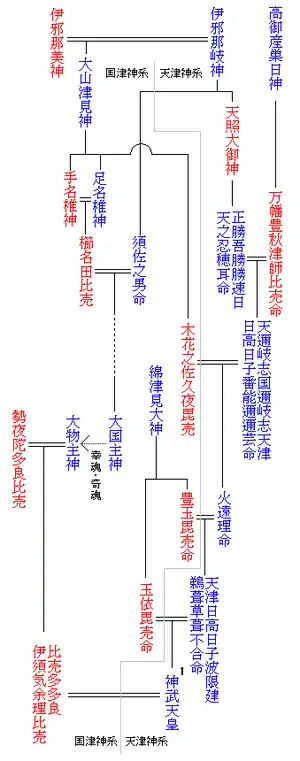
Although there are differences in details among the legends, the mother is depicted as the daughter of an influential person in the Yamato region, and the father as a god. It is said that she married Emperor Jimmu, became his empress, and gave birth to the second emperor, Emperor Sui Yasushi.[12][11]
Names
In the Kojiki (Records of Ancient Matters), it is shown that her name was first "Hototataraisukihime" (Hototataraisusugihime), but was later changed to "Himetataraisukeyorihime" (Himetataraisukeyorihime). For more details, see #Anecdotes of the time of birth in Kojiki. The name is sometimes written simply as "Isukiyorihime".
Sometimes it is written simply "Isuzu Ehime". (Be careful not to confuse her with her sister, Isuzu-yorihime.
Depiction by Kiki
Himetataraisuzuhime of Nihon Shoki / Kujiki Kujiki
The name "Himetataraisuhime" appears in Nihon Shoki, vol. 1, "Kamidaioki (Top)", and Kujiki, vols. 4 and 5, and in Nihon Shoki, vol. 3, "Emperor Jimmu", vol. 4, "Emperor Suizei", and Ikijimoto, vol. 7, "Ehimetataraisuhime".
There are several descriptions of her origin.
| Book | Place of Appearance | Mother | Father | Remarks | Source |
| Nihon Shoki | Volume 1 "The Chronicles of Japan
Chapter on the Appearance of the Treasure Sword |
Mount Miwa | [Shoki 1]The god Omiwa is said to be the Mitama of Ōkuninushi (Ōkuninushi). | [13][14][8] | |
| Nihon Shoki | Princess Mizokuhime of Mishima
or Tamagushihime |
Kotoshironushi | [Shoki 2] | [13][14][8] | |
| Nihon Shoki | Volume 3 "The Chronicles of Jimmu
Preceding the Accession of Jimmu |
Daughter of the god Mishima-mizo
Clematis japonica |
Kotoshironushi | [Shoki 3] | [15][14][8] |
| Nihon Shoki | Volume 4 "Suijing Ji
Article before Suijing's reign |
Kotoshironushi | "The eldest daughter of the Lord Jishiro".[Shoki 4] | [15][14][8] | |
| Kujiki | [Note 3] | Daughter of Mishima Mizokuhi
Princess Akatamae |
Kotoshironushi | Kotoyonushi is considered to be the son of Okukinushi. | [13] |
In the "Nihon Shoki", the "Kamishiroki", the "Jimmu", the "Suiyasu", and the "Sachiyo Kujimoto", it is said that Kotoshironushi was born to Tamakushihime, the daughter of "Mizokuhi" (Mizokui) of "Mishima". It also says that Kotoshironushi was transformed into a "Yatsuhirokuma Crocodile" at this time.
Himetataraisukeyorihime in Kojiki
In the middle volume of Kojiki, she appears as "Tomitatara Isusukihime" and "Hiyotatara Isukeyorihime".
| Book title | where it appears | mother | father | notes | source |
| The Kojiki. | Middle scroll Jimmu-ki |
Daughter of Mishimadori Hakui Seiyadarahime |
Ōmononushi | My father is Miwano-Omononokami.[Kojiki 1] | [16][17][6] |
Seiyadatara-hime was known as a beautiful woman. Omononushi disguised himself as a tannin-painted arrow (a red arrow) and, aiming at the place where Seiyadatara-hime was taking a bowel movement, floated down from the upper reaches of the river and poked Seiyadatara-hime in the pubic region (hoto). Surprised, Seiyadatara-hime took the arrow and returned to her room, where it turned into a beautiful boy. The two were married and had a daughter. They married and had a daughter, whom they named Hotototara Isusukihime. Later, however, the daughter disliked the name "Hoto" and changed it to "Himetataraisukeyorihime".
Marriage with Emperor Jimmu
According to the Nihon Shoki (Chronicles of Japan) and other sources, Iwarehiko (later Emperor Jimmu) left the Land of Himuka [Note 4]」and made an expedition to the east, and after many battles, established his government in the Yamato region[Note 5](Jimmu's eastern expedition). Iwarehiko built the Palace of Kashiwara (Kashihara City, Nara Prefecture) at the foot of Mount Unebi and ascended to the throne as the first emperor, Emperor Jimmu[Note 6]」
Prior to his accession to the throne, it was decided that the first emperor of Japan would receive a suitable consort, and Himetataraisuhime was chosen as his wife. According to the Nihon Shoki (Chronicles of Japan), the marriage of Himetataraisuhime to Emperor Jimmu (before his accession to the throne, to be precise) took place on September 24 (lunar calendar) of the year before his accession.[Note 7]. Emperor Jimmu ascended the throne in the New Year of the following year, and Himetataraisuhime became the empress at this time.[Note 8]
The "Kojiki" (Records of Ancient Matters) contains episodes related to the selection of a queen and marriage. (For details, see the story of Emperor Jimmu's wife question.
After the death of Emperor Jimmu
According to the Nihon Shoki (Chronicles of Japan), Emperor Jimmu died at the age of 127. Although there are differences in details, the Nihon Shoki and Kojiki describe a succession struggle that occurred among the children of Emperor Jimmu after his death (see Tegen-ear's Rebellion for details).
Iwarehiko (Emperor Jimmu) had married and had a child with Ohiratsuhime (Abira Hime) before he left for the eastern expedition from "Himuka Country[Note 9]. However, when Emperor Jimmu made Himetathalaisuhime the rightful empress, these children were reduced to the status of bastards. When Emperor Jimmu died, his bastard son, Tagishimi, wanted to succeed to the throne himself.[Note 10].
In the Kojiki (Records of Ancient Matters), Tagishimi took the widowed Himetathalaisuhime as his wife and tried to assassinate the legitimate children born to Emperor Jimmu and Himetathalaisuhime. Himetathalaisuhime, aware of this, is said to have written two waka poems and sent them to her children to warn them of her danger.[Kojiki 2].
| It is not possible for a man to be a man without a woman. |
| The clouds are rising over the narrow river Unebi Volcano, the leaves are rustling, and the wind is blowing. |
| O children of the Sagawa River[Note 11]、the wind is about to blow toward you from Tagishimimi. |
| It is not a question of whether or not a person will be able to live a long life. |
| Unebi Volcano In the daytime, the clouds and I stay, and in the evening, the wind will blow, and the leaves of the trees will rustle. |
| It is cloudy in the daytime on Mt. Unebi, but the leaves of the trees are rustling that the wind will blow when evening passes and night falls. |
The legitimate sons, who learned of Tagishimi's treasonous intentions through these allegorical songs, made the first move and defeated him. Kannuma Kawamimi-no-mikoto, who played the most active role, succeeded to the throne and ascended to the throne as the second emperor (Emperor Suizei). According to the "Nihon Shoki" (Chronicles of Japan), Himetataraisuhime took the title of "Empress Dowager" on New Year's Day 8 of the first year of Emperor Suiyasu.
Emperor Suizei welcomed Princess Isuzu Yoriyehime as his consort. Isuzu Yoriyoshihime was Himetataraisuhime's younger sister, and from the perspective of Emperor Suiyasu, she was his aunt. However, there are different versions of this story, with some claiming that the person who became the consort of Emperor Suiyasu was Kawamata Biyori and others claiming that the empress was Itoorihime.
Children
Emperor Jimmu's children with him were, in order from oldest to youngest, Hikoyai-no-Mikoto, Kamuyaimimi-no-Mikoto, and Kannuma Kawamimi (Emperor Sui Yasushi).
| Himetataraisuhime and the son of Emperor Jimmu | ||
| Nihon Shoki | The Kojiki. | Remarks |
| Hikoyai-no-Mikoto | There is no mention of it in the Nihon Shoki. | |
| Kamuyaimimi-no-Mikoto | Kamuyaimimi-no-Mikoto | He becomes the founder of the Tada clan. |
| Emperor Suizei | Kannuma no Mikoto | Emperor Suizei ascends to the throne as the second emperor. |
Siblings
Himetataraisuhime's mother, Tamagushihime (Seya-tara-hime), is said to have given birth to two other children.
- He is said to have had two other children. In the Sekaiyo Kouji Hongi, he is said to have served Emperor Jimmu and become "Shishoku Kokusei Daiyu" (Prime Minister).
- Isuzu Yoriyehime - sister of Himetataraisuhime. In Emperor Suizei, she is said to have become the empress of the second emperor, Emperor Suizei.
Theories about her origin
In the Nihon Shoki and the Kojiki, although the details of the stories differ, Himetataraisuhime is depicted as having a mother who is "the daughter of an influential person (a deity) in a region" and a father who is "a deity. There is a theory that Emperor Jimmu, the first emperor of Japan, may have used the marriage of a "daughter of a god" as a way to support the legitimacy of his regime when he took a regular wife.
The mother is depicted as belonging to Mishima (Mishima, Mishima) of Settsu (Osaka Prefecture) on her mother's side and Miwa (Miwa, Miwa, Miwasan) of Yamato (Nara Prefecture) on her father's side. These suggest the cooperation of several powerful clans in the Kinki region[Note 12]、and this marriage is between Iwarehiko (Emperor Jimmu), a stranger from "Himuka" (Hyuga Province), and a powerful man from Bongachi Province (Yamato and Settsu Provinces)[Note 13]There is also a theory that this is an indication of Iwarehiko's political method of not only conquering by force, but also consolidating his control base by harmonizing with the forces in the region. There is also a theory that it is an indication of the political method by which Iwarehiko not only conquered by force, but also tried to consolidate his control base by harmonizing with the forces in the region. As will be discussed later, there is also an interpretation that it indicates that Emperor Jimmu's forces secured iron manufacturing technology.
Grandfather: Mizokuhi of Mishima
In the "Nihon Shoki" (Chronicles of Japan), the mother is said to be the daughter of Mishima Mizokuhi, although there are some differences in wording. "Mizokuhi is also written as 溝樴, 溝樴耳神, and 溝杙 in the Kojiki (Records of Ancient Matters), and as 湟咋, 溝杭 (Shinsen Seijiroku ), Mizokui (Shinsen Seijiroku), and other characters may also be applied. "In addition, there are some historical records that refer to him as Mimi-gami, suggesting that he was an object of worship as a divine being. In the genealogy of the Kamo clan, this deity is said to be the ancestor of the Kamo clan and the Katsuragi Kunizo. There is also a theory that the name of the deity is related to "Mishima" and that it is the same deity as Shogikona, who was the ancestor deity of the Mishima prefectures.
The place name "Mishima" is thought to be Settsu Province Mishima County (present-day northern Osaka Prefecture). The Enki Shiki Shinmeicho (927) lists Mishima Kamojinshya (Mishima-e, Takatsuki City) and Mizokuijinshya (Ibaraki, Osaka|Ibaraki City), suggesting that "Mizokuhi of Mishima" was worshipped in this area.[Note 14].
In the Edo period, Kokugaku Nencho Motoi interpreted this "mizo (groove)" to refer to a toilet built over a stream of water, and this has become a common theory. Eiichi Mitani and others have adopted this theory, and there is also a theory that the toilet is strongly related to birth rituals. Kazuo Higo (Professor Emeritus, Tokyo University of Education) disagreed, saying that "mizo" means a ditch in a paddy field. Masayuki Tsugita developed this theory, claiming that Mishima-gun was an ideal place for rice cultivation and that "Mizokuhi of Mishima" was a farming god.
Mothers: Tamakushihime and Seiyadatarahime
Her mother's name is Tamakushihime in the Nihon Shoki (Chronicles of Japan) and Seya Datarahime in the Kojiki (Records of Ancient Matters). Both are said to have been known as beautiful women.[Shoki 5][Kojiki 3].
Noninaga Motoi compares Seiya to Yamato ProvinceHiragun-gun, Seinomura (Nara Prefecture Ikoma County Misato Town).
Birth by intermarriage
In both the Nihon-shoki and the Kojiki, Human-animal marriage is involved in the birth of Himetataraisuhime. The father deity visits the woman in the form of "Yahiro Wani" in the Nihon Shoki and "Tan-nuri no Ya" in the Kojiki. Thus, Himetataraisuhime is known as a representative example of a child from a different kind of marriage in Japanese mythology.[Note 15].
Anecdotes of her birth in Kojiki
In Kojiki, she is said to be the daughter of Omononushi God.[Note 16]. His birthplace is Mount Miwa in the Yamato region, or Miwa.
| Original text | The god of beauty and peace, the Lord of the big things, saw and felt, and when the beautiful woman? |
| The Great Meaning | The god Omonoshu (Ōmononushi) of Miwa saw the beautiful Seiyadatara-hime. He transformed himself into a red arrow (tannin-painted arrow), and seeing that Seiyadatara-hime was about to take a leak, he swept down from the upper reaches of the river and poked her in the hoto (pubic area). |
| Original text | The iron lady, with her hands clasped in front of her, took her to her mother's house. |
| The iron lady | The ironworker was surprised and stood up, took the arrow back to her room, put it on the floor, and immediately became a beautiful man and woman. And they were united, and Seiyadatara-hime bore a son. And they were united. |
This child was named Hottataraisukihime. She was said to have been beautiful like her mother. It is also said that she was a beautiful woman like her mother.
However, she disliked the word "hoto" and changed her name to Himetataraisukeyorihime.
Theories about the name
The original name "Hottatara" was derived from a legend that her mother, Seiyadatara Hime, was poked in the pubic region with an arrow. Some interpret the name as a derivative of the word "stand", meaning "hottatara". It is said that the word "hoto" was later changed to "hime" in disgust. There is another theory that "Tatara" is a part of the name inherited from her mother, Seya Datara Hime. The word "isusuki" is said to mean "to walk away in surprise," which is paraphrased as "isuke.
On the other hand, there is an interpretation that the word "tatara" in the name suggests a connection with iron manufacturing, and there is a theory that the fact that Emperor Jimmu took Himetataraizu-hime as his wife symbolizes that the regime had seized iron manufacturing technology, an important technology at that time. For more details, see #Relationship with TATARA Iron Manufacturing.
There is a theory that "Isuzu" means "bell" and refers to the many bells that adorn the hands and feet, or that it suggests a connection with metalworking. There is another theory that the original name "isusuki" was corrupted into "isuzu.
There is also a theory that "yori" means "yoroshi," and that it refers to the flower of the lily, which blooms on the banks of the Sasaigawa River at the foot of Mount Miwa, the home of Himetataraisuzuhime (Isukeyorihime).
The story of Emperor Jimmu's wife question
Prior to his accession to the throne, Emperor Jimmu was to receive a consort worthy of being the first empress. Okume-no-mikoto, a vassal who had followed Emperor Iwarehiko from Himuka, suggested Isukeyorihime (Himetataraisuhime) as a candidate for his wife. In the Kojiki, Okume-no-mikoto explains the anecdote of Isukeyorihime's birth to Emperor Jimmu, and tells him that Isukeyorihime, the "Son of God," deserved to be the rightful wife.
In the Kojiki (Records of Ancient Matters), there is an anecdote in which Emperor Jimmu and Okume-no-mikoto witnessed seven women on the shore of the Sadoi River and selected an empress from among them. The exchange of songs between Emperor Jimmu, Okume-no-mikoto, and Isukeyorihime is well known as the "wife questioning story" of Emperor Jimmu.
| Yamato no taka sajinu o Nana yuku o tomedomo tare o shima kamu |
| Who are the women of Ehime who go to Takasajino in Japan? |
| Which of the seven maidens who walked along the high ground beside the river in Yamato would you take as your wife? |
The name "Takasashino" refers to the plateau along the Sakui River. The Sawaigawa River originates from Mt. Miwa and flows near the precincts of Ogami Shrine. Before joining the Yamato River (Hatsuse River), the river becomes a ceiling river and its banks are elevated.
| Katsuga is also sick |
| I'm going to make a big deal about my brother. |
| Let's make her the elder who leads the way. |
In response to Emperor Jimmu's wish, Okume-no-Mikoto went to see Isukeyorihime. Isukeyorihime was surprised to see the unfamiliar appearance of Okume-no-Mikoto and replied, "I have never seen you before.
| Shuttle of the capital city of Ame |
| Tenchi, Chidori, Zanzi and other Tattoos |
| Why do you have tattoos around your eyes like various birds, and why do you have a sharp look in your eyes? |
In response, Ohkume no Mikoto replied as follows.
| I will only give my life to the virgin |
| My tattoos to see the girl face to face. |
| They have sharp eyes to see you directly and closely. |
After this, Isukeyorihime agrees to marry him. Emperor Kanmu went to Isukeyorihime's house "on the Sawaigawa (Sawaigawa) River" and stayed there for a night. The following is a poem about this time.
| I'd like to know what happened to you. |
| In a filthy hut in the Reed bed, I laid out the tatami mats, and we slept together. |
| The two of us slept together in a shabby hut on the grassy bank of the river, with sedge tatami mats neatly laid out. |
In this part, there is a note on the origin of the place name of Sawaigawa. The river is called "Sawaigawa" (Sawaigawa River) because there are many "yamayuri-so" (lily of the valley, which is actually a lily of the valley) in this area, and the lily of the valley is called "Sawai". On the right bank of the modern Sawaigawa River is a monument to Emperor Jimmu's sacred site, the Sawaigawa River.
Relation to Tatara Iron Manufacturing
There is a theory that the "tatara" part of the name Himetataraisuzuhime (Himetataraisukeyorihime) is interpreted in connection with Tatara iron manufacturing, indicating iron manufacturing in ancient Japan.[Note 17][Note 18][Note 19].
According to Yasunao Kojita (Nara Women's University), tatara refers to a tatara furnace, and "hoto" refers to the pubic area as well as the fireplace.[Note 20]. In other words, the fact that Emperor Jimmu took Himetataraisukeyorihime (= Himetataraisukeyorihime = Hottataraisukihime) as his wife is interpreted as an indication that the royal family controlled the iron and steel industry. Yutaka Yoshino (Japan Literature Association) states that the name "Hottataraisukeyorihime" refers to a priestess who served the god of molten ore and the blast furnace.
Nomoninaga Motoi and other early modern Kokugaku scholars did not interpret the word "tatara" in Himetataraisuzuhime (Himetataraisukeyorihime) to mean a bellows. In their view, the word "tatara" was a slang word used by blacksmiths and was not appropriate to be used in the name of a noble queen, thus dismissing its connection to iron making. "Some interpret "tatara" as a derivative of "stand," meaning "stood up (surprised by an arrow in the pubic region)" or "had an arrow put up (in the pubic region).
Objects of faith
The Emperor Meiji founded the Kashihara Jingu in 1890, where Emperor Jimmu and Himetatharaisuhime are enshrined as the main deities.
Himetataraisuhime also came to be revered as a "child guardian myojin" because she saved children, and is enshrined as the main deity at Torikawa Shrine (Honkomori-cho, Nara City, Nara Prefecture).[Note 21]. In June of every year, the Nitsukawa Shrine holds the "San-eda Matsuri" (commonly known as the Lily Festival), where Himetataraisuhime is worshipped by offering lilies grown in the Miwa Mountains.
At the upper reaches of the Sakui River, where Himetataraisuhime's parents lived, there is the Sakui Shrine. Here, the main deity is Okami Aratama, but also Himetataraisuhime, Omononushi (father of Himetataraisukeyorihime according to the Kojiki), Seiyadatarahime (mother of Himetataraisukeyorihime according to the Kojiki), Kotoshirohime (mother of Himetataraisukeyorihime according to the Kotoshironushi (father of Himetataraisukehime according to the Nihonshoki) are enshrined here.
He is also worshipped at Tsumori Jingu Shrine (Kumamoto Prefecture Kamimashiki District Mashiki Town) and Kosa Shrine (Kosa Town).
Genealogy
A genealogical tree based on the Nihon Shoki
| Himetataraisuzu-hime | Jimmu | Ahiratsu-hime | |||||||||||||||||||||||||||
| Kamuyaimimi | Emperor Suizei | Tagishimimi | |||||||||||||||||||||||||||
Footnotes
Original text of "Nihon Shoki"
- Nihon Shoki "The god of the great three chakras. The sons of this god, namely Kamo-kun etc., Osamu-kun etc., and also the seller of the fifty sells.
- Nihon Shoki "Kotoshironushi was transformed into a Kamotaketsunumi no Mikoto princess, or Tamayoribime, and gave birth to a child who was born after Jimmu.
- Nihon Shoki, the daughter of the chief deity and the goddess of the pegs of the common shima ditch, was born to the goddess and is called "Himeko".
- Nihon Shoki "Mother Himetataraisuzu Isuzu Himetataraisuzu, Kotoshironushi Kamiyuki Daijoya"
- Nihon Shoki"It is the most beautiful person in the country.
The original text of "Kojiki"
- The "Chronicle of the Ancient Times" says, "There is a woman in this area called Kamiko. It is said that the god's son is the daughter of Hikaru Mishima, and her name is Seiyata Tara Biki, and she is beautiful. Therefore, the gods of the great things of beauty and harmony saw and felt (omitted below)".
- "After the death of the emperor, when his younger brother, Geijimei, was about to marry his first wife, Izumi, he was about to kill his third brother and plot against him, and when his father, Izumi, was suffering from the pain of Izumi, he informed his sons by song.
- In the "Chronicle of the Ancient Times", "she is beautiful in appearance".
Notes
- In the Nihon Shoki, Ehime Tout Bellows Isuzu Ehime (Himetataraisuhime no Mikoto[1][2][3]In addition, there are various variations in the notation of "Isuzu Ehime". In addition, "Ehime foot bellows Isuzu Ehime (命)" is written in various ways. "In addition, there are various other spelling variations in "Ehime (媛)" and "姬 (姬)," "蹈 (蹈)" and "踏 (踏)," "韛 (韛)" and "鞴 ( bellows)," and "命 (命)" and "尊 (尊). "Princess Isuzuhime[4]"and "Princess Ehime Isuzu[5]"Ehime Isuzuhime no Mikoto[6]Princess Isuzu Hime", "Princess Isuzu Hime[7][8]"Himetobori Isuzuhime no Mikoto,[3] and "Hime-Todobori Isuzuhime-no-Mikoto[9].
- In Kojiki, he is referred to as Himetatara Isukeyorihime,[9] Himetatara Isukeyorihime ('Himetatara Isukeyorihime'[10]), Himetatara Isukeyorihime (' Himetataraisukeyorihime[11]), and Isukiyorihime. There are some variations in the notation, such as "売" and "賣", "気" and "氣", and "余" and "餘".
- In the "Chronicles of the First Generations", Volume 4 of the Genealogical Records, "Kotoshironushi was born to Mishima Gouhang, a daughter Tamayoribime, a son and a daughter (omitted), and a daughter who was born to Ṭifa Ṭuurin, a god who was made empress by Kashiwara Hara and gave birth to two sons, namely, the god Iris Naoi, the emperor, and Suijing, the second child, and Yaekushi".
- There are two theories: one that compares it to Hyuga Province (Miyazaki Prefecture), and one that denies this.
- In general, it refers to the Nara Basin.
- Strictly speaking, the name "Emperor Jimmu" is a posthumous name given to him in the Nara period (710-794); Nihon Shoki refers to him as "Emperor Shigaraki",[12].
- In Nihon Shoki, he began his search for a consort on August 16, the year before his accession to the throne ("Koshin year autumn August癸丑朔戊辰"),[10][18] and She chose Himetataraisuhime as her consort and married her on September 24 ("SeptemberJimmuShuoOtsumi")[19][20].
- In Nihon Shoki, the year of Emperor Jimmu's accession to the throne is taken as the year of the Metal Rooster. According to the calculation method established in the Meiji era (1868-1912), taking into account the Chinese prophecy theory and the Shin-Yu Revolution theory, this year is 660 BC. In the past, this was considered a historical fact, but in modern times it is not usually considered a historical fact.[12] For more information, see Emperor Jimmu accession chronology.
- The "Kojiki" records the names of two of his children. Tagishimimi ([21]) and Kisumimi ([22]).[23][24] On the other hand, the Nihongo Shoki has only the name of Tegenmimi-no-mikoto (Tagishimimino-mikoto) and does not mention the name of the person corresponding to Gisumimi-no-mikoto[23].
- According to Nihon Shoki and other sources, Tagishimi served under Emperor Jimmu for a long time. According to Nihon Shoki and other sources, Tagishimi served under Emperor Jimmu for a long time, but he was described as having a difficult personality and a tendency to "disobey humanity".[24] These portrayals are not necessarily considered to be the true historical facts. In the replacement of Emperor Jimmu with Emperor Sui Yasushi, the ultimogeniture took place, which is thought to have been common in ancient Japan. However, later on primogeniture became common, and some interpret this to mean that the explanation that the elder brother was eliminated because he was a bad person was necessary for readers who consider first-born inheritance to be legitimate[24].
- In the "Kojiki" (Records of Ancient Matters), there is a description of Emperor Jimmu visiting and staying at the house of Himetataraisuhime. Some researchers believe that commuter marriage was practiced in those days, with husbands going to their wives' homes. Especially in the case of an outsider marrying the daughter of an influential native, as in the case of Emperor Jimmu and Himetataraisuhime, it was common for the wife to stay at home after the marriage. Children were also raised in the family home of the wife. Therefore, it is believed that Emperor Jimmu's legitimate children were still living in his parents' house in Sawaigawa River (Sawaiko River) when this incident occurred. (Researchers do not agree that these accounts are true historical facts, but they believe that the stories reflect the customs of the time. [24].
- If Himetataraisuhime's father is Kotoshironushi or Okuninushi, as Nihon Shoki suggests, then Himetataraisuhime has roots in Izumo Province as well as in the Kinki region[25].
- Strictly speaking, it was in ancient times that Provinces of Japan such as Yamato and Settsu were established.
- Mizokui Shrine refers to Mishima Mizokui (Mishima Mizokui) as the founder of the shrine[10] and says that the Mishima clan would have been a powerful clan in the ancient Kawachi region[25].
- Emperor Kanmu's father, Ugayafukiaezu, also believed that his mother, Toyotamahime, was really Yahiro Wajii. His father, Hoori, was unaware of this and witnessed the true identity of Toyotama-hime by peeping at her birth. As a result, Toyota Mahime returns to the sea, leaving the baby behind. This baby is the father of Emperor Jimmu[26].
- Omonoshu (大物主神) was originally the clan deity of the Miwa clan.[27] On the other hand, Omononushi may be another name for Okuninushi (a descendant of Susanoo), and in Nihongo Shoki, Omononushi is the Mitama of Okuninushi.[27] Both were originally considered to be different deities[28][29].
- The character "鞴" used in Nihon Shoki refers to the bellows used in iron making[30].
- In modern Japan (before the gathering of the World War II), the origins of iron manufacturing in Japan have been traced back to the Kamishiro period,[31] with episodes in the Nihon Shoki and the Kojiki stating that when Amaterasu hid in Amano-Iwato, iron from "Amakayama (Nihon Shoki)" or "Amakinzan (Kojiki)" was used for metalworking. (Nihon Shoki)" or "Amakinzan (Kojiki)".[31][32] In modern times, it is generally accepted that iron making technology was introduced from mainland China along with rice cultivation,[32] but archaeological evidence is insufficient,[32] and no definitive theory has been established about its origin or age.[31] In terms of literary sources, iron manufacturing is specifically detailed in the Izumokuni fudoki of the 8th century, and it is thought that iron manufacturing was already established in this period[31].
- Teiichi Suzumoto (Chemical Society of Japan) has argued that the huge Emperor Nintoku's Mausoleum, which dates from around the early 5th century, was probably made possible to build by the establishment of iron tools, and that the Yamato Imperial Court of the time probably had secured tatara iron technology.[31] Fuigo has been excavated from the Higashi Nara Ruins (in Ibaraki City, Osaka Prefecture), and some have linked this to iron manufacturing by the Yamato Court.[33] At this Higashinara site (discovered in 1971), Dōtaku and their casts have been excavated, and it is certain that bronze bells were made there[34].
- The word "hoto" (溶鉱炉) also refers to "blast furnace"[33].
- The Isagawa Shrine is a regent shrine of the Miwasan and Ōmiwa Shrine, which is said to be the hometown of Himetataraisuhime[35].
Source
- A Dictionary of Japanese Personal Names, p925
- Britannica International Encyclopedia of Minor Subjects, 2014, "Emperor Jimmu" COTB version, viewed 30 July 2018.
- Shinto Daijiten (reduced edition), p1227 "Himetataraisuhime no Mikoto".
- Asanichi Nihon Rekishi Jinbun Jiten (Encyclopedia of Japanese Historical Figures), Asahi Shimbun, 1994, "Himetobori Isuzuhime" Cotobank edition, viewed 30 July 2018.
- The Genealogical Compendium, New Edition, Vol. 1, The Emperor (1), p61-63
- Digital Dictionary of the Japanese Names + Plus, Kodansha, 2015, "Ehime 蹈韛五十鈴媛命" cotbank edition, viewed 30 July 2018.
- Japanese Shinmei Jiten (Dictionary of the Divine Names of Japan), p.320 "Hime-Souto Isuzuhime no Mikoto".
- A Dictionary of Ancient Japanese Clan Names, Popular Edition p504
- The Encyclopedia Nipponica, Shogakukan, 1984-1994, "Emperor Jimmu" cotbank edition, viewed 30 July 2018.
- Tomitatara Isukihime, Hiyotara Isukiyorihime and Ehime-Tobuttoro Isuzuhime in "Nihon no Kami Yomikaku Jiten", p199-200
- Nihon Shinmei Jiten (Dictionary of the Japanese Gods), p320 "Hiyotara Isuke Yorihime".
- Illustrated Chronicle of the Emperors of Japan, p.37-41, "Emperor Jimmu".
- Ancient Japanese Gods and Goddesses Encyclopedia, p702 "Himetatara Suzuhime no Mikoto (Princess Isuzu)
- Dictionary of Japanese Gods and Buddha, p1094 "Himetatarai Suzuhime no Mikoto".
- Ancient Japanese Shinto Encyclopedia, p.702-703 "Hime Tattara Isuke-yorihime (Princess Isuzu)
- Ancient Japanese Shinto Encyclopedia, p702 "Hime Tara Isuke Yorihime (Hime Tara Isuke Yorihime)
- Hototarai Susukihime no Mikoto (Hototarai Susukihime no Mikoto)" in Ancient Japanese Shinto Encyclopedia, p730
- "Overview of Empress Characters", p26-27 "The First Emperor Jimmu, Empress Himetataraisuzu Himetataraisuzu"
- Japanese Name Dictionary (Shin-Sen-Otona-Name Jiten), p.262 "Himetataraisuhime no Mikoto
- "Japanese Women's Name Dictionary Popular Edition" p876 "Himetataraisuzu Himetataraisuzu"
- Nihon Shinmei Jiten (Dictionary of the Japanese Gods), p235 "Tagishimimikoto".
- Nihon Shinmei Jiten (Dictionary of the Divine Names of Japan), p151 "Kisumimi-no-mikoto".
- Nihon no Kami Yomikaku Jiten (A Dictionary of Japanese Gods and Goddesses), p.40-41 "Abira Hime / Ohira Tsuhime
- Illustrated Chronicle of the Emperors of Japan, p.42-43, "Emperor Sui Yasushi
- Hime in Mythology: Another Kojiki, p94-97 "The First Empress is the Son of God".
- Japanese Mythology Dictionary, p57-58 "Intermarriage".
- The Encyclopedia Nipponica, Shogakukan, 1984-1994, "Omonoshigami" cotbank version, viewed 30 July 2018.
- Daijirin Third Edition, Sanseidō, "Omonoshūjin" Cotbank version, viewed 30 July 2018.
- Asanichi Nihon Rekishi Jinbun Jiten (Encyclopedia of Japanese Historical Figures), Asahi Shimbun, 1994, "Omonoshigami" Cotobank edition, viewed 30 July 2018.
- Yasunao Kojita (Nara Women's University, History),"The 'Kojiki' and 'Nihonshoki'. Narrating the History of the Formation of the Japanese State : From the Perspective of Fire and Iron", 2005 (Methods in Japanese History, No. 2 pp. 145-168), viewed 30 July 2018.
- Teiichi Suzumoto (Chemical Society of Japan),"Tatara Iron and Wako Memorial Hall", 1979 Journal of Chemical Education, 1979, vol. 27, no. 1, 24-27, doi:10. 20665/kagakukyouiku.27.1_24, viewed 30 July 2018.
- Yoshihiko Shindo (Institute for Asian Studies, Asia University),"A Study on the Origin of Ironware Culture in Ancient Japan", 1975 Journal of the College of Liberal Arts, Asia University, 12, 99-118, viewed 30 July 2018.
- Hiroshi Yoshino,"The Story of Tara and Ota Taneko (Qicaian Zoso III)", Japanese Literature, 1975, vol. 24, no. 8, p. 75-83, doi:10.20620/nihonbungaku.24.8 _75, viewed on July 30, 2018.
- Britannica International Encyclopedia Minor Encyclopedia, 2014, "East Nara Site" cotbank edition, viewed 30 July 2018.
- Hime in Mythology: The Other Kojiki, p98-101 "The First Empress Who Saved Her Son with a Song".
Literature
- "Mythological Hime Tachi: Another Kojiki", Sankei Shimbun, Sankei Shimbun, 2018, ISBN 978-4-8191-1336-6
- "Nihon no Kami Yomiwake Jiten" (An Encyclopedia of Japanese Gods), Kenji Kawaguchi/editor, Kashiwa Shobo, 1999, 2009 (9th printing), ISBN 4-7601-1824-1
- "Kojiki to Nihon no Kami ga Kunderu Hon" (The Book of Ancient Matters and Understanding Japanese Gods), Kunihiro Yoshida, Gakken Publishing, 2015, ISBN 978-4-05-406340-2
- "Illustrated Chronicle of the Emperors of the Rekishi", Edited by Masao Mitobe, Kazuo Higo, Shizuko Akagi, Shigetaka Fukuchi, Akita Shoten, 1989, ISBN 4-253-00297-8
- "Genealogical Compilation", New Edition, Vol. 1, Upper Section, Divine Emperors (1), edited by Yotohiko Iwasawa, Meisho Shuppan, 1996, ISBN 4-626-01541-7
- "A Genealogical Directory of the Empresses of the Rekishi Era" (Bessatsu Rekishi Yomibon 24, Vol. 27, No. 29, 618), Minoru Sato (ed.), Shinninjin Oraisha, 2002
- "Nihonjinmei Daijiten (Shin-Sen Otona-mei Jiten)" Vol.5, Kunihiko Shimonaka/editor, Heibonsha, 1938, 1979 (reprint edition)
- "Nihon Josei Jinmei Jiten (Dictionary of Japanese Women's Biographies), Popular Edition", edited by Noboru Haga, Yasuko Ichibanghase, Kuni Nakajima, Koichi Soda, Japan Book Center, 1998, ISBN 4-8205-7881-2
- "Dictionary of Japanese Historical Personal Names", Nichigai Associates, 1999, ISBN 4-8169-1527-3
- "Dictionary of Japanese Ancient Clans and Personal Names, Popular Edition", Taro Sakamoto and Kunio Hirano, Yoshikawa Kobunkan, 1990, 2010 (Popular Edition, 1st Edition), ISBN 978-4-642-01458-8
- "Nihon Rekishi Chimei Taikei 30 Nara-ken no Chimei" (Japanese Historical Chimei Compendium 30), Heibonsha, 1981.
- "Kadokawa Japanese Dictionary of Geographical Names 29: Nara Prefecture", Kadokawa Japanese Dictionary of Geographical Names Compilation Committee, Rizo Takeuchi, editor, Kadokawa Shoten,1990,ISBN 4-04-001290-9