History of flags
A flag is a distinctive piece of fabric used as a symbol, a signalling device, or for decoration. While the origin of flags is unknown, flag like symbols have been described as far back as 11th century BC china, and have been used by other ancient civilisations such as Egypt and Rome.
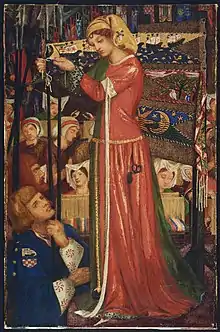
During the Medieval period silk from china allowed a verity of peoples, such as the Arabs and the Norse, to develop flags which flew from poles. Developments in heraldry lead to the creation of personal heraldic banners for rulers and other important people in the European kingdoms. Flags began to be regularly used on board ships for identification and communication in the age of sail. In the 18th century and onwards a rising tide of nationalism around the world meant that common people began to regularly identify them selves with the nation-states and it's symbols including flags. In the modern day, every national entity and many sub-national entities employ flags for identification.
Etymology
The Word 'flag' is derived from the Proto-Germanic, of unknown origin but likely from fflaken or ffleogen which means to fly or flap in the wind. The word first seems to have come into use in the 16th century and soon came to encompass a verity of items, including banners, ensigns, gonfalons and others.[1][2]
Proto-Flags
The origin of flags is unknown. Some of the earliest known banners come from ancient China to identify different parts of the army.[3] For example, it is recorded that the army's of Zhou dynasty in 11th century BC carried a white banner before them, although no depictions exist of it. An early representation of such Chinese flags is on the tomb of Emperor Wu of Han in a relief that shows two horseman bearing banners.[1][4]

Early representations of standards can be found on Egyptian bas-reliefs such as the Narmer Palette which is said to be the earliest representation.[5] These vexilloids, or flag like standards, were symbols of the nomes of pre-dynastic Egypt.[6] In fact, ancient Greek writers attributed the creation of standards to the Egyptians. According to Diodorus, Egyptian standards generally consisted of figures of sacred animals on the end of a staff of spear. Another often used symbol was a figure resembling an expanded semi-circular fan.[7]
Roman Standards
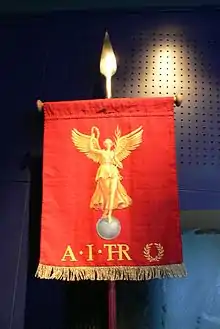
While the Persians used cloth banners to symbolise their armies it was the romans who first made the wide spread use of these symbols to represent there armies. These banners, also known as a Vexillum,[lower-alpha 1] were used to represent each army unit starting around 100 BC.[3][9] The Vexillum was composed of a piece of cloth fastened to a cross bar at the top of a spear, sometimes with fringe around the outside.[10] The only existent Roman vexillum is dated to the first half of the 3rd century AD and is housed in the Pushkin Museum of Fine Arts. It is an almost square piece of coarse linen cloth with the image of the goddess Victoria.[11]
The Roman Emperors used a banner similar in form called a labarum. It frequently bore upon it a representation of the emperor, sometimes by himself and sometimes accompanied by the heads of members of his family. It became associated with Constantine the Great and latter Christianity after he supposedly marched under a labarum bearing the Chi Rho.[12] These Roman standards were guarded with religious veneration in the temples of the metropolis and of the chief cities of the Empire.[13]
Medieval Period
With the innovation of silk in China, and subsequent propagation along the silk road, Flags as we known them to day began to develop.[14] Flags that comprise cloth attached to an upright pole at one side seem to have first been used by the Arabs who introduced it to the west in the 1st century, although they wouldn't be popular there until the 9th century.[3] Tradition holds that green flags were flown Muhammad's followers during the conquest of mecca and there is evidence of such standards being used by the grandson's of the Muhammad, generally triangular and flown from a vertical flag pole.[15][16] subsequent Islamic dynasty used a verity of different coloured banners to identify themselves often drawn from flags supposedly flown by the prophet during his life.[lower-alpha 2][17]
Another 9th century vertical flying flag is the Raven banner that was used widely by the Vikings. Although no complete illustration of this banner exist it probably appears on Northumbrian coins from the start of the century and later, in the 11th century, is most likely seen on the Bayeux Tapestry.[18]
Heraldic flags

A major stage in the development of flags in the west was the art of heraldry. Heraldry, which developed in approximately the second quarter of the 12th century, primarily deals with identification by means of devices placed on shields with these symbols becoming the means by which knights, and later other upper-class individuals became identified. It didn't take long for before these heraldic badges came to be emblazoned on flags. To start with the banners were extensions of the gonfanon, which consisted of a flag tied to a lance, but soon became diverse displays of important people's arms.[19] Traditionally there are several types, such as, pennons, Heraldic standards or Banner of arms.[20]
The pennon, which was a small, elongated flag with either pointed or swallow-tailed end. It would have been charged with the Badge or other armorial ensign of the owner and by displayed upon there lance, as a personal ensign.[21] A banner of arms is square or oblong and larger than the pennon, bearing the entire coat of arms of the owner, composed precisely as upon a shield but in a square or rectangular shape.[lower-alpha 3][22]
.svg.png.webp)
.svg.png.webp)
.svg.png.webp)
The heraldic standard appeared around the middle of the fourteenth century, and it was in general use by personages of high rank during the two following centuries. The standard appears to have been adopted for the special purpose of displaying badges.[23] The standard was often more versatile than a banner of arms because no one could possess more than one banner, since it displayed a set of unchangeable heraldic arms. A single individual, however, could possess as many standards as they wanted, since this flag displayed badges, which could be created at any time the owner wanted. For example, the standards of Henry VII, was mostly green and white (the colours of the Tudor livery) had in one "a red firye dragon" in another "a donne kowe" in a third "a silver greyhound and two red roses."[24]
Heraldic Standards are still in use in Scotland, at Highland gatherings the standard of the clan chiefs is displayed on the pipes of the Pipe major of the clan.[25]
Maritime Flags
Flags have probably been used at sea as a form of communication since the earliest days of trading ships with some evidence of the practice as far back as the ancient Greeks.[20][26] However, as international trade increased, in the Age of Sail in the early 17th century, European ships began displaying flags depicting their nationality or city of origin, as well as showing weather or not they are military or trade ships.[27] These flags eventually evolved into the national flags and maritime flags of today. As early as the 16th century English and Scottish ships were flying flags identifying their country of origin, with designs designs derived from badges worn by their respective soldiers during the middle-ages.[28] Flags also became the preferred means of communications at sea, resulting in various systems of flag signals; see, International maritime signal flags.
National Flags

Originally, flags representing a place would generally be the personal flag of it's rulers, however over time the practice of using personal banners as flags of places was abandoned in favour of flags that had some significance to the nation, often it's patron saint. An early example of this were the Maritime republics, such as Genoa, that could be said to have a national flag as early as the 12th century.[29] However, these were still mostly used in the context of marine identification.
Although some flags date back earlier, Widespread use of flags outside of military or naval context begins only with the rise of idea of the nation state at the end of the 18th century and particularly are a product of the age of revolution. The Revolutions such as those France and America called for people to begin think of themselves as citizens as apposed to subjects under a king, and thus necessitated flags that represented the collective citizenry, not just the power and right of a ruling family.[27][30] With nationalism becoming common across Europe in the 19th century national flags came to represent most of the states of Europe.[27] Flags also came to be used to foster a sense of unity between different peoples, such as the Union Jack representing a union between England and Scotland, or to represent unity between nations in a perceived shared struggle, for example Pan-Slavic colors or later Pan-Arab colors.[31]
As Europeans colonised the most of the rest of the world they exported they ideas of nationhood and national symbols, including flags, with a flag becoming seen as integral to the nation-building process.[32] Political change and social reform and Revolutions, allied with this growing sense of nationhood among ordinary people in the 19th and 20th centuries, led to the birth of new nations and flags around the globe.[33]
With the so many flags being created interest in these designs began to develop and the study of flags, Vexillology, at both professional and amateur levels emerged. After World War II, Western vexillology went through a phase of rapid development with many research facilities and publications being established.[34]
References
Notes
- In medieval times the pastoral staff of the bishop often had a small scarf attached to it. This was known as the vexillum, and was supposed to be derived from the Labarum because of its association with the first Christian emperor, Constantine the Great.[8]
- The Umayyad Caliphate are said to have used white flag to honour the Battle of Badr, Muhamad's first major battle. The Abbasid Caliphate used a Black Standard to set themselves apart from the Umayyads who they overthrew and as a sign of mourning for the deaths of the prophet's relatives at the Battle of Karbala. The Shia Fatimid Caliphate used the white standards as well as green flags as it was thought to be the prophet's favourite colour.[17] See Flags in early Islam for more information.
- "In the olden time, when a Knight had distinguished himself by conspicuous gallantry, it was the custom to mark his meritorious conduct by prompt advancement on the very field of battle. In such a case, the point or points of the good Knight’s Pennon were rent off, and thus the ... small Flag was reduced to the square form of the Banner, by which thenceforth he was to be distinguished" - Boutell (1914), pp. 247–248
Citations
- Barraclough 1971, p. 1.
- Online Etymology Dictionary.
- Jones 2014, p. 10.
- Xing 2013, p. 1.
- Macgeorge 1881, p. 13.
- Slater & Znamierowski 1997, p. 13.
- Macgeorge 1881, pp. 13–14.
- Hulme 1896, p. 2.
- Barraclough 1971, p. 2.
- Macgeorge 1881, p. 24.
- Rostovtzeff 1942.
- Macgeorge 1881, pp. 24–25.
- Hulme 1896, p. 3.
- Marshall 2017, p. 5.
- Barraclough 1971, p. 3.
- Marshall 2017, p. 117.
- Marshall 2017, pp. 116–117.
- Barraclough 1971, pp. 3–4.
- Barraclough 1971, pp. 5–6.
- Jones 2014, p. 11.
- Boutell 1914, p. 246.
- Boutell 1914, p. 247.
- Boutell 1914, pp. 250–251.
- Swinburne 1911.
- Barraclough 1971, p. 7.
- Barraclough 1971, p. 247.
- Nadler 2016.
- Cartledge 2013, p. 2.
- Barraclough 1971, pp. 7–8.
- Inglefield & Mould 1979, p. 48.
- Bartlett 2011.
- Virmani 1999.
- Inglefield & Mould 1979, p. 50.
- Xing 2013, p. 2.
Bibliography
- Barraclough, E.M.C. (1971). Flags of the World. Great Britain: William Cloves & Sons Ltd. ISBN 0723213380.
- Bartlett, Ralph G. C. (2011). Unity in Flags (PDF). 24th International Congress of Vexillology. Alexandria, Virginia: International Federation of Vexillological Associations.
- Cartledge, John (2013). Flags and emblems of the British Republic 1649-1660 (PDF). 25th International Congress of Vexillology. Rotterdam: International Federation of Vexillological Associations.
- Boutell, Charles (1914). Fox-Davies, Arthur Charles (ed.). The Handbook to English Heraldry (11th ed.). Reeves & Turner. Retrieved 23 November 2021.
- Hulme, Frederick Edward (1896). The Flags of the World. Frederick Warne & Co. Retrieved 22 November 2021.
- Inglefield, Eric; Mould, Tony (1979). Flags. Ward Lock. ISBN 9780706356526.
- Jones, Gareth, ed. (2014). Complete Flags of the World. Dorling Kindersley Publishing Staff. ISBN 9781409353713.
- Macgeorge, Andrew (1881). Flags; some account of their history and uses. Blackie & Son. Retrieved 22 November 2021.
- Marshall, Tim (2017). A Flag Worth Dying For: The Power and Politics of National Symbols. London: Eliot & Thompson. ISBN 9781783963034.
- Nadler, Ben (14 June 2016). "Where Do Flags Come From?". The Atlantic. Retrieved 24 November 2021.
- Rostovtzeff, Michael (November 1942). "Vexillum and Victory". The Journal of Roman Studies. Cambridge University Press. 32 (1–2): 92–106. doi:10.2307/296463.
- Slater, Stephen; Znamierowski, Alfred (1997). The World Encyclopedia of Flags & Heraldry (2007 ed.). Fall River Press. ISBN 9781435118386.
- Swinburne, Henry Lawrence (1911). . In Chisholm, Hugh (ed.). Encyclopædia Britannica. 10 (11th ed.). Cambridge University Press.
- Virmani, Arundhati (August 1999). "National Symbols under Colonial Domination: The Nationalization of the Indian Flag, March-August 1923". Past & Present. Oxford University Press (164): 169–197. Retrieved 24 November 2021.
- Xing, Fei (2013). The Study of Vexillology in China (PDF). 25th International Congress of Vexillology. Rotterdam: International Federation of Vexillological Associations.
- "flag". Online Etymology Dictionary. Retrieved 26 November 2021.