History of rock climbing
Although the practice of rock climbing was an important component of Victorian mountaineering in the Alps, it is generally thought that the sport of rock climbing began in the last quarter of the 19th century in at least three areas: Elbe Sandstone Mountains in Saxony near Dresden,[1] the north of England including the Peak district[2] and Lake District,[3] and the Dolomites in Italy.[4] Rock climbing evolved gradually from an alpine necessity to an athletic sport in its own right, making it imprudent to cite a primogenitor of the latter in each of these three locales. Nevertheless, there is some general agreement on the following:
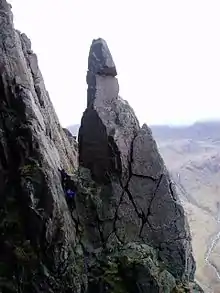
- Heralded as a sport in England in the late 1880s after the (well publicised) solo first ascent of the Napes Needle by Walter Parry Haskett Smith, rock climbing attracted increasing numbers of participants. An early benchmark approaching modern levels of difficulty was the ascent, by O. G. Jones, of Kern Knotts Crack (grade VS) in 1897. Jones was attracted to the new sport by a photo of the Needle in a shop window in the early 1890s. By the end of the Victorian era as many as 60 enthusiasts at a time would gather at the Wastwater Hotel in the Lake District during vacation periods.[5]
- Inspired by the efforts of late 19th century pioneers such as Oskar Schuster (Falkenstein, Schusterweg 1892), by 1903 there were approximately 500 climbers active in the Elbe Sandstone region, including the well-known team of Rudolf Fehrmann and the American Oliver Perry-Smith; their 1906 ascent of Teufelsturm (at grade VIIb) set new standards of difficulty. By the 1930s there were over 200 small climbing clubs represented in the area.[1]
- The solo first ascent of Die Vajolettürme in 1887 by the 17-year-old Munich high school student Georg Winkler encouraged the acceptance and development of the sport in the Dolomites.[4]
| Part of a series on |
| Climbing |
|---|
 |
| Background |
| Types |
| Lists |
| Terms |
| Gear |
As rock climbing matured, a variety of grading systems were created in order to more accurately compare relative difficulties of climbs. Over the years both climbing techniques and the equipment climbers use to advance the sport have evolved in a steady fashion.
Some historical benchmarks
- 1492 : Antoine de Ville ascends Mont Inaccessible, Mont Aiguille, a 300-meter rock tower south of Grenoble, France. Under orders from his king, he used the techniques developed for sieging castles to attain an otherwise unreachable summit. The ascent is described by François Rabelais in his Quart Livre.[6]
- 1695 : Martin Martin describes the traditional practice of fowling by climbing with the use of ropes in the Hebrides of Scotland, especially on St Kilda.[7]
- 1786 : The first ascent of Mont Blanc is often referred to as the start of mountaineering's “modern era”. It took another century before history documents the use of devices similar to today's fixed anchors: pitons, bolts and rappel slings.
19th century
- By the 19th century, climbing was developing as a recreational pastime. Equipment in the early 19th century began with an alpenstock (a large walking stick with a metal tip), a primitive form of three-point instep crampon, and a woodcutter's axe. These were the tools of the alpine shepherd, who was shortly to move from guiding sheep to guiding men, a much more lucrative enterprise. With time the alpenstock and the axe were combined into one tool: the ice-axe. Add a large, thick (and weak) rope, to help the client climb, and guide and novice were off to the mountains.[6]
- 1848 : Sebastian Abratzky, a local chimney sweep, enters Königstein Fortress by climbing one of the chimneys in the sandstone faces of the plateau to avoid paying an entrance fee. This is now considered historically the first free climb in the Elbe Sandstone Mountains and still a climbing route known as Abratzkykamin (IV (ca 5.4)).
- 1857 : Monte Pelmo was one of the first major Dolomite peaks to be climbed, by John Ball, the later president of the UK's Alpine Club.[8]
- 1859 - 1869 : Paul Grohmann makes numerous first ascents in the Dolomites, such as Tofana, Sorapiss, Cristallo and Langkofel.[8]
- 1864 : Gustav Tröger, Ernst Fischer, J. Wähnert und H. Frenzel, members of the local gymnastics association in Bad Schandau, climb the Falkenstein with artificial aid like ladders after several failed attempts. This is nowadays considered the start of rock climbing as a sport in the Elbe Sandstone Mountains. The Turnerweg (III (ca 5.3)) remains the easiest route to the top.
- 1869 : John Muir, famed naturalist and climber, wearing hiking boots, makes the first ascent of Cathedral Peak in Tuolumne Meadows as an on-sight, free solo.
- 1874 : Otto Ewald Ufer and H. Frick make the first ascent of Mönch. This is the first free ascent of a climbing rock in the Elbe Sandstone Mountains without artificial aid for sport.
- 1875 : Half Dome in Yosemite National Park was climbed by George Anderson. He used eye bolts in drilled holes as hand and toe holds. He used a fixed rope to return to his high point each day.[9][10][11]
- 1876 : Donald McDonald a crofter from The Isle of Lewis climbs the great stack of Handa after rowing across. This is thought to be the first recorded climb for leisure in the country.[12] The feat was recreated by modern climbers in the show The First Great Climb for BBC2, which showed the difficulty of such a task.[13] This could also be considered the start of the Sport of Rock Climbing.
- 1876 : Jean Charlet-Straton invents the basic body rappel in the French Alps. It is improved by Hans Dülfer about 1910.
- 1880s : The Sport of Rock Climbing begins in the Lake District, Peak District and Wales in Great Britain, Saxony near Dresden, and the Dolomites. W. P. Haskett Smith is frequently called the Father of Rock Climbing in the British Isles, and Oskar Schuster was an early climber in the Elbe Sandstone Mountains.
- 1881 : Benedikt Venetz leads Albert Mummery and Alex Burgener, all wearing boots with nails, up the first ascent of Aiguille Grepon, Chamonix, about 10 pitches total, via the crux, 40-foot Fissure Mummery, 5.7 R/X.
- 1881 : Michael Innerkofler and Hans Innerkofler as the first people on the Kleine Zinne (Cima Piccola/little peak - Tre Cime di Lavaredo). With 5.5, it was a tremendous climbing achievement for the time.[14]
- 1886 : W. P. Haskett Smith makes the first ascent (in free solo style) of the 70-foot Napes Needle (V Diff, about 5.5), in the Lake District of England. The resulting publicity introduces the general British public to the new sport of rock climbing.
- 1887 : Georg Winkler, at the age of 17, makes the first ascent - free solo - of Die Vajolettürme (about 5.6, seven pitches) in the Dolomites, initiating the sport of rock climbing in that area.
- 1892 : Oscar Eckenstein, a British climber and early bouldering advocate, conducts a bouldering competition, with cash prizes, among the natives while on an expedition to the Karakoram Mountains. ().
- 1893 : Lily Bristow is the first female to summit the difficult Aiguille Grepon, Chamonix.
- 1893 : Devils Tower is first summited by ranchers William Rogers and Willard Ripley through the use of wooden spikes pounded into a crack and then connected with a rope. After 6 weeks they summited on the Fourth of July.[9][15]
- 1897 : O. G. Jones leads, after a top rope ascent, Kern Knotts Crack VS 4b (ca 5.7) on the Great Gable in England
20th century
- 1900 (approximately) : Oscar Eckenstein demonstrates to British climbers the concept of modern balance climbing on his eponymous boulder in Wales. ()
- 1900 : Tita Piaz initiates, on Punta Emma, Piaz Route, free solo, 5.7-5.8, seven pitches in the Dolomites, Italy.
- 1900 : Rock climbers in the Dolomites start using rope-soled or felt-soled espadrilles instead of nailed boots.
- 1900 : Heinrich Pfannel, Thomas Maischberger, Franz Zimmer do the FFA of Dent du Geant, Southwest Face, Chamonix, France, bypassing the spikes, ropes and ladders used on the FA.
- 1901 : Michele Bettaga, Beatrice Tomasson, Artolo Zagonel make the first ascent of the 24-pitch South Face of Marmolada, Dolomites, (5.5, using only 4 piton/rings for anchors) in a day.
- 1906 : Oliver Perry-Smith, W. Huenig, Rudolf Fehrmann climb, Teufelsturm in the Elbe Sandstone Mountains. About a 60-foot climb. VIIb (with original shoulder stand c. 5.8+ X, now 5.9).
- 1908 : Tita Piaz, J. Klammer, R. Schietzold, Franz Schroffenegger make the first ascent of West Face of Totenkirchl, Austria, UIAA Grade V (5.7 X) 450 meters, 19 pitches. Perhaps the hardest long rock climb.
1910s
- 1910 : Hans Fiechtl replaces the attached ring on pitons with an eye in the body of the piton - a design used to this day.[6]
- 1910 : Otto Herzog designs the first steel carabiner, specifically made for climbing.[6]
- 1910 : Oliver Perry-Smith, Max Matthaeus, H. Wagner ascend The Grosser Falknerturm, Matthäusriß in the Elbe Sandstone Mountains, VIIb (5.8/5.9 X), 200-foot crack and chimney climb.
- 1910 : Max Matthäus leads Südriss on Kreuzturm VIIc (5.9+) Elbe Sandstone Mountains.
- 1910 : Angelo Dibona, G. Mayer, M. Mayer, A. Dimai, L. Rizzi climb North Face Cima Una, Dolomites, UIAA V+ (5.8) 2500 feet.
- 1910 : Franz Schroffenegger, Franz Wenter climb Northwest Face Delago Tower, 450 meters and later, North Face Croda di Re Laurino, 500 meters, Dolomites. Each climb has a crux UIAA Grade VI- (5.9- X).[16]
- 1911 : Paul Preuss makes the first ascent of the East Face of Campanile Basso, Italian Dolomites, free solo, with a pack and coiled rope over his shoulder, 900 feet, 5.7 on friable rock, then solos back down his route.[6]
- 1912 : Meije south face, by Angelo Dibona with Luigi Rizzi, Guido and Max Mayer[17]
- 1913 : Hans Dülfer on sights, free solo, Dulferriss on Fleischbank, Austria, UIAA VI- (5.9-) 6 pitches, 250 meters.
- 1913 : Hans Dülfer, Willi von Redwitz, after a rappel inspection, climb Direct West Face, Totenkirchl, Austria, UIAA V+ (5.8 R/X and two pendulum rope swings), 700 meters, 23 pitches in 8 hours. Longest rock climb to date.
- 1913 : Hans Dülfer leads West Face of Cima Grande, 5.8 R/X, 8 pitches, Dolomites. He uses equipment for unclimbable rock, creates a 5-step grading system, invents rope pendulum and dülfersitz rappelling techniques.[6]
- 1913 : Rudolf Fehrmann publishes the second edition of the guide book "Der Bergsteiger in der Sächsischen Schweiz" (The Climber in Saxon Switzerland), which includes the first binding rules for climbing in the area to protect the soft rock. These include that only natural holds of the rock are allowed for climbing. These rules for Free climbing are still in use and haven't changed significantly.
- 1911 : Paul Preuss, an advocate of pure Free climbing, uses the term "artificial aid" to describe the use of mechanical aids, either to protect or progress up (or down!) a rock. His rule number four (of six) stated: "The piton is an emergency aid and not the basis of a system of mountaineering."[6]
- Note: The two principal uses of pitons on an ascent are as protective safeguards (not used for actual hand or footholds - climbers refrained from putting weight on them except in the event of a fall) and as direct aid (used to physically assist in ascending a steep or overhanging slope rather than merely as protection). Climbers like Paul Preuss and Geoffrey Winthrop Young argued strongly against direct aid, but others of that era, including Hans Dülfer and Tita Piaz, advocated using such devices as artificial aids in order to climb otherwise unscalable walls. After World War I most European climbers chose to employ artificial aid when necessary. However, from the beginning days of rock climbing as a sport, through the 1940s, another form of artificial assistance was at times employed by teams of two or more climbers: the shoulder stand. From our current perspective it seems odd that many of those climbers who strenuously objected to hanging on a piton found the shoulder stand to be quite acceptable. Occasionally, historical climbing photos, (e.g., ) illustrate this strategy, which arose from the perception that ascending a route was a team effort, with two climbers constituting one natural climbing unit. Something to keep in mind when reading of very early climbs in the 5.8 to 5.10 range.
- 1914 : Siegfried Herford and companions climb, using shoulder stands, the Flake Pitch on Central Buttress of Scafell (5.8 A0, 5.9 today), England's hardest climb at the time. 3 pitches.
- 1916 : Ivar Berg climbs, free solo, Cave Arête Indirect E1 5a (5.9+) about 60 feet, at Laddow Rocks, Derbyshire, England, the first E1.[18]
- 1918 : Emanuel Strubich ascends, unprotected, Wilder Kopf, Westkante in Elbe Sandstone Mountains, VIIIa (5.10b X), two pitches, world's hardest short climb at the time. Two protection rings added years later.
1920s
- 1920s - 1930s : Robert L. M. Underhill and Miriam Underhill (Miriam E. O'Brien) - One of the early rock star climbing couples. Robert is remembered for introducing European climbing techniques to the west coast of the US through an article in the 1931 Bulletin of the Sierra Club.
- 1921 : Otto Herzog and Gustav Haber open Ha-He Dihedral UIAA VI (5.9+) Dreizinkenspitze, Austria,1000 Feet, in 2 days of climbing. Not repeated for three decades.
- 1922 : Hans Rost leads, with 2 protection rings, the overhanging arete Rostkante on Hauptwiesenstein, VIIIb (5.10d R), 90 ft. Elbe Sandstone, world's hardest short route for years. First 20 feet protected by a rope in a tree.
- 1922 : Paul Illmer and party ascend the Illmerweg on Falkenstein, VIIc (5.10a X), Elbe Sandstone Mountains
- 1923 : Willo Welzenbach, adding to Dülfer's five grades, creates the Roman Numeral, European rating system for difficulty of a section of a rock climb (Grades I to VI)[6] This system eventually became UIAA grading.
- 1925 : Fritz Wiessner and Roland Rossi ascend, on solid rock, the Southeast Face of Fleischbank, Austria, UIAA VI+ (5.10a). With 6 of 11 pitches at Grade VI, perhaps the most continuously difficult route.
- 1925 : Emil Solleder and Fritz Wiessner climb Furchetta North Face, Dolomites, a 20-pitch route with some poor rock and two pitches of UIAA VI (5.9 X) near the top, 750 meters.
- 1925 : Gustav Lettenbauer, Emil Solleder, climb Northwest Face of Civetta, Dolomites in a day, UIAA VI- (5.9 X), 1200 meters, 44 pitches, mostly moderate, some loose and wet rock, only 15 pitons for protection or belays.[6]
- 1925 : Albert Ellingwood and a party of three climb the 2000-foot Northeast Buttress (5.7) of Crestone Needle (14,197 feet).
- 1927 : Laurent Grivel designs and sells the first rock drill and expansion bolt.[6]
- 1927 : Joe Stettner and brother, Paul, apply European techniques in the USA on their ascent of the 9-pitch Stettner Ledges (5.7) on the East Face of Long's Peak.[9][10]
- 1927 : Fred Pigott's experiments with slinging natural chockstones and later machine nuts, for protection at Clogwyn Du'r Arddu on Snowdon, directly led to the development of the modern climbing nut.[6]
- 1929 : Luigi Micheluzzi, Demitrio Christomannos, Roberto Perathoner make, in 2 days, the first ascent of the South Pillar of the Marmolada, 5.9 and a little aid, 600 Meters, Dolomites.[6][19]
- 1929 : Miriam Underhill and Alice Damesme make the first "manless" ascent of the Aiguille Grepon, Chamonix.
1930s
- 1930 : Jack Longland leads, on sight, Javelin Blade E1 5b (5.10a X), Hollytree Wall, Idwal. Forty-foot runout at the crux on pitch two.
- 1931 : Emilio Comici and the Dolomites. Comici is the inventor of multi-step aid ladders, solid belays, a trail/tag line, and hanging bivouacs. Pretty much the origin of big wall climbing and techniques. He uses them first on the longest rock climb, a 3-day, 57-pitch, 1500 meter route, mostly free (5.9+ with 3 aid sections, only 35 pitons) on Northwest Face of the Civetta.[6]
- 1931 : Robert Underhill leads the first ascent of the North Ridge of Grand Teton, WY. About 1,500 ft. (5.7)
- 1931 : Glenn Exum makes the first ascent of Exum Ridge, free solo, (5.5), 11 pitches, on the Grand Teton, WY.
- 1932 : Giovanni Vinatzer, Giuani Rifesser climb Furchetta North Face route, Dolomites, adding a continuous, dangerous, 5-pitch direct finish, UIAA VII- (5.10b/c X), only 5 new protection pitons. Not repeated for 20 years.
- 1933 : Emilio Comici, Giuseppi Dimai, Angelo Dimai climb, in 3 days, mostly free using 70 pitons, the classic North Face of Cima Grande, Dolomites, 5.9 and three aid pitches. 1700 feet. World's most overhanging long route.
- 1933 : Giovanni Vinatzer and Vincenzo Peristi climb the North Face of Stevia, Dolomites, UIAA VII- (5.10c), 6 pitches total with 3 cruxes, VII-, VI+, VI+.
- 1934 : Pierre Allain champions bouldering at Fontainebleau; climbs L'Angle Allain (V2)
- 1934 : Dick Leonard, teams up with Jules Eichorn and Bestor Robinson for the first ascent of the Eichorn Pinnacle of Cathedral Peak in the Sierra Nevada. He also creates the concept and practice of the dynamic belay at Indian Rock.[9]
- 1934 : Raffaele Carlesso, Bartolo Sandri ascend, in 2 days, the South Face of Torre Trieste, Dolomites, 750 meters 35 pitches, UIAA VI+ (5.10b/c) and a bit of aid, using only 45 pitons.
- 1935 : Pierre Allain, adding a rubber rand to a tennis shoe to prevent side wear, makes a soft-soled, rubber climbing shoe. In 1947 with Edmond Bourdonneau, he markets an improved, stiffer, flat-soled shoe, the PA.
- 1936 : Giovanni Vinatzer and Ettore Castiglioni free climb, on excellent rock in two days, a 29-pitch route on the Marmolada, Dolomites, UIAA VII- (5.10c). Hardest long, totally-free climb in the world.
- 1937 : Vitale Bramani creates, and starts selling, the first leather boots with lug-soled (called tank-tread) rubber for rock climbing, mountaineering and hiking, the Vibram sole.
- 1937 : Emilio Comici re-climbs his route on Cima Grande alone, with some gear but no rope, mostly free (5.9) but pulling on some pitons, in three and a half hours.
- 1938 : Riccardo Cassin, Gino Esposito, Ugo Tizzoni ascend, ground up in 3 days, the classic, alpine, 3,500-foot Walker Spur of the Grandes Jorasses "...perhaps the finest in existence" - Gaston Rebuffat.
- 1939 : David Brower and the rest of his Berkeley crew use four bolts in the process of ascending Ship Rock in New Mexico.[9][10]
1940s
- 1940s : World War II leads to the development of inexpensive, army-surplus pitons, carabiners and the newly invented nylon rope, making leader falls significantly safer.[6]
- 1945 : Chris Preston, after a top rope ascent, leads, with no protection, the two pitches on Suicide Wall (E2 5c (5.10d X)) Ogwen, Wales
- 1945 : Herb Conn leads Leonard's Lunacy at Carderock MD USA, 50 feet, first 5.10 in USA possibly.
- 1946 : Mathias Rebitsch and Sepp Spiegl create an 8-pitch route on Fleischbank, Austria, UIAA VII (5.10d) with four hard pitches: VII, VII-, VI, VI-
- 1946 : Rene Ferlet climbs Marie-Rose (V3/V4) Fontainebleau.
- 1946 : John Salathe, at the age of 46, attempts to rope-solo aid the first ascent of the Lost Arrow Spire, one of the most exposed features in Yosemite Valley. (The protection bolt he places on that attempt was the first, or one of the first, in the valley.) He is also known for the first re-usable forged pitons, made from the axle of a Model A Ford.[9][10]
- 1947 : Pierre Allain, in France, and Raffi Bedayn, in USA, start marketing their own lightweight, aluminum carabiners for climbing. This allows a significant reduction in weight carried by lead climbers, especially on Big Walls.
- 1947 : Mathias Rebitsch, Franz Lorenz pioneer Nordverschneidung, 750 meters, some poor rock, on Lalidererspitze, Austria. UIAA VII+ (5.11a R). Probably the world's hardest long free climb, with several pitches of VII and VI+.
- 1949 : Harold Goodro leads Goodro's Wall, 5.10b/c, Big Cottonwood Canyon, UT, 80 feet.
- 1949 : Peter Harding leads, using a shoulder stand to start, the poorly-protected Demon Rib (E3 5c (5.10d R)) after a top-rope ascent, 60 feet, Black Rocks, Derbyshire, UK
1950s
- 1950 : John Salathe and Allen Steck climb Steck-Salathe on Sentinel Rock, Yosemite, 5.8 A3, in a 5-day push. 16 pitches. Yosemite's longest wall climb.
- 1951 : Joe Brown pioneers, on sight, Right Eliminate (E3 5c (5.10d R)) Curbar Edge, UK, a poorly-protected off-width crack that is 50 feet long.[20]
- 1952 : Lionel Terray, Guido Magnone make the first ascent of Monte Fitzroy (11,020 feet), Patagonia, 16 pitches of Alpine rock climbing, 5.9 with some aid.
- 1952 : Bonnie Prudden leads the first ascent of Bonnie's Roof, (5.8, A0) Shawangunks, NY. 2 pitches.
- 1952 : John Streetly leads, onsight, the FA of Bloody Slab (E3 5b (5.10a X)) Llanberis Pass, Wales
- 1952 : A Climber's Guide to Tahquitz Rock is published, laying out the beginnings of the Yosemite Decimal System.[21] Royal Robbins leads the FFA of Open Book, Tahquitz CA, California's first 5.9.
- 1952 : Cesare Maestri makes the first free solo ascent of the 44-pitch Solleder Route on Civetta, Dolomites, UIAA VI- (5.9-).
- 1952 : Joe Brown, threading pebbles for protection in wet conditions, leads Britain's most famous pitch, Cenotaph Corner, 140 ft., resting on 2 pitons at the very top, 5.9 A0. (5.10b today)
- 1952 : Harry Rost leads Talseite Schwager, Elbe Sandstone, 50 meters, 2 protection rings. Even with shoulder stands at three cruxes it is rated VIIIc (ca. 5.11a R/X). Soon done all free IXa (5.11b/c R) World's hardest short route.
- 1952 : Hermann Buhl, after riding his bike 100 miles from Austria, free solos the FFA of Piz Badile on the 8th ascent, UIAA VI+ (5.10a), 21 pitches in 5 hours, then rides back home.
- 1953 : Robert Paragot climbs Le Joker (V5) Fontainebleau
- 1953 : Edelrid Corp. invents the "Kernmantel" rope with an abrasion-protective outer sheath, making nylon ropes even safer.
- 1954 : Joe Brown and Don Whillans climb the West Face of Aiguille de Blaitiere, 15 pitches including the famous Fissure Brown (5.10b R), in the Alps.
- 1954 : Mark Powell, to supplement the Decimal System technical grade, adds a grade for route length/commitment in Yosemite, using Roman Numerals. Grade I (for 1 pitch climbs) to Grade VI ( for multi-day climbs).
- 1955 : Walter Bonatti Considered one of the greatest climbs of all time, his solo, Big Wall, first ascent of a new route (free and aid) on the Southwest Pillar of the Dru takes six days.
- 1955 : John Gill introduces chalk & modern dynamics to bouldering; first V8 (1957), V9 (1959) These are the world's hardest boulder problems for nearly 20 years. [9][22][23]
- 1957 : Layton Kor appears in the climbing community of Colorado and gains recognition as an outstanding climber. Makes speedy, landmark first ascents, including the West Buttress of El Capitan (1963), Chief's Head (1961), Standing Rock (1962), and the Yellow Wall on Long's Peak (1962). Kor is noted as one of the key forces behind the progression of climbing in the western USA.[9]
- 1957 : Walter Philipp, Dieter Flamm, in 2 days, climb Philipp-Flamm on Civetta, 3100 ft. UIAA VI+ (5.10b R) & a bit of aid. 44 pitons for belays. Only 43 pitons for protection in 40 pitches. Most serious Alpine free climb.
- 1957 : Royal Robbins, Jerry Gallwas, Mike Sherrick climb the NW Face of Half Dome, Yosemite, in a single push of 5 days. 25 pitches, 5.7 A3, many pitons and about 15 direct aid bolts.[24]
- 1958 : Warren Harding and team climb the 3,000 foot Nose of El Capitan using siege tactics, taking a total of 45 days over an extended period. Almost entirely aid climbing with 600 pitons and many bolts (125), the climb is given worldwide recognition. 5.8 A3
- 1958 : Don Whillans climbs, free solo, Goliath (E4 5c/6a (5.11a R)), Burbage, (now South Yorkshire), UK, a wide, overhung, 30-foot crack.
- 1959 : Royal Robbins and Tom Frost free climb Steck-Salathe route on Sentinel Rock, Yosemite, all except 30 feet. 16 pitches. Six pitches of 5.9 or 5.10a.[19] Most strenuous multi-pitch free climb in America.
- 1959 : John Gill free solos, on sight, Sometime Crack, 5.10b/c (R/X as a solo) at Devil's Lake, WI, a 40-foot, overhanging crack.
- 1959 : Ray Northcutt free climbs, after a couple tries, the 50-foot, Direct Start to Bastille Crack (5.10d) in Eldorado Canyon, Colorado. This was the hardest, short free climb in North America at the time.[25]
1960s
- 1960 : Dave Rearick and Bob Kamps make the first ascent of the Diamond (5.8 A3), Longs Peak, CO, a 10-pitch, alpine, Big Wall climb all above 13,000 feet of altitude.
- 1961 : Royal Robbins, Chuck Pratt, and Tom Frost, after fixing 9 pitches, ascend the 3,000-foot, Salathe Wall on El Capitan in a 6-day push (484 pitons, 13 bolts). 5.9 A4 Continuous ascent by Robbins & Frost in 1962.[26]
- 1961 : Allan Austin free solos, after a top rope ascent, Wall of Horrors, E3 6a (5.11c X) Almscliffe, UK, 60 feet.
- 1961 : John Gill makes the unrehearsed, first ascent of The Thimble, 5.12a R/X, solo, wearing PA shoes and using some chalk, 30 feet high, SD, USA. Hardest short climb in the world.[27]
- 1962 : Barry Brewster free climbs Vulcan (E4 6a, 5.11c) at Tremadoc, Wales, a former aid pitch with many pitons already in place (almost a Sport Climb).
- 1962 : Layton Kor, Bob Culp, Rick Horn climb the classic Naked Edge. 8 pitches total, 5.8 A4, Eldorado Springs CO
- 1964 : Royal Robbins and Pat Ament free climb Athlete's Feat, Boulder CO. Five very short, hard pitches (5.11a. 5.10d, 5.10d, 5.10c, 5.9).[25] Most difficult multi-pitch in USA.
- 1964 : Robbins, Pratt, Frost, and Yvon Chouinard climb, single push, the 28-pitch North American Wall on El Capitan,[26] 5.8 A5 Maybe the hardest aid climb in the world.
- 1965 : Frank Sacherer and Eric Beck do the FFA of the Direct North Buttress, Middle Cathedral Rock, Yosemite, 5.10c, 17 pitches. One pitch of 5.10c and six pitches of 5.9. Hardest long free route in USA.
- 1965 : Fritz Eske leads, resting briefly on one sling, the strenuous Königshangel 80 feet on Frienstein in the Elbe Sandstone Mountains, IXa (5.11b/c)
- 1965 : Europe's biggest vertical rock face, Norway's Troll Wall, climbed simultaneously by Norwegian and British teams. Not a race, but Norwegians summited the day before the Brits. Norwegian climbers, Leif Normann Eriksen, Ole Daniel Ennersen, Odd Eliassen and Jon Teigland. The English, Bill Tweedale, John Ammatt and Tony Howard. Tony Nicholls had been on first attempt and lead what was one of the hardest pitches on the wall but when the four retreated in foul weather, 'Nick' trashed his hands so badly he couldn't return.
- 1965 : Yvon Chouinard, T M Herbert ascend, in a single push, the 32-pitch Muir Wall on El Cap, 5.9 A5. First new El Cap route by a party of two.
- 1965 : Chuck Pratt and Chris Fredericks climb the classic, 2-pitch, off-width Twilight Zone in Yosemite, 5.10c/d X.[24]
- 1965 : Greg Lowe free climbs the USA's first roped 5.11c with his on sight ascent of Crack of Doom at City of Rocks, Idaho.
- 1966 : Chris Fredericks and Jim Logan complete the FFA of Crack of Fear on sight, 5.11a/b, Rocky Mountain NP, CO. 3 pitches. Perhaps the hardest off-width in US.[25]
- 1967 : Pat Ament leads the FFA of Country Club Crack (5.11c) Boulder CO. First route in USA with two 5.11 pitches.
- 1967 : Pete Cleveland climbs Superpin in the Black Hills (5.11X)[9] 80 feet high. No protection after the first 30 feet. Most daring first ascent in USA. Unrepeated for many decades.
- 1967 : John Stannard leads first free ascent of Foops, 5.11d, Shawangunks, after several falls. Hardest roped pitch in USA. Eight-foot horizontal roof a major mental breakthrough in world free climbing.[28]
- 1968 : Joining the French boulderers and British climbers, American free climbers begin to adopt the smooth-soled climbing shoe (PA, RD, EB, etc.), instead of the European kletterschuh.
- 1968 : Greg Lowe and Jeff Lowe free climb Macabre Wall, Ogden UT, five total pitches (5.12a, 5.11d, 5.10d and 2 very easy pitches). Probably the most difficult multi-pitch climb in America.
- 1968 : Royal Robbins solos on aid the second ascent of Muir Wall on El Capitan,[26] and is forced to add an aid bolt at the crux. The first time El Cap is climbed alone. Nine days on the wall.
- 1968 : Tom Proctor leads Our Father (E4 6b/5.12a R), 60 feet, at Stoney Middleton, UK, after placing 2 protection pitons and a sling runner on rappel.
- 1968 : Reinhold Messner leads, on sight, a 12-foot, crux slab on Central Pillar of Heiligkreuzkofel, UIAA VIII (5.11c R), 7 free pitches, one rope pendulum total, Dolomites. Technically, the hardest free pitch in the Alps.
- 1969 : Pete Cleveland top ropes, after much work, Bagatelle (5.12c/d) about 50 ft. at Devil's Lake, Wisconsin, ushering the 5.12+ grade to the world. First led, after rehearsal, by Tom Deutchler in 1981 (5.12d X).
1970s
- 1970 : Bernd Arnold climbs, barefoot using 6 protection rings, the North face on the Schwager, 200 feet, in the Elbe Sandstone Mountains, IXb (5.11d R).
- 1970 : Warren Harding and Dean Caldwell ascend, ground up in 27 days, Wall of Early Morning Light, El Capitan, Yosemite. 28 pitches. 5.8 A5 with many bolts. Most days ever spent on a wall.
- 1971 : Peter Haan leads, on sight, the FFA of the 3-pitch Left Side of the Hourglass, Yosemite, 5.11a R/X.[24]
- 1971 : Al Rouse climbs Positron (E5 6a / 5.11 A1) Gogarth, Anglesey.
- 1971 : John Stannard starts the "Clean Climbing" movement in US with his publication Eastern Trade. A year later, Doug Robinson coins the term "Clean Climbing" in Chouinard catalog.
- 1972 : Jimmie Dunn creates the 25-pitch Cosmos, 5.9 A4. The first time a new El Capitan aid route is done solo. Charlie Porter solos Zodiac, 5.9 A4 later the same year.
- 1973 : Jim Erickson establishes the Cassandra roof crack, 5.11a/b free solo, on sight, 3 pitches, on Ralston Buttes, Colorado.[27] Perhaps the first free solo at 5.11.
- 1973 : John Bragg free climbs the 20-foot, Kansas City roof in the Shawangunks, 5.12b/c after some falls.[27][28] (Also, chalk use on roped climbs becomes more accepted, making routes a bit easier)
- 1973 : Beverly Johnson repeats the New Dimensions route, 5.11a Yosemite CA.. Diana Hunter repeats, on sight, Wide Country route, pitch one, 5.11a/b, Eldorado Springs CO.[25] Hardest female free climbs in USA.
- 1973 : John Long leads the FFA, after placing protection on rappel & heavily taping his gloved hands to fit the crack, of the 15-foot roof, Paisano Overhang, 5.12c Tahquitz/Suicide CA. Perhaps the hardest off-width crack.
- 1973 : Beverly Johnson and Sibylle Hechtel are the first female team to ascend El Capitan following the Triple Direct route, Yosemite.
- 1973 : Henry Barber, after getting a little beta on the climb, free solos, on sight, Steck-Salathe route on Sentinel Rock, Yosemite 5.10a 16 pitches. First free solo of a big wall in the USA.
- 1974 : Steve Wunsch ascends Super Crack, 5.12d, Shawangunks, USA, 60 feet, after several falls.[27][28]
- 1974 - 1977 : Jim Holloway establishes - in Colorado - the hardest bouldering problems in the world, at the time. These include Slapshot (V13) and Meathook (V11),[22][23]
- 1975 : David Breashears creates Perilous Journey, 5.11c X, on Eldorado Mountain, CO. On sight, 100 feet, no protection.[25] Perhaps the boldest First Ascent of the 70s.
- 1975 : Charlie Porter aid solos the remote, Big Wall, Northwest Face Mount Asgard, Baffin Island, 40 pitches, 5.10 A4. Alone for 9 days climbing and 41 more days carrying loads in and out.
- 1975 : Ron Kauk, John Bachar, John Long, alternating pitches, lead free all 12 pitches on Astro Man, (5.11c) Yosemite, following the pitches on aid. Five pitches of 5.11. First individual free ascent by Kauk in 1977[29]
- 1976 : Art Higbee, Jim Erickson, after ground-up attempts, both free climb all the 25-pitch NW Face Half Dome, Yosemite 5.12d (newer variations are 5.12a), leading all but the final 10 ft.[30] Four pitches of 5.12, four of 5.11.[31]
- 1976 : Mick Fowler leads, after rehearsal, FFA of Linden, Curbar Edge, UK. E6 6b (5.12a X) 60 ft.; Ron Fawcett solos Slip 'n' Slide E6 6a (5.11c X) 35ft., Crookrise, UK; Steve Bancroft solos Narcissus E5 6b (5.11d R),25 ft.Froggatt, UK
- 1977 : Helmut Kiene, Reinhard Karl make the first ascent of a 10-pitch climb with off-width crux, Pumpriße UIAA Grade VII (5.10d/5.11a) Austria, using nuts for protection.
- 1977 : Dale Bard, John Lakey, lead the Owl Roof, 5.12d, 2 pitches, after several tries. Yosemite's hardest off-width crack.
- 1977 : Ray Jardine climbs Phoenix (5.13a), after chiseling a couple holds at the start and ten days of work, in Yosemite Valley. The beginning of "hangdogging" by some climbers on free climbing projects in the US.
- 1977 : Barbara Devine is the first female to redpoint the route Kansas City (5.12b/c), Shawangunks,USA
- 1978 : Ray Jardine begins selling the first modern spring-loaded camming device (SLCD or cam), which he invented several years earlier.
- 1978 : John Long leads the FFA of The Hangover Tahquitz Rock CA free, 5.13a, after a few tries. Probably the first 5.13 that was not chiseled.
- 1978 : Dave Diegelman, Dale Bard, Jim Bridwell climb Sea of Dreams on El Cap, Yosemite, 5.9 A5 in 10 days. 27 pitches, only 39 drilled holes. Probably the world's hardest aid route.
- 1979 : Tony Yaniro leads the FFA of Grand Illusion, Sugarloaf (CA), 5.13b[9] after pre-placing pieces of protection and many days of work. 50 feet.
- 1979 : Lynn Hill leads Ophir Broke, 5.12c/d, Telluride, CO, the most difficult first ascent ever led by a female.
- 1979 : John Bachar , after rehearsals, does the first free solo of the 3-pitch Nabisco Wall via Butterballs (5.11a, 5.11c, 5.11a) Yosemite.
1980s
- 1980 : Boreal introduces the first "sticky rubber" shoe, the Fire. The new rubber instantly adds one or two grades to "free" climbing ability on most routes.
- 1980 : Patrick Edlinger on sights the Sport Climb La Polka des Ringards, 7b+ (5.12c) Buoux, France.
- 1980 : John Redhead, climbs, after inspection, The Bells, The Bells Gogarth, Wales. E7 6b (5.12c X)
- 1980 : Bill Price climbs Cosmic Debris, Yosemite, 5.13b[9] after some work. 80 feet.
- 1980 : John Bachar, climbing on sight, is the first to free solo Moratorium, Yosemite, 3 pitches, 5.11b.
- 1981 : Steve Hong climbs Sphinx Crack, 5.13b South Platte, CO, after many days of work.
- 1981 : Maurizio Zanolla (Manolo) climbs Il mattino dei maghi, Totoga, Italy, 7c+ (5.13a R/X) with only 4 protection bolts, placed on rappel, (only 2 spit) on 130 feet route.
- 1981 : John Bachar, Dave Yerian ascend Bachar-Yerian, 5.11c/d R/X, ground up, in Tuolumne, Yosemite. 4 pitches. Way run-out. Protection bolts drilled from hooks.
- 1982 : Leonard Coyne and Randy Leavitt establish Stratosfear, 5.11d R/X Black Canyon, CO, 30 pitches, after a rappel inspection on a couple of the top pitches.[25] Most serious grade VI free climb in USA.
- 1983 : Ron Fawcett, after a rappel inspection, leads Master's Edge at Millstone Quarry in the Peak District, graded E7 6c (5.12c X) 70 ft.
- 1983 : Alan Watts introduces sport climbing to the US, with Watts Tots, 5.12b at Smith Rock, Oregon[9]
- 1983 : Bernd Arnold climbs barefoot, without chalk, Schallmauer on Amselspitze, Elbe Sandstone Mountains. (first Xa in the area, ca 5.12c)
- 1984 : Jerry Moffat redpoints The Face, 5.13c Altmuhltal, Germany. (By the mid-80s, advances of ultimate difficulty occur on rehearsed, bolt-protected, one-pitch Sport Climbs.)
- 1984 : Lynn Hill leads the trad climb Vandals, 5.13a, Shawangunks, USA after some work.[27]
- 1984 : Jerry Moffat repeats, on sight, the Sport Climb Pol Pot, 7c+ (5.13a) Verdun, France and the trad climb Phoenix (5.13a) Yosemite.
- 1984 : Martin Scheel redpoints a nine-pitch sport climb Amarcord 7b+ (5.12c) Rätikon, Switzerland.
- 1985 : Peter Croft free solos, after rehearsal, the Rostrum, North Face route, 5.11c in Yosemite Valley. 6 pitches.
- 1985 : John Bachar free solos the established route Father Figure (5.12d/13a), 60 feet, Joshua Tree NP, after rehearsals.
- 1985 : Russ Clune, after rehearsals, free solos the classic route Supercrack 5.12d, Shawangunks NY .
- 1985 : Wolfgang Güllich climbs Punks in the Gym, Mt. Arapiles, Australia (some say the first 5.14a/b some say 5.13d)
- 1986 : Luisa Iovane redpoints her new sport route Comeback (5.13b) Valle San Nicolo, Italy.
- 1986 : Johnny Dawes leads, after rehearsals, the trad route Indian Face, Clogwyn Du'r Arddu, Wales. E9 6c (5.12c X)
- 1986 : Antoine Le Menestrel climbs La Rage de Vivre, Buoux, (many credit this as the first 5.14a)[23]
- 1987 : Peter Croft onsights the FFA of Pitch 2 of University Wall, Squamish, Canada (5.13a/b) calling it The Shadow.
- 1987 : Wolfgang Güllich climbs Wallstreet, Frankenjura, 5.14b, the most difficult sport route.
- 1987 : Peter Croft climbs free solo, after rehearsal, Astroman route, 12 pitches, 5.11c, in Yosemite.
- 1988 : Catherine Destivelle is the first woman to climb 5.13c with her repeat of the sport route Chouca at Buoux, France.[27]
- 1988 : Isabelle Patissier redpoints the sport route Sortileges 5.13d, Cimai, France.[27]
- 1988 : Todd Skinner, Paul Piana, alternating pitches, lead free (following on aid) all the sections (with only 3 sling belay rests) of Salathe Wall, El Cap, Yosemite, 34 pitches, 5.13b. 4 pitches of 5.13, 5 of 5.12.
1990s
- 1990 : Ben Moon climbs Hubble, Raven Tor, suggesting 8c+(5.14c).
- 1990 : Lynn Hill climbs the established route Masse Critique 5.14a, Cimai, France. First female to redpoint the grade.[27]
- 1991 : Wolfgang Güllich climbs Action Directe, Frankenjura, then considered the first 5.14d / 9a / 11
- 1991 : Beat Kammerlander redpoints Neverending Story, an 11-pitch sport climb at X+ (5.14a) Rätikon, Switzerland. Hardest Alpine sport climb.
- 1992 : John Middendorf and Xaver Bongard climb The Grande Voyage, in 18 days on the world's tallest sheer rock face, Great Trango Tower, Karakoram, considered the hardest big wall climb in the world. 5.10+, A4+, WI4
- 1993 : Lynn Hill is the first person to free climb the 3,000-foot Nose Route of El Capitan (5.14a/b) adding the two hardest pitches near the top. For years this had been the most coveted goal in the world of rock climbing.[9] In 1980 Ray Jardine had controversially chiseled several holds on three lower pitches, still used by all climbers to "free" climb the route. Hardest long free climb in the world in 1993.
- 1994 : Stefan Glowacz redpoints a 9-pitch sport climb Des Kaisers Neue Kleider 8b+ (5.14a) Fleischbank, Austria.
- 1994 : Thomas Huber leads The End of Silence, 8b+ (5.14a), Berchtesgaden, Germany. 11 pitches, sport climb.
- 1994 : Beat Kammerlander redpoints his 6-pitch sport route Silbergeier 5.14a, Rätikon, Switzerland.
- 1995 : Alexander Huber, after much work, is the first person to continuously free climb the Salathe Wall Yosemite, 5.13b. He leads every pitch, but still uses 2 sling belay rests.
- 1995 : Fred Rouhling climbs Akira, a long boulder problem followed by a short, strenuous, roped finish, some chiseled holds, Charente, France 5.14d/5.15a
- 1995 : Josune Bereziartu repeats the route Honky Tonk, 8c, Onate, Spain. Hardest female redpoint.
- 1996 : Ron Kauk after pre-placing nuts for protection, leads Magic Line 5.14b, Yosemite. Possibly the hardest trad pitch.
- 1996 : Alexander Huber climbs Open Air (9a+) – Schleierwasserfall, 5.15a
- 1996 : Elie Chevieux on sights the routes Massey Ferguson 5.14a, Calanques, France, and Matilda Marie 5.14a, Cuenca, Spain[27]
- 1998 : Bernabe Fernández climbs Orujo, Malaga, some chiseled holds, 5.15a.
2000s
- 2000 : Neil Bentley climbs Equilibrium, Burbage South, Derbyshire. E10 (5.14a/b)
- 2000 : Josune Bereziartu repeats the route Honky Mix, 8c+ Onate Spain.
- 2002 : Yuji Hirayama makes the first redpoint of Salathe Wall on El Capitan (5.13d or harder), free climbing every pitch on lead, and bypassing all the sling belay rests used by all previous free parties.
- 2002 : Alex Huber repeats, free solo, after rehearsals, Hasse-Brandler route on Cima Grande, Dolomites, 5.12a, 1500 feet
- 2002 : Beth Rodden on sights the trad route Grand Illusion (5.13b/c) Sugarloaf, CA.
- 2002 : Josune Bereziartu redpoints the testpiece Bain de Sang, 9a, St-Loup, Switzerland.
- 2004 : Yuji Hirayama on sights the route White Zombie, Baltzola, Spain, 5.14b.[27]
- 2004 : Tommy Caldwell, after much effort, does the FFA of the Dihedral Wall 5.14a, Yosemite. 26 pitches total, 1 of 5.14 and 8 of 5.13.
- 2005 : Michael Reardon free solos, on sight, the route Romantic Warrior (5.12b) a very continuous, 10-pitch climb, Sierra Nevada, CA
- 2005 : Steph Davis is the first female to free climb Salathe Wall (5.13b) Yosemite, CA.
- 2006 : Josune Bereziartu on sights the climb Hydrofobia, 5.14a Montsant, Spain. Hardest female onsight of the time.[27]
- 2007 : Hansjorg Auer free solos, after a brief inspection, the Fish Route, 5.12c 35 pitches on the Marmolada, Dolomites.
- 2008 : Chris Sharma climbs Jumbo Love, Clark Mountain, California. 5.15b
- 2008 : Beth Rodden creates Meltdown (5.14c) possibly the hardest trad pitch in USA.
- 2008 : Tommy Caldwell and Justen Sjong make the FFA of Magic Mushroom 5.14a on El Cap, Yosemite. 28 pitches, 2 of 5.14a and 11 of 5.13.
- 2009 : Ueli Steck leads, in 4 days, the classic route Golden Gate on El Cap, Yosemite USA 5.13a, on-sighting all 3 pitches of 5.13, all 5 pitches of 5.12, and 9 of the 10 pitches of 5.11. His one fall on "easy" pitch is due to wet rock.
2010s
- 2012: June 5–6, Alex Honnold, first to solo (using occasional gear for aid or protection) "Yosemite Triple Crown " (Mt. Watkins South Face, El Capitan Nose, and Half Dome NW Face); it took him 18 hours and 50 minutes.[32]
- 2012: Adam Ondra climbs Change, Flatanger, Norway, 5.15c 9b+
- 2014: January 15, Alex Honnold became the first person to free-solo, after rehearsal, the Big Wall route El Sendero Luminoso (the Shining Path, 5.12d), in El Potrero Chico, Mexico.
- 2014: Pete Whittaker climbs the El Cap classic, Freerider, via Teflon Corner, 5.12d, 28 pitches, without falling.
- 2015: March 7, Chris Sharma made the first ascent of El Bon Combat at Cova de Ocell near Barcelona, at a proposed grade of 5.15b/c, one of the five hardest routes in the world.[33]
- 2015: March 17, Ashima Shiraishi redpointed the route Open Your Mind Direct, in Santa Linya, Spain at only 13 years old. Originally rated as a 9a (5.14d), there has been some controversy over the rating due to a broken hold at the end of the route. Some claim the broken hold bumps the rating to a 9a+ (5.15a).[34]
- 2015: Tommy Caldwell and Kevin Jorgeson are the first to free climb all the 32 pitches of "Dawn Wall", Yosemite Valley, California. (5.14c[35])
- 2016: On August 3, 2016, the International Olympic Committee (IOC) formally announced that sport climbing would be a medal sport in the 2020 Summer Olympics.[36] The event debut was postponed to 2021, due to COVID-19.
- 2017: February 26, Margo Hayes becomes the first woman to redpoint a 9a+ (5.15a) by repeating La Rambla at the Spanish crag Siurana.[37]
- 2017: June 3, Alex Honnold, after much rehearsal, free solos the 3,000-foot wall of El Capitan, Free Rider route, 5.13a, in 3hrs and 56mins[38]
- 2017: September 3, Adam Ondra climbs Silence in Flatanger, Norway, suggesting a grade of 9c (5.15d)
- 2017: October 22, Angela Eiter (at age 31) climbed La Planta de Shiva (Villanueva del Rosario, Spain), a graded 9b (5.15b) route, becoming the world's first female to climb this grade
2020s
- 2020: July 2020 Laura Rogora (at age 19) became the second Woman in history to climb a 9b (5.15b) route (Ali Hulk Sit Extension Total in Rodellar, Spain)
- 2020: Angela Eiter makes the first ascent of Madame Ching, 9b (5.15b) Austria. Hardest first ascent by a female.
See also
References
- Goldammer, Albert & Wächtler, Martin (1936). "Bergsteigen in Sachsen", Dresden
- Craddock, J. P. (2009-09-07). Jim Puttrell: Pioneer Climber and Cave Explorer (First ed.). Matador. ISBN 9781848761803.
- Jones, Owen Glynne (1900). Rock Climbing in the English Lake District, G. P. Abraham & Sons, Keswick
- Bergakrobaten: Die Dolomiten und die Erfindung des Kletterns, Città di Bolzano, Bolzano 2006
- Hankinson, Alan (1972). The First Tigers, J. M. Dent & Sons, London
- Middendorf, John (1999). "The Mechanical Advantage". Ascent. Retrieved 19 March 2013.
- Martin, Martin (1703) "A Voyage to St. Kilda" in A Description of The Western Islands of Scotland Archived 2007-03-13 at the Wayback Machine. Retrieved 3 March 2007.
- Die Besteigung der Berge - Die Dolomitgipfel werden erobert (German: The ascent of the mountains - the dolomite peaks are conquered)
- A History of Free Climbing in America, Wizards of Rock by Pat Ament
- Climbing in North America by Chris Jones
- Muir, John (1912). "The Yosemite".
- The Guga Hunters, Donald S. Murray
- The First Great climb, BBC News
- Climbing the mountains - The dolomite peaks are conquered (German)
- National Park Service. "Devils Tower Study".
- Bernard, Antonio. "Precursors of the VI Degree in the Catinaccio Group". Gognablog.
- Horst Höfler "Dream Teams – Die erfolgreichsten Seilschaften des Alpinismus." (2008) pp 25.
- Craggs, Chris (2009). "Western Grit", Rockfax, Sheffield
- "100 Years Big Wall Free Climbing". gripped.com.
- "logbook/crags/curbaredge".
- Mountaineering: The Freedom of the Hills, 6th Edition, The Mountaineers, Seattle, Washington, ISBN 0-89886-427-5. P. 550.
- Sherman, John (1994). Stone Crusade: A Historical Guide to Bouldering in America. The Mountaineers Books. ISBN 978-0-930410-62-9. Retrieved November 24, 2018.
- "Hard rock climbs - First routes of each grade". stanford.edu. Retrieved November 24, 2018.
- Meyers, George (1987). Yosemite Climbs. Denver CO: Chockstone Press. pp. History Section.
- Achey, Jeff (2002). Climb!. Seattle WA: The Mountaineers Books.
- Spirit of the Age by Pat Ament
- Oviglia, Maurizio. "The Evolution of Free Climbing". planetmountain.
- Williams, Dick (1996). The Gunks Select. Vulgarian Press. p. 292. ISBN 0-9646949-0-5.
- Hudon, Mark. "Astroman's Pre-History". supertopo.com.
- Reid, Don (1994). Yosemite Free Climbs. Helena MT: Falcon Press. p. 371. ISBN 0-934641-59-5.
- McNamara, Chris (2011). Yosemite Big Walls. Mill Valley CA: Super Topo. pp. 172, 173. ISBN 978-0-9833225-0-4.
- Bacon, Sean. "Honnold's Biggest, Baddest Solo Yet". Climbing. Cruz Bay Publishing, Inc. Retrieved 1 March 2017.
- "Watch Chris Sharma Send His Hardest FA: El Bon Combat (5.15b/c)". Climbing.com. Cruz Bay Publishing, Inc. Retrieved 1 March 2017.
- "Ashima Shiraishi Climbs Possible 5.15". Climbing.com. Cruz Bay Publishing. Retrieved 1 March 2017.
- "Rock Climb Dawn Wall Free, Yosemite National Park". Mountain Project. Retrieved 2019-01-07.
- "Olympic Games Tokyo 2020". International Federation of Sport Climbing. 2020.
- "Margo Hayes repeats La Rambla, first woman to climb 9a+". Planet Mountain. PlanetMountain. Retrieved 1 March 2017.
- "Exclusive: Alex Honnold Completes the Most Dangerous Free-Solo Ascent Ever". 3 October 2018.