The Holocaust in Bohemia and Moravia
The Holocaust in the Protectorate of Bohemia and Moravia resulted in the deportation, dispossession, and death of 80,000 Jews during the German occupation of Czechoslovakia.

Before the Holocaust, the Jews of Bohemia were the most assimilated and integrated Jewish community in Europe; antisemitism was lower than elsewhere. The first anti-Jewish regulations were implemented during the Second Czechoslovak Republic following the Munich Agreement and the German occupation of the Sudetenland. Following the German invasion and occupation of the rest of the Czech lands, additional anti-Jewish measures followed, directed by the Protectorate administration (which included both German and Czech officials). Jews were stripped of their employment and property, required to perform forced labor, and subject to various discriminatory regulations including, in September 1941, the requirement to wear a yellow star. Many were evicted from their homes and concentrated into substandard housing.
Some 30,000 Jews, from the pre-invasion population of 118,310, managed to emigrate before it was banned in October 1941. The first deportation of Jews was in October 1939 as part of the Nisko Plan. In October 1941, mass deportations of Protectorate Jews commenced, first to Łódź Ghetto, in the Warthegau. From November, the transports departed for Theresienstadt Ghetto in the Protectorate, a transit ghetto which was, for most, a temporary stopping-point before deportation to ghettos, extermination camps, and other killing sites farther east. By the end of 1944, only 6,795 Jews lived in the Protectorate (outside of Theresienstadt Ghetto), most of them in mixed marriages.
Many Jews faced harassment and discrimination in postwar Czechoslovakia if they spoke German as their first language. Today the Holocaust is commemorated in memorials and in literature such as that written by the Czech Holocaust survivors Jiří Weil and Arnošt Lustig.
Background
.jpg.webp)
The first Jewish communities in Bohemia and Moravia were probably established by the eleventh century, under the rule of the Přemyslid dynasty. Medieval Jewish communities were established in Prague, Brno, Cheb, Příbram, Pilsen, Jihlava, Znojmo, and Olomouc, among other places. However, Jews were expelled from most of the royal cities in the fifteenth and sixteenth centuries. From 1526, Bohemia and Moravia were under the rule of the Habsburg Monarchy. In 1557, Ferdinand I expelled the Jews from Bohemia (but not Moravia), but this decree was never fully enforced. Full freedom of residence, granted in 1623, was reversed with the Familiants Law (in force 1726–1848) which restricted Jewish settlement to 8,541 families in Bohemia and 5,106 families in Moravia and limited marriages to one son per family. Some Jews emigrated while others dispersed to small villages to evade the restrictions.[1] In the nineteenth century, the Czech National Revival agitated for autonomy for the Czech-speaking majority.[2] During the 1890s, most Jews were German-speaking and considered themselves Germans.[3][4][5]
Following World War I, the Czech lands (including the border Sudetenland, which had a German majority) became part of the new country of Czechoslovakia.[2] By the 1930s, German-speaking Jews had been numerically overtaken by assimilated Jews speaking Czech;[6] Zionism also made inroads among the Jews of the periphery (Moravia and the Sudetenland).[7] In the late nineteenth and early twentieth century, thousands of Jews came to Prague and other large cities in Bohemia and Moravia from small villages and towns.[8][1] Of the 10 million inhabitants of pre-1938 Bohemia and Moravia, Jews composed about 1% (117,551) according to the 1930 census. By this time, most Jews lived in large cities such as Prague (35,403 Jews, who made up 4.2% of the population), Brno (11,103, 4.2%), and Moravská Ostrava (6,865, 5.5%).[9] The majority of Jews were tradesmen or businessmen.[10]
Antisemitism in the Czech lands was lower than elsewhere in Central and Eastern Europe and strongly opposed by the national founder and first president, Tomáš Garrigue Masaryk (1850–1937),[11][12] while secularism among both Jews and non-Jews facilitated integration.[13] Nevertheless, there had been isolated cases of anti-Jewish rioting during the birth of the Czechoslovak republic in 1918 and 1920.[14][11][15] Following a steep decline in religious observance in the nineteenth century, most Bohemian Jews were indifferent to religion,[16] although this was less true in Moravia.[17] The Jews of Bohemia had the highest rate of intermarriage in Europe;[18] between 1928 and 1933, 43.8% married out of the faith compared to 30% in Moravia.[3][19] Unlike in Nazi Germany, the high rate of intermarriage continued after 1933, until the 1939 invasion.[19] The high rate of integration—Czech Jews were the most integrated community in Europe—led to difficulties identifying Czech Jews for their later deportation and murder.[20]
Second Czechoslovak Republic
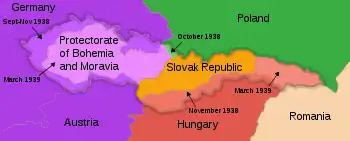
During the mid-1930s, Czechoslovakia accepted thousands of German (and Austrian, after the Anschluss) Jews fleeing persecution, although right-wing politics eventually led to immigration restrictions and an end to racial persecution as a reason for seeking asylum.[21][22] Since the mid-1930s, antisemitism was on the rise in Czechoslovakia.[23] In February 1938, many Jews with Polish citizenship, including long-term residents, were expelled to Poland from Moravská Ostrava. Some of them were immediately sent back by the Polish police.[24] Some ten thousand Austrian refugees were refused entry in 1938, and Polish Jews deported from Austria were shuttled to the Polish border.[25]
In September 1938, the Munich Agreement resulted in the annexation of the Sudetenland to Nazi Germany.[23] About 200,000 people fled or were expelled from the annexed areas, including more than 90 percent of the 30,000 resident Jews. The Czechoslovak authorities tried to prevent Jews from crossing the new border even though the Munich Agreement gave these Jews the option to retain their Czechoslovak citizenship. Some of the Jewish refugees had to wait for days in no-man's land.[26][27][28] Non-Jewish Czech refugees were given preferential treatment and the arrival of German-speaking Jewish refugees contributed to a rise in antisemitism in the rump Czechoslovak state.[23][29]
In mid-December, Rudolf Beran, prime minister of the authoritarian, right-wing government of the Second Czechoslovak Republic, announced that he intended to "solve the Jewish question".[30][31][32] In January 1939, Jews who had immigrated to Czechoslovakia after 1914 (including naturalized citizens) were ordered to be deported from the country.[33] Meanwhile, Jews were banned from the civil service,[32][30] excluded from Czech professional associations,[34] state hospitals dismissed Jewish doctors, and Jewish army officers were put on leave. German professional and educational institutions dismissed Jewish teachers and lecturers, while German newspapers laid off their Jewish reporters.[31] According to historian Wolf Gruner, the Second Republic's persecution of Jews "were independent developments influenced by radical Czech circles, and had little to do with any direct pressure imposed by Hitler".[33]
German occupation
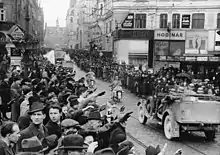
On 14 March 1939, the Slovak State declared independence with German support. Carrying out plans made since October 1938, Germany invaded the Czech rump state, establishing the Protectorate of Bohemia and Moravia. This nominally autonomous protectorate was partially annexed into the Greater German Reich.[35] In the Protectorate, ethnic Germans were granted Reich citizenship and were accountable only to German authorities. Czechs and Jews were counted as Protectorate subjects, a second-class status, and were governed by the Czech puppet administration (in practice, under the control of the Reich Protector).[36] The Czech administration operated under Prime Minister Alois Eliáš (from April) and President Emil Hácha,[37] both of whom were conservative Catholics who approved anti-Jewish measures while retaining contact with the Czechoslovak government-in-exile. However, its justice minister, Jaroslav Krejčí, was known for his pro-Nazi sentiments. In March, Hácha formed the National Partnership, a political organization to which 98.5% of the adult male Protectorate citizens would belong (women and Jews were forbidden from joining).[38] The German administration was controlled by Konstantin von Neurath, former foreign minister of Germany, and Karl Hermann Frank, formerly the Deputy Chairman of the Sudeten German Party.[37]
At the time of the annexation, there were at least 118,310 Jews living in 136 recognized communities in the Protectorate.[39][37] During the first week after the annexation there was a wave of suicides among Jews, with 30–40 suicides reported each day in Prague.[40][41]
Persecution of Jews
The gradual persecution of Jews created a "ghetto without walls" and created the conditions which enabled their deportation and murder later on.[20] The phases of persecution prior to mass deportation were primarily carried out by the Protectorate administration (involving both German and Czech officials) with some intervention from Berlin.[42] According to Gruner, careerism and potential for material gain are likely motives for Czech bureaucrats who implemented anti-Jewish regulations.[43] Some initiatives first applied in the Protectorate, such as the freezing of Jews' bank accounts, were later rolled out in other parts of Greater Germany.[43]
Initial measures
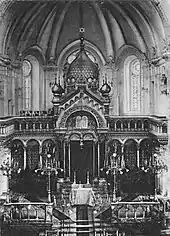
During the annexation, anti-Jewish riots occurred in a number of locations. In Olomouc, Vsetín, and Ostrava, synagogues were burned by German and Czech rioters. In Iglau (Jihlava) Jews were prohibited from riding streetcars and forced to clear snow from the streets. Prague Jewish organizations were shut down or taken over by the Gestapo.[39] Irregular anti-Jewish violence was quiet for much of 1939, but in a nine-day period in June arsonists targeted 7 synagogues in Ostrava.[44] A wave of arrests targeted thousands of left-wing activists and German refugees. More than a thousand were deported to concentration camps in the Reich; most of these were Jews.[39][45] In September 1939 another wave of arrests targeted Protectorate citizens who could be used as hostages and those with ties to Poland. These arrests also disproportionately affected Jews.[45]
The Czech government largely remained in place and had considerable autonomy.[46] In the Protectorate, anti-Jewish persecutions were carried out by several agencies, including the Office of the Reich Protector, the Gestapo, and the Czech government.[47] At once, the definition of the Nuremberg Laws was applied to relationships between Jews and "German-blooded" people, forbidding relationships between them. Czech–Jewish marriages were initially still allowed, the regulation of such was left to the Protectorate government.[19] Professional restrictions imposed under the Second Republic intensified after the takeover. On 17 March, Beran's government announced a ban on Jews practicing a wide range of professions.[48]
On 25 March, the Reich Interior Ministry decided to delegate "whether and what measures it undertakes against the Jews" to the Protectorate government. In the following weeks, professional associations of merchants, lawyers and physicians took advantage of the antisemitic mood to expel their Jewish members. By June, the umbrella Jewish organization reported that many middle-class Jews had lost their jobs.[49] The Jewish Social Institute, a social welfare organization, was allowed to reopen on 6 April and provided relief to many unemployed Jews as well as refugees.[50]
The Eliáš government drafted the first ordinance on anti-Jewish legislation, which would have defined a "Jew" as someone with four Jewish grandparents who had belonged to a Jewish community after 1918. Jews would be barred from working in public agencies, corporations, schools, administrations, courts, stock exchanges, the arts, and medicine. However, the Reich Protector's office dismissed the proposal as too mild in its definition of "Jew", and therefore issued its own resolution on 21 June.[51] Part of the Czech government's calculation in arguing for a narrower definition of "Jew" was to reduce the amount of Jewish property that would be transferred to Germans as a result of Aryanization.[52] A second wave of synagogues—in Brno, Olomouc, Uherský Brod, Chlumec, Náchod, Pardubice, and Ostrava—were burned in May and June.[51]
Emigration
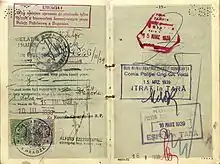
Fourteen thousand Jews, disproportionately those from the Sudetenland, emigrated between Munich and March 1939.[32][30] Many Jews were reluctant to leave family members behind or try to start a new life in a country where they did not know the language. An additional challenge was that most Jews were unable to emigrate because of immigration restrictions, and other countries' quotas were already filled by German and Austrian Jews. Some desperate parents agreed to send their children to the United Kingdom on the Kindertransport, which rescued 669 Jewish children from Bohemia and Moravia prior the outbreak of war.[32] The growing poverty among Jews caused by anti-Jewish restrictions was another barrier to their emigration, which was banned by the Security Service in May 1939. The Nazi occupiers originally planned not to create a Central Office for Jewish Emigration in Prague, as there was for Austria. The Prague office was set up later on 15 July for the purpose of leveraging the property of Czech Jews to help the emigration of German Jews, and initially only had effect in the city and its surroundings.[53] Another office was considered for Brno.[54]
Fewer Jews were able to escape from the Protectorate than from prewar Germany or Austria, due to the narrower window for legal emigration (July 1939 to September 1941). According to official figures, 26,111 emigrated legally.[55] Almost half of these left for other European countries,[56] where some were killed in countries that were later occupied by Germany. An unknown number fled illegally to Poland in 1939 or to Axis-aligned Slovakia and Hungary.[57][58] Historian Hillel J. Kieval estimates that this illegal emigration amounted to several thousand Jews, many of whom joined the Czechoslovak military formations abroad.[59] In February 1940, working-age Jews were barred from emigrating from the Protectorate;[60] by this time, hardly any destinations were open except Shanghai.[61] All Jewish emigration was banned throughout the Reich on 16 October 1941.[62]
Nisko Plan
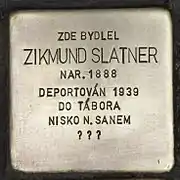
The outbreak of World War II with the September 1939 invasion of Poland dramatically changed the situation of Czech Jews.[63] The Nisko Plan was a scheme to concentrate Jews in the Lublin District, at the time the most remote area of German-occupied Europe and adjacent to the partition line with the Soviet Union.[64] The Nisko operation targeted the border areas as a first step toward the deportation of all 2 million Jews in Greater Germany to be completed by April 1940.[65]
On 18 October 1939, 901 men were deported from Ostrava to Nisko. Border police and SS personnel accompanied the transport,[66] and Adolf Eichmann personally met it in Nisko.[67] The second transport carried 400 Jewish men from Ostrava and was accompanied by protests by local Czechs. The third took 300 men from Prague on 1 November, and was also protested by Czechs. It was turned around in Sosnowiec when the Nisko Plan was cancelled by SS chief Heinrich Himmler,[68][69] because it conflicted with the higher-priority goal of resettling Volksdeutsche in the Warthegau and West Prussia.[70] Transports were expected to resume in early 1940, but Reinhard Heydrich postponed them on 19 February in favor of deporting Polish Jews from the annexed areas[71] and disposing of the Jews of Greater Germany through forced emigration.[72]
The Nisko deportees were dumped in the local area to fend for themselves. Harsh conditions prompted some to flee across the border into the Soviet Union;[72] 123 deportees returned to Czechoslovakia in 1945 with Svoboda's Army.[73] In April 1940, the camp was dissolved and the 460 survivors from the Protectorate were allowed to return home, bringing with them firsthand accounts of the brutality that they had suffered.[72][74][73]
Aryanization

Hermann Göring ordered that all Aryanization in the Protectorate take place with the approval of the Reich Ministry of the Economy, to avoid chaotic property transfers as had taken place in Vienna after the Anschluss. As a result, Jews were forbidden to sell companies and real estate. About 30,000 Jewish-owned businesses existed in the Protectorate, and Czechs and Germans fought over who would have the right to take them over. The Germans were favored and Aryanization was even extended to businesses owned by Czechs, leading Hácha to complain of "Germanization under the cloak of Aryanization".[75] On 21 June, the Reich Protector announced that all Jewish property was claimed by Germany, frustrating Czech efforts to claim Jewish-owned businesses.[44]
Jews were required to register their business assets on 7 February 1940 and personal property on 16 March.[76] Couples in which one partner was Jewish, especially those in which the other was an ethnic German, faced pressure to divorce. Some opted for a "paper divorce" in order to preserve the family property under the non-Jewish partner's name, or the job of the non-Jewish partner, while continuing to live together. However, the divorce removed the Jewish partner's exemption from deportation.[77]
Before the Nazi occupation, many municipalities wanted to acquire Jewish synagogues, cemeteries, and other community property for public use or housing. The Nazi authorities were disappointed that some Czech municipalities were able to acquire this property at a low or null price and insisted that municipalities seeking to acquire Jewish property pay the full value to the fund of the Central Office for Jewish Emigration. Despite this cost, some municipalities went ahead with these acquisitions; selling Jewish gravestones as building material was common.[78] Aryanization of Jewish property was mostly complete by 1941.[79]
Employment and forced labor
_in_the_Protectorate_of_Bohemia_and_Moravia.png.webp)
By the summer of 1939 Jews were banned from any job except manual labor. At the time, 25,458 men and 24,028 women were of working age (18–45 years).[50] On 23 October, another order from the Reich Protector barred Jews from salaried employment.[71] Further employment regulations were announced on 26 January 1940, with the result that Jews were banned from all management positions among other provisions. Increasing numbers of Jews were without employment or income.[80][71] The next two measures came from the Czech government: on 19 March Jews were excluded from the unemployment system and had to register at labor offices to receive unemployment assistance. Instead, they were recruited into locally organized forced labor, such as burning trash. On 24 April they were barred from working in law, education, pharmacies, medicine, or publishing.[76] The forced unemployment of Jews led to tremendous pressure on the Jewish community's welfare rolls, which it attempted to counter by retraining Jews in agriculture and skilled crafts via the Protectorate labor offices.[81][60]
Plans for the employment of the Protectorate's Jews in forced labor in the event of war were drawn up before the occupation of the territory, in February 1939. It was expected to employ Jews in road-building and quarries, although what agency would be responsible was not decided.[82] However, in mid-1940, despite the increasing unemployment among Jews, the central authorities did not introduce any generalized forced labor program. Instead, municipalities took the initiative and developed a forced labor program similar to that in Germany and Austria, but organized locally. In early July 1940, the town of Holešov requested permission to conscript its Jews into forced labor. A report in Neuer Tag magazine encouraged other localities to follow this practice. By July, 60% of Jewish men in the Protectorate were employed in forced labor projects and the remainder in independent employment that had not yet been barred to them. Unlike in Germany and Austria, Jews were initially not segregated from Czechs in forced labor because both were considered inferior.[83]
In early 1941 forced labor intensified as many municipalities including Prague hired Jews at minimal wages to clear snow. The Jewish communities were ordered to judge the fitness for work of all men aged 18 to 50. By the summer, more than 11,700 of 15,000 Jewish men were engaged in a variety of forced labor projects, initially focused on agriculture and construction and later on industry and forestry. Segregated labor details for Jews only were introduced.[84] Forced labor deployments were further intensified in early 1942 despite the beginning of systematic deportation from the Protectorate.[85] The forced laborer population peaked in May 1942, at which point 15,000 men and 1,000 women were deployed. After that, increasing recruitment of women and the less physically able was not able to compensate for the losses to deportation.[86][85] Many forced laborers did not receive sufficient wages to cover their basic needs, and therefore still required welfare paid by the Jewish community. Many Jews suffered health problems as a result of poor conditions and insufficient nutrition.[85]
Restrictions on civil rights
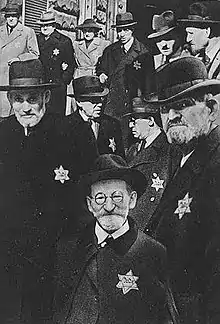
In January 1940, the remit of the Prague Central Office was extended to the entire Protectorate, and in March it obtained control of all Jewish communities, to which everyone classified as Jews according to the Nuremberg Laws were ordered to report even if they were not members of the Jewish community. Jews' freedom of movement was restricted with a curfew imposed after 20:00, and they were barred from visiting cinemas and theaters by the Hácha government. Protectorate identification cards for Jews were stamped with the red letter "J".[87] In August 1940, Jews were banned by order of the Reich Protector from all voting rights and public office, all positions involving the media and public opinion, and all Czech associations.[54] Jews were also restricted from shopping except a few hours of the day in mid-1940,[88][89] and eventually businesses had to choose whether to serve Jewish or non-Jewish customers.[90] Jews were banned from attending German schools in March 1939, and in August 1940 the Czech government banned Jewish students from the Czech schools as well.[91] Prohibition of private tutoring of Jewish students followed, and in July 1942 all education for Jewish students was banned.[92]
Since 1939,[93] the Reich Protector received many petitions to require Jews to wear special markings such as a yellow star or armband. However, even though Jews were marked in the former Polish regions annexed into Nazi Germany, this was not approved for Bohemia and Moravia.[94][95] The yellow star was introduced in Bohemia and Moravia at the same time as in Germany, in September 1941.[96] Earlier, lack of distinction between Jews and other residents made it difficult to enforce anti-Jewish laws, and the star made it easier to target Jews for antisemitic violence.[93] Failure to wear it was vigorously enforced and punishable with deportation to a concentration camp.[72] Later in September, Heydrich was appointed Reich Protector and deposed the Czech government under Eliáš, replacing him with the hardliner Krejči.[97] One of Heydrich's first actions as Reich Protector, on 1 October, was to shut down all synagogues.[96][93]
Because the Nazis viewed Jews in racial terms, individuals of Jewish ancestry who did not identify as Jews were forced to register with the Jewish community as "B-Jews". In March 1941 there were 12,680 "B-Jews" living in the Protectorate, the majority of them Christians.[93] In November 1940, the Hácha government passed a ban on marriages between ethnic Czechs and Jews. However, the Nazi authorities repeatedly refused to publish the decree; it did not go into effect until March 1942.[98] In late 1941 and early 1942, some Jews took advantage of this loophole to evade deportation by marrying a Czech.[99]
Ghettoization
.JPG.webp)
During the first years of the German occupation, many Jews moved to Prague in order to apply for visas to foreign countries, while others headed to the countryside to evade anti-Jewish restrictions or obtain goods on the black market.[100] In 1940 and 1941, public transit restrictions were imposed both in Prague and other municipalities. Jews were either restricted to the last car of streetcars or banned from public transport entirely. There were also restrictions imposed on leaving the municipality of residence or moving to a different address without the permission of the authorities.[101]
In mid-1939, it was first proposed by German officials (Oberlandräte) to make parts of Bohemia and Moravia "Jew-free" by deporting Jews to Prague.[102] In early 1940, municipalities began to pressure Jews to vacate their homes.[103] The first expulsion of Jews was in 1940 from Mladá Boleslav when at the orders of the Oberlandrat of Jičín 250 Jews were imprisoned in a nearby castle. Later expulsions targeted Jews living in the city of Jihlava and the Zlín region outside of Uherský Brod, where Jews were forced into a ghetto.[102] In late 1940, twenty-five municipalities forced their Jewish residents to leave their homes and live in abandoned castles or factories.[79] Six municipalities expelled all Jews to Prague.[104] Forced relocation disrupted prewar social ties with non-Jews and reduced the ability to cope with anti-Jewish regulations.[105]
In late 1940, Jewish-owned housing was registered in Prague and Brno, by the Central Office. By early the next year, Jews were being concentrated into "Judenhäuser" (lit. 'Jew houses') in Prague, a joint initiative by the city government, the Central Office, and the Nazi Party.[106] This primarily entailed moving Jews from peripheral districts of Prague into older housing already occupied by other Jews in the central city, especially Josefov and the Old Town.[105] Simultaneously, Jews were resettled from the districts to large cities.[106] In September 1941, Heydrich launched the final phase of the ghettoization in order to force Jews into a smaller number of towns and cities to make it easier to deport them.[107] The National Partnership demanded further ghettoization of Jews; in October 1941, Hácha presented such demands to the Reich Protector. These were rejected as the Germans were already planning the systematic deportation of Jews.[96]
Relations with Czech population
The majority of Czechs felt sympathy for Jews and did not collaborate with the Nazis, which was repeatedly emphasized in the wartime Western press.[108] In 1940, an antisemitic faction took over the leadership of the National Partnership and issued decrees that forbade Czechs from associating with Jews, but many Czechs ignored them and most of the regulations were repealed following a public outcry. Czech acts of defiance against antisemitic decrees, as well as the public protests against the Nisko deportations in 1939, was closely related to their opposition to the German occupation.[109][52] In addition, Czechs worried that after the Jews were eliminated, they would be next.[52] The Security Service reported that during 1941, "the Czech attitude towards the Jews became a serious problem for the occupation authorities".[110] However, even some Czech resistance figures published antisemitic articles.[111]
A minority of Czechs took part in the persecution of Jews.[111] The Czech fascist newspapers Vlajka and Arijský boj ("Aryan Struggle"—a Czech version of Der Stürmer) were noted for their antisemitic invective and publishing denunciations of Jews and "Jew-lovers".[112] Historian Benjamin Frommer has argued that these newspapers made it easier for some ordinary Czechs to denounce their neighbors, by providing an alternative to the Nazi authorities.[108] Arijský boj received 60 denunciations daily in October 1941;[113] such denunciations often resulted in the arrest of Jews breaking the regulations.[114] Those who sent in denunciations helped enforce the laws by reporting alleged violations.[115] The Security Service reported that some Czechs tried to help Jews avoid deportation. In 1943, it reported that attitudes had changed and Czechs were grateful that the occupiers rid them of the Jewish population.[116] The resistance also reported to the government-in-exile that some Czechs believed that the Jews deserved their fate.[86]
Final Solution
Direct transports

On 16 or 17 September 1941, Hitler approved a proposal to deport 60,000 Jews from the Reich and the Protectorate to Łódź Ghetto, in the Warthegau.[117] In preparation for the deportation, another census was carried out. By the criteria of the Nuremberg Laws, 88,000 Jews still lived in the Protectorate, 46,800 in Prague. Heydrich, Frank, Horst Böhme, and Eichmann met at Prague Castle on 10 October to finalize deportation plans. They decided that 5,000 Jews would be deported from Prague from 15 October, initially to Nazi ghettos where they would perform forced labor. Upon their deportation, Jews' remaining property would be expropriated.[96] Due to overcrowding in the Łódź Ghetto, and partly to make space for the new arrivals, Kulmhof extermination camp was opened in fall 1941.[118]
Five transports with 1,000 Jews each departed from Prague on 16, 21, 26 and 30 October and 3 November, arriving in Łódź the next day.[96][119] These transports were organized by the Central Office and the Gestapo, with the latter responsible for drawing up transport lists.[96] Hitler designated Minsk and Riga as the destination for subsequent transports due to overcrowding in Łódź; on 16 November, a transport took Jews from Brno to Minsk.[120][96] Many deportees perished from the poor living conditions in the ghetto. Others died in labor camps in western Poland or after deportation to the extermination camps at Kulmhof, Majdanek and Auschwitz; only around 250 people survived. From the transport to Minsk, about 750 of the deportees were murdered in a mass execution on 27–29 July 1942; only 12 returned after the war.[121]
Following the assassination of Reinhard Heydrich on 27 May 1942, martial law was declared in the Protectorate.[86][122] Hundreds of people, especially Jews, were executed on accusations of sabotage, treason and economic crimes.[107] On 10 June, 1,000 Jews were deported from Prague; some were removed from the transport at Majdanek and others deported to Ujazdów in the Lublin District, near Sobibor extermination camp;[86][122][123] only one man survived.[123] On 27 October 1944, 18 members of the Council of Elders of the Prague Jewish Community were deported directly to Auschwitz; all were killed.[122][123]
Theresienstadt Ghetto
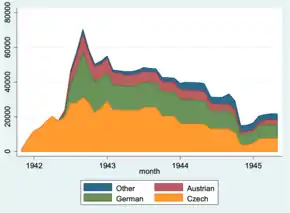
In October 1941, the Prague Jewish Community was ordered to prepare for the deportation of the remaining Jews to locations within the Protectorate. The site chosen was Theresienstadt (Terezín) a walled fortress town north of Prague on the border with the Sudetenland.[125] Deportation to Theresienstadt began in November 1941 with a transport of 350 men from Prague. The next month, more than 7,000 people were deported to Theresienstadt, from Prague, Pilsen, Brno, and other places.[126][127] Deportees were permitted to bring only 50 kilograms (110 lb) of personal items, which were ultimately stolen.[128] The ghetto was furnished with property that had earlier been confiscated from Jews and funded by confiscated assets and the proceeds of inmates' forced labor.[129] From the outset, Theresienstadt was designated as a transit ghetto. The first transport left for Riga on 9 January 1942.[126][127]
At the Wannsee Conference on 20 January, Heydrich announced that Theresienstadt was being prepared as an old-age ghetto for German Jews.[126] This decision meant that the Czech Jews transported there had to be deported farther east.[130] The original residents of Theresienstadt had to leave and the Germans among them received compensation from the Central Office out of the fund of confiscated Jewish property.[126] On 29 May, two days after Heydrich's assassination, Jewish leaders were told to expect the "complete evacuation of the Jews from the Old Reich, the Ostmark, and the Protectorate". Those older than 65 would stay in Theresienstadt while younger Jews would be deported to the East.[86] Along with being subjected to forced labor while imprisoned at Theresienstadt, prisoners were used outside the ghetto for various forced labor projects, including forestry, coal mining, and the ironworks in Prague. After the Lidice massacre, a work detail of 30 Jews from Theresienstadt was forced to bury the victims.[131]
Out of a total of 141,000 Jews deported to Theresienstadt,[132] 73,608 were from the Protectorate.[133] At the time of liberation, 6,875 Theresienstadt prisoners were from the Protectorate; about 100 Protectorate Jews were on the transport of Jews from Theresienstadt to Switzerland in early 1945 and 700 left the camp in early May.[134] Between 9 January 1942 and 28 October 1944, about 60,000 of the Jews from the Protectorate were later deported farther east to various locations in Poland and the Baltics;[135] a bit less than half (28,368) were deported to Auschwitz.[136] Only 3,371 survivors of these deportations are reported.[137]
Remaining Jews

While in Prague the deportation of the city's 46,801 Jews stretched over more than two years, elsewhere in the Protectorate (except for Brno) all Jews were deported from the locality within a few days. As a result, for the non-Jewish population of Prague deportation of Jews from Holešovice became a regular event, while outside the city the elimination of local Jewish communities was a shocking disruption with a clear before and after.[138] Property belonging to deported Jews was collected by the Trustee Office of the Jewish community of Prague for resale. At its height, hundreds of Jews worked for this office, gathering such items as clothing, furniture, tableware, and carpets, as well as hundreds of thousands of books and hundreds of pianos.[126] There were more than fifty branch offices for dealing with the property of Jews outside of Prague, where the items were categorized and valued for sale. After the Heydrich assassination, there was an intensified push to confiscate the last remaining property of families that had not yet been deported. In November 1942, a law was passed confiscating all property from Jews deported from the Protectorate.[139]
By June 1943, almost the entire Jewish population of the Protectorate including 39,395 from Prague and 9,000 from Brno had been deported.[132][140] Most of those left were in mixed marriages; from March 1943 such Jews were subjected to forced labor duty. By 1944, 83.4 percent of Jews outside Theresienstadt were performing forced labor, while the remainder were considered incapable of work.[141] Mischlinge who were not deported were also drafted into forced labor programs.[142] In mid-1944, non-Jewish husbands of Jewish women were summoned for forced labor and in September all able-bodied Jews from outside the capital were drafted into mica splitting at a camp in Hagibor.[143]
Between June 1943 and January 1945, another 900 people were sent to Theresienstadt in small groups; these were primarily divorcés and widows of mixed marriages and offspring from such marriages who reached 14 years of age.[132][140] By the end of 1944, only 6,795 Jews officially lived in the Protectorate.[140][144] Between January and 16 March 1945, 3,654 intermarried Jews and Mischlinge were deported to Theresienstadt after the mixed marriage exception was cancelled.[143][132][133] A total of 2,803 people considered Jews according to the Nuremberg Laws were reported to have survived in the Protectorate without being deported.[134]
Historians consider that hiding was relatively rare in the Protectorate,[145][110] due to geographical, demographic, and political factors rather than Czech collaborationism.[110] Czechs caught assisting Jews with forged papers or hiding places were sentenced to death and executed.[146] The exact number of Jews who survived in hiding in the Protectorate is unknown; H. G. Adler estimated it at 424.[145][147][134] According to one estimate, some 1,100 Jews acquired false papers, but the majority left the Protectorate, either as foreign workers in Germany or else to Slovakia or Hungary; not all of these survived the war. Those who had the greatest chance of surviving was the small group who had never been registered as Jews.[148]
Aftermath
Bohemia and Moravia were liberated by May 1945 by both Western Allies, who arrived in Pilsen on 5 May, and the Red Army, which captured Prague on 9 May 1945 following the Prague Offensive.[147][149] More than three-quarters of Czechoslovak war victims were Jews who died in the Holocaust.[147][150] The total death toll of Jews from the Protectorate was about 80,000,[147][150] 80 percent of the prewar population.[151] Besides those who emigrated, about fourteen thousand Jews survived in other ways.[150][152] In 1946, there were an estimated 23,000 Jews living in the Czech lands, of whom half had lived elsewhere before the war.[153] A third of Jews who had emigrated since 1938 returned after the war, and 19,000 Jews emigrated to Palestine within a few years.[154] By 1950, only around 14,000 to 18,000 Jews remained in Czechoslovakia.[155]
President Edvard Beneš made it clear that postwar Czechoslovakia was to be a nation of Czechs and Slovaks only. The Jews who remained in the country faced pressure to assimilate or leave.[156][157] Two to three thousand Jews who had identified themselves as Germans on prewar censuses could not regain their Czechoslovak citizenship and were subjected to the same discrimination as ethnic Germans, including deprivation of citizenship, forfeiture of property, and requirement to wear white armbands.[157][158] Due to discrimination, thousands of Jews applied to leave the country voluntarily.[159] The deportation of Jews as part of the expulsion of Germans was abruptly halted in September 1946 due to media outrage and objections from the military governor of the American occupation zone of Germany.[157][160] Some Jews were nevertheless deported.[161][162] Although two thousand "German" Jews were eventually able to regain their Czechoslovak citizenship,[157] most ended up emigrating, primarily to Germany.[162] Anti-Jewish rioting was reported in 31 locations.[154]
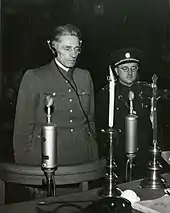
Although postwar laws negated Aryanization, most Jews (even those recognized as Czechs) faced severe obstacles in recovering their property.[163][164] Many Jews were unable to return to their homes, now occupied by non-Jewish Czechs.[154] Any connection to German nationality (for example, having attended a German-language school) was a reason not to return a confiscated house to a Jewish survivor.[164] When Jews had left movable property with non-Jewish acquaintances, not infrequently they were unwilling to return it.[165][166] Both Communists and some nationalists demanded the nationalization of Jewish property.[167] Several Holocaust perpetrators and collaborators were tried before People's Courts and executed, as part of a purge of collaborators that was one of the strictest in Europe.[168][169] People who denounced Jews or helped to purge them from associations were punished harshly, unlike Aryanizers.[169]
In the 1952 Slánský trial, fourteen Communists (eleven Jewish—including Holocaust survivors) were accused of belonging to a Zionist conspiracy. Eleven of them were executed.[170][171] An additional 6,000 Jews emigrated after the Warsaw Pact invasion of Czechoslovakia in 1968. In the 1970s and 1980s, a number of reports predicted that the Czech Jewish community would disappear. By the 1989 Velvet Revolution, no more than 10,000 Jews lived in Czechoslovakia.[172] As of 2019, about 3,900 Jews live in the Czech Republic.[173]
Legacy
.jpg.webp)
During the Communist rule in Czechoslovakia the Holocaust was mostly ignored in the Communist historical culture.[174] While the Lidice massacre became a hegemonic symbol of the German occupation, the largest massacre of Czechoslovak citizens during the war—when almost 4,000 Czech Jews were executed on the night of 8–9 March 1944 in Auschwitz—was almost forgotten outside the Jewish community.[175] The tendency to add Jewish victims into the total of Czechoslovak war victims while ignoring the Holocaust was common in Communist historiography, and criticized by opposition group Charter 77.[176] In the 1970s and 1980s, Miroslav Kárný was the first Czech historian to write about the Holocaust in Bohemia and Moravia, primarily on his own initiative as a private citizen.[177][178]
After the 1989 fall of the Communist regime, scholarly interest in the Holocaust greatly increased, which many academic theses relating to the Holocaust being published. The interest peaked around 2000.[179] Czech historians have struggled to integrate the Holocaust into Czech history, which historian Michal Frankl has described as "mildly ethnocentric".[180] The Romani genocide triggered heated public debate over the role of the Second Republic and Protectorate government in setting up concentration camps for Romani and Sinti people at Lety and Hodonin.[179][181] The expulsion of Germans was also a very controversial issue in historiography and in Czech–German relations.[182] In contrast, the Holocaust has often been perceived as noncontroversial in the Czech Republic.[179][181] During the late 2010s, some historians began to examine the Holocaust outside of a national framework and research issues such as the role of the Protectorate government and some parts of the Czech population in the persecution of Jews. This research encountered a backlash and led to similar politicization as had already occurred in Poland and Hungary.[183]
The Holocaust also became a subject of Czech popular culture, mostly after 1989.[180] Representation of the Holocaust is greater in "soft" forms of popular culture (such as literature) than "hard" forms, such as museums and monuments.[184] The names of 77,297 known victims of the Holocaust from Bohemia and Moravia are written on the walls of Pinkas Synagogue in Prague.[152][185] Additional memorials are located at Terezín and a few other locations.[184] The 1960 film Romeo, Julie a tma was one of the most successful Czechoslovak short films abroad and depicts a young man's unsuccessful attempt to hide his Jewish lover.[186] Jiří Weil and Arnošt Lustig, both Holocaust survivors, became known for their literature on the event.[187] In the twenty-first century, an important trend in literature is writers who tie together the Holocaust and the expulsion of Germans, considering both events as part of a ten-year process in which the traditional coexistence of Czechs, Germans, and Jews in the Czech lands was violently destroyed.[188]
References
Citations
- Kieval, Hillel J. "Bohemia and Moravia". YIVO Encyclopedia. Retrieved 4 November 2020.
- Osterloh 2015, p. 68.
- Čapková 2012, p. 22.
- Rothkirchen 2006, p. 18.
- Gruner 2015, p. 99.
- Čapková 2012, p. 152.
- Čapková 2012, p. 250.
- Čapková 2012, pp. 17, 24–25.
- Gruner 2015, p. 101.
- Gruner 2019, p. 28.
- Gruner 2015, p. 100.
- Čapková 2012, p. 25.
- Čapková 2012, p. 24.
- Rothkirchen 2006, pp. 27–28.
- Gruner 2019, p. 25.
- Čapková 2012, pp. 16, 22.
- Rothkirchen 2006, p. 34.
- Rothkirchen 2006, p. 49.
- Frommer 2020, p. 48.
- Frommer 2014, p. 137.
- Gruner 2015, p. 102.
- Frankl 2014, p. 547.
- Gruner 2015, pp. 102–103.
- Gruner 2019, p. 33.
- Frankl 2014, p. 549.
- Frankl 2014, pp. 549–550.
- Osterloh 2015, p. 76.
- Frommer 2021, pp. 200–201.
- Frommer 2021, p. 201.
- Gruner 2019, p. 42.
- Gruner 2015, p. 103.
- Frommer 2021, p. 202.
- Gruner 2019, p. 43.
- Frankl 2014, p. 550.
- Gruner 2015, pp. 103–104.
- Gruner 2015, pp. 104–105.
- Gruner 2006, p. 141.
- Gruner 2015, pp. 106, 108.
- Gruner 2015, p. 106.
- Gruner 2019, p. 61.
- Frommer 2021, p. 203.
- Gruner 2019, p. 381.
- Gruner 2019, p. 396.
- Frommer 2021, p. 206.
- Frommer 2021, p. 205.
- Gruner 2019, p. 66.
- Gruner 2006, p. 142.
- Frommer 2021, pp. 203–204.
- Gruner 2015, pp. 107–108.
- Gruner 2006, pp. 143–144.
- Gruner 2015, pp. 108–109.
- Láníček 2013, p. 18.
- Gruner 2006, p. 144.
- Gruner 2006, p. 145.
- Schmidt-Hartmann 2015, p. 358.
- Gruner 2019, p. 400.
- Frommer 2019, p. 39.
- Gruner 2019, pp. 60–61.
- Kieval, Hillel J. "Czechoslovakia". YIVO Encyclopedia. Retrieved 4 November 2020.
- Frommer 2021, p. 217.
- Gruner 2019, pp. 387, 389.
- Browning 2007, p. 197.
- Gruner 2006, p. 146.
- Browning 2007, pp. 12, 37.
- Gruner 2019, pp. 116–117.
- Gruner 2015, p. 111.
- Gruner 2006, p. 147.
- Gruner 2015, pp. 111–112.
- Browning 2007, p. 41.
- Browning 2007, p. 43.
- Gruner 2015, p. 112.
- Frommer 2021, p. 220.
- Schmidt-Hartmann 2015, p. 360.
- Browning 2007, p. 42.
- Gruner 2015, pp. 107, 109.
- Gruner 2015, p. 113.
- Frommer 2020, pp. 57–58.
- Frommer 2021, pp. 212–213.
- Gruner 2019, p. 389.
- Gruner 2006, pp. 148–149.
- Gruner 2019, p. 388.
- Gruner 2006, pp. 141–142.
- Gruner 2006, pp. 149–150.
- Gruner 2019, pp. 389–390.
- Gruner 2019, pp. 392–393.
- Gruner 2015, p. 119.
- Gruner 2006, p. 148.
- Gruner 2006, p. 150.
- Gruner 2015, p. 114.
- Frommer 2021, pp. 208–209.
- Frommer 2021, pp. 213–214.
- Frommer 2021, p. 215.
- Frommer 2021, p. 219.
- Gruner 2006, pp. 150–151.
- Gruner 2015, pp. 113–114.
- Gruner 2015, p. 117.
- Gruner 2015, p. 116.
- Frommer 2020, p. 49.
- Frommer 2021, p. 223.
- Frommer 2021, p. 210.
- Frommer 2021, p. 209.
- Frommer 2021, p. 211.
- Gruner 2019, p. 387.
- Gruner 2019, p. 100.
- Frommer 2021, p. 212.
- Gruner 2015, pp. 114–115.
- Gruner 2019, p. 391.
- Láníček 2013, pp. 17–18.
- Gruner 2015, pp. 112, 114.
- Láníček 2013, p. 17.
- Láníček 2013, p. 20.
- Frommer 2014, pp. 139–140.
- Frommer 2014, p. 140.
- Gruner 2019, p. 233.
- Frommer 2014, pp. 140–141.
- Láníček 2013, pp. 19–20.
- Browning 2007, p. 325.
- Browning 2007, p. 366.
- Browning 2007, pp. 375–376.
- Browning 2007, p. 376.
- Schmidt-Hartmann 2015, pp. 361–362.
- Láníček 2013, p. 77.
- Schmidt-Hartmann 2015, p. 362.
- Rothkirchen 2006, p. 234.
- Frommer 2021, p. 221.
- Gruner 2015, p. 118.
- Blodig & White 2012, p. 181.
- Frommer 2021, p. 222.
- Gruner 2019, p. 392.
- Gruner 2019, pp. 316–317.
- Frommer 2021, p. 228.
- Schmidt-Hartmann 2015, p. 365.
- Gruner 2015, p. 122.
- Schmidt-Hartmann 2015, p. 367.
- Schmidt-Hartmann 2015, p. 366.
- Hájková 2014, pp. 48–49.
- Frommer 2021, p. 200.
- Frommer 2021, pp. 222–223.
- Gruner 2019, p. 393.
- Gruner 2019, p. 367.
- Gruner 2019, pp. 360–361.
- Gruner 2019, pp. 362–363.
- Frommer 2021, p. 227.
- Gruner 2015, pp. 120–121.
- Frommer 2019, pp. 37, 40.
- Gruner 2019, p. 359.
- Gruner 2015, p. 121.
- Hájková 1997, p. 56.
- Láníček 2013, p. 146.
- Gruner 2019, p. 380.
- Láníček 2013, p. 1.
- Schmidt-Hartmann 2015, p. 368.
- Čapková 2021, p. 240.
- Gruner 2019, p. 373.
- Láníček 2013, p. 186.
- Čapková 2021, pp. 244, 252.
- Gruner 2019, p. 372.
- Čapková 2018, p. 69.
- Čapková 2018, pp. 74–75.
- Čapková 2018, pp. 79–80.
- Hájková 2014, p. 51.
- Čapková 2021, p. 246.
- Gruner 2019, pp. 372, 374.
- Čapková 2021, pp. 247–248.
- Čapková 2021, p. 248.
- Hájková 2014, p. 50.
- Gruner 2019, pp. 372–373.
- Gruner 2019, pp. 370, 374.
- Čapková 2021, p. 247.
- Sniegon 2014, p. 61.
- Wein 2015, p. 159.
- Hallama 2015, p. 12.
- Bazyler et al. 2019, p. 103.
- Sniegon 2014, p. 211.
- Frankl 2013, pp. 166–167.
- Frankl 2013, pp. 173–174.
- Hallama 2015, p. 29.
- Frankl 2013, p. 175.
- Frankl 2017, p. 262.
- Frankl 2013, p. 189.
- Frankl 2021, p. 7.
- Frankl 2013, p. 188.
- Frankl 2021, pp. 8–9.
- Tippner 2021, p. 83.
- Frankl 2013, pp. 177–178.
- Sniegon 2014, p. 64.
- Sniegon 2014, pp. 58, 64.
- Tippner 2021, pp. 81–82.
Books
- Browning, Christopher R. (2007). The Origins of the Final Solution: The Evolution of Nazi Jewish Policy, September 1939 – March 1942. University of Nebraska Press. ISBN 978-0-8032-0392-1.
- Čapková, Kateřina (2012). Czechs, Germans, Jews?: National Identity and the Jews of Bohemia. Berghahn Books. ISBN 978-0-85745-475-1.
- Gruner, Wolf (2006). Jewish Forced Labor Under the Nazis: Economic Needs and Racial Aims, 1938-1944. Cambridge University Press. ISBN 978-0-521-83875-7.
- Gruner, Wolf (2019). The Holocaust in Bohemia and Moravia: Czech Initiatives, German Policies, Jewish Responses. Berghahn Books. ISBN 978-1-78920-285-4.
- Hallama, Peter (2015). Nationale Helden und jüdische Opfer: Tschechische Repräsentationen des Holocaust [National heroes and Jewish victims: Czech depictions of the Holocaust] (in German). Vandenhoeck & Ruprecht. ISBN 978-3-525-30073-2.
- Láníček, Jan (2013). Czechs, Slovaks and the Jews, 1938-48: Beyond Idealisation and Condemnation. Springer. ISBN 978-1-137-31747-6.
- Rothkirchen, Livia (2006). The Jews of Bohemia and Moravia: Facing the Holocaust. University of Nebraska Press. ISBN 978-0803205024.
- Sniegon, Tomas (2014). Vanished History: The Holocaust in Czech and Slovak Historical Culture. Berghahn Books. ISBN 978-1-78238-295-9.
- Wein, Martin (2015). A History of Czechs and Jews: A Slavic Jerusalem. Routledge Jewish Studies Series. Routledge. ISBN 978-1-317-60821-9.
Book chapters
- Bazyler, Michael J.; Boyd, Kathryn Lee; Nelson, Kristen L.; Shah, Rajika L. (2019). "Czech Republic". Searching for Justice after the Holocaust: Fulfilling the Terezin Declaration and Immovable Property Restitution. Oxford University Press. pp. 103–116. ISBN 978-0-19-092306-8.
- Blodig, Vojtěch; White, Joseph Robert (2012). "Protectorate of Bohemia and Moravia". Ghettos in German-Occupied Eastern Europe. Encyclopedia of Camps and Ghettos, 1933–1945. 2. Indiana University Press. pp. 177–184. ISBN 978-0-253-00202-0.
- Čapková, Kateřina (2021). "Periphery and Center: Jews in the Bohemian Lands from 1945 to the Present". Prague and Beyond: Jews in the Bohemian Lands. University of Pennsylvania Press. ISBN 978-0-8122-9959-5.
- Frankl, Michal (2013). "The Sheep of Lidice: The Holocaust and the Construction of Czech National History". Bringing the Dark Past to Light. The Reception of the Holocaust in Postcommunist Europe. University of Nebraska Press. pp. 166–194. ISBN 978-0-8032-2544-2.
- Frommer, Benjamin (2014). "Verfolgung durch die Presse: Wie Prager Büroberater und die tschechische Polizei die Juden des Protektorats Böhmen und Mähren isolieren halfen" [Persecution by the Press: How Prague Bureaucrats and the Czech Police Helped to Isolate the Jews of the Protectorate of Bohemia and Moravia]. Alltag im Holocaust: Jüdisches Leben im Großdeutschen Reich 1941–1945 [Everyday Life during the Holocaust: Jewish Lives in the Greater German Reich, 1941–1945] (in German). De Gruyter. pp. 137–150. doi:10.1524/9783486735673.137. ISBN 978-3-486-73567-3.
- Frommer, Benjamin (2019). "The Saved and the Betrayed: Hidden Jews in the Nazi Protectorate of Bohemia and Moravia". Unlikely Heroes: The Place of Holocaust Rescuers in Research and Teaching. University of Nebraska Press. pp. 37–56. ISBN 978-1-4962-1632-8.
- Frommer, Benjamin (2020). "Privileged Victims: Intermarriage between Jews, Czechs, and Germans in the Nazi Protectorate of Bohemia and Moravia". Intermarriage from Central Europe to Central Asia: Mixed Families in the Age of Extremes. University of Nebraska Press. pp. 47–82. ISBN 978-1-4962-0211-6.
- Frommer, Benjamin (2021). "The Holocaust in Bohemia and Moravia". Prague and Beyond: Jews in the Bohemian Lands. University of Pennsylvania Press. pp. 196–234. ISBN 978-0-8122-9959-5.
- Gruner, Wolf (2015). "Protectorate of Bohemia and Moravia". The Greater German Reich and the Jews: Nazi Persecution Policies in the Annexed Territories 1935–1945. War and Genocide. Berghahn Books. pp. 99–135. ISBN 978-1-78238-444-1.
- Osterloh, Jörg (2015). "Sudetenland". The Greater German Reich and the Jews: Nazi Persecution Policies in the Annexed Territories 1935–1945. War and Genocide. Berghahn Books. pp. 99–135. ISBN 978-1-78238-444-1.
- Schmidt-Hartmann, Eva (2015). "Tschechoslowakei" [Czechoslovakia]. Dimension des Völkermords: Die Zahl der jüdischen Opfer des Nationalsozialismus [Dimension of the genocide: the number of Jewish victims of Nazism] (in German). De Gruyter. pp. 353–380. doi:10.1524/9783486708332.353. ISBN 978-3-486-70833-2.
Journal articles
- Čapková, Kateřina (2018). "Between Expulsion and Rescue: The Transports for German-speaking Jews of Czechoslovakia in 1946". Holocaust and Genocide Studies. 32 (1): 66–92. doi:10.1093/hgs/dcy005. ISSN 8756-6583.
- Frankl, Michal (2014). "Prejudiced Asylum: Czechoslovak Refugee Policy, 1918–60". Journal of Contemporary History. 49 (3): 537–555. doi:10.1177/0022009414528260. ISSN 1461-7250. S2CID 159781378.
- Frankl, Michal (2017). "Free of Controversy? Recent Research on the Holocaust in the Bohemian Lands". Dapim: Studies on the Holocaust. 31 (3): 262–270. doi:10.1080/23256249.2017.1371725. ISSN 2325-6249. S2CID 165816065.
- Frankl, Michal (2021). "Holocaust History in the Bohemian Lands". S: I.M.O.N. Shoah: Intervention. Methods. Documentation. 8 (2): 5–12. doi:10.23777/SN.0221/ART_MFRA01. ISSN 2408-9192.
- Hájková, Alena (1997). "Erfassung der jüdischen Bevölkerung des Protektorates" [Registration of the Jewish Population of the Protectorate]. Theresienstädter Studien und Dokumente (in German) (4): 50–62. CEEOL 155843.
- Hájková, Anna (2014). "To Terezín and Back Again: Czech Jews and their Bonds of Belonging from Deportations to the Postwar". Dapim: Studies on the Holocaust. 28 (1): 38–55. doi:10.1080/23256249.2014.881594. S2CID 18142106.
- Tippner, Anja (2021). "Postcatastrophic entanglement? Contemporary Czech writers remember the holocaust and post-war ethnic cleansing". Memory Studies. 14 (1): 80–94. doi:10.1177/1750698020976463. S2CID 231955961.
| Commandants |
| ||||||
|---|---|---|---|---|---|---|---|
| Prisoner leadership |
| ||||||
| Deportation | |||||||
| Culture | |||||||
| Propaganda |
| ||||||
| Topics |
| ||||||
| |||||||

