Housing in the United States
Housing in the United States includes both detached homes and apartment buildings. Housing is a vital economic sector, contributing to 15% of the GDP.[1] For regional details, see also housing in the United States by state.
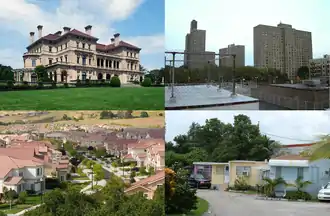
Overview
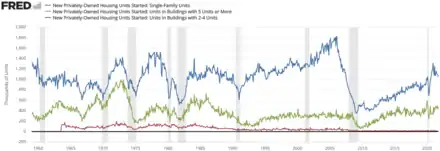
Housing as shelter is one of the "basic needs" of humans, offering protection against the elements.[2] It also provides a place of privacy away from the public eye where daily activities can take place. Residents often have personal attachment to a house, making it a home. A home's location, style and access to schools, parks, and other amenities can align a household to a greater community to reinforce cultural or religious bonds. These characteristics can also reinforce segregation and unequal access to amenities.[3]
Housing is also important to developers, builders, lenders, realtors, investors, architects, and other specialized professions and trades. These groups view housing as a commodity for financial gain.[3]
As the United States industrialized in the 20th century, demand for housing fueled job growth and consumer products to create economic growth. By the 1970s, manufacturing began to decline and the knowledge economy began to emerge. As a result, regional economies began to diverge and housing costs rose drastically in economic centers such as New York, San Francisco and Boston.[4] By 2016, housing costs in two thirds of the United States had exceeded wage growth.[5]
For households earning 30% of the county's median income, most counties in the United States do not have rental housing considered affordable to at least half that income segment (one-third of 30% of median).[6]
Construction
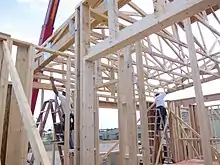
Wood framing is widely used in home construction in the United States. Concrete is used to build a foundation, usually with either a crawl space, or basement included. Interiors usually have drywall. Roofing often consists of asphalt shingles, although steel, and tile materials are also used.[7]
Homelessness
.svg.png.webp)
In 2014, approximately 1.5 million homeless people resided in shelters.[8] As of 2018, the Department of Housing and Urban Development reported there were roughly 553,000 homeless people in the United States on a given night,[9] or 0.17% of the population. Recent spikes in the homeless population include a 44% increase in Seattle in 2017[10] and 16% in the city of Los Angeles in 2019.[11][12] In January 2018 the federal government statistics gave comprehensive encompassing nationwide statistics, with a total number of 552,830 individuals, of which 358,363 (65%) were sheltered in provided housing, while some 194,467 (35%) were unsheltered.[13]
References
- "Housing and GDP" (PDF).
- Denton, John A. (1990). Society and the official world: a reintroduction to sociology. Dix Hills, N.Y: General Hall. p. 17. ISBN 978-0-930390-94-5.
- Carswell, Andrew T. (2012-05-31). The Encyclopedia of Housing, Second Edition. SAGE Publications. ISBN 978-1-4129-8958-9.
- "Housing Is Key to Improving the American Economy". Bloomberg.com. 2019-02-05. Retrieved 2021-01-21.
- "Home prices rising faster than wages: Report". CNBC. 2016-03-24. Retrieved 2021-03-16.
- In A High-Rent World, Affordable And Safe Housing Is Hard To Come By (with map)
- Anderson, L. O. (1975). Wood-Frame House Construction. US Department of Agriculture.
- "Here are 10 New Facts About Sheltered Homelessness in America". National Alliance to End Homelessness. November 10, 2015. Retrieved March 21, 2020.
- The 2018 Annual Homeless Assessment Report (AHAR) to Congress. December 2018. Authors: Meghan Henry, Anna Mahathey, Tyler Morrill, Anna Robinson, Azim Shivji, and Rian Watt, Abt Associates. Department of Housing and Urban Development (HUD).
- "Seattle's homeless population went up 44% in the last two years". Q13 FOX News. December 6, 2017.
- EVEN AS HOUSING PLACEMENTS REACH NEW HEIGHTS, 2019 GREATER LOS ANGELES HOMELESS COUNT SHOWS 12% RISE IN HOMELESSNESS
- Cowan, Jill (June 5, 2019). "Homeless Populations Are Surging in Los Angeles. Here's Why". The New York Times. Retrieved March 21, 2020.
- www.whitehouse.gov
Further reading
- Alex F. Schwartz (2013). Housing Policy in the United States. Routledge. ISBN 978-1-135-28008-6.
- Joint Center for Housing Studies (November 2020), The State of the Nation's Housing 2020, Harvard University, OCLC 1114953160
- Francesca Mari (December 2, 2020), "What's Between 30 Million Americans and an Eviction Tsunami?", New York Times
- Heather Long (December 7, 2020), "Millions of Americans are heading into the holidays unemployed and over $5,000 behind on rent", Washington Post
- Conor Dougherty (December 15, 2020), "Use It or Lose It: Tenant Aid Effort Nears a Federal Cutoff", New York Times
- "US evictions crisis: 'My pride has gone. We're pretty much homeless now'", BBC News, UK, December 19, 2020
- Jonathan O'Connell; Anu Narayanswamy (December 24, 2020), "Struggling renters face avalanche of evictions without federal aid", Washington Post
- Ross Barkan (January 4, 2021), "It's Time for America to Reinvest in Public Housing", Nytimes.com
- "Amazon pledges billions for affordable homes in US", BBC News, UK, January 6, 2021
- Barbara Kiviat; Sara Sternberg Greene (January 7, 2021), "Losing a Home Because of the Pandemic Is Hard Enough. How Long Should It Haunt You?", New York Times
- Haisten Willis (January 7, 2021), "Accessory dwellings offer one solution to the affordable housing problem", Washington Post
- Dale Maharidge (January 13, 2021), "How the United States Chose to Become a Country of Homelessness", The Nation
- "How Many Americans Are Homeless? No One Knows", New York Times, January 28, 2021
- Peter Hepburn; Yuliya Panfil (January 28, 2021), "The Black Hole at the Heart of the Eviction Crisis", New York Times
External links
 |
Wikimedia Commons has media related to Housing in the United States. |
- Housing Needs By State, Washington, DC: National Low Income Housing Coalition
- COVID-19 Housing Policy Scorecard, Eviction Lab
- "Homelessness Statistics by State", Usich.gov, Washington DC: U.S. Interagency Council on Homelessness