Humboldt 7 massacre
The Humboldt 7 massacre was the extrajudicial killing of four unarmed Directorio Revolucionario Estudiantil militants by Cuban police on 20 April 1957 in Havana, Cuba, during the Cuban Revolution. It occurred when a contingent of Cuban police, led by Lt. Colonel Esteban Ventura Novo, entered apartment 201 of Humboldt 7, a residential building where several revolutionary militants were staying. The four men who were killed in the incident took part in the 1957 Havana Presidential Palace attack and the seizure of the Radio Reloj station at the Radiocentro CMQ Building.
| Humboldt 7 massacre | |||
|---|---|---|---|
| Part of the Cuban Revolution | |||
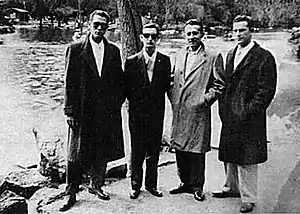 (left to right) Fructuoso Rodríguez Pérez, Joe Westwood Rosales, Faure Chomon, Juan Pedro Carbó. Pictured in Mexico City, 1956. | |||
| Date | 20 April 1957 | ||
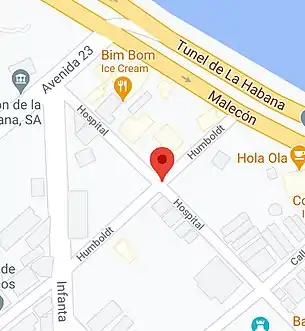
| Location | Humboldt 7, Havana, Cuba N 23° 8' 33.068 W 82° 22' 39.933 | ||
| Caused by | Havana Presidential Palace attack (1957)
Seizure of Radio Reloj station Betrayal of DRE by Marcos Rodríguez Alfonso | ||
| Goals | Kill or apprehend militants (police) Evade police (DRE) | ||
| Methods | Surprise attack | ||
| Resulted in | All militants killed | ||
| Parties to the civil conflict | |||
| |||
| Lead figures | |||
| |||
| Number | |||
| |||
| Casualties | |||
| Death(s) | All 4 DRE militants | ||
Prior to the incident, police often arrested or assassinated suspected revolutionary figures, and they were searching for the four men for their involvement in the attacks on the Presidential Palace and the Radiocentro CMQ Building. The men were betrayed by Marcos Rodríguez Alfonso (also known as "Marquitos"), a revolutionary who was against the conflict to remove Fulgencio Batista from power. After an argument with the men, he informed Lt. Colonel Esteban Ventura of their location; police promptly converged on the area and shot the men while they attempted to flee.[1][2][3]
The incident was referred to as an assassination and a massacre after it occurred, and the event greatly reduced the locals' support for the police. The incident was covered up by police officials until a post-revolution investigation in 1959. Marquitos was arrested and, after a double trial, he was sentenced by the Supreme Court to the penalty of death by firing squad in March 1964.[4][5]
Background
The failed attacks on the Presidential Palace and Radio Reloj provoked a strong reprisal by Cuban police as they launched one of the worst waves of repression and violence across Havana. Police squads, of their own initiative, went after opposition leaders who had not participated in the attacks, including Carlos Márquez Sterling, an attorney and professor of law and economics at the University of Havana, President of the Constitutional Convention, and signer of the 1940 Constitution of Cuba. One of the casualties was attorney and former senator Dr. Pelayo Cuervo Navarro, a figure in the opposition and leader of the Ortodoxo Party. Pelayo Cuervo was assassinated by the police the night of 13 March and is buried at the Colon Cemetery.[6]
March 13–April 20
Eleven days after the assault on the Presidential Palace, on 24 March 1957, some of the surviving members of the Directorio Revolucionario Estudiantil met at the home of Andrés Silva ("Cheo" Silva) on Calle L, between 15 and 17, in el Vedado, with the aim to discuss and analyze the recent actions of the attacks. Present were Fructuoso Rodríguez, Joe Westbrook, Faure Chomón, Julio García Oliveras, and Enrique Rodríguez Loeches.
The DRE agreed to appoint Fructuoso Rodríguez as Secretary General of the Revolutionary Directorate; to appoint Luan Pedro Carbó Serviá and José Machado as members of the Executive Board; and publish a document addressed to the country explaining the events of March 13. It was further agreed that Faure Chomón should go abroad in order to secure arms, and that the rest of the Directorio should, despite of persecution by Batista, remain in Havana.
After a week, the Directorio met again in the basement of a house on 19th Street between B and C, in el Vedado, the place from where the Radio Reloj assailants had departed for the failed attack on March 13.
This would be the last meeting that Fructuoso Rodríguez would preside over. On April 20 he would, together with Juan Pedro Carbó Serviá, José Machado and Joe Westbrook, be assassinated by Ventura. They were the victims of a denunciation by Marcos Rodríguez Alfonso , a.k.a. “Marquitos.” As a result, on April 20, Esteban Ventura Novo would attack the apartment where they were hiding on number 7 Humboldt street.
According to the plans, those that attacked the Radio Reloj station at the Radiocentro CMQ Building would regroup later at the University of Havana, with the aim of re-installing the headquarters of the Directorio. When Fructuoso Rodríguez and Joe Westbrook, along with Julio García Oliveras, Enrique Rodríguez Loeches, and other colleagues arrived, it was decided to place a 30-caliber machine gun on the steps of the university, and in two more strategic places within the campus.
A short time later, Faure Chomón arrived wounded, and reported on the failure of the assault on the Palace. For this reason it was decided that the best thing would be to withdraw from that location before the forces Batsta, far superior in men and equipment, surrounded the university.
Fructuoso and García Oliveras seized a truck of the "Cafeteras Nacional" and proceeded to a house located on 6th street and the corner of Calle 21, in Vedado. Fructuoso hid in another house in el Vedado, and later in that of the leadership of the Moviviento de 26 de Julio. From there he moved to the basement of the house on 19th Street, meeting other colleagues there.
Humboldt 7

The situation of the group became difficult with each passing day. Little by little the apartments that the Directorio Revolucionario Estudiantil had used on March 13, as well as others that they had in reserve, were falling into the hands of the Batista police. In the midst of enormous tension, some of the youth who were being persecuted, and for security reasons, began to seek refuge elsewhere. On April 9 or 10, Fructuoso and another member of the group moved to a house on Calle 17 between Calles 26 and 28, in el Vedado. Fructuoso saw his wife Marta Jiménez for the last time, she was in an advanced stage of pregnancy.
Shortly thereafter, they went to an apartment on Calle Ayuntamiento at the corner of San Pedro, in El Cerro. Later they went to a house on Calle Tercera between A and B, in Vedado and then spent the night one day in a doctor's office, on Calle 25 at the corner of I, also in el Vedado.
On April 14, both companions moved to an apartment on General Lee Street, in La Víbora, where Fructuoso would meet Carbó and Machadito. Joe was staying elsewhere.
For his part, Joe Westbrook left the university along with other classmates, first going to a boarding house and then to the house of a journalist where he separated from his companions. In a few days he would go to the basement of the house on 19th Street. Joe had been hiding in Marianao, he also hid at his girlfriend's house, on 18th Street, in el Vedado.
Juan Pedro Carbó Serviá and José Machado (Machadito) after retiring, injured in the Presidential Palace attack, circumventing the harassment of the police, had taken different paths, and after many vicissitudes and constant change of reguge, both arrived in the basement of the house on 19th Street.
When they decided to leave this place for security reasons, Rodríguez Loeches moved Carbó and Machadito to a house on Calle Aramburu between Jovellar and the old Espada Cemetery in the Barrio de San Lázaro. Then, García Oliveras took them to the apartment on calle General Lee, in La Víbora, where they were be united with Fructuoso.
At dawn on April 15, Machadito observed that a patrol car was guarding the block, and immediately raised the alarm to the others, but the event had no consequences. The next morning he saw the patrol car again, this time its occupants were talking with the night watchman and it seemed to him that he was pointing to the apartment window.
Machadito thought that they were surrounded and that a clash with Batista's police was inevitable. Quickly, the three combatants dressed, and armed with pistols, went out into the street ready to confront the police, but nothing happened, it had been a false alarm, the police had not detected them. There were too many coincidences, and they no longer felt safe in the apartment and they agreed to leave for a house reserved for emergencies that Machadito had in Zapata on the corner of 2, in el Vedado. At that time, late in the morning, the three student leaders, after walking several blocks, took a bus to house in Zapata.
The situation was worsening every day. The police tried to locate the Palace attackers by making surprise searches, arresting innocent citizens, torturing them, looking for any clue that would lead them to the attackers. There were many days and hours of insomnia and tension; Machadito was restless. He traveled by bus to make an asylum request with a journalist from "El País", a failed effort.
Again they moved, this time to a house on 30th Street between 35 and Kohly Avenue, in Nuevo Vedado. Then they got the three of them a shelter in the premises of the Pharmaceutical College, which was located on Malecón, between Galiano and San Nicolás, where they stayed until the night of the 19th.
Meanwhile, García Oliveras on Monday the 22nd informed Machadito that he could take refuge in an embassy. Joe Westbrook, meanwhile, secured the 7 Humboldt apartment, where the three revolutionaries finally went at midnight on the 19th.
In the morning of the 20th nothing foreshadowed what would occur in the afternoon. García Oliveras had arranged to pick up Joe Westbrook that afternoon at his girlfriend's house and take him to Humboldt #7, but it took him longer than expected and Joe, eager to meet with his comrades, asked his girlfriend to take him. At that time, and due to an informer (punished later by the Revolutionary governtment), the Batista police knew of the location where the four leaders of the Directory were hiding.[7][8]
Humboldt 7 surrounded

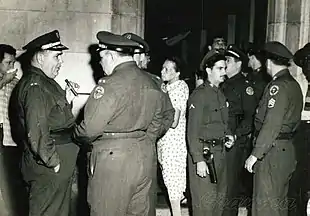
At approximately five thirty in the afternoon, Esteban Ventura Novo and a group of policemen surrounded #7 Humboldt, with the butts of their weapons the policemen banged on the door of apartment 201.
Joe Westwood managed to get to the neighboring apartment on the ground floor, 202 and with the neighbor's permission, he sat on a sofa in the living room and pretended to be a visitor and hoping to avoid detection. When there was a knock on the door, Joe Westbrook reassured the woman and calmly she got up and opened it. The police jumped on him, the neighbor asked not to hurt him, but it was useless. When he had barely walked a few feet down the hall, they opened fire. The machine-gun burst brought him down, he was killed instantly. He was in his early twenties.
The other revolutionaries slipped through a vent arriving at another apartment on the ground floor, number 101. Unaware that they were surrounded from outside and inside the building, they went out in different directions. Juan Pedro Carbó, tried to get to the elevator, the police recognized him and fired. Through a window, Fructuoso and Machadito jumped into the downstairs hall. The height was great, when they fell to the ground, Fructuoso was knocked unconscious and Machadito broke both ankles. When the latter tried to get up, one of the policemen fired his machine gun through the bars of the gate that closed the corridor.
The bodies of the four student leaders of the Directorate were dragged along the sidewalk to the corner, to the outrage of the people, who from the balconies of their houses shouted to the police: "Assassins! Assassins!" [9]
Dead in the Humboldt 7 massacre
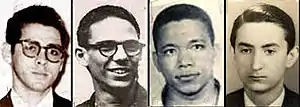
Fructuoso Rodríguez Pérez, Juan Pedro Carbó Serviá, José Machado Rodrigues (Machadito), Joe Westwood Rosales.
Betrayal
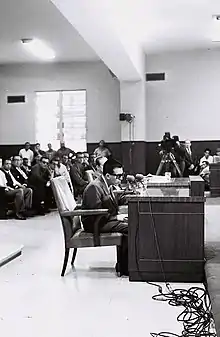
After the assault of March 13 on the Presidential Palace the survivors hid in various apartments throughout Havana seeking safety. In the case of Fructuoso Rodríguez, Juan Pedro Carbó and Machadito, they wandered for 38 days until they reached Hum-boldt 7. Joe Woestbrook, finding refuge from the first moment in the house of his girlfriend Dysis Guira, did not suffer the same vicissitudes. After wandering for days, they find the apartment of Humboldt 7, obtained by another young revolutionary, Pérez Cowley, with the knowledge of Marquitos. When they arrived at Humboldt 7 in the early morning, they find Joe Westbrook and Marquitos. An argument between Juan Pedro Carbó and Marquitos is the cause of the betrayal of the 4 revolutionaries by Marquitos.[5]
Joe Westbrook hurt Marquitos self-esteem, and is his motivation to disclose the location to Esteban Ventura and the police department. That day, at 5:50 p.m., the four men are surrounded and murdered. Three days later, Marquitos took refuge in the Brazilian embassy, where there were members of other revolutionary organizations. Two months later they left for a country in Central America. After spending time in Costa Rica, Mar-quitos is invited by Dysis Guira to visit Argentina, where he has taken refuge. In December 1957 he arrived in Mexico and stayed for a year. There he meets communist leaders Joaquín Ordoqui and his wife Edith García Buchaca. On January 28, 1959, he returned to Cuba and later traveled to Prague on a film scholarship. In the Czech capital he coincides with the military delegation of Raúl Castro. He is appointed to accompany Commander Pilón and other soldiers to France, a manifest action in the absence of suspicion. In the almost two years that Marquitos remained in Prague, no steps were taken to return him to Cuba. Why? The conviction was missing, there was no probative element of an accusation.[5]
Some time later he receives a message from the Brazilian ambassador in Cuba to go to another country. The message is intercepted by friendly intelligence services, who inform Osvaldo Sánchez and he warns Commander Ramiro Valdés about Marquitos' steps. He is ordered to arrest and return him to Cuba under charges of collaborating with the enemy. An important observation for those who think that the PSP helped him: Marquitos's custodians on the return trip were PSP militants. For two and a half years he remains in detention and is interrogated in 5th grade, and 14 and later in Villa Marista by officials of the State Security. Unable to obtain guilt for his betrayal in Humboldt 7, attention towards him relaxes. In the Villa Marista office he works as a nurse's aide and plays base-ball, evidence of the lack of evidence against him. Interrogator Caldeiro asked his boss, Hamel Ruiz, to be resettled in another case as he was unable to obtain his confession. It was necessary to make him confess or release him. That was the dilemma that was presented to the leadership of the Ministry of the Interior. The insistence of Marta Jiménez (Fructuoso's widow) and other companions that Marquitos was the traitor inhibited them from releasing him. Releasing him would have led to an opinion contrary to the government for supporting the alleged informer.[5]
Faced with this dilemma, they chose to make one last effort. At the end of 1962, the Head of State Security decided to double the interrogation to obtain his confession. They brought investigator Vicente Gutiérrez, a former Partido Socialista Popular (PSP) member, into the case. The momentum given to the case began to shift in a better direction. Vicente Gutiérrez made his first conclusion: “If all the occupants of apartment 201 on Hum-boldt 7 were killed on the spot, who could have informed Ventura that Marcos escaped? Marquitos would have to be the informer."[5]
If the statement made by Vicente were true: "The delay for years to do justice is explained by the unrestricted support enjoyed by Marcos Rodríguez", then it would not have happened that a Partido Socialista Popular militant would have reached that conclusion. However, having reached that first step, it was necessary to get his confession. Vicente Gutiérrez and the two interrogators did not rest in their efforts. They thought that Felipe Mirabal, former second chief of the SIM, imprisoned in the Cabaña, could help in the clarification; but the resource did not work and he was returned to prison. However, the ruse of having someone who identifies him for having been at the meeting with Esteban Ventura continued to be used. They put Marcos to write about the most recent events in his life and then they found something that would give the final impulse to the case. Marquitos did not refer to the discussion that arose that morning of the meeting in Humboldt 7. Vicente Gutiérrez explained it during the trial in an enlightening way: "The lie was that when he recounted the visit to Humboldt's apartment, he pointed out this as a cordial visit in which holds friendly conversations with classmates. It does not reflect anything of the incident that occurred and for this reason this increases the suspicions, which are now irrefutable, that he is Humboldt's informer 7." It is Vicente who manages to find his weakest point in the Marquitos story. It is necessary to reiterate that the person who discovers it is a member of the PSP, who scrutinizes the smallest details of the event. The DR was suspicious, but could not prove it. So, the two questions already mentioned: why he was able to hide his betrayal and the participation of other people in helping Marquitos are discarded. Now, let's look at the difference between support and protection. If the protection had existed, then Ordoqui could have influenced Vicente Gutiérrez, a former member of the PSP. Something important to underline: there was a veiled criticism of the revolutionary government. Because if Ordoqui actually gave Marquitos unrestricted support, the revolutionary government also participated in the compromise. As the saying goes, whoever kills the cow is as guilty as the one who holds its leg.[5]
Another fact to take into account. During Marcos Rodríguez's time in detention at La Cabaña, his father visits Ordoqui and suggests that he go see his son. Ordoqui's response. "No, it is not good to go see him, he must show his innocence. It is not possible for a political leader to make an appearance at State Security. The father tells him: "I am his father." I understand it, but I am a political leader who should not get involved in the problems of investigations being carried out by State Security. I am sure that they are doing well." During one of the interrogations, Marcos was asked if he had betrayed them for money. Then he said no. "No, for money, no!" Thus they finally obtained their confession in 1963, but it was not until 1964 that the trial was held. Before Fidel travels to Moscow, they inform him of Marquitos' confession. He gave instructions to Raúl and Dorticós to be the one who would handle the case. Some time later, a letter from Marquitos taken from La Cabaña by his father reaches the hands of Faure Choumón, who talks to Ramiro and he forwards it to Dorticós. The president told Fidel that the trial could no longer be delayed.[5]
Trial

It seems at first like a political matter, when the representatives of the Directorio Revolucionario Estudiantil express that the denouncement was the result of sectarianism, and on those words rested the evidence of his betrayal. Carlos Rafael replied: "Sectarianism does not breed denunciation. It is bad, it is harmful, it isolates us from the masses and the people, but it does not engender whistleblowers or traitors." It is from that judgment, in April 1964, that the two opinions on the fact emerge and that is why the judgment acquires a political character.[5]
In 1964 the revolutionary courts of the Castro government tried and convicted Marcos Rodríguez Alfonso, aka “Marquitos”, for tipping Esteban Ventura Novo of the Havana police to the 7 Humboldt hideout. The trial lasted from March 14 to March 19. An appeal from a conviction was heard by the Supreme Court from March 23 to March 30 and the court's decision was announced April 1, 1964.[10]
Marcos Rodríguez Alfonso confessed during his trial:
- Marcos Rodríguez: I cannot find words to be able to narrate such a crime that for it I deserve death. To me it was difficult to accept that I did such a thing. That is why I always tried through all means to hide, to distort, because it seemed to me that I had not done that. It was so monstrous, so inhuman, so cruel, so horrible that I could not accept that I had done such a thing.
- Interrogator: Why did you precisely call Ventura? And not just someone else.
- Marcos Rodríguez: I primarily thought of him because he was an executioner. That's why I did it. Frankly, I cannot continue. Excuse me.[11]
Marcos Rodríguez Alfonso was executed on April 2 by a firing squad. There was no official announcement.[12][7][8]
Criticism
Was Marquitos the Humboldt 7 informer?
Nicolás Águila argued in 2015 that Marquitos was sentenced with no solid evidence presented at the trial regarding his alleged denunciation. Apart from suspicions and inconclusive circumstantial evidence, the only "evidence" at work in the summary was the defendant's confession, extracted after three years of detention and under the pressure of strong interrogations and confrontations with high-ranking leaders of the regime; including a confrontation with Fidel Castro in the role of interrogator. Marquitos was sentenced to capital punishment after a long politicized process, one plagued by irregularities and arbitrary procedures. The ex-officio appeal to the Supreme Court in practice turned into a second trial.
Marquitos was accused, seven years after the fact, of having been the informer who handed over to the Police four members of the Revolutionary Directorate (DR) who were refugees in an apartment on 7 Humboldt Street, in Havana, after participating in the assault on the Presidential Palace and in the seizure of the Radio Reloj station on March 13, 1957. The four young militants were mercilessly massacred on April 20, 1957, by the police forces under the command of the then-captain Esteban Ventura Novo, a repressor with a notorious bloodthirsty record in Havana.
Is denunciation a crime?
It was not in Batista's time and much less after that denunciations have never been classified as a criminal offense in the Cuban penal code, on the contrary, it has been encouraged and even rewarded (paid) by both dictatorships. It can be understood as a civic duty to report to the police if the existence of a group of fugitives hiding in a home is known.
Águila argues that the young people of Humboldt 7 may be considered idealistic revolutionaries, according to the romantic perception of the time, but taking over a station (Radio Reloj) at gunpoint and attacking the Presidential Palace through a commando operation, with the balance of many dead and wounded, constitute facts of extreme gravity under any government, dictatorial or not. The alleged denunciation of Marquitos, as disgusting as it may be, was not in itself a crime that deserves such a drastic penalty.
Marquitos, again, Águila argues, should not have been sentenced to death under any legal concept as whatever law they were following was retroactively applied, in a trial without procedural guarantees, a sanction that on the date of the alleged crime was not contemplated in the legislation in force in the Republic and not even in the criminal regulations of the Sierra Maestra. Which constitutes an unmitigated legal monstrosity.
Was there a death penalty sanction in April 1957?
They applied retroactively to Marquitos, as they did to the so-called Batista henchmen in 1959, a sanction that was not in force on the date of his alleged crime. The Cuban Constitution of 1940 had abolished the death penalty in its article 25, except for cases of "crimes of a military nature and persons guilty of treason or espionage in favor of the enemy in time of war with a foreign nation."
Likewise, the alleged denunciation of Marquitos is even prior to the death penalty law enacted in the Sierra Maestra on February 21, 1958, through Regulation No. 1 of the Rebel Army, based on the criminal laws of the Republic on Arms during the Second War of Independence. So Marquitos was retroactively applied a sanction that was based on the Mambisa procedural legislation of 1896. It goes without saying that the retroactive application of a law only proceeds if it favors the defendant and never if it harms him.
Was the death sentence against Marquitos fair?
It was grossly unfair and disproportionate. Even admitting that the denunciation was a serious crime, the death penalty was an obviously excessive sentence. Marquitos cannot be held directly responsible for the Humboldt 7 massacre. In fact, he paid the blame for the heinous crime of Ventura Novo with a vengeful execution that also has the overtones of burning the files. Marquitos knew first-hand the dirty insides of the old Communist Party (PSP), its transversal espionage and its infiltration in the other revolutionary organizations of the time. They applied the old maxim of pirates: "Dead men tell no tale".
Was the defendant a minor on the date of his alleged allegation?
Marquitos stated at the beginning of the trial that he was 17 years old on the day of the 7 Humboldt massacre; that is to say, on April 20, 1957. Which meant that he was underage and thus could not be charged with /capital punishment. However, later, responding to a cross-examination question by the defense about his age on the present day, he rectified and declared a date of birth that made him of legal age in 1957 for the purposes of criminal responsibility.
So, with 20 years not yet completed on the date indicated (if we consider valid that he was born in 1937, a fact that some question), the accused was of legal age to be shot (more than 18 years), but he was under the age of marriage (under 21 years old). A glaring contradiction that the public defender took advantage of in his timid final argument, citing the young age of the accused as a mitigating circumstance of the death penalty. His plea for clemency was naturally ignored. Already before, Fidel Castro himself, doubled as a prosecutor, had requested the death penalty for Marquitos. Which means that he was sentenced to death beforehand.
Conclusion
After a long politicized process, plagued by irregularities and arbitrary procedures, Marquitos was sentenced to capital punishment. To make matters worse, the ex-officio appeal to the Supreme Court in practice turned into a second trial.
Marquitos should not have been sentenced to death under any legal or human concept. Laws were retroactively applied, in a trial without procedural guarantees, a sanction that on the date of the alleged crime was not contemplated in the legislation in force in the Republic and not even in the criminal regulations of the Sierra Maestra.
Furthermore, the minority of Marquitos was not taken into account. The execution of Marquitos was a crime comparable to the Humboldt 7 massacre itself. Or even worse. In that trial, not only was Marquitos condemned to the firing squad but Cuban Justice, which had already been shot in January 59, received with that vengeful sentence the final coup de grace. Technically, Marquitos was innocent.[13]
Gallery
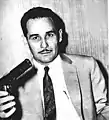 Esteban Ventura Novo a known killer and torturer of the Havana Police.
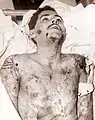 Fructuoso Rodriguez killed April 20, 1957, Humboldt 7 massacre.
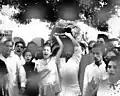 Marta Jiménez Martínez his wife, pregnant, at Fructuoso's funeral.
See also
Notes
References
- "Humboldt 7, una criminal delación". Retrieved 13 March 2021.
- "The Martyrs of Humboldt 7". 25 October 2016. Archived from the original on 12 August 2019. Retrieved 28 October 2018.
- "Humboldt 7 y el hombre que delató a mi padre". 6 March 2011. Archived from the original on 12 August 2019. Retrieved 12 August 2019.
- "Los Amagos de Saturno".
- "El crimen de Humboldt 7" (PDF). Retrieved 12 March 2021.
- "Palace Attack Trial Set April 5, 2 Set Charged". 29 June 2009. Archived from the original on 25 October 2018. Retrieved 28 October 2018.
- "Marquitos, ¿inocente o culpable?". Archived from the original on 29 December 2018. Retrieved 12 August 2019.
- "Cuban Is Reported Executed; Castro Role at Trial Studied". The New York Times. 5 April 1964. Retrieved 12 March 2021.
- "El día que asesinaron a cuatro héroes". Retrieved 10 March 2021.
- "Trial of Marcos Rodríguez Alfonso" (PDF). Retrieved 11 March 2021.
- "Los Amagos de Saturno". Retrieved 11 March 2021.
- "Marquitos, ¿inocente o culpable?". 6 November 2019. Retrieved 13 March 2021.
Additional reading
External links
- El Crimen de Huimboldt 7 (II)
- El crimen de Humboldt 7
- El niño de la foto de Humboldt 7
- Humboldt 7, una criminal delación
- "Tragic events of Wednesday March 13"
- Fructuoso Rodríguez: García Buchaca encubrió al delator de mi padre - América TeVé
- A Tribute to Those Who Died at Humboldt 7
- Library of Congress_Juicio Marcos Rodriguez Alfonso, marzo 23-30, 1964
- A refuge for the best of the Cuban nation
- Cuban Is Reported Executed; Castro Role at Trial Studied
- La masacre de Humboldt 7, Bohemia
- Segunda Vista del Juicio Contra el Delator Marcos Rodrigues
- 27_marzo_1964_13-pages-21-31_Bohemia
- Fructuoso Rodríguez. Apuntes para la biografía de un revolucionario
 |
Wikimedia Commons has media related to Havana Presidential Palace attack (1957). |