Idora Park
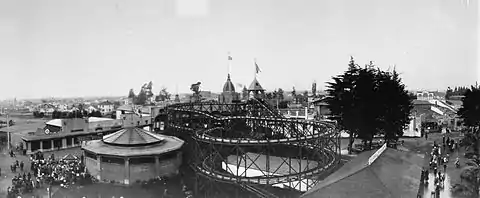
Idora Park was a 17.5-acre (71,000 m2) Victorian era trolley park in north Oakland, California constructed in 1904 on the site of an informal park setting called Ayala Park on the north banks of Temescal Creek. It was leased by the Ingersoll Pleasure and Amusement Park Company that ran several Eastern pleasure parks. What began as a pleasure ground in a rural setting for Sunday picnics evolved into a completeamusement park visited by many residents of the San Francisco Bay Area. Its popularity declined after the advent of the automobile, and it was closed and demolished in 1929.
History
The Realty Syndicate constructed the park in 1903[1] on a site of Ayala Park that included an opera house, ranchlands and greenhouses on the north banks of Temescal Creek in North Oakland. Rodney Ingersoll erected the first figure-eight "sky railway" on the site in 1903. Idora Park was leased by the Ingersoll Pleasure and Amusement Park Company that ran several Eastern pleasure parks. Originally its name was to be Kennywood Park (after an amusement park in Pennsylvania). Mr. Ingersoll may have decided to name it after his daughter, Idora. (A park with the same name, in Youngstown, Ohio, was said to have been named either by a contest winner claiming "I adore it!", or after a local First Nations band.)
The Realty Syndicate also owned and operated what the Key System transit company, the Claremont Hotel and the Key Route Inn. The company's major partners were Frank C. Havens; and Francis "Borax" Smith, who earned his fortune in borax mining, subsequently investing it in transit and commercial and housing properties in the East Bay area.
Located on the block bounded by Telegraph Avenue, Shattuck Avenue, 56th and 58th streets in the northern section of Oakland,[1] Idora Park was famous for its opera house. A wall surrounded the park. Admission was 10 cents, and it was open 30 or more weeks per year. Bertrand York managed the park from 1911 until its razing in 1929.
In the early 1900s, Idora Park was also the site of public demonstrations with lighter-than-air and heavier-than-air flying machines, including a balloon-launched glider flight by David Wilkie in a glider designed by John J. Montgomery on February 22, 1906. It was also the location for the final construction of The California Arrow, a dirigible built by Thomas Baldwin in 1904. On August 3, 1904 the first successful round-trip difficult flight in the United States was made by Baldwin with The California Arrow at Idora Park.[2]
In the aftermath of the 1906 San Francisco earthquake, as many as 2,500 displaced people found shelter in Idora Park. Food and relief supplies were provided by the Realty Syndicate, purchased from Capwell's Department Store.[3] In the period that followed, comic stars from the Tivoli Theater relocated to Oakland and renamed themselves the Idora Park Comic Opera Company. Shows like The Mikado, The Pirates of Penzance and The Wizard of the Nile were performed under the direction of Paul Steindorff in a wooden opera house called the Wigwam Theater. In 1919, when Oakland's own 159th Regiment returned from France, the soldiers were admitted at no charge.
Rides
Idora Park rides cost 5 cents. Many were advertised as being the "largest" or "first."
- The Circle Swing, A large round flat disk or bench suspended by chains from a central pole, on which people could sit to swing
- The Social Whirl, a platform inside a structure where people say until centrifugal force pushed them off
- Barrel-of-Fun
- Trip through Hades
- Helter Skelter, a slide-type ride
- Chutes
- The miniature railway train, a small steam-powered railroad that carried people through the park
- Haunted swing
- Ferris wheel
- Touring Cars
- Circle Wave
- The Flying Swing, a swings (ride) with cars suspended from a central point that turned fast enough for the cars to become elevated
- The Tickler, apparently a ride with a car on a twisting track
- Merry-go-round
- The Mountain Slide, which appeared to be a slide down through a mountain
- The Auto Race Course, a circular track where two full-size electrically powered automobiles, filled with people, raced each other to the finish
Rides were renamed regularly. In published descriptions of the park, one finds titles such as Dodge 'em, The Whip, Over the Top, Race Through the Clouds, and the Magic Carpet.
Roller coasters
The park has five traditional roller coasters during its history:
- Ingersoll Figure 8 Toboggan, 1906-1916
- L.A. Thompson Scenic Railway, 1906-1921, (owned and operated by the Thompson Company)
- Race Thru The Clouds, a twin track coaster (dates unknown)
- The Big (or Giant) Dipper, 1922-1928, John A. Miller designed at a cost of $60,000
- Skyrocket (or Thunderbolt), also designed by Miller, 1927–1928
Attractions
Idora Park boasted the first outdoor public address system built by Magnavox, the first radio theater in the West, and a huge searchlight. Like many things at the park, the searchlight was reputed to be the largest in the world. The evening light display used so much power that it outstripped the original capacity, and a new system had to be installed in 1907.[4]
The walled-in park had a zoo, ostrich farm, animal shows, dance hall, racetrack, outdoor amphitheater, Japanese garden, bear grotto, a main street called the Glad Way, and a penny arcade, photo gallery, and shooting gallery. In 1904 a ballpark with a 3000-seat double deck grandstand was erected, and after the 1906 earthquake, the Pacific Coast League relocated there. The park had the largest roller skating rink in California, the largest west of Chicago, that rented clamp-on skates. A bandstand was at its center. The Mountain Slide had a firework volcanic display on Saturday nights. There were hot-air balloon ascensions, from which the acrobatic team of Frank and Carrie Hamilton parachuted.
At The Laying Hens, participants threw a ball at a wooden hen sitting on a barnyard fence, and if it were hit, it fell over and delivered a hard-boiled egg to eat. The park offered electric souvenirs, table tennis, a musical arcade, a dancing pavilion, a roof garden and grill, lunch counters, open-air concerts, and numerous refreshment booths.
Entertainment
Vaudeville performers sorted in Idora Park's stages. Famous stars who emerged from Oakland included Hobart Bosworth, Fatty Arbuckle, Mabel Normand, and possibly Lon Chaney. It has been said that Charlie Chaplin and Buster Keaton improved their skating skills at the Idora Park rink, described (in 1913) as the largest in the world. Something called the Cabaret de la Mort existed for a time. Jack London's daughter Becky describes trips to Idora Park with her father (link below).
Aimee Semple McPherson held the largest outdoor baptism to date before 10,000 spectators in the swimming tanks after returning from the Far East following the death of her husband Robert James Semple.
Refreshments
Idora Park was famous for its crispy sour milk waffles (a recipe later published in the Oakland Tribune). Ice cream, popcorn and Coney Island "Red Hots" were a nickel, whiskey a dime, Busch Beer from St. Louis was five cents. The park's restaurant featured full-course meals for 75 cents to one dollar, and soda pop was available in 12-ounce bottles.
Demise
Idora Park was eclipsed by the rise of the automobile and Neptune Beach in nearby Alameda. It was razed in 1929, and a plan to develop the Central Square, an apartment and business complex, was announced. The Depression interrupted these plans, and a variety of small storybook houses and worker housing apartment blocks were eventually constructed on the 17-acre site.
In 1930 a new roller rink, Rollerland, was constructed facing Telegraph Avenue in the 5400 block.
References
- Clippings file, Oakland History Room, Oakland Public Library, 125 14th Street Oakland CA 94612
- Oakland Enquirer - April 12, 1902, May 6, 1902, November 26, 1903
- Oakland Herald - April 20, 1907
- Berkeley Daily Gazette - February 4, 1943
- Montclarion - July 26, 1978, January 24, 1997
- Oakland Herald April 20, 1907
- Oakland Tribune - July 19, 1908, January 27, 1929, April 26, 1931, June 30. 1929, October 7, 1943, July 23, 1944, & January 1, 1961, May 10 & 17, 1970
- Bagwell, Beth (1982) Oakland, The Story of a City, Presidio Press, California, page 148, ISBN 0-89141-146-1.
- Harwood, Craig S. and Fogel, Gary B. Quest for Flight: John J. Montgomery and the Dawn of Aviation in the West, University of Oklahoma Press 2012.
- Bagwell, Beth (2012) Oakland, The Story of a City, Oakland Heritage Alliance, California, page 176, ISBN 978-0-615-62916-2.
- Bagwell, Beth (2012). Oakland: the story of a city. Oakland, CA: Oakland Heritage Alliance. p. 148. ISBN 978-0-615-62916-2.