Ilocano people
The Ilocanos (Ilocano: Tattao nga Iloko/Ilokano), Ilokanos, or Iloko people are the third largest Filipino ethnolinguistic group and mostly reside within the Ilocos Region in the northwestern seaboard of Luzon, Philippines, Ilocano people speaks Iloko or Iloco Language.
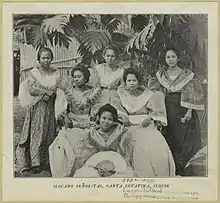 Ilocano women from Santa Catalina, Ilocos Sur, c. 1900. | |
| Total population | |
|---|---|
| 8,074,536 (8.8%) (2010)[1] | |
| Regions with significant populations | |
 Philippines Philippines(Ilocos Region, Cordillera, Cagayan Valley, Central Luzon, Metro Manila)  United States United States(Hawaii, California) Worldwide | |
| Languages | |
| Ilocano, Filipino, English | |
| Religion | |
| Predominantly Roman Catholicism, Aglipayan minority, Iglesia ni Cristo, Protestantism, Members Church of God International, Jehovah's Witnesses, Islam, Buddhism[2][3] | |
| Related ethnic groups | |
| Filipinos (Ibanag, Ivatan, Pangasinan, Kapampangan), Austronesian peoples |
Historically, the Ilocano people are resourceful and industrious, their resilience, probably, stemming from their geographical location and extreme weather patterns. Their high inclination to save, misread by non-Ilocanos as characteristic of a typical tightwad, is evident in the high average savings rate of the region throughout the years. Ilocanos have an elaborate network of beliefs and practice which he applies when he deals with the people around him.[4]
The people are essentially rice producers who also indulge in extensive agriculture with cash crops like tobacco and garlic. There has been a continual migration of labor to different parts of the country to the southernmost reaches, and even to other places like Hawaii and California. Outmigration was caused by dense population pressures in a land with limited agricultural potentials. Ilocos Region It is one of the most densely populated regions in the country. The agricultural production is not sufficient to meet local needs thus much of the population went into the labor market and interregional trade. Tobacco is the leading cash crop. The textile industry in the area has a long tradition. Fishing is second only to agricultural production.
Among the more dominant of the ethnic groups, they have figured prominently in the political, educational, economic, religious, and other sectors of society. Intensely regionalistic like most of the other major groups, the Ilocano take pride in their roots and language.[5]
Etymology
The word Ilocano or Ilokano originates from the word Iloko (archaic Spanish form, Yloco), the conjugation of i- (meaning 'of') and look (meaning 'bay'), which means 'from the bay' in Ilocano. Alternatively, according to some records, the name “iluko” is derived from “l-”(originating from) and “luku” or “lukung (a valley or depression of land, hence "lowland"). It is located between the “gulod” (mountains) and the “luek” (sea or bay). Iloc“ano” is the Spanish word for "us" ano, which refers to the people (e.g., Americano, Italyano, Africano, Mexicano, etc.). Males are referred to as Ilocano or Ilokano while females are referred to as Ilocana or Ilokana.
History
Pre-History
Two theories are prominent among historians regarding the spread of what historians call the Austronesian peoples.
- A theory posted by the anthropologist Henry Otley Beyer, known as the Wave of Migration Theory, posits that from 300 to 200 BC[6] a migration of Austronesian speaking people from the island of Borneo arrived on the shores of northwest Luzon. They were supposedly the most recent of the three waves of migration to the Philippines known as the Malays. Before the arrival of these people, the inhabitants of northwest Luzon were a different Austronesian speaking people called the proto-Malay group, consisting of the modern Tinguian, Isneg, Kalinga, Kankanaey, Bontoc and other tribes collectively known today as the Igorot. Prior to the arrival of the Igorot were the people known today as the Aeta or Negritos. Different studies show that the Ilocanos came to the Northwestern Luzon along with the Kalingas, Apayaos, and Tingguians.[7] Over time, the Malay people intermarried with the proto-Malay and/or Aeta people, and it is their descendants who lived along the coasts of Northwestern Luzon that the Spanish first came in contact with and called Ilocanos.
- Nowadays, the most commonly accepted theory is the "Out of Taiwan" model. In this model, it is suggested that the ancestors of today's Austronesian peoples originated from migrations from the island of Taiwan during the Neolithic period.
Social Structure
While Spain applied the term barangay to the settlements in the Ilocos region upon contact, the Ilocano people called their towns, íli, and a smaller group of houses, purók.[8]
These residents of the íli were organized in a class society. At the top of the class system was a chief or agtúray or ári and his family. The ári earned his position due to strength, wealth and or wisdom.[9] This position could also be inherited and usually reserved for a male; however, in the event that no male heir was available, a strong female heir was accepted.[10]
If the heir was found to be weak by the íli, then another ári family would be put in place and the former ári family could fall down in class. Together with a community of elders called amáen or panglakáyen íli, the ári administered justice and governed the daily lives of the íli and led his/her people to war if necessary.
Below the ári were the wealthy babaknáng, or Maharlika in Tagalog, some of whom could easily move into the position of ári. Their wealth was maintained by their control of trade with primarily the Chinese, Japanese, Igorots, and the Tagalogs. Goods often traded were rice, cotton, gold, wax, iron, glass beads, honey, and stoneware jars called burnáy.
Below the babaknáng were the kailianes, a class that helped the ári in sailing, working his/her fields, and preparing for celebrations. In exchange, the kailianes were given gifts directly from the ári.[11]
The katalonan were below the babaknáng and the kailianes and they were tenant farmers who consisted of the majority of the population in an íli. They largely practiced wet-rice agriculture which included rice and taro as well as dry agriculture that included cotton.
At the bottom of the pre-colonial Ilocano society were the ubíng and below them, the tagábu, also called "adípen". The ubíng were servants while the tagábu were slaves. The tagábu acquired their status through unresolved debt, insulting a member of the babaknáng or ári, by being prisoners of war, or even inheriting the debt of their ancestor.[12]
Appearances
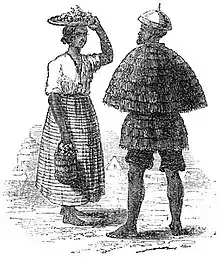
Both Ilocano men and women grew their hair long, but tied it up in different ways. Some women twisted their hair to create a bun, while some men twisted their hair and hid it under a turban like wrapping called a bangal or potong. The patterns and colors of the bangal had many meanings. For example, red potong indicated that the wearer had killed, while a striped pattern indicated that the wearer killed at least seven people.[13] In addition to the bangal, farmers and fishermen also wore a gourd hat called a kattukong[14] on sunny or rainy days. The kattukong was made from a hollowed and dried calabash gourd or tabúngaw in Ilocano with a woven interior made of anahaw, nipa, bamboo, and/or rattan. Also often worn during rainy days was a cape called a annangá, also called "lábig" or "kalapiáw", which was often made of nipa palm leaves.
Juan de Salcedo
The Spanish conquistador Juan de Salcedo explored the northern regions of the Philippines in 1571, where he traveled to the Ilocos region (among other places), colonizing the North, and establishing several Spanish municipalities, including Villa Fernandina known as Vigan City in the present time and Tagudin.
War with Zambales and Pangasinan 1660
In 1660, Andres Malong, a chief of San Carlos, Pangasinan or Binalatongan as it was called then, allied with the people of Zambales in an effort to remove the Spanish colonizers and subdue those who supported Spain. Malong was formerly employed by the Spanish to help colonize non-Christian towns and villages in Pangasinan, however, as Malong subjugated others, he realized he could also overcome the outnumbered Spanish.
With his Zambales allies, Malong crowned himself the king of Pangasinan and sent out letters to all the chiefs of the Ilocos Region, Pampanga and Cagayan Valley and demanded that they too align and recognize Malong as their king and kill any Spaniards among them. If they did not, Malong warned that he would invade and punish them for not joining his cause.[15]
Unlike Pangasinan and the Zambales, The Ilocos at the time was a region that the Spanish invested its soldiers and missionaries in and routinely secured. Towns such as Vigan, Ilocos Sur and Tagudin, Ilocos Sur were quickly conquered by the Spanish encomiendas, fortifications and Catholic churches quickly established to subjugate the Ilocano people into the Spanish Empire. The Spanish were swift in this process to stake their claim on the region's gold trade with the Igorots.[16] They sought to prevent Chinese and Japanese pirates and different European powers such as the Dutch or English from taking these trade routes. Considering this relatively recent history with the Spanish and primarily under the influence of Catholic missionaries, many of the Ilocano chiefs rejected Andres Malong's offer.
.jpg.webp)
In response to their rejection, Malong sent a Zambales chief named Don Pedro Gumapos, who had recently conquered the Pampanga region with 6,000 men, to invade the Ilocos as well as Cagayan regions. Gumapos and his men were met with only 1,500 Spanish loyalist Ilocanos under the command of the alcalde mayor of the region and even missionaries. As such, the Zambales and Pangasinese army quickly defeated them and marched as far north as Vigan, Ilocos Sur where they sacked and burned the Spanish stronghold and nearby villages. With many of the Spanish missionaries and colonial authorities in Ilocos evacuated and/or in retreat, Malong then asked Gumapos to assist him in Pangasinan, where the Spanish were beginning to advance on him. As Gumapos and his troops traveled back down through Narvacan, Ilocos Sur, they continued to raid Ilocano towns and villages for supplies. Ultimately, the people of Narvacan responded with guerrilla tactics aided by their Tinguian allies.[17] This retaliation by the Ilocano people was devastating and caused more fatalities on Gumapos' army than with the Spanish lead Ilocano forces.
As the invading army headed south, they sacked and/or burned the coastal towns of Santa Maria, Ilocos Sur, San Esteban, Ilocos Sur, Santiago, Ilocos Sur and Candon, Ilocos Sur. When they finally approached Santa Cruz, Ilocos Sur, Gumapos encountered a Spanish led army who had just finished reconquering Pangasinan and captured Andres Malong. Despite learning of Malong's defeat, Gumapos led his army to battle. Gumapos and his army were defeated after two large battles. After being captured, Gumapos was sent back to Vigan, Ilocos Sur where he was executed by hanging.[18] The Ilocos Region would not see another revolt against the Spanish until 1762.
The Basi Revolt 1807
The Basi Revolt, “also known as Ambaristo Revolt,” erupted on September 16, 1807 in the present-day town of Piddig, Ilocos Norte. Led by Pedro Mateo a “cabeza de barangay” of Piddig and Saralogo Ambaristo an Ilocano and Tinguian and composed of townspeople from Piddig, Badoc, Sarrat, Laoag, Sinait, Cabugao, Magsingal and other towns of Ilocos, they marched under their own flag of yellow and red horizontal bands and made their way southward towards the provincial capital of Vigan to protest against the abuses of the Spanish colonial government.
Historical accounts said in the year 1786, It began as a result of the people’s frustration over the “Basi” (the local beverage of the Ilocos, where it has been consumed even before the Spanish conquest) Wine Monopoly imposed by the Spanish Colonial government and prohibited the private manufacture of basi, forcing Ilocanos to buy from government stores. It was a draconian colonial policy that deeply impacted both the economy and the culture of the Ilocanos.
Even before the arrival of the Spaniards, Basi was an important part of the Ilocanos' society and culture. Drinking Basi plays such a great importance in Ilocano culture, from marriage to childbirth and to death, it is a part of their ritual, tradition, and daily life; It's also one of the things that brings happiness to Ilocano people especially the masses despite the cruelty of colonialism. Basi was a major industry in the Ilocos Region at that time, therefore in addition to the grief of Ilocanos had also lost their livelihood, in other words, they had been robbed of their happiness as well as an essential part of their culture and heritage.
Fueled by these abuses, the wine-loving Ilocanos were then prompted to start the uprising in Piddig town and later spread in the northern and southern towns of Ilocos province. On September 28, 1807, Ilocano forces on their way to the capital "Ciudad Fernandina de Vigan" were assassinated by Spanish forces while crossing the Bantaoay River in San Ildefonso, Ilocos Sur, resulting in the deaths of hundreds of Ilocano forces. Those who survived the battle were hanged and their heads pierced with wooden poles and flagged by the Spaniards as a warning to anyone who wanted to strike and fight against the Spaniards.
The Basi Revolt lasted for 13 days and almost liberated Ilocos from colonialism. The series of unrest also led the colonial government to divide the province into the now Ilocos Norte and Ilocos Sur. Despite failing to attain their ultimate goal of liberation for Ilocanos, the Basi Revolt succeeded in inspiring future movements for justice and freedom in Northern Luzon.[19]
American Colonial era and World War II
In 1901, the region came under American colonial rule, and in 1941, under Japanese occupation.
During 1945, the combined American and the Philippine Commonwealth troops including with the Ilocano and Pangasinan guerillas liberated the Ilocos Region from Japanese forces during the Second World War.
Post-Independence Period
Several modern presidents of the Republic of the Philippines hailed from the Region: Elpidio Quirino, Ferdinand Marcos. Marcos expanded the scope of the original Ilocos Region by transferring the province of Pangasinan from Region III into Region I in 1973, and imposed a migration policy for Ilokanos into Pangasinan;[20] He also expanded Ilokano influence amongst the ethnic peoples of the Cordilleras by including Abra, Mountain Province, and Benguet in the Ilocos region in 1973,[21] although these were later integrated into the Cordillera Administrative Region in 1987. A third "Ilocano" President, Fidel V. Ramos, hailed from Pangasinan.
Martial Law Era
Ilocanos were also among the victims of human rights violations during the martial law era which began in September 1972, despite public perception that the region was supportive of Marcos' administration.[22] In Ilocos Norte, various farmers from the towns of Vintar, Dumalneg, Solsona, Marcos and Piddig were documented to have been tortured,[22] and eight farmers in Bangui and three indigenous community members in Vintar were "salvaged" in 1984.[22]
Ilocanos who were critical of Marcos' authoritarian rule included Roman Catholic Archbishop and Agoo, La Union native Antonio L. Mabutas, who spoke actively against the torture and killings of church workers.[23][24] Others were student activists student activists Romulo and Armando Palabay of San Fernando, La Union, whose torture and death in a Military camp in Pampanga would lead to then being honored as martyrs of the fight against the dictatorship at the Philippines' Bantayog ng mga Bayani memorial.[25] Another prominent opponent of the martial law regime was human rights advocate and Bombo Radyo Laoag program host David Bueno, who worked with the Free Legal Assistance Group in Ilocos Norte during the later part of the Marcos administration and the early part of the succeeding Aquino administration. Bueno was assassinated by motorcycle-riding men in fatigue uniforms on October 22, 1987 – part of a wave of assassinations which coincided with the 1986–87 coup d'etat which tried to unseat the democratic government set up after the 1986 People Power Revolution.[26][27]
Demographics
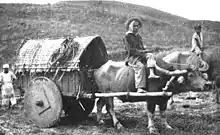
Ilocanos number 8,074,536 in the Philippines in 2010.[28] A few Ilocanos living in the Cordilleras have some Cordillerano blood.
Ethnic Homeland
Ilocandia is the term given to the traditional homeland of the Ilocano people, which constitutes present-day Ilocos Norte and the northern portions of Ilocos Sur, hence in early history and early Ilocano inhabitants of the region called their place as “samtoy”, from “sao mi toy”, which literally meant "our language here" in Iloco Language.
Ilocano Diaspora
The mounting population pressure due to the substantial population density during the mid-19th century caused the migration of the Ilocanos out of their traditional homeland. By 1903, more than 290,000 Ilocanos migrated to Central Luzon, Cagayan Valley, and Metro Manila. More than 180,000 moved to the provinces of Pangasinan, Tarlac, and Nueva Ecija. Almost 50,000 moved to Cagayan Valley; half of them resided in Isabela. Around 47,000 lived in Zambales and more than 11,000 in Sultan Kudarat.
Later migrations brought Ilocanos to the Cordilleras, Mindoro, Palawan, and Mindanao provinces[29] of Sultan Kudarat, North Cotabato, and South Cotabato.
The Ilocano diaspora continued in 1906 when Ilocanos started to migrate to Hawaii and California. They are called the “Manongs”[30] or “Sakadas”, the first generation of Filipino immigrants to the United States of America, primarily in California and Hawaii. In Iloco, the term "manong" is loosely used to refer to an elderly gentleman. Sakadas "imported ones" “lower-paid workers recruited out of the area” and a term for “migrant workers” in and from the Philippines, doing manual agricultural labor. Within the Philippines, sakadas work in provinces other than their own. In the 20th century, Filipino men were imported by the Hawaiian Sugar Planters' Association to work in the sugarcane and pineapple fields to Hawaii as "skilled laborers" from 1906 to 1946 mainly from the Ilocos region of the Philippines to seek their fate, or “gasat” in Iloco, for a better life for themselves and their families.
The Hawaiian Sugar Planters' Association approved a plan to recruit labor from the Philippines in April 1906 and asked Albert F. Judd to represent them. The first Filipino farm laborers in Hawaii arrived in December 1906 from Candon, Ilocos Sur, aboard the SS Doric (1883).[31]
Ilocanos composed the largest number of expatriates in the United States, though most are bilingual with Tagalog. There is a significant Ilocano community in Hawai'i, in which they make up more than 85% of the Filipino population there.[32]
Languages
Most Ilocanos speak Iloco Language, which is part of the Northern Philippine subgroup of the Austronesian family of languages. They also speak Tagalog, and English as second languages.
Iloco, like all Philippine languages, is an Austronesian language, it is related to Malay (Indonesian and Malaysian), Tetum, Chamorro, Fijian, Māori, Hawaiian, Samoan, Tahitian, Paiwan, and Malagasy. It is closely related to some of the other Austronesian languages of Northern Luzon, and has slight mutual intelligibility with the Balangao language and the eastern dialects of the Bontoc language.
Iloco language is a very expansive language family believed to originate in Taiwan. Iloco comprises its own branch within the Philippine Cordilleran language subfamily. It is spoken as first language by seven million people.
A lingua franca of the northern region of the Philippines, it is spoken as a secondary language by more than two million people who are native speakers of Ibanag, Ivatan, and other languages in Northern Luzon.
Religion
Most Ilocanos are Roman Catholics, and Aglipayans, which originated in Ilocos Norte.[2][3][33]
Indigenous Ilocano Religion
Prior to the arrival of the Spanish, Ilocanos were animists who believed in spirits called anito who were either bad or good, male or female. The anito ruled over all aspects of the universe. For example, “Litao” were anitos of water, “Kaibáan”, also called “Kanibáan”, were anitos of the undergrowth in a forest, and “Mangmangkik” were anitos of trees. The Mangmangkik were often feared for causing sickness when a fellow tree was cut down. To appease the Mangmangkik before cutting down a tree, the following chant was made:
- Bari Bari.
- Dikat agunget pari.
- Ta pumukan kami.
- Iti pabakirda kadakami.
This chant calls on the Mangmangkik and beseeches them not to curse the people cutting the tree down.[34] Similar chants and phrases are uttered to appease the Kaibáan when hot cooking water is thrown out into the yard for disposal. The Kaibáan can be befriended, giving luck and blessing to the person. Likewise, if a Kaibáan is angered, illness and in some cases death would plague the person's health and family.
Other ways anitos were respected and appeased were through offerings and sacrifices to idols on platforms called a simbaan or designated caves where the anito frequents. These offerings, called atang', consisted of various foodstuffs and sweets, as well as cigars and “paan”.
“Atang” is also offered to the deceased during prayers for the dead or on “Pista Ti Natay” ,“Undas” or All Soul's Day. Plates of food prepared for an atang consist of delicacies such as suman, dudul, linapet, baduya, patopat or balisongsong (snacks made from sticky rice or rice flour); busi (caramelized popped rice); linga (black sesame seeds); sticky rice with coconut milk; and bagas (uncooked rice) shaped in a crucifix and topped with fresh eggs. The food may also be accompanied by bua ken gawed (betel nut and piper leaf), apog (lime powder), basi (fermented sugarcane wine), and tabako (tobacco). These offerings are placed in front of a photo of the departed and/or image of Jesus, Mary, or the Holy Family during wakes and anniversaries in homes or in front of the graves, after which the family and/or mourners of the deceased may also offer prayers. [35]
Ilocanos believe that the soul has not yet left the world of the living during the wake and still needs sustenance, hence the offering of food as they transcend onto the afterlife. It is also believed that the soul returns to the land of the living after the 9-day wake and must be welcomed back. In instances when the deceased appears in a dream or when a family member suddenly experiences unexplainable sickness, atang is performed as an appeasement ritual for the deceased who may have been offended or disturbed. It is also interpreted as asking the deceased to intercede for their loved ones, and thanking them for warning against bad omen through dreams. Clearly, the significance of the atang for the Ilocanos goes beyond the remembrance and honoring of the dead loved ones. It connotes their view of life after death and the relation of the living to the departed.[36]
Another practice that survived well into the 19th century was 'sibróng', associated with human sacrifice and headhunting, sibróng was a prevalent practice in the Ilocos region. The person who carried out the executions was called the 'mannibróng'; this term now means 'thief' in modern Ilocano. Before the death of a community leader or a member of the Principalía, the dying person would lift his hand raised with a certain number of fingers. The number of fingers raised would be the indicator of how many people would have to be killed in order to accompany the dying to the afterlife. In other cases, the people chosen by the mannibróng would have their fingers cut off instead of being executed. Síbrong can also refer to the practice of placing a human head in the foundations of the building to protect the structure from damage.[37][38]
Culture
Ilocandia boasts a vibrant culture that bears some resemblance back to colonial times. The colonial city of Vigan, sometimes known as the “Intramuros of the North," still has its original Castillan colonial architecture. Old Spanish-style dwellings (often known as bahay na bato or Vigan houses) line the small and cobblestoned streets. Enormous, high-pitched roofs, large and rectangular living rooms with life-sized mirrors, ancient, wooden furniture, and elegant Vienna sets characterize these majestic mansions.[39]
The churches of the Ilocos Region are a lasting emblem of the Ilocano's triumphant transformation from practitioners of local religions to believers in theistic Christianity. The Vigan Cathedral in Ilocos Sur, with its gigantic hand-carved pictures of the route crucis; the Magsingal Cathedral (also in Ilocos Sur), with its centuries-old wooden altar; the St. Augustine Church in Paoay (Ilocos Norte), with its massive buttresses; and Santa Maria Church (Ilocos Sur) is a UNESCO World Heritage Site that is located on a hill with an 80-step stone stairway.[39]
Dances were mainly a reflection of the gracious ways of the Ilocano. The “dinaklisan” (a dance common to fisher folks), the “agabel” (a weaver’s dance) and the “agdamdamili” (a pot dance) illustrate in simple steps the ways of the industrious Ilocano. Other popular dances among the Ilocanos are Tadek, Habanera, Comintan, Saimita, Kinotan, Kinnalogong. [39]
Cuisine
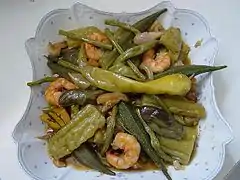
Ilocanos boast of a somewhat healthy diet heavy in boiled or steamed vegetables and freshwater fish, but are particularly fond of dishes flavored with “bugguong”, fermented fish that is often used instead of salt. Most people are unaware that Ilocano cuisine arose out of necessity. Due to the severe conditions of the region, Ilocanos had no choice but to make do with what they had, including the bitterest bitter gourd! Ilocandia is known for its strong culinary traditions all around the country. It's an island-strewn, salt-loving, porcine-dominated regional cuisine known for its delectable dishes.
Ilocanos have unwavering loyalty for its “sukang Iloko” (sugarcane vinegar), bugguong (fish or shrimp paste), bawang (garlic), and meats with a crispy finish. They always find ways to turn the most basic of ingredients into something spectacular, whether it's with naughty-sounding vegetable names or artery-clogging meat dishes.
Ilocanos often season boiled vegetables with bugguong monamon (fermented anchovy paste) to produce pinakbet, dinengdeng, inabraw, buridibod and many others local dishesh. Local specialties include the abuos, soft white larvae of ants, and "jumping salad" or tiny, live shrimp with kalamansi juice.
Dinakdakan[40] made from masskara or grilled pig's head parts and offal, blended with lasoná or sibuyas and pig's brain, Insarabasab[41] made out of chopped flame grilled pork mixed with chillies, lasoná or sibuyas (onion) sukang Iloko (vinegar) and other spices, Ilocos Empanada [42]an orange-tinged “glutinous rice flour with atsuete” fried dish stuffed with vegetables or green papaya, skinless longganisa, and egg., Bagnet a pork belly boiled and deep fried until it is crispy “chicharon” , Poqui Poqui made of eggplant, tomatoes, and eggs., Igado a strips of meat, liver, and other internal organs such as kidney, heart, and intestines, this dish reflects the influence of the Spanish cuisine, from “higado”., Pinapaitan[43] (composed of cow or goat innards and bile), Sinanglaw[44] (beef innards, tendon, face and bile), and Dinardaraan[45] (dry pork blood stew) are another popular dish among among Ilocanos and Filipinos.
Another food that is popular for many Ilocanos is “marunggay”. It is a good condiment for meat soup called la'uya (e.g. tinola) or it can be mixed with the famous dinengdeng, a soup made of mainly vegetables with prawn aramang or armang. Most households grow this tree in their backyards and usually offered free for all the neighbors who may want them. Many Ilocanos from Hawai'i are fond of eating them. The Ilocano people are also known to be the first ethnic group in the Philippines to eat the larvae and eggs of abuos (weaver ants). The practice has since been infused as well with other ethnic groups in northern Luzon.[46]
Literature
Ilocano animistic past offers a rich background in folklore, mythology and superstition (see Religion in the Philippines). There are many stories of good and malevolent spirits and beings. Its creation mythology centers on the giants “Aran” and her husband “Angalo”, and “Namarsua” (the Creator).
One of the most well-known Ilocano literary works written in Iloco is the “Biag ni Lam-Ang”(The Life of Lam-Ang), an epic poem about the fantastic life and escapades of an Ilocano hero named Lam-ang. "Biag ni Lam-ang" is a testament in the Ilocano literature, It reflects values important to traditional Ilokano society; it is a hero's journey steeped in courage, loyalty, pragmatism, honor, and ancestral and familial bonds. The Ilocano writer Elizabeth Medina is probably the most remarkable living Ilocano writer in the Spanish language.
Ilocano culture revolves around life rituals, festivities, and oral history. These were celebrated in songs “kankanta”, dances “salsala”, poems “dandaniw), riddles “burburtia”, proverbs “pagsasao”, literary verbal jousts called “bucanegan” (named after the writer Pedro Bucaneg, and is the equivalent of the Balagtasan of the Tagalogs), and epic stories.
The Ilokano people had their indigenous writing system and script known as “kur-itan”. There have been proposals to revive the kur-itan script by teaching it in Ilokano-majority public and private schools in Ilocos Norte and Ilocos Sur.[47]
Pre-colonial Ilocano people of all classes wrote in a syllabic system known as Baybayin prior to European arrival. They used a system that is termed as an “abugida”, or an alphasyllabary. It was similar to the Tagalog and Pangasinan scripts, where each character represented a consonant-vowel, or CV, sequence. The Ilocano version, however, was the first to designate coda consonants with a diacritic mark – a cross or virama – shown in the Doctrina Cristiana of 1621, one of the earliest surviving Ilokano publications. Before the addition of the virama, writers had no way to designate coda consonants. The reader, on the other hand, had to guess whether a consonant not succeeding a vowel is read or not, for it is not written. Vowel kudlits interchange between e or i, and o or u. Due to this, vowels "e" and "i" are interchangeable and letters "o" and "u", for instance "tendera" and "tindira" (shop-assistant).
Craftsmanship
Even before the coming of the Spaniards, the Ilocano people of Northern Luzon were already crafting tools and objects that describe their culture and civilization. Prior to the Spanish colonization that westernized the Ilocano people, the Ilocanos already invented the Dadapilan (a tool use for crushing sugarcane). Other cultural items includes tilar (native loom), dulang (low table), abel/inabel[48] (textile), burnay[49] (native jar), almiris, (mortar), maguey products, panday (blacksmith), and sag-ut (cotton yarn). The Ilocanos of Northern Luzon are one of the ethnolinguistic groups of the Philippines that was colonized by Spaniards but preserved some of its indigenous arts.
Notable Ilocanos
- Marilou Diaz-Abaya, Filipina director, her father is from Paoay, Ilocos Norte.[50]
- Edmundo Abaya Archbishop Emeritus Edmundo M. Abaya, DD was born on Jan. 19, 1929 in Candon, Ilocos Sur.During his active years in the ministry, Abaya had served as chairman of the CBCP's Commission on Ecumenical and Interreligious Affairs from 1988 to 1989. The first appointee of the late pope-turned-saint John Paul II as bishop in the Philippines died on September 20, 2018
- Joseph Emilio Abaya DOTC secretary His father, Cong. Plaridel Abaya hails from Candon Ilocos Sur. A descendant of Isabelo Abaya of Candon, Ilocos Sur, “one of the greatest heroes of the Revolution in the entire North”.
- Mac Alejandre, Filipino director.[51]
- Gregorio Aglipay, founder of the Aglipayan Church.
- Pedro Almazan, leader from Laoag; proclaimed and crowned King of Ilocos; led the First Ilocos Revolt in January 1661.
- Magnolia Antonino (born December 14, 1915) was a Senator of the Philippines. She was married to Gaudencio Antonino, also a Senator.
- Rodolfo "Pong" Gaspar Biazon (born April 14, 1935) is a former General and Chief of Staff of the Armed Forces of the Philippines, Philippine Marines officer, and politician in the Philippines. He was elected Senator in the 1992 election for a term of 3 years. He was elected to his first six-year term in the 1998 election, and was re-elected in the 2004 election. Biazon was born in Batac, Ilocos Norte.
- Jose Burgos, Filipino priest and martyr during Spanish times.
- Sonny Cabatu (born on October 10, 1960 in Cabugao, Ilocos Sur), is a semi-retired Filipino professional basketball player in the Philippine Basketball Association and was the very first draft pick of the league in 1985. He is also the father of current Barangay Ginebra Kings player Junjun Cabatu.
- Antonio Carpio, Associate Justice, Ilocano father[52]
- Conchita Carpio-Morales, former Ombudsman of the Philippines.
- Niña Corpuz, former Filipino journalist from Batac, Ilocos Norte
- Marcelino Crisologo, writer, playwright, and first governor of Ilocos Sur
- Lilia Cuntapay, Filipina horror actress,[53]
- Isabelle Daza, daughter of Gloria Diaz.
- Gloria Diaz, Miss Universe 1969 from Aringay, La Union.
- Ces Drilon, Filipina news anchor, Her father is Ilocano.[54]
- Juan Ponce Enrile, a former senator who served as Senate President from 2008 to 2013. He is from Gonzaga, Cagayan.
- Josefa Llanes Escoda, women's rights activist, founder of the Girl Scouts of the Philippines.
- Darren Espanto, Filipino singer, His parents are Ilocano From Nueva Vizcaya.
- Erlinda Fadera-Basilio, ambassador and permanent representative of the Philippines to the United Nations and other international organizations in Geneva, Switzerland; the first woman Vice President of the UN Human Rights Council; founding member of the English Speaking Union (ESU), Philippines Chapter. She is from Bacnotan, La Union.
- Leona Florentino, famous woman poet.
- Coleen Garcia, Filipina actress, her mother is Ilokana from La Union.[55]
- Francisco Sionil José, prominent English-language novelist.
- Bianca King, Filipina actress, her mother is Ilokana.[56]
- Doug Kramer, Filipino basketball player, His Mother is Ilokana From La Union.[57]
- Carlo Lacana, Filipino actor.[58]
- Jessie Mendiola Filipina Actress, Her mother Didith Garvida hails from Bangui Ilocos Norte.
- Japoy Lizardo, Filipino actor/athlete[59]
- General Antonio Luna, general of Emilio Aguinaldo's era.
- Juan Luna, famous Filipino painter, older brother of Antonio.
- Guji Lorenzana, Filipino actor/singer,[60]
- Antonio Mabutas – Agoo, La Union-born first Bishop of the Diocese of Laoag and the second Archbishop of the Archdiocese of Davao, historically notable as the first Roman Catholic Archbishop to write a pastoral letter to criticize human rights violations under the Marcos dictatorship.[61][62]
- Ernesto Maceda also known as Manong Ernie was a Filipino politician, lawyer, and columnist who served as a Senator of the Philippines from 1971 to 1972 and again from 1987 to 1998. He served as Senate President from 1996 to 1998. His Mother, a Madarang came from Candon Ilocos Sur.
- Ferdinand Marcos, 10th President of the Philippines (1965–1986).
- Ferdinand Marcos Jr., also known as BongBong Marcos, is the only son of former president Ferdinand Marcos. He served as governor of Ilocos Norte from 1998 to 2007. He also served as a representative of Ilocos Norte's 2nd District. He was formerly a Senator of the Philippines.
- Maria Imelda Josefa Romualdez Marcos, also known as Imee Marcos, daughter of former president Ferdinand Marcos, is a former representative of the 2nd District of Ilocos Norte in the Philippine House of Representatives (1998 to 2007). She is the governor of Ilocos Norte since 2010. She belongs to the Kilusang Bagong Lipunan political party.
- Mariano Marcos, father of Ferdinand Marcos, was a lawyer and a politician.
- Martha Vanessa Antonio del Moral, better known by her screen name Vaness del Moral (born on May 23, 1988 in Baguio, Benguet, Philippines), is a Filipina actress and a talent at one of the top management groups in the Philippines, the GMA Artist Center.
- Jimboy Martin, Filipino Actor, He is originally from Nueva Vizcaya.[63]
- Alma Moreno (born May 25, 1959 in Cervantes, Ilocos Sur) is a Filipina actress whose mother is Ilocano and father is from Pampanga.
- Bienvenido Nebres, the longest-serving university president of Ateneo de Manila University; member of the board of trustees of Georgetown University, Regis University, the Asian Institute of Management (where he sits as Vice-Chair), and other colleges and universities in the Philippines.
- Jane Oineza, Filipina actress,[64]
- Camilo Osías (March 23, 1889 Balaoan, La Union – May 20, 1976 Manila) was a Filipino politician, twice for a short time President of the Senate of the Philippines.
- Bela Padilla, Filipina actress, Her mother is Ilocano From Nueva Ecija [65]
- Daniel Padilla, Filipino actor, His paternal grandmother is Ilokana and the sister of Bela Padilla's maternal grandmother.
- Kylie Padilla, Filipina actress, Her father, Robin Padilla is also an Ilocano From Nueva Ecija
- Robin Padilla, Filipino actor, from Nueva Ecija.
- Armando "Mandrake" Ducusin Palabay – Filipino student leader and activist from San Fernando La Union, honored at the Philippines' Bantayog ng mga Bayani as a martyr of the resistance against the Marcos dictatorship.[66][67]
- Jim Paredes, Filipino musician, his father is Ilocano from Abra[68]
- Quintín Paredes (September 9, 1884 – January 30, 1973), a Filipino lawyer, politician, and statesman. He was born in Bangued, Abra.
- Markus Paterson, Filipino actor,[69]
- Marc Pingris, Filipino basketball player,[70]
- Yassi Pressman, Filipina actress, her mother is from Isabela.
- Elpidio Quirino, 6th President of the Philippines (1948–1953) and native of Caoayan, Ilocos Sur.
- Artemio Ricarte (October 20, 1866 — July 31, 1945) was a Filipino general during the Philippine Revolution and the Philippine–American War. He is considered by the Armed Forces of the Philippines as the "Father of the Philippine Army". Ricarte is also notable for never having taken an oath of allegiance to the United States government, which occupied the Philippines from 1898 to 1946. Ricarte was born in Batac, Ilocos Norte.
- Alden Richards, Filipino actor, his paternal grandmother is Ilokana from Sinait, Ilocos Sur[71]
- Jericho Rosales, Filipino actor[72]
- Maja Salvador,Filipina actress[73]
- Gabriela Silang, wife of Diego, revolutionary.
- Luis "Chavit" Singson (born June 21, 1941), better known as Chavit Singson, a Filipino politician from Vigan City. He was a former Governor of the province of Ilocos Sur, Philippines since 1998. He is the owner of the Partas Bus Company. Singson is said to have started EDSA II, when in October 2000 he alleged he gave President Joseph Estrada PHP400 million as payoff from illegal gambling profits.
- Liza Soberano Hope Elizabeth Soberano (formerly known by the screen name Hope Soberano) is a young Filipina American model and actress who starred in the teleserye Forevermore. Her father and ancestors are Ilocanos from Sta. Maria, Asingan, and Baguio.[73]
- Jessica Soho (born March 27, 1964) is a Filipino broadcast journalist, documentarian, and news director who received a George Foster Peabody Award and was the first Filipino to win the British Fleet Journalism Award in 1998. She is from San Juan, La Union
- Benito Soliven, studied law at the University of the Philippines, graduated summa cum laude, placed third in the 1921 Bar Examinations, the first lawyer of Santo Domingo, Ilocos Sur, an intellectual, a linguist, a successful political leader, an Outstanding Congressman, a three-termer in the House of Representatives acclaimed as "Valedictorian" in congress having the greatest number of bills most of which were passed/approved by his colleagues, a hero of World War II, he helped his needy clients free of charge. He is the father of the late Maximo Villaflor Soliven, a prominent Filipino journalist and newspaper publisher, and realtor Victorio V. Soliven. A school and a town are also named after him, the Benito Soliven Academy, located in Santo Domingo, Ilocos Sur and Benito Soliven in the province of Isabela.
- Carlos P. Garcia, 8th President of the Philippines (1957–1961), his parents were natives from Bangued, Abra.
- Máximo Villaflor Solivén (September 4, 1929 – November 24, 2006) was a prominent Filipino journalist and newspaper publisher. In a career that spanned six decades, he attained his greatest peak and influence with the Philippine Star, which he co-founded in 1986, and where he served as publisher until his death. His daily column published in the Star, titled "By The Way", was one of the most widely read newspaper columns in the Philippines
- Bryan Termulo, Filipino singer, His mother is Ilokana from La Union[74]
- Fabian Ver, former General and Chief of the Armed Forces of the Philippines.
- Glennifer Perido, beauty pageant titleholder, from Tabuk, Kalinga.
- Teófilo Yldefonso, "the Ilocano Shark" (February 9, 1903 – July 19, 1943), was a Filipino swimmer who specialized in the breaststroke. He was the first Filipino to win an Olympic medal, and the only Filipino to win multiple medals. He was born in Piddig, Ilocos Norte.
- Nova Villa, Filipino actress.[75]
- Vice Ganda Also Known as Jose Mari Viceral, a Filipino comedian, his mother is Ilokana from La Union[76]
Ilocano people from Central Luzon
- Gregorio C. Brillantes from Camiling, Tarlac, a multi-award-winning fiction writer and magazine editor, is one of the Philippines' greatest writers in English.
- Onofre Corpuz, from Camiling, Tarlac, writer and former secretary of the Department of Education; 13th president of the University of the Philippines; president of the Development Bank of the Philippines.
- Ramon Magsaysay, 7th President of the Philippines, from Iba, Zambales.
- JB Magsaysay, Pinoy Big Brother (season 1) housemate and grandson of former President Ramon Magsaysay.
- Nicanor Reyes Sr., founder and first president of the Far Eastern University in Manila. He envisioned a school that would promote the teaching of accounting to Filipinos, a profession formerly available only to foreigners. His hometown was Paniqui, Tarlac.
- Ruby Rodriguez from San Marcelino, Zambales is a Filipina actress and a co-host of the television variety show Eat Bulaga! in the Philippines.
- Paulino Santos, from Camiling, Tarlac, a former chief of staff of the Philippine Army during the time of Philippine President Manuel Luis Quezon; founder of Penal Colonies and a Philippine Constabulary Second Lieutenant.
Pangasinense people
- Anne Curtis, Filipina actress, Her mother is Ilocano from Pangasinan.[77]
- Jasmine Curtis-Smith Filipina actress, younger sister of anne curtis.
- Jhong Hilario, Filipino actor/host/dancer[78]
- Danny Ildefonso a professional basketball player who played in San Miguel Beerman, now Petron Blaze Boosters who won 8 PBA championships and 2 MVP's and rookie of the year award in 1998. He is fluent in Ilocano. He is from Urdaneta City, Pangasinan.
- Gloria Macapagal-Arroyo, daughter of *Eva Macapagal, who is from Pangasinan.
- Fidel V. Ramos, 12th President of the Philippines (1992–1998) from Lingayen, Pangasinan
- Carmen Rosales, actress Pangasinan
Foreign nationals of Ilocano ancestry
- John Leo Dato, Filipino-American boxer
- Matthew Libatique, an American Hollywood cinematographer and Oscar nominee, best known for his work with director Darren Aronofsky on such films as A Star is Born, Iron Man 1 and Iron Man 2, Inside Man, Miracle at St. Anna, Gothika, Cowboys & Aliens, π, Requiem for a Dream, The Fountain and Black Swan
- Jasmine Trias, 3rd-place winner in American Idol Season 3.
- Jocelyn Enriquez, singer in the Dance Music Genre who did the hit songs A Little Bit Of Ectasy and Do You Miss Me.
- Benny Agbayani, professional baseball player.
- Larry Ramos (born Hilario Ramos on April 19, 1942 in Hawaii), professional guitar player and singer who was awarded a Grammy for his participation in the 1962 album, Presenting The New Christy Minstrels, and who was a key part of the 1960s American pop band the Association.
- Thelma Buchholdt, J.D., elected member, Alaska State House of Representatives (1974–1982).
- Carlos Bulosan, Binalonan, Pangasinan-born novelist and poet best-known today for his novel America Is in the Heart[79]
- David Bunevacz, athlete.
- Mikey Bustos, YouTube star and Canadian Idol finalist.[80]
- Ben Cayetano, 5th Governor of Hawaii (1994–2002).
- Philip Vera Cruz, labor union leader.
- Emil Guillermo, journalist and 2000 American Book Award winner.
- Gina Ortiz Jones, Filipina-American Iraq War veteran, intelligence officer and politician.[81]
- Ana "The Hurricane" Julaton (from Pozorrubio, Pangasinan) is a boxer. She won the San Francisco Golden Gloves, the California State Championships, was a Diamond Belt champion and closed out her amateur career by winning the silver medal in the United States Amateur Championships. As a professional boxer, Julation is close to the top in winning world titles with the fewest professional bouts. As of 2010, she is a world-title holder of the International Boxing Association and the World Boxing Organization.[82][83]
- Lt. Gen. Edward Soriano, first Filipino American General of the US Army (ret).
- Maj. Gen. Antonio Taguba, second Fil-Am General of the US Army.
- Brian Viloria, light flyweight boxing champion.
- PJ Raval, Fil-Am filmmaker and director of the feature documentary Call Her Ganda about the murder of Jennifer Laude by US Marine Joseph Scott Pemberton.
- Bretman Rock, a YouTube star, his parents were from Cagayan Valley, and now currently living in Hawaii.
- Vincent Bueno, Austrian singer who represented Austria in the 65th Eurovision song contest.
See also
Notes and sources
- "2010 Census of Population and Housing, Report No. 2A: Demographic and Housing Characteristics (Non-Sample Variables) – Philippines" (PDF). Philippine Statistics Authority. Retrieved May 19, 2020.
- "Ilokanos." Junior Worldmark Encyclopedia of World Cultures. The Gale Group, Inc. 1999. Retrieved December 10, 2009.
- Project, Joshua. "Ilocano in Philippines". joshuaproject.net.
- "Ilocano Lowland Cultural Community". National Commission for Culture and the Arts. Retrieved 2021-11-03.
- "Peoples of the Philippines: Ilocano". National Commission for Culture and the Arts. Retrieved 2021-11-03.
- Nydegger, William F; Nydegger, Corinne (1966). Tarong an Ilocos Barrio in the Philippines. p. 2. ISBN 052-000-157-5.
- Cole, Fay-Cooper (1922). The Tinguian Social, Religious, and Economic Life of a Philippine Tribe.
- de los Reyes 1890, p. 52
- Mateo 2004
- de los Reyes 1890, p. 55
- de los Reyes 1890, p. 56
- de los Reyes 1890, pp. 56–57
- de los Reyes 1890, pp. 114–115
- "The Tabungaw Hat Maker of San Quintin". silverbackpacker.com. 2018-05-10. Retrieved 2021-11-03.
- Helen Blair, Emma; Alexander Robertson, James (1906). The Philippine Islands, 1493–1898. Cleveland, Ohio: The Arthur H. Clark Company. pp. 169–181. ISBN 9332857164.
- A. Newson, Linda (2009). Conquest and Pestilence in the Early Spanish Philippines. Honolulu, HI: University of Hawaii Press. pp. 188–189. ISBN 978-9715506366.
- Helen Blair, Emma; Alexander Robertson, James (1906). The Philippine Islands, 1493–1898. Cleveland, Ohio: The Arthur H. Clark Comopany. pp. 199–200. ISBN 9332857164.
- M. Cortes, Rosario (1974). Pangasinan 1572–1800. Quezon City, Philippines: University of Philippines Press. pp. 164–165. ISBN 9789711004583.
- "National Museum launches virtual edition of 'The Basi Revolt' – Manila Bulletin". mb.com.ph. Retrieved 2021-11-03.
- "Presidential Decree No. 1, s. 1972". September 24, 1972. Retrieved May 27, 2019.
- "Presidential Decree No. 224, s. 1973". June 22, 1973. Retrieved November 5, 2016.
- https://www.bulatlat.com/2012/10/02/ilocanos-remember-dark-days-of-martial-law-vow-to-continue-fight/
- "Honoring Davao's Contributions to the Struggle for Rights, Freedom". Bantayog ng mga Bayani. Archived from the original on 2018-02-28. Retrieved 8 February 2020.
- Maglana, MAgz (2017-07-10). "VOICES FROM MINDANAO: Fear is not a good foundation for getting Mindanao out of the rut". MindaNews. Archived from the original on 2020-02-08. Retrieved 8 February 2020.
- "PALABAY, Armando D. – Bantayog ng mga Bayani". bantayog.org. Retrieved 2020-01-22.
- Clarke, Gerard (2006). The Politics of NGOs in Southeast Asia. Routledge.
- "A Tribute to Human Rights Lawyer David Bueno (1988)". August 19, 2015.
- "2010 Census of Population and Housing, Report No. 2A: Demographic and Housing Characteristics (Non-Sample Variables) – Philippines" (PDF). Philippine Statistics Authority. Retrieved 19 May 2020.
- Cimatu, Frank (2000-05-19). "Ilocanos Top Migrants in Mindanao". Philippine Daily Inquirer. Retrieved 2021-10-19.
- "Remembering the Manongs and Story of the Filipino Farm Worker Movement". National Parks Conservation Association. Retrieved 2021-11-03.
- Sunday, ROMEL DELA CRUZ |; December 20; 2020; A.m, 12:05 (2020-12-20). "The legacy of the Sakadas in Hawaii". Hawaii Tribune-Herald. Retrieved 2021-11-03.CS1 maint: numeric names: authors list (link)
- "Uhm Center For Philippine Studies". Archived from the original on August 9, 2007.
- "UCLA Language Materials Project". Archived from the original on 2010-12-30. Retrieved 2012-09-28.
- de los Reyes 1890, pp. 85–88
- "Undas 2021 (Atang)". National Museum. 2021-11-02. Retrieved 2021-11-03.
- "Undas 2021 (Atang)". National Museum. 2021-11-02. Retrieved 2021-11-03.
- Mayor Apostol, Virgil (2010). Way of the Ancient Healer: Sacred Teachings from the Philippine Ancestral Traditions. pp. 100–101. ISBN 978-155-643-941-4.
- de los Reyes 1890, p. 131
- "Ilocano Lowland Cultural Community". National Commission for Culture and the Arts. Retrieved 2021-11-03.
 This article incorporates text from this source, which is in the public domain.
 - "Dinakdakan". Kawaling Pinoy. 2021-08-13. Retrieved 2021-11-03.
- Raymund (2014-04-24). "Insarabasab". Ang Sarap (A Tagalog word for "It's Delicious"). Retrieved 2021-11-03.
- "Orange you glad you can now make Ilocos Empanadas at home? Here's how". When In Manila. 2020-05-20. Retrieved 2021-11-03.
- Raymund (2013-08-13). "Pinapaitan". Ang Sarap (A Tagalog word for "It's Delicious"). Retrieved 2021-11-03.
- Raymund (2012-03-06). "Sinanglaw". Ang Sarap (A Tagalog word for "It's Delicious"). Retrieved 2021-11-03.
- "Dinardaraan Recipe (Ilocano Dinuguan)". Panlasang Pinoy. Retrieved 2021-11-03.
- "Kapuso Mo, Jessica Soho: Walastik na sarap ng hantik!" – via www.youtube.com.
- Orejas, Tonette (2018-04-27). "Protect all PH writing systems, heritage advocates urge Congress". INQUIRER.net. Retrieved 2021-11-03.
- admin (2018-09-28). "Abel: The Ilocano Weaving Industry Amidst Globalization". The Yale Review of International Studies. Retrieved 2021-11-03.
- "What is Burnay?". findanyanswer.com. Retrieved 2021-11-03.
- CineVision, Asian. "MARILOU DIAZ-ABAYA, OBSESSIONS AND TRANSITIONS: A Biographical Survey (1/6) – Asian CineVision".
- Mac C. Alejandre [@macalejandre] (7 July 2011). "@KarmaWins80 my father is ilocano, my mother is tagalog/ilocano. Very native. Alejandre though is portuguese italian. I wonder hw we got it" (Tweet) – via Twitter.
- "Global Balita | Archive for November 2006".
- "Lilia Cuntapay interview in Ilocano" – via www.youtube.com.
- Ces Oreña-Drilon [@cesdrilon] (3 July 2013). "@CarisaManuel it was my dad who was Ilocano and the staple we had once a week was saluyot & labong w/ inihaw na isda" (Tweet) – via Twitter.
- Coleen Garcia [@coleengarcia] (20 June 2011). "haan ko ammo ngem ni nanang ko ilokana ☺ RT @aprilonbloom: @coleengarcia AMMUM AGILOKANO TEH?" (Tweet) – via Twitter.
- bianca king [@bianca_king] (26 March 2011). "I'm ilocana. I'm cheating. I have a translator. My friend here in cebu teaches me. Heehee" (Tweet) – via Twitter.
- Doug Kramer [@DougKramer44] (6 November 2011). "@anklethan wen iloKANO ak! Ilocanong American" (Tweet) – via Twitter.
- Carlo Lacana [@Itscarlolacana] (13 February 2013). "@MaureenValerio Oo Ilocos norte ako" (Tweet) – via Twitter.
- Japoy Lizardo [@japoy_lizardo] (29 March 2013). ""@myzMycel: @japoy_lizardo ilocano ka gayam kuya Japs? O_o"- wen!! ^^" (Tweet) – via Twitter.
- "Find out what's happening in New York on BlackPlanet". BlackPlanet.com.
- "Honoring Davao's Contributions to the Struggle for Rights, Freedom". Bantayog ng mga Bayani. Archived from the original on 2018-02-28. Retrieved 8 February 2020.
- Maglana, MAgz (2017-07-10). "VOICES FROM MINDANAO: Fear is not a good foundation for getting Mindanao out of the rut". MindaNews. Archived from the original on 2020-02-08. Retrieved 8 February 2020.
- Salterio, Leah C. "The big PBB 737 winners". philstar.com.
- Jane Oineza [@itsJaneOineza] (6 June 2013). ""@Missashleyjoyy: @itsJaneOineza Nalpas kamin. ilokana ka gayam. :)" – wen ah. Ni mamang ken papang ko. :)" (Tweet) – via Twitter.
- Bela Padilla [@padillabela] (2 November 2010). "@dealwithAYISHA no haha my lola naman is from nueva ecija so half of me is pure ilocano :) I can say nagpudot and magan tayon. Hahaha" (Tweet) – via Twitter.
- "PALABAY, Armando D. – Bantayog ng mga Bayani". bantayog.org. Retrieved 2020-01-22.
- Armando Palabay (YouTube Video). Commission on Human Rights of the Philippines.
- Jim [@Jimparedes] (1 July 2010). "My father s from Abra. I grew up in MLA RT @chrisduran81: @jimparedes oh you're ilocano sir, are you from San Juan, La Union?" (Tweet) – via Twitter.
- @markusrpaterson (May 26, 2017). "Ilocano kami eh #AskMarkus twitter.com/russinigang/status/868006593333346305 …" (Tweet) – via Twitter.
- "Marc Pingris vows to play stingy 'depensang Ilokano' against TnT import Ivan Johnson". Spin.ph. March 31, 2015.
- Richard Faulkerson© [@R_FAULKERSoN] (12 October 2015). "@ofcaldub_ILS my mom is from Sinait. :)" (Tweet) – via Twitter.
- Jericho Rosales [@jericho_rosales] (12 August 2013). "@jairusdevirus apologies.. Although i'm an Ilocano" (Tweet) – via Twitter.
- "Speaking Ilocano only challenge" – via www.youtube.com.
- http://www.launion.gov.ph/page.php?10
- http://www.pep.ph/photos/611/Nova_Villa,_Happy_Homebody/num/3/635
- jose marie viceral [@vicegandako] (16 October 2011). ""@mariceldeleon: @vicegandako ilocano ka?"-opo. Taga batangas kasi tatay ko e. ☺" (Tweet) – via Twitter.
- Anne Curtis-Smith [@annecurtissmith] (15 September 2012). "@leizion she's ilocana. No I don't. I wish I could though!!!" (Tweet) – via Twitter.
- Jhong hilario [@jhongsample] (13 April 2011). ""@simply_resi: @jhongsample ano po province nyo?"-pangasinan po.ilocano :)" (Tweet) – via Twitter.
- Juan, E. San (2008). "Carlos Bulosan, Filipino Writer-Activist: Between a Time of Terror and the Time of Revolution". CR: The New Centennial Review. 8 (1): 103–134. ISSN 1532-687X.
- YouTube sensation Mikey Bustos and how to be 'Pilipino' – Pinoy Abroad – GMA News Online gmanetwork.com
- Pastor, Rene (25 June 2018). "Will Gina Ortiz-Jones become the first Filipina American in Congress? | INQUIRER.net". usa.inquirer.net. Retrieved 2018-07-09.
- Lauren Smiley. "The Eyes of the Hurricane". SF Weekly. March 10, 2010.
- "Ana Julaton: Her Side of the Ring". Mightygloves.com. November 28, 2009.
References
- de los Reyes, Isabelo (1890). History of Ilocos. ISBN 978-971-542-729-6.
- Mateo, Grace Estela C. (2004). A history of Ilocos: a story of the regionalization of Spanish colonialism (Ph. D. thesis). University of Hawaii at Manoa. hdl:10125/11655.
External links
 |
Wikimedia Commons has media related to Ilocano people. |
- The Online Ilokano Dictionary Project – A free Ilokano dictionary application. The primary objective of TOIDP is to provide an online Ilokano resource for people to utilize so that they may overcome the language barriers existing between the English and Ilokano languages. Feel free to browse around and make full use of the tools available on this site.
- Tarabay iti Ortograpia ti Pagsasao nga Ilokano – A free ebook version of the Guide on the Orthography of the Ilokano Language developed by the Komisyon ng Wikang Filipino (KWF) in consultation with various stakeholders in Ilokano language and culture. Developed back in 2012 as a resource material for the implementation of the Department of Education's K-12 curriculum with the integration of MTB-MLE or Mother Tongue-Based Multilingual Education.
- Most Popular Ilocano Website
- World's Most Famous Ilocanos
- Ilocano: Ti Pagsasao ti Amianan
- NAKEM Centennial Conference
- Tawid News Magasin Ilokano News and Literature Portal
- dadapilan.com – Iloko literature portal featuring original Iloko works by Ilokano writers and a forum for Iloko literary study, criticism, and online workshop.
- Ilocano.org – An online community for Ilocanos.
- IlocanoPride
- Learn Filipino A webpage to learn how people are called in Ilocano
| Indigenous |
| ||||||||||||||||||||||||
|---|---|---|---|---|---|---|---|---|---|---|---|---|---|---|---|---|---|---|---|---|---|---|---|---|---|
| Immigrants or expatriates |
| ||||||||||||||||||||||||
Philippines articles | |||||||||||||||||||
|---|---|---|---|---|---|---|---|---|---|---|---|---|---|---|---|---|---|---|---|
| History |
|  | |||||||||||||||||
| Geography | |||||||||||||||||||
| Politics |
| ||||||||||||||||||
| Economy | |||||||||||||||||||
| Society |
| ||||||||||||||||||
| |||||||||||||||||||

Authority control: National libraries  |
|---|