Impact events on Jupiter
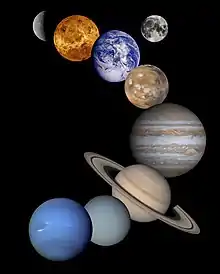
In modern times, numerous impact events on Jupiter have been observed, the most significant of which is the impact of comet Shoemaker-Levy 9 in 1994. Because of its mass, Jupiter, the most massive planet in the Solar System, has a vast sphere of gravitational influence, the region of space where an asteroid capture can take place under favorable conditions.[1]
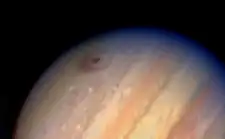
Jupiter is able to frequently capture comets in orbit around the Sun. In general, these comets travel some revolutions around the planet, following unstable orbits that are highly elliptical and perturbable by solar gravity. While some of them eventually recover a heliocentric orbit, others crash into the planet or more rarely one its satellites.[2][3]
In addition to the mass factor, Jupiter's relative proximity to the inner Solar System allows it to influence the distribution of minor bodies there. For a long time, it was believed these characteristics led Jupiter to attract or expel from the system most of the wandering objects in its vicinity and thus to determine a reduction in the number of objects that are potentially dangerous to Earth. Subsequent dynamic studies have shown the situation is more complex; the presence of Jupiter tends to reduce the frequency of impact on the Earth of objects coming from the Oort cloud,[4] while it increases the number of impacts of asteroids[5] and short-period comets.[6]
For this reason Jupiter has the highest frequency of impacts of any planet in the solar system, justifying its reputation as the "sweeper" or "cosmic vacuum cleaner" of the solar system.[7] 2009 studies suggest an impact frequency of once every 50–350 years for an object of between 0.5 and 1 km (0.31 and 0.62 mi) in diameter; impacts with smaller objects would occur more frequently. Another study estimated comets 0.3 km (0.19 mi) in diameter impact Jupiter once in approximately 500 years and those 1.6 km (0.99 mi) in diameter do so once in every 6,000 years.[8]
About Jupiter
Jupiter is a gas giant planet with no solid surface; the lowest atmospheric layer, the troposphere, gradually changes into the planet's inner layers.[9] The impacts of comets and asteroids generate temporary phenomena that are progressively masked by the action of the winds, and whose significance depends upon the size of the impacting object. Human knowledge of such impacts is dependent upon direct and almost immediate observation of the event itself or of the phenomena associated with it.
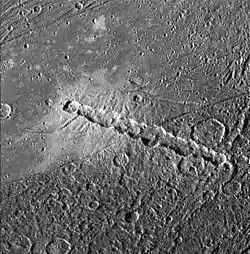
The cratered surfaces of Jupiter's major satellites provide information about the most ancient epochs. In particular, the discovery by the Voyager missions of 13 crater chains on Callisto and three on Ganymede,[10] and the evidence of the impact of comet Shoemaker-Levy 9 provide consistent evidence of ancient fragmentation of comets and their impacts with Jupiter and its moons. While the chains of craters observed on Earth's moon often radiate from major craters and are commonly believed to have been created by secondary impacts of the material ejected from the main collision, those present on the Jovian moons are not connected to a main crater, and it is likely they were created by the impact of a series of cometary fragments.[11][12][13]
The first evidence of impacts on Jupiter was found in the 17th century; Japanese amateur astronomer Isshi Tabe discovered among the correspondence of Giovanni Cassini's observations some drawings representing a dark spot that appeared on Jupiter on December 5, 1690, and follow its evolution over 18 days; it could constitute evidence of the observation of an impact on Jupiter prior to that of Shoemaker-Levy 9.[14]
The impact of a meteoroid on Jupiter was first captured in 1979 by the Voyager 1 spacecraft, which recorded a rapid flicker of light in the planet's atmosphere.[15]
Impacts by years
| Event | Date (UTC) | Rough original size (meters) |
Latitude (°) | Longitude (°) |
|---|---|---|---|---|
| Sep 2021 event[16] | 2021/09/13 18:39:30 | ? | -5.5 | 105.7 |
| Aug 2019 event[17] | 2019/08/07 04:07 | ? | −20 | ? |
| May 2017 event[18] | 2017/05/26 19:25 | 12 | +51.2 | ? |
| Mar 2016 event[18] | 2016/03/17 00:18:33 | 15 | +4 | ? |
| Sep 2012 event[19][18] | 2012/09/10 11:35:00 | 30 | +2 | 345 |
| Aug 2010 event[19][18] | 2010/08/20 18:22:12 | 10 | +11 | ? |
| Jun 2010 Jupiter impact event | 2010/06/03 20:31:20 | 13 | −16.1 | 342.7 |
| Jul 2009 Jupiter impact event | 2009/07/19 13:30 | 200-500 | −57 | 305 |
| Jul 1994 Comet Shoemaker–Levy 9 | 1994/07/16-22 | 1800 | −65 | ? |
1994 impacts
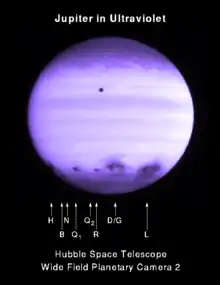
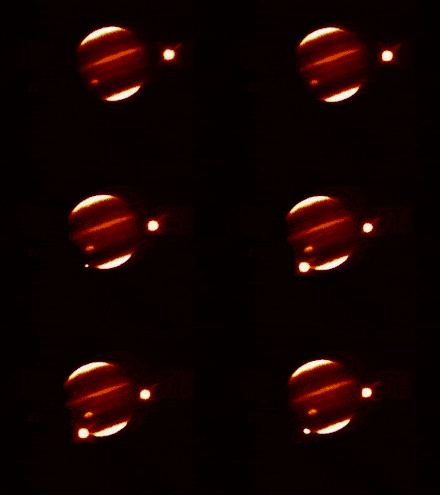
On July 16, 1994, the first of a series of fragments of Comet Shoemaker–Levy 9, which had broken up two years earlier, impacted Jupiter's atmosphere. The impacts were observed by terrestrial telescopes and several space observatories, including the Hubble Space Telescope, the ROSAT X-ray-observing satellite, the W. M. Keck Observatory, and the Galileo spacecraft, which was then en route to Jupiter with a scheduled arrival in 1995. Although the impacts took place on the side of Jupiter hidden from Earth, Galileo, then at a distance of 1.6 AU (240 million km; 150 million mi) from the planet, was able to see the impacts as they occurred. Jupiter's rapid rotation brought the impact sites into view for terrestrial observers a few minutes after the collisions.[21]
Two other space probes observed the impact; the Ulysses spacecraft, primarily designed for solar observations, was pointed towards Jupiter from its location 2.6 AU (390 million km; 240 million mi) away, and Voyager 2, which was then 44 AU (6.6 billion km; 4.1 billion mi) from Jupiter, was programmed to look for radio emissions in the 1–390 kHz range and make observations with its ultraviolet spectrometer.[22]
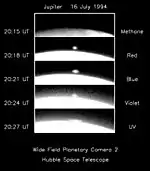
The first impact occurred at 20:13 UTC on July 16, 1994, when fragment A of the comet's nucleus entered Jupiter's southern hemisphere at about 60 km/s (35 mi/s).[23] Instruments on Galileo detected a fireball that reached a peak temperature of about 24,000 K (23,700 °C; 42,700 °F) before expanding and rapidly cooling to about 1,500 K (1,230 °C; 2,240 °F) after 40 seconds. The plume from the fireball quickly reached a height of over 3,000 km (1,900 mi).[24] A few minutes after the fireball was detected, Galileo measured renewed heating, which was probably caused by ejected material falling back into the planet. Earth-based observers detected the fireball rising over the limb of the planet shortly after the initial impact.[25]
Despite published predictions,[26] astronomers had not expected to see fireballs from the impacts,[27] and did not know how visible the other atmospheric effects of the impacts would be from Earth. Observers saw a huge dark spot appear after the first impact. The spot was visible from very small telescopes, and was about 40,000 km or 25,000 mi—almost one Earth radius across. This and subsequent dark spots were thought to have been caused by debris from the impacts, and were markedly asymmetric, forming crescent shapes in front of the direction of impact.[28]
Over the next six days, 21 distinct impacts were observed, the largest of which occurred on July 18 at 07:33 UTC when fragment G struck Jupiter. This impact created a large, dark spot over 12,000 km or 7,500 mi—almost one Earth diameter across, and was estimated to have released an energy equivalent to six million megatons of TNT.[29] On July 19, two impacts 12 hours apart created impact marks of similar size to that caused by fragment G. Impacts continued until July 22, when fragment W struck the planet.[30]
2009 impact
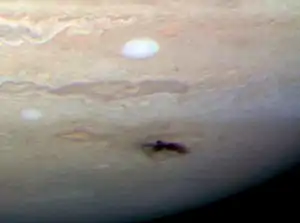
On July 19, 2009, amateur astronomer Anthony Wesley discovered a new black spot about the size of Earth in Jupiter's southern hemisphere. Thermal infrared analysis showed it was warm and spectroscopic methods detected ammonia. The impact was studied by NASA's Hubble Space Telescope; the study suggests the observed incident was caused by an asteroid about 500 metres (1,600 ft) wide.[32][33][34][35] The impact resulted into a 4800 km debris field, dark in the visible and bright in methane absorption bands; it was observable for several months using amateur telescopes and for a minimum of six months with a professional ones.[36]
2010 impact
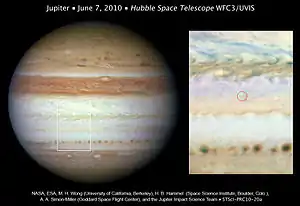
An impact event that occurred on June 3, 2010, involved an object estimated at between 8 and 13 meters (26 and 43 ft), and was recorded and first reported by Anthony Wesley.[37][38] The impact was also captured on video in the Philippines by amateur astronomer Christopher Go.[39][40]
2012 impact
On 10 September 2012 at 11:35 UTC, amateur astronomer Dan Petersen, using a Meade 12″ LX200 telescope, saw a fireball on Jupiter that lasted between one and two seconds. George Hall had been recording Jupiter with a webcam on his 12" Meade; upon hearing the news, Hall checked the video to see whether the impact was captured. Hall had captured a four-second clip of the impact and released the video to the public. The impact's estimated position on Jupiter was longitude = 345 and latitude = +2. Michael H. Wong estimated the fireball was created by a meteoroid less than 10 m (33 ft) in diameter. Several collisions of this size may happen on Jupiter each year. The 2012 impact was the fifth observed on Jupiter, and the fourth such event between 2009 and 2012. It was similar to the flash observed on 20 August 2010.[41][42]
2016 impact
On March 17, 2016, an impact fireball on Jupiter's limb was recorded by Gerrit Kernbauer using an eight in (20 cm) telescope operating at f/15 in Moedling, Austria. This report was later confirmed by an independent observation by amateur John McKeon.[43][44] The size of the impacting object was estimated to be between 7 and 19 m (23 and 62 ft).[18][45]
2017 impact
On May 26, 2017, amateur astronomer Sauveur Pedranghelu in Corsica, France, observed a flash on Jupiter. The event was announced the next day, and was quickly confirmed by German observers Thomas Riessler and André Fleckstein. The impactor had an estimated size of between 4 and 10 m (13 and 33 ft).[18]
2020 impact
On April 10, 2020, the Juno spacecraft observed a fireball on Jupiter that was consistent with the impact of a 1–4 metres (3.3–13.1 ft) meteor. It was the first fireball to be detected by Juno. Researchers estimate Jupiter experiences approximately 24,000 impact events of this size per year—around 2.7 per hour. For comparison, Earth experiences between up to ten such events per year, depending on the size of the impactor.[46]
2021 impact
At 22:39:27 UTC on September 13, 2021, the Brazilian amateur astronomer José Luis Pereira reported the observation of a bright spot on Jupiter lasting for two seconds.[47] Two astronomers from France and Germany confirmed the observation, suggesting a likely impact event caused by a small asteroid or comet around 100 m (330 ft) in diameter.[47] An image taken by astrophotographer Damian Peach one hour after the impact showed no aftermath.[48]
Phenomena associated with the impacts
The phenomena associated with an impact on a gas giant are mainly transitory in nature, and depend on the size of the impacting body and its composition.[49]
In the case of small meteoroids, the light emission associated with the penetration into the upper layers of the atmosphere was observed but in the two events in 2010, no alterations in the clouds were observed, either in the minutes immediately following the impact or in the subsequent revolutions, in a similar way to what happens after a fireball in the Earth's atmosphere.[50]
In the case of objects with a diameter greater than 100 m (330 ft), which are able to penetrate below the visible cloud layer, the phenomenology becomes more complex.[51] A large part of the kinetic energy of the impacting object is transferred to the atmosphere, causing a rapid increase in the local temperature, which is associated with an intense light emission. The mass of atmospheric gas that is affected expands upwards, where it meets less resistance. A plume that can reach up to 1,000 km (620 mi) and temperatures of 1,000 kelvins (730 °C) in a few seconds for an impacting object of about 2 km (1.2 mi).[51] When the expansion stops, the plume precipitates on itself and the impact with the atmosphere causes a new temperature increase. This phenomenology was observed in the impacts of the larger fragments of comet Shoemaker-Levy 9.[52] This also leads to the upwelling of material from the deepest areas of the planet. In the case of the Comet Shoemaker-Levy 9 impacts, ammonia and carbon disulfide, which are typically present in the troposphere, remained in the upper atmosphere for at least 14 months after the event.[53]
Collisions can also generate seismic waves, which in the case of the SL9 traveled across the planet at a speed of 450 metres per second (1,500 ft/s) and were observed for more than two hours after the impact.[54] In some cases, aurorae may appear near the impact site and at the antipodal zone, evaluated with respect to Jupiter's magnetic field and interpreted as a consequence of the fallout of the plume material.[55] In the case of the impacts of Comet Shoemaker-Levy 9, a marked increase in radio emissions from Jupiter was detected; this was interpreted as a consequence of the introduction of relativistic electrons into the planet's magnetosphere.[56]
At the impact site, depending on the size of the impacting object and its composition, when observed in visible and ultraviolet ranges, an extremely dark spot appears. This spot is bright in the infrared range; its size is related to the intensity of the infrared emissions from the impact plume. In the case of cometary objects of between 1 and 2 km (0.62 and 1.24 mi), such as fragment G of Comet Shoemaker-Levy 9, the spot is predominant with respect to the typical formations of the Jovian atmosphere. The spot consists of a central ellipse corresponding to the site of the explosion and a thicker half-ring in the opposite direction to that of impact and corresponding to the ejected material. The process leading to the stain formation is unclear; scholars believe it is mainly composed of debris.[57]
Small spots can disappear in a few days or weeks. Larger spots, however, remain for several months, although deforming over time. In the case of multiple impacts, as in the case of Comet SL9, an "impact band" corresponding with the band occupied by the spots can form. In 1994, this band did not form from the union of the spots but appeared as they began to dissolve and persisted until around June of the following year.[49]
Identification of the impacting body
Only in the case of the impact of Comet Shoemaker-Levy 9 was it possible to observe the impacting body before the collision with Jupiter; in all other cases, an attempt to identify their nature and origin was made by analyzing the effects on the atmosphere. The information acquired during the impacts of the twenty-one fragments of the comet was important for subsequent studies.
The identification of specific chemical species through spectroscopic analysis of the debris makes it possible to distinguish a comet, which are rich in water and poor in silicon, from an asteroid. The atmospheric depth reached by the disturbance generated in the explosion and the duration of the disturbance itself allow scientists to estimate the dimensions of the impacting body.[58]
This information is useful for developing models of comet and asteroid populations near the orbit of Jupiter. The impact of 2009 was particularly important and could change our knowledge of the number of Jupiter-crossing asteroids if it was statistically significant. The identification, however, may be incorrect, highlighting our limited knowledge of the internal composition of cometary nuclei.[59]
Impact frequency
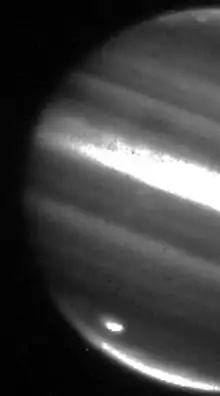
The frequency of impacts on a planet can be defined as the average interval between two consecutive impacts; a high value corresponds to a short interval between two consecutive impacts. In 1998, Nakamura and Kurahashi that estimated every 500–1000 years, a comet with a diameter greater than 1 km (0.62 mi) could impact the planet.[60] This estimate was revised after the 1994 impact of Comet Shoemaker-Levy 9. In the various subsequent works, values between 50 and 350 years were suggested for an object of 0.5 and 1 km (0.31 and 0.62 mi). They are based on some assumptions that have been questioned since the impact of 2009.[61]
In particular, it was believed the role of asteroids was marginal and that impacts on Jupiter were mainly caused by comets.[62] Since then, the data deriving from the observations have radically changed; in 2008, the two confirmed observations indicated a time interval of about 300 years between the impact observed by Cassini and that of SL9. In 2010, a new observation reduced this value because only fifteen years had passed since the previous impact and it could be possible to estimate, based on the last two observations, an impact frequency of 10 years for an object of 0.5 and 1 km (0.31 and 0.62 mi).[61]
Regarding the impacts with meteoroids, their distribution in the outer solar system is not known and therefore it is not possible to provide a forecast on the frequency of impact without relying on partial data.[50]
Considering a meteoroid of about 10 meters (33 ft) in diameter, we would have:
- an impact per year on Jupiter, from considerations relating to the craterization of the surfaces of the satellites;[50]
- 30-100 collisions per year, basing the data on asteroid and cometary populations near the planet's orbit.[50]
For comparison, a frequency of impact with an object of this size every 6–15 years has been estimated for the Earth.[50]
To estimate the frequency of impacts, observation campaigns were launched with the involvement of amateurs. Marc Delcroix of the Société Astronomique de France and a group of astronomers from the University of the Basque Country led by Ricardo Hueso developed the DeTeCt software to allow rapid identification of any impact and facilitate the rapid spread of the news.[63] In addition, Japanese amateurs from the Association of Lunar and Planetary Observers (ALPO) have activated the "Find Flash" project.[64] The two projects led to an estimate of the minimum impact frequency of meteoroids at about three events per year. Hueso, however, believes it is more likely between 10 and 65 impacts per year of meteoroids with a diameter of between 5 and 40 meters (16 and 131 ft) can occur on the planet. For larger objects capable of leaving a visible scar on the planet's cloud cover for weeks, he provides an impact frequency of one every 2–12 years. Even larger objects would impact Jupiter every 6–30 years.[18]
Following the impact of 10 April 2020 observed by the Juno probe, Rohini S. Giles and colleagues estimated the number of impacts on Jupiter caused by meteoroids with masses between 250 and 5,000 kg (550 and 11,020 lb) to be approximately 24,000 events of per year or around 2.7 per hour.[46]
Search campaigns
From the observation of the impact events on Jupiter, it is possible to deduce information on the composition of comets and asteroids, and the deeper layers of the Jovian atmosphere. The frequency of impacts provides information on the populations of asteroids and comets in the outer solar system.[36]
Recent impact sites can be recognized by the characteristics that include the appearance of dark spots on the planetary disc, as happened in 2009. CCD detectors can determine spots as small as approximately 300 km (190 mi) wide. Sanchez-Lavega and colleagues suggest exploiting the brightness of the spots at a wavelength of 890 nm, which is detectable using near-infrared-sensitive CCDs or those that are sensitive to the range 2.03-2.36 μm, detectable using K filters.[61]
In the case of the meteoroids that do not leave evident impact marks, the light emission that accompanies the atmospheric entry lasts for between one and two seconds, and a continuous monitoring of the planet's surface at high frequency is necessary for their identification. Hueso et al. suggest telescopes with a diameter between 15 and 20 cm (5.9 and 7.9 in) are the ideal tools for their detection if equipped with a webcam or other video recording tools.[50]
More information on the frequency of impact can be obtained by analyzing the historical observations of Jupiter conducted in the 18th and 19th centuries in the light of the new knowledge acquired.[65] For example, Hungarian astronomer Illés Erzsébet analyzed the correspondence about observations made at three Hungarian observatories and identified three possible impact events that occurred in 1879, 1884, and 1897.[66]
In 2007, some studies related the ripples of Jupiter's rings to the impact of Comet SL9 by analyzing the time evolution recorded by the instruments on board the Galileo, Cassini, and New Horizons probes that visited the planet.[67][68] In the rings, "fossil traces" could be present from which the occurrence of previous impacts could be deduced or, in the future, traces of events not directly observed could appear.[69][70]
Jupiter as a "cosmic vacuum cleaner"
The impact of Comet SL9 highlighted Jupiter's role as a "cosmic vacuum cleaner" or Jupiter barrier for the inner Solar System. The planet's strong gravitational influence leads to many small comets and asteroids colliding with the planet. The rate of cometary impacts on Jupiter is thought to be between 2,000 and 8,000 times higher than the rate on Earth.[71]
The extinction of the non-avian dinosaurs at the end of the Cretaceous period is generally thought to have been caused by the Cretaceous–Paleogene impact event, which created the Chicxulub crater,[72] demonstrating impacts are a serious threat to life on Earth. Astronomers have speculated without Jupiter to mop up potential Earth impactors, extinction events might have been more frequent and complex life might not have been able to develop.[73] This is part of the argument used in the Rare Earth hypothesis.
In 2009, it was shown the presence of a smaller planet at Jupiter's position in the solar system might significantly increase the impact rate of comets on Earth. A planet of Jupiter's mass seems to provide increased protection against asteroids but the total effect on all orbital bodies within the solar system is unclear. This and other recent models call into question the nature of Jupiter's influence on Earth impacts.[74][75][76]
Collisions in mass culture
The direct observation of impact events on Jupiter has led to the growing awareness, even in public opinion, of the devastating consequences of an impact of a comet or asteroid with Earth. The possibility of such an event has become concrete and must be guarded against.[77][78][79]
The collision of Comet SL-9 with Jupiter, to which extensive media coverage was dedicated,[80] brought the subject to public attention. Among the forms of communication aimed at the general public were the 1998 films Deep Impact by Mimi Leder and Armageddon by Michael Bay.
The discovery of the subsequent impacts has shown these events are far more frequent than previously thought.[81] The role played by non-professional astronomers in identifying the signs of impact is also significant, thanks to a reduction in the cost of advanced observation instruments.[82]
Further reading
- Peek, Bertrand M. (1981). Faber and Faber Limited (ed.). The Planet Jupiter: The Observer's Handbook. Londra. ISBN 0-571-18026-4. OCLC 8318939.
- Burgess, Eric (1982). Columbia University Press (ed.). By Jupiter: Odysseys to a Giant. New York. ISBN 0-231-05176-X.
- Rogers, John H. (1995). Cambridge University Press (ed.). The Giant Planet Jupiter. Cambridge. ISBN 0-521-41008-8. OCLC 219591510.
- Beebe, Reta (1996). Smithsonian Institution Press (ed.). Jupiter: The Giant Planet (2 ed.). Washington. ISBN 1-56098-685-9.
- D. C. Jewitt, S. Sheppard, C. Porco, F. Bagenal; T. Dowling; W. McKinnon (2004). Cambridge University Press (ed.). Jupiter: The Planet, Satellites and Magnetosphere (PDF). Cambridge. ISBN 0-521-81808-7. Archived from the original (PDF) on 2007.CS1 maint: multiple names: authors list (link)
- Linda T. Elkins-Tanton (2006). Chelsea House (ed.). Jupiter and Saturn. New York. ISBN 0-8160-5196-8.
Scientific articles
- National Space Science Date Center, NASA (ed.). "Comet Shoemaker-Levy 9 Collision with Jupiter".
- K. S. Noll (1995). "HST Spectroscopic Observations of Jupiter Following the Impact of Comet Shoemaker-Levy 9". Science. 267 (5202): 1307–1313. doi:10.1126/science.7871428. PMID 7871428. S2CID 37686143.
- Martin, T.Z. (1996). "Shoemaker-Levy 9: Temperature, Diameter and Energy of Fireballs". Bulletin of the American Astronomical Society. 28: 1085. Bibcode:1996DPS....28.0814M.
References
The article was partially translated from the Italian Wikipedia article. For original, see it:Eventi d'impatto su Giove.
- Chebotarev, G.A. (1964). "Gravitational Spheres of the Major Planets, Moon and Sun". Soviet Astronomy. 7: 620. Bibcode:1964SvA.....7..618C.
- Tancredi, G. (1990). "Temporary Satellite Capture and Orbital Evolution of Comet P/Helin-Roman-Crockett". Astronomy and Astrophysics. 239 (1–2): 375–380. Bibcode:1990A&A...239..375T.
- Ohtsuka, Katsuhito (2008). "Quasi-Hilda Comet 147P/Kushida-Muramatsu: Another long temporary satellite capture by Jupiter" (PDF). Astronomy & Astrophysics. 489 (3): 1355. arXiv:0808.2277. Bibcode:2008A&A...489.1355O. doi:10.1051/0004-6361:200810321. S2CID 14201751. Archived from the original (PDF) on 2013.
- Horner, J.; Jones, B.W.; Chambers, J. (2010). "Jupiter - friend or foe? III: the Oort cloud comets". International Journal of Astrobiology. 9 (1): 1–10. arXiv:0911.4381. Bibcode:2010IJAsB...9....1H. doi:10.1017/S1473550409990346. S2CID 1103987.CS1 maint: multiple names: authors list (link)
- Horner, J.; Jones, B.W. (2008). "Jupiter: Friend or foe? I: the asteroids". International Journal of Astrobiology. 7 (3&4): 251–261. arXiv:0806.2795. Bibcode:2008IJAsB...7..251H. doi:10.1017/S1473550408004187. S2CID 8870726.
- Horner, J.; Jones, B.W. (2009). "Jupiter - friend or foe? II: the Centaurs". International Journal of Astrobiology. 8 (2): 75–80. arXiv:0903.3305. Bibcode:2009IJAsB...8...75H. doi:10.1017/S1473550408004357. S2CID 8032181.
- Dennis Overbye (2009). "Jupiter: Our Cosmic Protector?". The New York Times. p. WK7.
- Roulston, M.S.; Ahrens, T (March 1997). "Impact Mechanics and Frequency of SL9-Type Events on Jupiter". Icarus. 126 (1): 138–147. Bibcode:1997Icar..126..138R. doi:10.1006/icar.1996.5636.
- Guillot, Tristan (1999). "A comparison of the interiors of Jupiter and Saturn". Planetary and Space Science. 47 (10–11): 1183–1200. arXiv:astro-ph/9907402. Bibcode:1999P&SS...47.1183G. doi:10.1016/S0032-0633(99)00043-4. S2CID 19024073.
- Schenk, Paul M.; Asphaug, Erik (1996). "Cometary Nuclei and Tidal Disruption: The Geologic Record of Crater Chains on Callisto and Ganymede". Icarus. 121 (2): 249–24. Bibcode:1996Icar..121..249S. doi:10.1006/icar.1996.0084.
- Greeley, R.; Klemaszewski, J. E.; Wagner, L. (2000). "Galileo views of the geology of Callisto". Planetary and Space Science. 48 (9): 829–853. Bibcode:2000P&SS...48..829G. doi:10.1016/S0032-0633(00)00050-7.CS1 maint: multiple names: authors list (link)
- McKinnon, W.B.; Schenk, P.M. (1995). "Estimates of comet fragment masses from impact crater chains on Callisto and Ganymede". Geophysical Research Letters. 22 (13): 1829–1832. Bibcode:1995GeoRL..22.1829M. doi:10.1029/95GL01422. hdl:2060/19970004996.
- Schenk, Paul M.; Asphaug, Erik; McKinnon, William B.; Melosh, H. J.; Weissman, Paul R. (June 1996). "Cometary Nuclei and Tidal Disruption: The Geologic Record of Crater Chains on Callisto and Ganymede". Icarus. 121 (2): 249–24. Bibcode:1996Icar..121..249S. doi:10.1006/icar.1996.0084. hdl:2060/19970022199.
- Tabe, I.; Watanabe, J.-I.; Jimbo, M. (1997). "Discovery of a Possible Impact SPOT on Jupiter Recorded in 1690". Publications of the Astronomical Society of Japan. 49: L1–L5. Bibcode:1997PASJ...49L...1T. doi:10.1093/pasj/49.1.L1.CS1 maint: multiple names: authors list (link)
- Cook, A.F.; Duxbury, T.C. (1981). "A Fireball in Jupiter's Atmosphere". J. Geophys. Res. 86 (A10): 8815–8817. Bibcode:1981JGR....86.8815C. doi:10.1029/JA086iA10p08815.
- King, Bob (14 September 2021). "Amateur Spots Possible New Impact Flash at Jupiter". Sky & Telescope. Retrieved 14 September 2021.
- Mack, Eric. "Jupiter just got slammed by something so big we saw it from Earth". CNET. Retrieved 2019-08-09.
- R. Hueso; M. Delcroix; A. Sánchez-Lavega; S. Pedranghelu; G. Kernbauer; J. McKeon; A. Fleckstein; A. Wesley; J.M. Gómez-Forrellad; J.F. Rojas; J. Juaristi (2018). "Small impacts on the giant planet Jupiter". Astronomy & Astrophysics. 309: 277–296. arXiv:1804.02434. Bibcode:2018Icar..309..277B. doi:10.1016/j.icarus.2018.03.012. S2CID 119397579.
- "A Fresh Impact on Jupiter".
- "Hubble Ultraviolet Image of Multiple Comet Impacts on Jupiter". News Release Number: STScI-1994-35. Hubble Space Telescope Comet Team. July 23, 1994. Archived from the original on December 5, 2017. Retrieved November 12, 2014.
- Yeomans, D.K. (December 1993). "Periodic comet Shoemaker–Levy 9 (1993e)". IAU Circular. 5909. Retrieved July 5, 2011.
- Williams, David R. "Ulysses and Voyager 2". Lunar and Planetary Science. National Space Science Data Center. Retrieved August 25, 2008.
- "Comet Shoemaker–Levy 9 Collision with Jupiter". National Space Science Data Center. February 2005. Archived from the original on February 19, 2013. Retrieved August 26, 2008.
- Martin, Terry Z. (September 1996). "Shoemaker–Levy 9: Temperature, Diameter and Energy of Fireballs". Bulletin of the American Astronomical Society. 28: 1085. Bibcode:1996DPS....28.0814M.
- Weissman, P.R.; Carlson, R. W.; Hui, J.; Segura, M.; Smythe, W. D.; Baines, K. H.; Johnson, T. V.; Drossart, P.; Encrenaz, T.; et al. (March 1995). "Galileo NIMS Direct Observation of the Shoemaker–Levy 9 Fireballs and Fall Back". Abstracts of the Lunar and Planetary Science Conference. 26: 1483. Bibcode:1995LPI....26.1483W.
- Boslough, Mark B.; Crawford, David A.; Robinson, Allen C.; Trucano, Timothy G. (July 5, 1994). "Watching for Fireballs on Jupiter". Eos, Transactions, American Geophysical Union. 75 (27): 305. Bibcode:1994EOSTr..75..305B. doi:10.1029/94eo00965.
- Weissman, Paul (July 14, 1994). "The Big Fizzle is coming". Nature. 370 (6485): 94–95. Bibcode:1994Natur.370...94W. doi:10.1038/370094a0. S2CID 4358549.
- Hammel, H.B. (December 1994). The Spectacular Swan Song of Shoemaker–Levy 9. 185th AAS Meeting. 26. American Astronomical Society. p. 1425. Bibcode:1994AAS...185.7201H.
- Bruton, Dan (February 1996). "What were some of the effects of the collisions?". Frequently Asked Questions about the Collision of Comet Shoemaker–Levy 9 with Jupiter. Stephen F. Austin State University. Retrieved January 27, 2014.
- Yeomans, Don; Chodas, Paul (March 18, 1995). "Comet Crash Impact Times Request". Jet Propulsion Laboratory. Retrieved August 26, 2008.
- Dennis Overbye (24 July 2009). "Hubble Takes Snapshot of Jupiter's 'Black Eye'". The New York Times. Retrieved 6 June 2010.
- "Hubble Images Suggest Rogue Asteroid Smashed Jupiter". 3 June 2010. Archived from the original on 7 June 2010. Retrieved 4 June 2010.
- "Mystery impact leaves Earth-sized mark on Jupiter". CNN. July 21, 2009.
- Overbye, Dennis (July 22, 2009). "All Eyepieces on Jupiter After a Big Impact". New York Times.
- Amateur astronomer spots Earth-size scar on Jupiter, Guardian, July 21, 2009
- Hueso, R.; Pérez-Hoyos, S.; Sánchez-Lavega, A.; Wesley, A.; Hall, G.; Go, C.; Tachikawa, M.; Aoki, K.; Ichimaru, M.; Pond, J. W. T.; Korycansky, D. G.; Palotai, C.; Chappell, G.; Rebeli, N.; Harrington, J.; Delcroix, M.; Wong, M.; de Pater, I.; Fletcher, L. N.; Hammel, H.; Orton, G. S.; Tabe, I.; Watanabe, J.; Moreno, J. C. (December 2013). "Impact flux on Jupiter: From superbolides to large-scale collisions" (PDF). Astronomy & Astrophysics. 560: A55. doi:10.1051/0004-6361/201322216.
- Sayanagi, Kunio M. (3 June 2010). "Jupiter hit by another impactor Thursday". Ars Technica. Archived from the original on 5 June 2010. Retrieved 4 June 2010.
- Bakich, Michael (4 June 2010). "Another impact on Jupiter". Astronomy Magazine online. Retrieved 4 June 2010.
- Bakich, Michael (2010-06-04). "Another impact on Jupiter". Astronomy Magazine online. Retrieved 2010-06-04.
- "Jupiter 2020 by Chris Go". www.christone.net.
- Franck Marchis (2012-09-10). "Another fireball on Jupiter?". Cosmic Diary blog. Retrieved 2012-09-11.
- Franck Marchis (11 September 2012). "Flash on Jupiter – most likely a meteor". Cosmic Diary blog. Retrieved 29 November 2012.
- Plait, Phil (29 March 2016). "Jupiter Got Whacked by Yet Another Asteroid/Comet!". www.slate.com. Retrieved 12 April 2016.
- Dvorsky, George (29 March 2016). "Something Just Slammed Into Jupiter". gizmodo.com. Retrieved 12 April 2016.
- Something Just Slammed Into Jupiter https://gizmodo.com/ready-to-edit-something-just-slammed-into-jupiter-1767726856
- Giles, Rohini S.; Greathouse, Thomas K.; Kammer, Joshua A.; Gladstone, G. Randall; Bonfond, Bertrand; Hue, Vincent; Grodent, Denis C.; Gérard, Jean-Claude; Versteeg, Maarten H.; Bolton, Scott J.; Connerney, John E. P.; Levin, Steven M. (8 February 2021). "Detection of a bolide in Jupiter's atmosphere with Juno UVS". Geophysical Research Letters. 48 (5): e91797. arXiv:2102.04511. Bibcode:2021GeoRL..4891797G. doi:10.1029/2020GL091797. S2CID 231855339.
- "EarthSky | Impact on Jupiter surprises skywatchers". earthsky.org. 2021-09-14. Retrieved 2021-09-15.
- Damian, Peach (2021-09-15). "Damian Peach on Twitter". Twitter. Retrieved 2021-09-15.
- Rogers, J.H. (1996). "The comet collision with Jupiter: II. The visible scars". Journal of the British Astronomical Association. 106 (3): 125–149. Bibcode:1996JBAA..106..125R.
- Hueso, R. (2010). "First Earth-based Detection of a Superbolide on Jupiter" (PDF). The Astrophysical Journal Letters. 721 (2): L129–L133. arXiv:1009.1824. Bibcode:2010ApJ...721L.129H. doi:10.1088/2041-8205/721/2/L129. S2CID 37619282.
- Takata, T. (1994). "Comet Shoemaker-Levy 9: Impact on Jupiter and plume evolution". Icarus. 109 (1): 3–19. Bibcode:1994Icar..109....3T. doi:10.1006/icar.1994.1074.
- Carlson, R.W. (1995). "Galileo infrared observations of the Shoemaker-Levy 9 G impact fireball: A preliminary report". Geophysical Research Letters. 22 (12): 1557–1560. Bibcode:1995GeoRL..22.1557C. doi:10.1029/95GL01189.
- McGrath, M.A. (1996). "Long-term Chemical Evolution of the Jupiter Stratosphere Following the SL9 Impacts". Bulletin of the American Astronomical Society. 28: 1149. Bibcode:1996DPS....28.2241M.
- Ingersoll, A. P. (1995). "Waves from the collisions of comet Shoemaker-Levy 9 with Jupiter". Nature. 374 (6524): 706–708. Bibcode:1995Natur.374..706I. doi:10.1038/374706a0. PMID 7715724. S2CID 4325357.
- Hill, T.W. (1995). "Mid-latitude Jovian aurora produced by the impact of comet Shoemaker-Levy-9". Geophysical Research Letters. 22 (13): 1817–1820. Bibcode:1995GeoRL..22.1817H. doi:10.1029/95GL01774.
- Olano, C.A. (1999). "Jupiter's Synchrotron Emission Induced by the Collision of Comet Shoemaker-Levy 9". Astrophysics and Space Science. 266 (3): 347–369. Bibcode:1999Ap&SS.266..347O. doi:10.1023/A:1002020013936. S2CID 118876167. Archived from the original on 2016.
- Field, G.B. (1995). "Dust as the cause of spots on Jupiter". Astronomy and Astrophysics. 294 (3): L53–L55. Bibcode:1995A&A...294L..53F.
- Fletcher, L.N. (2010). "Jupiter Impacts in the Thermal-Infrared: Comparing Atmospheric Responses in 1994, 2009 and 2010". American Astronomical Society, DPS Meeting #42, #31.03; Bulletin of the American Astronomical Society. 42: 1010. Bibcode:2010DPS....42.3103F.
- Orton, G.S. (2011). "The atmospheric influence, size and possible asteroidal nature of the July 2009 Jupiter impactor". Icarus. 211 (1): 587–602. Bibcode:2011Icar..211..587O. doi:10.1016/j.icarus.2010.10.010.
- Nakamura, T. (1998). "Collisional Probability of Periodic Comets with the Terrestrial Planets: An Invalid Case of Analytic Formulation". Astronomical Journal. 115 (2): 848–854. Bibcode:1998AJ....115..848N. doi:10.1086/300206.
- Sánchez-Lavega, A. (2010). "The impact of a large object with Jupiter in July 2009" (PDF). The Astrophysical Journal Letters. 715 (2): L150. arXiv:1005.2312. doi:10.1088/2041-8205/715/2/L155. S2CID 119251280.
- Zahnle, K.; Dones, L.; Levison, H.F. (1998). "Cratering Rates on the Galilean Satellites". Icarus. 136 (2): 202–222. Bibcode:1998Icar..136..202Z. doi:10.1006/icar.1998.6015. PMID 11878353.CS1 maint: multiple names: authors list (link)
- M. Delcroix; R. Hueso; J. Juaristi (2019). "Jupiter and Saturn impact detection project" (PDF). EPSC Abstracts. EPSC-DPS Joint Meeting 2019, Geneva, Switzerland, 15–20 September 2019. 13. EPSC-DPS2019-970-2.
- Europlanet 2020 (ed.). "Jupiter blasted by 6.5 fireball impacts per year on average".
- Hockey, T. A. (1995). "Historical Planetary Astronomy". American Astronomical Society, 187th AAS Meeting, #27.04; Bulletin of the American Astronomical Society. 27: 1325. Bibcode:1995AAS...187.2704H.
- Erzsébet, Illés-Almár (2001). VUB (ed.). Miklós Konkoly Thege (1842-1916). 100 Years of Observational Astronomy and Astrophysics - A collection of papers on the history of Observational Astrophysics; SL9-like impact-traces on Jupiter?. Brussels: C. Sterken; J.B. Hearnshaw. Bibcode:2001mkt..book...75I. ISBN 90-805538-3-2.
- Showalter, M.R.; Hedman, M.M.; Burns, J.A. (2010). "Vertical Ripples in the Jovian Ring". American Astronomical Society, DPS Meeting #42, #19.01; Bulletin of the American Astronomical Society. 42: 980. Bibcode:2010DPS....42.1901S.CS1 maint: multiple names: authors list (link)
- Showalter, M.R.; Hedman, M.M. (2010). "Vertical Warping of the Jovian Ring". American Astronomical Society, DDA Meeting #41, #11.03; Bulletin of the American Astronomical Society. 41: 939. Bibcode:2010DDA....41.1103S.
- nationalgeographic.com/blog (ed.). "Did a Comet Make Jupiter's Rings Wave?". Breaking orbit.
- Kazan, Casey. "A Mystery Object Impacted Jupiter's Rings: Was It the 1994 Comet Shoemaker-Levy?". Archived from the original on 23 December 2010.
- Nakamura, T.; Kurahashi, H. (February 1998). "Collisional Probability of Periodic Comets with the Terrestrial Planets – an Invalid Case of Analytic Formulation". Astronomical Journal. 115 (2): 848. Bibcode:1998AJ....115..848N. doi:10.1086/300206.
For Jupiter-interacting comets of greater than 1 km (0.62 mi) diameter, a Jupiter impact takes place between every 500 and 1000 years, and an Earth impact every two-to-four million years.
- "PIA01723: Space Radar Image of the Yucatan Impact Crater Site". NASA/JPL Near-Earth Object Program Office. August 22, 2005. Archived from the original on August 8, 2016. Retrieved July 21, 2009.
- Wetherill, George W. (February 1994). "Possible consequences of absence of "Jupiters" in planetary systems". Astrophysics and Space Science. 212 (1–2): 23–32. Bibcode:1994Ap&SS.212...23W. doi:10.1007/BF00984505. PMID 11539457. S2CID 21928486.
- Horner, J.; Jones, B. W. (2008). "Jupiter – friend or foe? I: The asteroids". International Journal of Astrobiology. 7 (3–4): 251–261. arXiv:0806.2795. Bibcode:2008IJAsB...7..251H. doi:10.1017/S1473550408004187. S2CID 8870726.
- Horner, J.; Jones, B. W. (2009). "Jupiter – friend or foe? II: the Centaurs Jupiter". International Journal of Astrobiology. 8 (2): 75–80. arXiv:0903.3305. Bibcode:2009IJAsB...8...75H. doi:10.1017/S1473550408004357. S2CID 8032181.
- Grazier, Kevin R. (January 2016). "Jupiter: Cosmic Jekyll and Hyde". Astrobiology. 16 (1): 23–38. Bibcode:2016AsBio..16...23G. doi:10.1089/ast.2015.1321. PMID 26701303. S2CID 23859604.
- A. Carusi, The Spaceguard Foundation. ESA Portal (ed.). "Spaceguard Integrated System for Potentially Hazardous Object Survey" (PDF).
- tuttoscienza.it (ed.). "Il pericolo di un impatto con la terra". Archived from the original on 2007.
- Chapman, C.R. (1995). CUP Archive (ed.). The great comet crash: the impact of comet Shoemaker-Levy 9 on Jupiter. pp. 103–108. Bibcode:1995gcci.conf..103C. ISBN 0-521-48274-7.
What If?
- J. Kelly Beatty. S. Alan Stern (ed.). "The "Great Crash"" (PDF). The Trill of Planetary Exploration as told by Leading Experts.
- NASA (ed.). "Hubble Images Suggest Rogue Asteroid Smacked Jupiter".
- Chandler, David L. MIT News Office (ed.). "Jupiter, solar system's 'big bully,' takes a punch". Archived from the original on 2012.
| Geography |  | ||||||||
|---|---|---|---|---|---|---|---|---|---|
| Moons |
| ||||||||
| Astronomy |
| ||||||||
| Exploration and orbiting missions |
| ||||||||
| Related | |||||||||
| |||||||||