Incisive bone
| Incisive bone | |
|---|---|
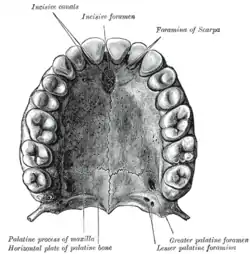 The bony palate and alveolar arch. (Premaxilla is not labeled, but region is visible.) | |
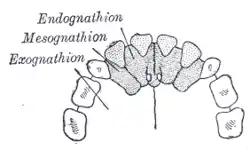 The premaxilla and its sutures. | |
| Details | |
| Identifiers | |
| Latin | os incisivum |
| TA98 | A02.1.12.031 |
| TA2 | 833 |
| FMA | 77231 |
| Anatomical terms of bone | |
In human anatomy, the incisive bone or (Latin) os incisivum is the portion of the maxilla adjacent to the incisors. It is formed from the fusion of a pair of small cranial bones at the very tip of the jaws of many animals, usually bearing teeth, but not always. They are connected to the maxilla and the nasals. While Johann Wolfgang von Goethe was not the first one to discover the incisive bone in humans, he was the first to prove its presence across mammals. Hence, the incisive bone is also known as Goethe's bone.[1]
In other animals the term premaxilla is more often used to refer to the incisive bone. Yet other terms include premaxillary bone, os premaxillare, intermaxillary bone, and os intermaxillare.[1]
History
In 1573, Volcher Coiter was the first to illustrate the incisive suture in humans. Pierre Marie Auguste Broussonet and Félix Vicq-d'Azyr were the first to describe the incisive bone as a separate bone within the skull in 1779 and 1780, respectively.[1]
In the 1790s, Johann Wolfgang von Goethe began studying zoology, and formed the impression that all animals are similar, being bodies composed of vertebrae and their permutations. The human skull is one example of a metamorphosed vertebra, and within it, the intermaxillary bone rests as evidence linking the species to other animals.[2]
Incisive bone and premaxilla
Incisive bone is a term used for mammals, and it has been generally thought to be homologous to premaxilla in non-mammalian animals. However, there are counterarguments. According to them, the incisive bone is a novel character first acquired in therian mammals as a composition of premaxilla derived from medial nasal prominence and septomaxilla derived from maxillary prominence. In the incisive bones, only the palatine process corresponds to the premaxilla, while the other parts are the septomaxilla. Based on this, the incisive bone is not completely homologous to the non-mammalian premaxilla. This was hypothesized by Ernst Gaupp in 1905[3] and demonstrated by developmental biological- and paleontological experiments in 2021.[4] This issue is still under debate.
References
- Barteczko, K; Jacob, M (March 2004). "A re-evaluation of the premaxillary bone in humans". Anatomy and Embryology. 207 (6): 417–437. doi:10.1007/s00429-003-0366-x. PMID 14760532.
- Gillispie, Charles Coulston (1960). The Edge of Objectivity: An Essay in the History of Scientific Ideas. Princeton, NJ: Princeton University Press. p. 194. ISBN 0-691-02350-6.
- Gaupp, E. (1905). "Neue Deutungen auf dem Gebiete der Lehre vom Säugetierschädel". Anat. Anz. 27: 273–310.
- Higashiyama, Hiroki; Koyabu, Daisuke; Hirasawa, Tatsuya; Werneburg, Ingmar; Kuratani, Shigeru; Kurihara, Hiroki (November 2, 2021). "Mammalian face as an evolutionary novelty". PNAS. 118 (44): e2111876118. doi:10.1073/pnas.2111876118. PMID 34716275.
Authority control  | |
|---|---|
| Scientific databases | |
| Other | |