Indian Association for the Cultivation of Science
Indian Association for the Cultivation of Science (IACS) is a public, deemed, research university for higher education and research in basic sciences under the Department of Science & Technology, Government of India, situated at the heart of the Cultural capital of India.[3][4] Established in 1876 by Mahendra Lal Sircar, a private medical practitioner, it focuses on fundamental research in basic sciences.[5] It is Asia's oldest research institute[6][7] Located at Jadavpur, South Kolkata near Jadavpur University, Central Glass and Ceramic Research Institute and Indian Institute of Chemical Biology. It is spread over a limited area of 9.5 acres[8] and currently in the process of building a super-advanced SMART campus at Baruipur.[9]
 Seal of IACS | |
Other name | IACS Kolkata |
|---|---|
| Motto | To cultivate Science in all its departments with a view to its advancement by original research and with a view to its varied application to the arts and comforts of life. |
| Type | Deemed University |
| Established | 29 July 1876 |
| Founder | Dr. Mahendra Lal Sircar |
| Affiliation | UGC |
| President | Srivari Chandrasekhar |
| Director | Tapas Chakraborty |
| Location | 2A & 2B Raja S C Mullick Road Kolkata-700032, West Bengal, India 22.4983°N 88.3686°E |
| Campus | Urban |
| Language | English |
| Website | www |
| University and College rankings | |
|---|---|
| Global – Overall | |
| CWUR World | 1092 (2021)[1] |
| National – Overall | |
| CWUR National | 19 (2021))[2] |
.png.webp)
The association is engaged in research in various fields of physics, chemistry, biological sciences, mathematical and computational sciences, materials sciences and various interdisciplinary areas.
Indian Journal of Physics (IJP)
Indian Journal of Physics was founded in 1926. It is published monthly.[10] Springer distributes print version of the Journal worldwide. The present chief editor of the journal is Prof. Subham Majumdar, who is a senior professor in the School of Physical Sciences, IACS.
Second Campus (Offshore Campus at Baruipur)
Union Minister of Science and Technology, Dr. Harsha Vardhan unveiled the foundation stone of the Syamaprasad Mookerjee Advanced Research and Training (SMART)[9] campus of Indian Association for the Cultivation of Science(IACS) at Baruipur. It will have the facilities for cutting-edge research in multiple disciplines such as fundamental sciences, engineering sciences and medical sciences.[11]
Academic Divisions
Starting from 2018, after being declared as a deemed university by MHRD, for academic purposes, departments and centres in the Institute are broadly assigned to six major schools, each headed by a Chairperson (School Chair):
- School of Applied and Interdisciplinary Sciences (SAIS)
- School of Biological Sciences (SBS)
- School of Chemical Sciences (SCS)
- School of Materials Sciences (SMS)
- School of Mathematical and Computational Sciences (SMCS)
- School of Physical Sciences (SPS)
Apart from these 6 major schools, there are a few centers, designed to perform specific and cutting-edge research, by the institute administration:
- Centre for Computer Research, Education and Services (CCRES)
- Director's Research Unit (DRU)
- Technical Research Center (TRC)
- Central Scientific Services (CSS)
- Raman Centre of Atomic, Molecular & Optical Sciences
- Polymer Structural Unit
- Energy Research Unit
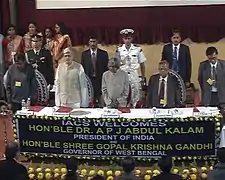 Former president of India, Dr. APJ Abdul Kalam at IACS
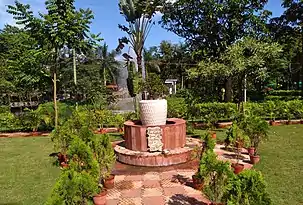
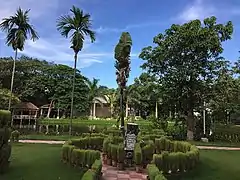 Front garden of IACS
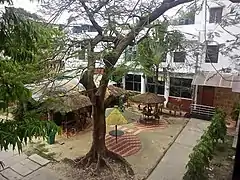 Canteen at IACS
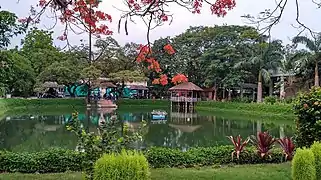 Mahendra Sarobar at IACS
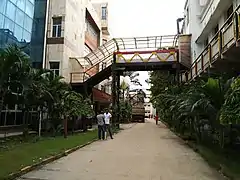 Connector between Centenary Building and Main building of IACS
Administration
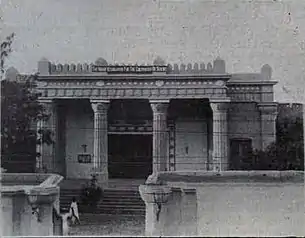
At its inception, the IACS was headed by a President, with the Honorary Secretary responsible for the day-to-day running of the Society. Until 1911, the office of President was de facto held by the Lieutenant-Governor of Bengal, when the Lieutenant-Governor (Governor from 1912) became the co-patron of the Society alongside the Viceroy of India, whose office-holders were automatically Patrons of the Society until 1947.[12][note 1] Following India's independence in 1947, the administration of the IACS was reconstituted, with the designation of "Honorary Director" substituted for "Honorary Secretary."[13] The Director's prefix of "Honorary" was dropped in 1953.[14]
Presidents of the IACS (1876-present)
- Sir Richard Temple, 1st Baronet FRS (1876-1877)
- The Hon. Sir Ashley Eden FASB (1877-1882)
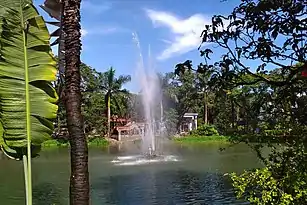 Mahendra Sarobar, IACS
 - Sir Augustus Rivers Thompson (1882-1887)
- Sir Steuart Bayley (1887-1890)
- Sir Charles Alfred Elliott FASB (1890-1895)
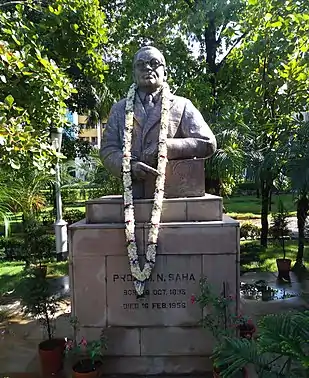 Prof. Meghnad Saha, first director of IACS
 - Sir Alexander Mackenzie (1895-1898)
- Sir John Woodburn (1898-1903)
- Sir Andrew Henderson Leith Fraser FASB (1903-1909)
- Sir Edward Norman Baker (1909-1911)
- Raja Pyare Mohan Mukherjee FASB (1911-1922)[15]
- Hon. Justice Sir Ashutosh Mukherjee FASB, FRSE, FRAS, MRIA (1922-1924)[16]
- Sir Rajendra Nath Mookerjee FASB (1924-1934?)[17]
- Sir Nilratan Sircar (1934-1942)[18]
- Prof. Rai Bahadur Sir Upendranath Brahmachari FNI, FASB (1942-1946)[19][20]
- Prof. Meghnad Saha FNI, FASB, FRS (1946-1951)[20][21]
- Prof. Sir Jnan Chandra Ghosh FNI (1951-1954)[22][23]
- Hon. Justice Charu Chandra Biswas (1954-1957)[24]
- Hon. Chief Justice Phani Bhusan Chakravartti (1957-1958)[25]
- Prof. Satyendra Nath Bose FNI, FRS (1958-1962)[26][27]
- Hon. Justice Rama Prasad Mookerjee (1962-1965)[27]
- Prof. Jnanendra Nath Mukherjee FNI, FCS (1965-1968)[28]
- Prof. Basanti Dulal Nagchaudhuri FNA (first term, 1968–1970)[29][note 2]
- Prof. Sushil Kumar Mukherjee FNA (first term, 1970–1973)[30][31]
- Prof. Sukumar Chandra Sirkar FNA (1973-1974)[31]
- Prof. Basanti Dulal Nagchaudhuri FNA (second term, 1974–1977)[32][33]
- Prof. Bimal Kumar Bachhawat FNA (1977-1983)[33]
- Prof. Sushil Kumar Mukherjee FNA (second term, 1983–1997)[34][35]
- Prof. Arun Kumar Sharma FNA, FASc (1997-2000)[35]
- Prof. M. M. Chakraborty (2000-2003)[36][37]
- Prof. Ashesh Prosad Mitra FNA, FASc, FRS (2003-2007)[38]
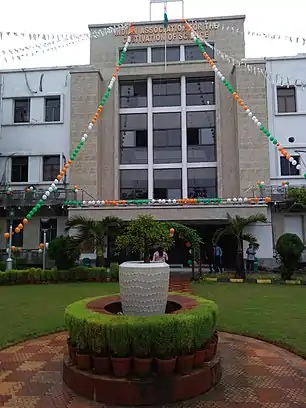 Independence Day celebration at IACS (August 15, 2019)
 - Prof. Shri Krishna Joshi FNA, FASc (2007-2014)[39]
- Prof. Man Mohan Sharma FNA, FASc, FRS, FREng (2014–2021)[40]
- Prof. Srivari Chandrasekhar, FNA, FASc (2021–present)
Honorary Secretaries of the IACS (1876-1947)
- Dr. Mahendralal Sarkar (Founder-Secretary, 1876–1904)[41]
- Dr. Amritalal Sarkar (1904-1919)[41][18]
- Prof. Sir C. V. Raman (1919-1933)[18]
- Prof. K. S. Krishnan (1933-June 1934)[18]
- Prof. Sisir Kumar Mitra (June 1934-November 1935)[18]
- Prof. Jnanendra Nath Mukherjee FNI, FCS (November 1935-April 1944)[42]
- Prof. Meghnad Saha FNI, FASB, FRS (April 1944 – 1945)[43][44]
- Prof. Priyadaranjan Ray FNI (1945-1947)[44]
Directors of the IACS (1953-present)
- Prof. Meghnad Saha FNI, FASB, FRS (1953-1956)[14][24]
- Prof. Priyadaranjan Ray FNI (officiating, 1956–1958)[24][26]
- Prof. Kedareswar Banerjee FNI (1959-1965)[45][28]
- Prof. Debidas Basu (1968-1980)[29][46]
- Prof. Sadhan Basu FNA, FASc (March 1981-August 1982, on medical leave from July)[46][34]
- G. S. Banerjee IAS (acting, July–December 1982)[34]
- Prof. Asok Kumar Barua FASc (December 1982 – 1989)[34]
- Prof. Usha Ranjan Ghatak FNA, FASc (1989-1993)[47]
- Prof. Dipankar Chakravorty FNA, FASc (1993-1999)[48]
- Prof. Debashis Mukherjee FNA, FASc (1999-2008)[49][50]
- Prof. Kankan Bhattacharyya FNA, FASc (2008-2013)[50][51]
- Prof. Subhas Chandra Roy (acting, February–September 2013)[51]
- Prof. Deb Shankar Ray FNA, FASc (acting, September 2013-April 2015)[52]
- Prof. Santanu Bhattacharya FNA, FASc (April 2015 – April 2021)[40]
- Prof. Tapas Chakraborty[53], FASc (Additional Charge, April 2021 - present)
Notable alumni and associates[54]
Nobel Laureate[55]
- Sir C.V. Raman, FRS, Former Faculty of IACS
Bharat Ratna (Highest Civil Honor in India)
- Sir C.V. Raman, FRS, Former Faculty of IACS
- Prof. C.N.R. Rao, FRS, Former Chairman of Review Committee of IACS
Fellow of the Royal Society (FRS), London
- Sir J. C. Bose, former faculty of IACS
- Sir C. V. Raman, former faculty of IACS
- Prof. Meghnad Saha, former faculty and Director of IACS
- K. S. Krishnan, alumnus, former faculty of IACS
- S. N. Bose, former faculty of IACS
- A. P. Mitra, former Chairman of the IACS Council
- C. N. R. Rao, former Chairman of the Review Committee of IACS and IACS Fellow
- M. M. Sharma, former Chairman of the IACS Governing Council and IACS Fellow
- TV Ramakrishnan (IACS Fellow)
- Ajay Sood (IACS Fellow)
Padma Vibhushan (Civil Honor in India)
- C. N. R. Rao, former Chairman of the Review Committee of IACS and IACS Fellow
- M. M. Sharma, former Chairman of the IACS Governing Council and IACS Fellow
Padma Bhusan (Civil Honor in India)
- K. S. Krishnan, alumnus, former faculty of IACS
TWAS Prize[56]
- C. N. R. Rao, former Chairman of the Review Committee of IACS and IACS Fellow
- Animesh Chakravorty, former faculty of IACS
- Kankan Bhattacharyya, former student, faculty and Director of IACS
- Santanu Bhattacharya, former Director of IACS
- D. D. Sharma, former faculty member, IACS
Alexander von Humboldt Research Award
- D. Mukherjee, former student, faculty and Director of IACS
Fellow of the World Academy of Sciences (FTWAS)
- C. N. R. Rao, former Chairman of the Review Committee of IACS and IACS Fellow
- D. Mukherjee, former student, faculty and Director of IACS
- Kankan Bhattacharyya, former student, faculty and Director of IACS
- Santanu Bhattacharya, former Director of IACS
- T. Saha-Dasgupta, former Faculty of IACS
Shanti Swarup Bhatnagar (SSB) Prize
- K. S. Krishnan, alumnus, former faculty of IACS
- S. Basu, received in 1965, former faculty of IACS
- C. N. R. Rao, former Chairman of the Review Committee of IACS and IACS Fellow
- U. R. Ghatak, former Director and faculty of IACS
- Animesh Chakravorty, former faculty of IACS
- Mihir Chowdhury, former faculty of IACS
- D. Mukherjee, former student, faculty and Director of IACS
- Kankan Bhattacharyya, former student, faculty and Director of IACS
- Akhil R. Chakravarty, former Student of IACS
- D. S. Ray, former student and faculty of IACS
- Sourav Pal, former student of IACS
- Santanu Bhattacharya, former Director of IACS
- Samaresh Bhattacharya, former Student of IACS
- Krishnendu Sengupta, present faculty member, IACS
- Pradyut Ghosh, present faculty member, IACS
- P. S. Mukherjee, former Student of IACS
- Jyotirmayee Dash, present faculty member, IACS[57]
Notable research works
Nobel laureate Sir C. V. Raman conducted his work on the Raman effect in this institute.[58] His work was first published in the Indian Journal of Physics, which is published by IACS.[59]
At the university, Debashis Mukherjee developed the Mk-MRCC method to account for electron correlations in molecular systems. Another important discovery has been in the area of solvation dynamics of molecules and particular the dynamics of water molecules around the surfaces of membranes. These experiments performed by Professor Kankan Bhattacharyya provided a insight into the behavior of water near biological surfaces and led to his coining of the word "biological water".
Notes
- With the exceptions of Sir (later Lord) Antony MacDonnell (Lieutenant-Governor 1893-1895), Sir Charles Cecil Stevens (Lieutenant-Governor 1897-1898), James Bourdillon (Lieutenant-Governor 1902-1903), Sir Lancelot Hare (Lieutenant-Governor 1906) and Francis Slacke (Lieutenant-Governor 1906-1908).
- Prior to 1970, the Indian National Science Academy was named the "National Institute of Sciences of India", and its fellows bore the post-nominal "FNI". The post-nominal became "FNA" in 1970 when the association adopted its present name.
References
- "Indian Association for the Cultivation of Science 2021-2022 Ranking". Retrieved 27 July 2021.
- "Indian Association for the Cultivation of Science 2021-2022 Ranking". Retrieved 27 July 2021.
- Uma Dasgupta (2011). Science and Modern India: An Institutional History, C. 1784-1947. Pearson Education India. ISBN 9788131728185.
- Bernhard Joseph Stern (1978). Science and Society. p. 84.
- "Indian Association for the Cultivation of Science, Kolkata". dst.gov.in. Archived from the original on 29 May 2014. Retrieved 19 April 2014.
- "saha.ac.in". Retrieved 8 October 2017.
- "Indian Association for the Cultivation of Science". twas.org. Retrieved 19 April 2014.
- "About IACS". iacs.res.in. Retrieved 19 April 2014.
- "Dr.Harsh Vardhan unveils foundation stone of shyamaprasad mookerjee advance research and training campus". United News of India. 13 September 2018. Retrieved 12 October 2018.
- "Indian Journal of Physics". Springer. Retrieved 5 June 2021.
- "Second campus for science hub". The Telegraph. 14 September 2018. Retrieved 12 October 2018.
- Report of the Indian Association for the Cultivation of Science for the Year 1915. Anglo-Sanskrit Press. 1915. p. 144.
- The Indian Association for the Cultivation of Science: Annual Report for 1947-1948. 1948. pp. 25–26.
- "The Indian Association for the Cultivation of Science: Annual Report for 1952-53" (PDF). Archive - IACS. Retrieved 7 October 2017.
- Report of the Indian Association for the Cultivation of Science for the Year 1923. Anglo-Sanskrit Press. 1923. p. 11.
- "IACS - Annual Report for the Year 1924" (PDF). Archive - IACS. Retrieved 7 October 2017.
- Indian Association for the Cultivation of Science: Annual Report for the Year 1935. 1935. p. 1.
- "Raman, Krishnan and the IACS Episodes of the 1930s" (PDF). INSA - Indian Journal of History of Science. Retrieved 7 October 2017.
- Indian Association for the Cultivation of Science: Annual Report for the Year 1942. 1942. p. 20.
- Indian Association for the Cultivation of Science: Annual Report for the Year 1946. 1946. p. 1.
- "The Indian Association for the Cultivation of Science: Annual Report for 1950-51" (PDF). Archive - IACS. Retrieved 7 October 2017.
- "The Indian Association for the Cultivation of Science: Annual Report for 1951-52" (PDF). Archive - IACS. Retrieved 7 October 2017.
- "Indian Association for the Cultivation of Science: Annual Report for 1953-54". Nature. 174 (4428): 495–496. 1954. Bibcode:1954Natur.174..495.. doi:10.1038/174495a0. S2CID 4203443.
- Indian Association for the Cultivation of Science: Annual Report for 1955-56. 1956. p. 2.
- Indian Association for the Cultivation of Science: Annual Report for 1957-58. 1958. p. 2.
- Indian Association for the Cultivation of Science: Annual Report for 1958-59. 1959. p. 2.
- Indian Association for the Cultivation of Science: Annual Report for 1961-62. 1962. p. 2.
- Indian Association for the Cultivation of Science: Annual Report for 1965-66. 1966. pp. 2–4.
- Indian Association for the Cultivation of Science: Annual Report for 1968-69. 1969. p. 1.
- Indian Association for the Cultivation of Science: Annual Report for 1970-71. 1971. p. 1.
- Indian Association for the Cultivation of Science: Annual Report for 1973-74. 1974. p. 1.
- Indian Association for the Cultivation of Science: Annual Report for 1974-75. 1975. p. 1.
- Indian Association for the Cultivation of Science: Annual Report for 1977-78. 1978. p. 1.
- Indian Association for the Cultivation of Science: Annual Report for 1982-83. 1983. pp. 1–4.
- Indian Association for the Cultivation of Science: Annual Report for 1997-98. IACS. 1998. p. 3.
- Indian Association for the Cultivation of Science: Annual Report for 2000-2001. IACS. 2001. p. 3.
- Indian Association for the Cultivation of Science: Annual Report for 2002-2003. IACS. 2003. p. 6.
- Indian Association for the Cultivation of Science: Annual Report for 2003-2004. IACS. 2004. p. 1.
- Indian Association for the Cultivation of Science: Annual Report for 2007-2008. IACS. 2008. pp. 8–11.
- Indian Association for the Cultivation of Science: Annual Report for 2014-15. IACS. 2015. p. 11.
- Report of the Indian Association for the Cultivation of Science for the Year 1904. Anglo-Sanskrit Press. 1904. p. 1.
- The Indian Association for the Cultivation of Science: Annual Report for the Year 1943. 1943. p. 2.
- The Indian Association for the Cultivation of Science: Annual Report for the Year 1944. 1944. p. 16.
- The Indian Association for the Cultivation of Science: Annual Report for the Year 1945. 1945. p. 15.
- Indian Association for the Cultivation of Science: Annual Report for 1959-60. IACS. 1960. p. 2.
- Indian Association for the Cultivation of Science: Annual Report for 1980-81. IACS. 1981. p. 2.
- Indian Association for the Cultivation of Science: Annual Report for 1989-90. IACS. 1990. p. 1.
- Indian Association for the Cultivation of Science: Annual Report for 1992-93. IACS. 1992. p. 1.
- Indian Association for the Cultivation of Science: Annual Report for 1999-2000. IACS. 2000. p. 1.
- Indian Association for the Cultivation of Science: Annual Report for 2008-09. IACS. 2009. p. 7.
- Indian Association for the Cultivation of Science: Annual Report for 2012-13. IACS. 2013. p. 9.
- Indian Association for the Cultivation of Science: Annual Report for 2013-14. IACS. 2014. p. 11.
- "Director". iacs.res.in. Retrieved 19 July 2021.
- Annual Report, 2019-'20 (PDF). 2020.
- "Nobel Prize". iacs.res.in. Retrieved 14 October 2021.
- "TWAS Prize". iacs.res.in. Retrieved 14 October 2021.
- "SS Bhatnagar Prize". iacs.res.in. Retrieved 8 October 2021.
- "Sir Venkata Raman - Biographical". nobelprize.org. Retrieved 19 April 2014.
- "Indian Journal of Physics". springer.com. Retrieved 19 April 2014.
External links
 |
Wikimedia Commons has media related to Indian Association for the Cultivation of Science. |

Authority control | |
|---|---|
| General | |
| National libraries | |
| Other | |