Indian Navy LPD programme
Indian Navy has planned 4 LPDs/LHDs to be built in 2020s for amphibious warfare, island protection and disaster relief roles. Each ship is expected to displace 30 to 40 thousand tonnes and able to carry 12 special operations and 2 heavy-lift helicopters and armed with CIWS and missiles. It is also expected to carry directed energy weapons once developed and operationalised by India. Ships are to be manufactured by an Indian shipyard but may be based on design from a foreign one.
| Class overview | |
|---|---|
| Operators |  Indian Navy Indian Navy |
| Preceded by | INS Jalashwa (L41) |
| Planned | 4 |
| General characteristics [1] | |
| Type | Landing platform dock with large deck |
| Displacement | 30,000-40,000 tonnes |
| Length | 200 m (660 ft) |
| Draft | 8 m (26 ft) (Full load) |
| Propulsion | Integrated full electric or hybrid propulsion systems |
| Speed | 14–16 kn (26–30 km/h; 16–18 mph) economical speed |
| Range | 10,000 NM (19,000 km; 12,000 mi) |
| Boats & landing craft carried |
|
| Complement | 540 sailors and 900 troops |
| Sensors and processing systems | |
| Armament |
|
| Aircraft carried |
|
| Aviation facilities |
|
Navy envisaged customised amphibious warfare ships for specific roles and concept was dubbed as "Multi Role Support Vessel" (MRSV) in 2010s.[2] Ministry of Defence had finalised a project for the procurement of four Landing Helicopter Docks.[3] The project was worth ₹16,000 crore (US$2.6 billion), and tenders were issued in December 2013 to three domestic shipyards.[4][5] The number however later was revised to two due to budget constraints.[6] As tender couldn't reach conclusion even till 2020 causing very long delays, it was scrapped and replaced by a new RFI for 4 LPDs with new requirements.[7] These will be first LPDs to be built in India. Indian navy currently uses an LPD INS Jalashwa (L41) imported from the United States.
History
MRSV concept
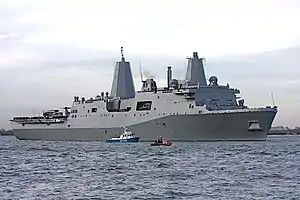
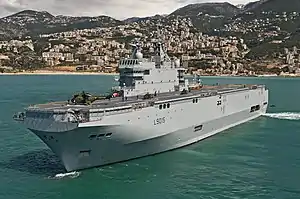
Multi-Role Support Vessel (MRSV) concept was first sought out by the Indian Navy in 2011, during a procurement program, to find a vessel that could fill multiple roles, including amphibious warfare operations, force projection, various aviation operations, area defence including security for islands that are sovereign territory and humanitarian and disaster relief operations. An acquisition tender worth billions of dollars was offered and there was initially eight respondents from the U.S. and Europe.[8]
The Indian Navy issued a ₹16,000 crore (160 Billion INR - US$2.6 billion) domestic tender to three domestic shipyards - Larsen & Toubro (L&T) which has tied up with Navantia of Spain, Pipavav Defence and Offshore Engineering which has partnered with France's DCNS, and ABG Shipyard (Later disqualified due to poor financial health)[9] which has partnered with United States' Alion. After the winning design is selected, the private shipyard will construct two LPDs and the remaining two will be constructed by state-owned Hindustan Shipyard Ltd (HSL). Later it was decided to give the entire LPD contract to private players upon acceptance of their revised bids.[10][4][5] After years of delay, on 21 May 2017 Ministry Defense gave "In-principle approval" for the project.[9]
The number was later reduced to two ships from four required earlier due to budget constraints being faced by Indian Navy at that time.[6]
Cancellation
In November 2019 Business Insider reported that the Navy is approaching Ministry of Defence to scrap this tender and issue a fresh one in the near future. The main reasons behind this was reported to be years of delays and technological advancements made in amphibious assault ships in the years since the tender was issued in 2006.[11]
In October 2020 Indian navy scrapped the multibillion-dollar tender over the new qualitative requirements. After 7 years of launching acquisition procedure the navy withdrew from request for proposals as the project was initiated back in year 2006 and a lot of technological improvements have been occurred and the navy requires new specifications in the landing platform docks.[12]
Revival
In late August 2021, a new RFI was declared for the construction of 4 new LPDs/Landing Platform Dock from Indian shipyards, the specifications of which indicates those 4 ships would rather perform like bigger and more advanced LHDs/Landing Helicopter Dock.[1][7]
The RFI specifies the requirement of LPD classification ships to be of a range of 200 meters in length with a loaded draft of 8 meters with a speech of 14–16 kn (26–30 km/h; 16–18 mph) in general. The ships would have a range of 10,000 nautical miles (19,000 kilometres) and will be driven by integrated fully electric or hybrid method of propulsion. The RFI mentions a "through deck" for helicopters which makes it more akin to an LHD than LPD. The ship would carry two heavy lift (of 40 tonnes range) and 12 multirole helicopters along with two ship-borne UAV systems. The deck will store both heavy helicopters in folded-blade configuration and support the simultaneous operations of 4 helicopters as well. The rest of the aircraft will be stored in hangars below the deck and will be lifted to and from the deck with two lifts; each capable of supporting 24 tonnes at once.[14]
Ships will be equipped with various 3D C, D, E, F and I band radars for ground and air surveillance along with EOTS and IRST. For armament, ships will be armed with 32 VL-SRSAM missiles, 16 anti-ship missiles and 4 AK-630 CIWS guns with electro-optical fire control system, 8 MMGs and 6 MMGs with stabilised remote controlled stations. AK-630 might be replaced by naval directed energy weapons once developed and deployed by India. Each ship of these specifications is expected to reach a displacement of 30,000 to 40,000 tonnes.[14]
From the date of awarding the contract, anticipated delivery time lines for the first vessel is maximum of 60 months followed by delivery of one vessel every 12 months from then on.
Potential contenders
The RFP will be issued to shipyards and design whose proposals would meet required criteria. Although only Indian shipyards are able to participate in tendering, they can pick derivative of a foreign design.
Potential builders
The following major Indian shipyards with large shipbuilding capabilities are expected to participate in bidding of tenders;
- Cochin Shipyards Limited (CSL)
Largest shipbuilder in India which built 45,000 tonnes INS Vikrant, first indigenous aircraft carrier built by India.
L&T has a major shipyard in Hazira and a new one; Kattupalli Shipyard is being built near Chennai specialised for large-sized warships, car carriers and offshore patrol vessels. Existing shipyard in Hazira build mid-sized ships of 20,000 deadweight capacity with a maximum length of 160 meters.
They are currently building the Project 17A-class frigates for the Indian Navy and have previously built INS Aditya, a 24,500 tons and 172 meters long replenishment vessel.
MDL has been building offshore vessels, frigates, destroyers and submarines for Indian Navy for a decades. Although, its existing facilities don't support construction of such a large ship, it has been planning a major capacity expansion (CAPEX) to build large-sized ships.
Potential designs
Following designs are likely to compete in Indian LPD tender:
 Russia: Export variant of Project 23900 amphibious assault ship (Ivan-Rogov class).
 France: Mistral-class amphibious assault ship can carry 16 heavy helicopters and has been a part of MRSV bidding previously. Indian Navy had also watched Mistral in Varuna 21 naval exercise with France.
 Spain: Navantia published a video in 2019 proposing design of Juan Carlos I class LHDs for Indian MRSV programme.
See also
References
- "REQUEST FOR INFORMATION FOR PROCUREMENT OF LANDING PLATFORM DOCKs (LPDs)" (PDF). Ministry of Defence. Government of India.
- "Multi-Role Support Ship (MRSS)". Global Security. Retrieved 16 February 2012.
- Defence News Admin (26 November 2011). "India To Buy Four Large Amphibious Ships, Air Tankers". Defence News. Archived from the original on 6 June 2013. Retrieved 16 February 2012.
- the 2013 tender, two LPDs were to be built by domestic private sector and remaining by a state-owned company. Now it has been decided to give the entire LPD contract to private players upon acceptance of their revised bids./article/20131212/DEFREG03/312120012/India-Construct-4-LPDs "India To Construct 4 LPDs" Check
|url=value (help). Defense News. 12 December 2013. Retrieved 13 December 2013. - "LPDs Lead India's Push To Boost Sealift, Amphibious Capabilities". Defense News. 14 January 2014. Archived from the original on 20 January 2014. Retrieved 14 January 2014.
- Dutta, Amrita Nayak (18 November 2020). "Hit by budget crunch, Indian Navy now plans to buy 2 Landing Platform Docks instead of 4". The Print. New Delhi. Retrieved 31 August 2021.
- Bhalla, Abhishek (26 August 2021). "Indian Navy's procurement of amphibious ships revived after hitting dead end last year". India Today. Retrieved 30 August 2021.
- P, Rajat. "Amphibious vessels to strengthen Navy". The Times of India. Retrieved 1 September 2021.
- PTI (21 May 2017). "Government gives green signal to build worth over Rs 20,000 crore". The Economic Times. Retrieved 16 June 2017.
- "Amphibious vessels to strengthen Navy". The Times of India. 10 September 2011. Archived from the original on 6 November 2012.
- "Navy mulls scrapping Rs 20k-cr tender for building four amphibious warships". Business Standard. Retrieved 10 November 2019.
- "Indian Navy scraps tender to procure 4 Landing Platform Docks at Rs 20k cr". Business Standard India. Press Trust of India. 12 October 2020. Retrieved 13 October 2020.
- "Indian Navy's new amphibious ships to be packed with UAVs, missiles, helicopters". The Week. 26 August 2021. Retrieved 3 September 2021.
External links
- The Indian Navy's New ‘Expeditionary’ Outlook, Admiral (Retd) Arun Prakash, 20 October 2012. Observer Research Foundation.