Indrapura (Champa)
Indrapura was the capital city of the ancient kingdom of Champa from 875 CE until 982,[1]: 122 for several decades,[2][3]: 72, 93 under the reign of Indravarman I (877-890) and some of his followers belonging to the 6th dynasty in Dong Duong.[3]: 53 The word Indrapura means "City of Indra" in Sanskrit, Indra being the Hindu God of Storm and War, and King of the Gods in the Rig Veda.

History
King Vikrantavarma of Champa installed his government in Virapura ( Phan Rang, Ninh Thuận province). Because of heirless, then he had to choose one of the son of the royal family from the northern tribe to suceed the throne. The new king (Indravarman II ) decided to move the capital to the north where is Indrapura.
Influence of Mahayana Buddhism
This era also remarked the rise of Mahayana Buddhism into Champa kingdom from religious life and society. Buddhism was technically the official religion of the country as well as royal court. The king of Champa ordered to build the large Buddhist monastery in Indrapura which was recorded as the largest monastery of Southeast Asia at that time From 875 to 982, Champa also maintained the relation with Khmer empire and Java that had some influences on the architecture of Cham
End and destruction
The rising of the two neighbors Đại Cồ Việt in the north and Khmer empire in the West were the threat to the national security. The war between Champa and Khmer empire in 945 and Đại Cồ Việt under Early Lê dynasty in 979 that led to the weakening of the country. In 982, Emperor of Đại Cồ Việt (Lê Hoàn) led the armies and destroy the city in Cham–Vietnamese War (982) and killed the Cham king Paramesvaravarman . After this event, this ended the role of Indrapura as the govenmental seat of the kingdom and the capital city was moved to the south (Vijaya), now in Bình Định province.
In 1471, in the Cham–Vietnamese War (1471), the city was annexed into Đại Việt by Vietnamese emperor Lê Thánh Tông . This war also ended the flourish and independence of the Champa and it was treated as the vassal state of Đại Việt (Vietnam) until the whole countries was annexed by Vietnamese emperor Minh Mạng in 1832.
Now
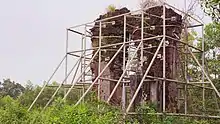
The site is near the present-day village of Đồng Dương, Bình Định Bắc commune, Thăng Bình District of Quảng Nam province. Unlike his predecessors, Indravarman II was a Mahayana Buddhist, so he built a great Buddhist monastery. The ruins was mostly destroyed by Vietnam War bombings and nowadays even by looting of bricks.[4]
The Museum of Cham Sculpture ("Bao Tang Cham") at Da Nang, founded in 1915 by the École française d'Extrême-Orient (EFEO), has a valuable collection of Cham sculptures, which were retrieved from Đông Dương as well as from other archeological sites, such as Mỹ Sơn and Tra Kieu.
Notes
- Coedès, George (1968). Walter F. Vella (ed.). The Indianized States of south-east Asia. trans.Susan Brown Cowing. University of Hawaii Press. ISBN 978-0-8248-0368-1.
- O'Reilly, 2006 p.139
- Maspero, G., 2002, The Champa Kingdom, Bangkok: White Lotus Co., Ltd., ISBN 9747534991
- The Southeast Asian Archaeology Newsblog
References
- O'Reilly, Dougald J.W. (2006). Early Civilizations of south-east Asia. Altamira Press. ISBN 978-0-7591-0279-8.
- Ngô Văn Doanh (2006). Chămpa ancient towers: reality & legend. Hanoi: The Gioi Publishers.
- Finot, Louis (1904). "Notes d'épigraphie : VI. Inscriptions du Quang Nam" (PDF). BEFEO (in French). 4 (4): 83–115. doi:10.3406/befeo.1904.1296. Retrieved 2009-08-22.
External links
- (in French) Historical photos of Champa archeological sites on EFEO website