Industry of Pakistan
Pakistan's industrial sector (in FY21) accounts for 18.11% of the GDP.[1] Of this, manufacturing makes up 12.52%, mining constitutes 2.18%, construction makes up 2.05%, and electricity & gas 1.36%. The majority of industry is made up of textile units, with textiles contributing $15.4b to exports, making up 56% of total exports. Other units include surgical instruments, chemicals, and a budding automotive industry.
Mining and Quarrying
Pakistan has immense reserves of various minerals and natural resources. Important minerals found in Pakistan are gypsum, limestone, chromites, iron ore, rock salt, silver, gold, precious stones, gems, marble, copper, coal, graphite, sulphur, fire clay, silica. The salt range in Punjab Province has one of the largest deposit of pure salt founded in the world. Balochistan province is a mineral-rich area having substantial mineral, oil and gas reserves which have not been exploited to their full capacity or fully explored, recent government policies have begun to develop this region of the country and to tap into the immense resources found there. The province has significant quantities of copper, chromite and iron, and pockets of antimony and zinc in the south and gold in the far west. Natural gas was discovered near Sui in 1952, and the province has been gradually developing its oil and gas projects over the past fifty years.[2]
Major reserves of copper and gold in Balochistan's Reko Diq area have been discovered in early 2006. The Reko Diq mining area has proven estimated reserves of 2 billion tons of copper and 20 million ounces of gold. According to the current market price, the value of the deposits has been estimated at about $65 billion, which would generate thousands of jobs.
The discovery has ranked Rekodiq among the world's top seven copper reserves. The Rekodiq project is estimated to produce 200,000 tons of copper and 400,000 ounces of gold per year, at an estimated value of $1.25 billion at current market prices. The copper and gold are currently traded at about $5,000 per ton and $600 per ounce respectively in the international market.[3] Khyber Pakhtunkhwa Province accounts for at least 78% of the marble production in Pakistan. Pakistan is home to some of the most finest and purest grades of marble, granite and slate found in the world. Much of the grades A Marble that is exported out of European countries like Italy actually have their origins in Pakistan which previously lacked fine polishing and processing machinery. The Government has taken steps to invest in this crucial sector with the recent establishment of a Marble City within Balochistan.[4]
The industry currently employs 0.15% of the workforce, constituting 2.18% of the GDP, around $6.5b. The sector registered a -6.49% recession in FY21.
Fuel extraction industry
Pakistan's first oil field was discovered in the late 1952 in Balochistan near a giant gas field at suo Sui in Balochistan. The Toot oilfield was discovered in the early 1960s Islamabad in the Punjab. Production has steadily increased since then.[5]
Pakistan's first gas field was the giant gas field at Sui in Balochistan which was discovered in the late 1952.[6] Pakistan is also a major producer of Bituminous coal, Sub-bituminous coal and Lignite. Coal mining started in the British colonial era and has continued to be used by Pakistani industries after independence in 1947.[7][8]
Pakistan produced about 45 tonnes of Uranium in 2006.[9]
Manufacturing
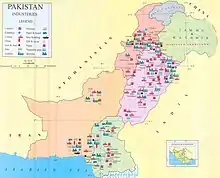
Pakistan's manufacturing sector is dominated by textiles, FBT (food, beverages, and tobacco), Coke & Petroleum, and Pharmaceuticals. The manufacturing sector is made up of three 'parts': Large Scale Manufacturing (LSM), Small Scale Manufacturing (SSM), and slaughtering. Large Scale Manufacturing at 9.73% of GDP dominates the overall manufacturing sector, accounting for 76.1% of the sectoral share followed by Small Scale Manufacturing, which accounts for 2.12% of total GDP and 16.6% sectoral share. The third component, slaughtering, accounts for 0.94% of GDP with 7.4% sectoral share. As a whole, the manufacturing sector is 12.79% of GDP, and employs 16.1% of the labor force.
The manufacturing sector was hard-hit by the COVID-19 outbreak and subsequent lockdown(s). Mobility restrictions resulted in labor problems, while the international supply chain disruption depressed natural resource imports. The LSM sector, most reliant on these two factors, contracted 10.12% as a result. The SSM managed to grow by 1.50%, not as badly reliant or affected by these factors, while the slaughtering sector grew as normal. In FY21, when restrictions were relaxed or removed, the sector rebounded with 9.29% growth. This was largely the result of the Temporary Economic Refinance Facility (TERF). As a result, Pakistan recorded $14.4B textile exports; the highest ever.
| Sector | FY19 | FY20 | FY21 |
|---|---|---|---|
| LSM | -2.60% | -10.12% | 9.29% |
| SSM | 8.24% | 1.50% | 8.31% |
| Slaughtering | 3.54% | 4.05% | 3.89% |
Textiles
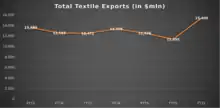
Textiles are the back of Pakistan's manufacturing base, contributing $15.4b to exports, making up 56% of total exports, and employing 40% of the labor force. Pakistan is the 8th largest exporter of textiles in Asia, and the 4th largest producer of cotton in the world. With increasing urbanization, and a growing middle-class, textiles have come under greater demand.
The majority of the industry is located in Sindh and Punjab, especially north Punjab with the cities of Sialkot and Faisalabad being notable centers.
Food Processing
The food and beverage processing industry is the 2nd largest industry of Pakistan after textiles, accounting for 27% of production and 16% of employment in the manufacturing sector. Pakistan exported $4.5B worth of food. Most of the food industry in Pakistan is concentrated in Punjab (60%) followed by Sindh (30%), KPK (6%),Baluchistan (2%) and ICT (2%). In total, there are approximately 2500+ food processing units in Pakistan.
Automotive Industry
Pakistan's automotive industry is the one of the fastest growing industries of the country, accounting for 4% of Pakistan's GDP and employing a workforce of over 1,800,000 people.[10] Currently there are over 3200 automotive manufacturing plants in the country, with an investment of ₨92 billion (US$570 million) producing 1.8 million motorcycles and 200,000 vehicles annually. Its contribution to the national exchequer is nearly ₨50 billion (US$310 million). The sector, as a whole, provides employment to 3.5 million people and plays a pivotal role in promoting the growth of the vendor industry. Pakistan's auto market is considered among the smallest, but fastest growing in South Asia. Over 180,000 cars were sold in the fiscal year 2014–15, rising to 206,777 units fiscal year 2015–16. this is an old data, please verify before publish
Technology
Pakistan has huge potential for the technology industry, which includes software development and electronics manufacturing. Pakistan Aeronautical Complex recently started the manufacturing of Tablet PCs, Ebook readers, and notebooks in collaboration with INNAVTEK of China. Software development also has a huge potential, which is being utilized as a result of numerous projects initiated by the Government of Pakistan.
Construction

After the devastating 2005 Kashmir earthquake Pakistan has instituted stricter building codes. The cost of construction in Pakistan will increase 30 to 50% due to implementation of a new building code which requires strengthening of structures to withstand earthquake of 8 to 8.5 magnitude. The demand for cement has increased due to reconstruction after the earthquake. The price of cement has increased by 50% and Pakistan government banned export of cement to lower the prices and the reconstruction costs.
Dubai Ports World, announced on June 1, 2006 that it will spend $10 billion to develop transport infrastructure and real estate in Pakistan.[11] Dubai Ports World is also discussing the possibility of the company taking over operational management of Gwadar port in Balochistan.[12]
Emaar Properties, announced on May 31, 2006 three real estate developments in the cities of Islamabad and Karachi in Pakistan. The projects, with a total investment of $2.4 billion, will include a series of master planned communities that will set new benchmarks in commercial, residential and retail property within Pakistan.[13]
In addition the conglomerate signed an unprecedented $43 billion deal to develop two island resorts - Bundal Island and Buddo Island - over the next decade.[14]
The Federal Bureau of Statistics provisionally valued this sector at Rs.178,819 million in 2005 thus registering over 88% growth since 2000.[15]
Electricity, gas and water supply
Pakistan has extensive energy resources, including fairly sizable natural gas reserves, some proven oil reserves, coal (Pakistan has the largest coal reserves in the world[16]), and a large hydropower potential. However, the exploitation of energy resources has been slow due to a shortage of capital and domestic political constraints. Domestic petroleum production totals only about half the country's oil needs, and the need to import oil has contributed to Pakistan's trade deficits and past shortages of foreign exchange.
The current government has announced that privatization in the oil and gas sector is a priority, as is the substitution of indigenous gas for imported oil, especially in the production of power. Pakistan is a world leader in the use of compressed natural gas (CNG) for personal automobiles.
The short-term national energy demand has expanded significantly since 2001 due to massive rise in sales of durable goods like refrigerators, washing machines, split air conditioners, et al..[17] In 2004, Access Group International announced plans to invest $1 billion over the next 5 years in solar cell manufacture and wind farms. MOUs have been signed with Alternate Energy Development Board.[18] In early 2005, the government approved a 25-year Energy Security Plan to boost electric capacity eightfold.[19]
The Canadian conglomerate Cathy Oil and Gas signed a memorandum of understanding in late 2006 to invest $5 billion in oil and gas exploration, development, production and commercialisation in Pakistan.[20]
The World Bank estimates that it takes about 32 days only to get an electrical connection in Pakistan.[4]
The Federal Bureau of Statistics provisionally valued this sector at Rs.215,662 million in 2005 thus registering over 62% growth since 2000.[21]
See also
References
- https://www.sbp.org.pk/departments/stats/PakEconomy_HandBook/exl/Ch-1.xlsx
- "Himala South Asian, Pakistan Edition". Archived from the original on 21 October 2007. Retrieved 9 September 2008.
- http://www.pakpositive.com/common/clicks/out2.php?pakpositive=%3A%2F%2Fwww.dawn.com%2F2006%2F04%2F14%2Ftop8.htm
- "Documents & Reports - Temporary Redirects". World Bank.
- "Canadian Firm to Develop Pakistan Oilfield - PakPositive". www.pakpositive.com.
- "Pakistan.Gov.pk - The Official Web Gateway to the Government of Pakistan". Archived from the original on 28 May 2007. Retrieved 9 September 2008.
- "USTDA Grant To Support Integrated Coal Mining, Power Generation Project In Pakistan - U.S. Embassy Islamabad Pakistan". 2 November 2007. Archived from the original on 2 November 2007.
- "Page not found - Pakistan & Gulf Economist". Pakistan & Gulf Economist. Cite uses generic title (help)
- "World Uranium Mining 2016 - World Nuclear Association". www.world-nuclear.org.
- "Automotive Industry's Contribution to Pakistan [Infographic]". propakistani.pk.
- "Business Real Estate News | Technology | Travel Guide". www.ameinfo.com.
- "Daily Times". Daily Times.
- "Emaar Technologies". www.emaar.com.
- "Pakistan agrees $43bn development". 28 September 2006 – via news.bbc.co.uk.
- (PDF). 19 June 2007 https://web.archive.org/web/20070619224443/http://www.statpak.gov.pk/depts/fbs/statistics/national_accounts/table4.pdf. Archived from the original (PDF) on 19 June 2007. Missing or empty
|title=(help) - Coal, Granite, China Clay and other Resources of Thar Archived 2010-02-11 at the Wayback Machine, Geological Survey of Pakistan, URL accessed on April 2, 2006
- "Pakistan's post-9/11 economic boom". 21 September 2006 – via news.bbc.co.uk.
- "Archived copy". Archived from the original on 1 December 2008. Retrieved 9 September 2008.CS1 maint: archived copy as title (link)
- "Archived copy". Archived from the original on 12 October 2008. Retrieved 9 September 2008.CS1 maint: archived copy as title (link)
- "Canadian firm to invest $5bn in oil and gas exploration". 26 September 2006.
- (PDF). 19 June 2007 https://web.archive.org/web/20070619224443/http://www.statpak.gov.pk/depts/fbs/statistics/national_accounts/table4.pdf. Archived from the original (PDF) on 19 June 2007. Missing or empty
|title=(help)
| Companies |
| ||||||
|---|---|---|---|---|---|---|---|
| Currency, governance, regulation | |||||||
| History | |||||||
| Transportation | |||||||
| Sectors |
| ||||||
| People and labour |
| ||||||
| Domestic economies | |||||||
| Central business districts |
| ||||||
| See also |
| ||||||
 Category Category | |||||||

Industry of Asia | |
|---|---|
| Sovereign states |
|
| States with limited recognition |
|
| Dependencies and other territories |
|
| |
