Inostrancevia
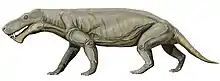
Inostrancevia[nb 1] is an extinct genus of carnivorous therapsids, containing the largest members of gorgonopsians, predators characterized by long, saber-tooth-like canines. The various species inhabited northern Russia during the Upper Tatarian (Vyatskian),[4] a Russian regional stage equivalent to the Wuchiapingian stage of the Late Permian period,[5] dating from approximately 259 to 252.3 million years ago. It is known from several skulls and two almost-complete skeletons.[6]
| Inostrancevia Temporal range: Wuchiapingian, [1] | |
|---|---|
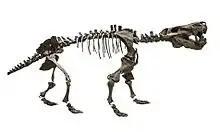 | |
| Mounted skeleton of Inostrancevia alexandri at the Museo delle Scienze, Trento, Italy | |
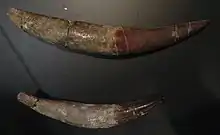 | |
| Inostrancevia tooth (top) compared to the tooth of the therapsid Leogorgon (bottom) | |
Scientific classification  | |
| Kingdom: | Animalia |
| Phylum: | Chordata |
| Clade: | Synapsida |
| Clade: | Therapsida |
| Clade: | †Gorgonopsia |
| Family: | †Gorgonopsidae |
| Subfamily: | †Inostranceviinae |
| Genus: | †Inostrancevia Amalitsky, 1922 |
| Type species | |
| †Inostrancevia alexandri Amalitsky, 1922 | |
| Species | |
| |
| Synonyms | |
| |
Description
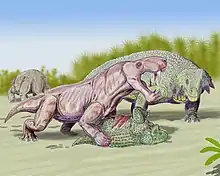
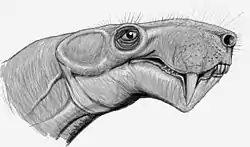
The two fossil skeletons attributed to the species I. alexandri indicate a size exceeding 3 m (9.8 ft) long, the skulls alone measuring 50 cm (20 in). However, another species, I. latifrons, known only from some vertebrae, an incomplete shoulder girdle and three skulls (one of which, well preserved and measuring 60 cm (24 in)),[7] indicates a size approaching 3.5 m (11.5 ft) long and a mass of 300 kg (661.3 lbs), making the genus Inostrancevia the largest known gorgonopsian, along with the South African genus Rubidgea, estimated to be 3.4 m (11.2 ft) long.
Like several other gorgonopsians, Inostrancevia was characterized by strongly developed canine teeth, with those of the upper jaw up to 15 cm (5.9 in) long, the root corresponding to half its length. The dentition of Inostrancevia can be compared to those of saber-toothed cats, such as Smilodon or other mammals with this similar morphology. Their bodies were slender, with rather short legs.[4] Inostrancevia shared its habitat with Scutosaurus which it likely preyed upon.[4]
Discovery
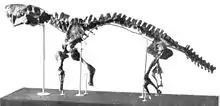
The first fossils were found in the Sokolki Assemblage Zone of the Kutuluk and Salarevo Formations in the Oblast of Arkhangelsk[4] as part of the Northern Dvina River excavations led by Amalitsky during the end of the 19th century. Two nearly complete skeletons were found alongside several other skeletal remains, one of which was mounted and exhibited in Saint Petersburg in 1900 with the other following a few years later. Proper descriptions of the findings were published posthumously in 1922.[6][2]
Classification
Below is a cladogram from the phylogenetic analysis of Gebauer (2007):[8]
| Gorgonopsia |
| |||||||||||||||||||||||||||||||||||||||||||||||||||||||||||||||||||||||||||
Explanatory notes
- Inostrancevia was named by the Russian paleontologist Vladimir P. Amalitsky[2] in honour of the Russian geologist Aleksandr Inostrantsev.[3]
References
- http://fossilworks.org/bridge.pl?a=taxonInfo&taxon_no=39127
- Amalitsky, V. P. (1922). "Diagnoses of the new forms of vertebrates and plants from the upper Permian of North Dvina". Bulletin of the Russian Academy of Sciences. Saint Petersburg. 16 (6): 329–340.
- "Inostrancevia". Paleofile. Retrieved 4 January 2014.
- Ivakhnenko, M. F. (2001). "Tetrapods from the East European Placket—Late Paleozoic Natural Territorial Complex". Proceedings of the Paleontological Institute of the Russian Academy of Sciences (in Russian). 283: 1–200 [103].
- Kukhtinov, D. A.; Lozovsky, V. R.; Afonin, S. A.; Voronkova, E. A. (2008). "Non-marine ostracods of the Permian-Triassic transition from sections of the East European platform". Boll.Soc.Geol.It. (Ital.J.Geosci.). 127 (3).
- Pravoslavlev, P. A. (1927). "Gorgonopsidae from the North Dvinsky excavations of V. P. Amalitsky" (PDF). Academy of Sciences of the Union of Soviet Socialist Republics. Leningrad: 170.
- https://age-of-mammals.ucoz.ru/index/inostrancevii/0-1010
- Gebauer, E.V.I. (2007). Phylogeny and evolution of the Gorgonopsia with a special reference to the skull and skeleton of GPIT/RE/7113 ('Aelurognathus?' parringtoni) (PDF) (PhD thesis). Tübingen: Eberhard-Karls Universität Tübingen. pp. 1–316.
External links
 |
Wikimedia Commons has media related to Inostrancevia. |
- Taxonomical Information
- Raúl Martín. "Inostrancevia" (pencil drawing).
- Anatomical Information
| ||||||||||||||||||||
| ||||||||||||||||||||
| ||||||||||||||||||||