Introduction and Allegro (Ravel)
Introduction and Allegro for Harp, Flute, Clarinet and String Quartet (French: Introduction et allegro pour harpe, flûte, clarinette et quatuor) was written by Maurice Ravel in 1905. It premiered on 22 February 1907 in Paris.
Background
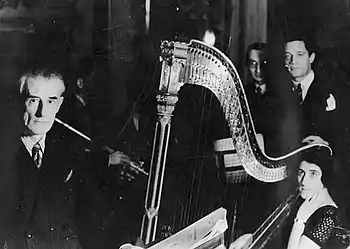
To showcase its new chromatic harp, the Pleyel company commissioned Claude Debussy in 1904 to write his Danse sacrée et danse profane for harp and orchestra. The Érard company responded by commissioning Maurice Ravel to write a piece to display the expressive range of its double-action pedal harp.[1] Ravel completed his Introduction and Allegro for a septet of harp, flute, clarinet and string quartet in June 1905, dedicating it to Albert Blondel, director of Maison Érard.[2] He wrote it at breakneck speed, as he had to complete it before embarking on a boating holiday with friends.[3]
Ravel omitted the Introduction and Allegro from the catalogue of his works,[4] made no mention of it in his autobiography,[1] and referred to it in only two of his letters.[2] Nevertheless, it was often performed at his concerts and it was the very first of the small number of his own works that Ravel recorded (1923; Gwendolen Mason, harp; Robert Murchie, flute; Haydn P. Draper, clarinet.[5])
In 1906 Ravel wrote a version for two pianos.[6] In a letter to Désiré-Émile Inghelbrecht on 26 February 1911, Ravel sanctioned the work being arranged for larger forces.[2]
Description
It is written in the key of G-flat major and it is the first piece to explore and exploit the full resources of the solo instrument.[1] It is sometimes described as a miniature concerto,[3] but it is more usually classified as a genuine chamber music work.[7]
The Introduction and the Allegro are played without a break. The Introduction, Très lent, takes only 26 bars. The Allegro in a modified sonata form begins with the solo harp expanding the material presented before. The woodwinds expose a second theme, accompanied by pizzicato. After a fortississimo climax in the development, a harp cadenza leads to a "straightforward" recapitulation and a close "without extensive fireworks or bombast of any kind".[4] The work takes about 11 minutes to perform.
Premieres and notable performances
The premiere took place on 22 February 1907 at the Circle Music Hall of the French Photographic Society in Paris, featuring Micheline Kahn (harp), Philippe Gaubert (flute), M. Pichard (clarinet), and the Quartet Firmin Touche, all under the direction of Charles Domergue.
In October 1928 in London at the Aeolian Hall and several days later at the town hall in Oxford, Ravel included this work in chamber music concerts at which he conducted.
In Belgium following a benefits concert for war veterans, his recordings of chamber works including the Introduction and Allegro were played to the attendees of the Society of Phonic Arts and Sciences.
It was premiered in the United States in New York at the Gallo Theater on 15th January 1928 by a group including the harpist Carlos Salzedo. Salzedo's then-wife Lucile Lawrence, also a harpist, was personally instructed by Ravel in the performance of the work.
The work was also performed in the Philharmonic Hall in the Lincoln Center, New York and later broadcast on television, on the 23 December 1963 edition of Leonard Bernstein's Young People's Concerts.[8] with 13 year old harpist Heidi Lehwalder, together with Weldon Bury playing clarinet and Amos Eisenberg playing flute.
Recordings
Later recordings include:
- Denise Herbecht with an ensemble led by Piero Coppola (1931)
- Lily Laskine, with flautist Marcel Moyse and the Quatuor Calvet (1938)
- Ann Mason Stockton and the Hollywood String Quartet
- Heidi Lehwalder, Richard Stoltzman, James Galway, and the Tokyo String Quartet
- Melos Ensemble with harpist Osian Ellis (two recordings, 1961[9] and 1967[10][11][12])
- The Melos Ensemble was founded to play chamber music like this for both woodwinds and strings, along with Beethoven's Septet and Octet, Schubert's Octet and Mendelssohn's Octet.[13] Osian Ellis was the harpist, playing with Richard Adeney (flute), Gervase de Peyer (clarinet), Emanuel Hurwitz and Ivor McMahon (violin), Cecil Aronowitz (viola) and Terence Weil (cello).[14]
- Marisa Robles, with Christopher Hyde-Smith, flute; Thea King, clarinet; Jürgen Hess and Galina Solodchin, violin; John Underwood, viola; Joy Hall, cello) (1970)[15]
- Edward Druzinsky and the full string section of the Chicago Symphony Orchestra led by Jean Martinon
- Nicanor Zabaleta.[1]
References
- Gutmann, Peter (2003). "Maurice Ravel - Introduction & Allegro for Harp, Strings, Flute & Clarinet". Classical Notes. Retrieved 2016-05-07.
- "Maurice Ravel's Introduction et allegro: The Relationship of Three Extant Manuscripts to the Printed Edition". Tinny Words Blog. 2007. Archived from the original on 2012-03-20. Retrieved 2016-05-07.
- Maurice-ravel.net. Archived 31 March 2017 at the Wayback Machine from the original.
- Introduction et Allegro, for flute, harp, clarinet, and string quartet Classical Archives 2008
- R.E.B (2000). "Review: Ravel Conducts Ravel". Classical Review. Archived from the original on 2016-03-04. Retrieved 2016-05-07.
- Ravel - Introduction et allegro (2-piano) Media Fire
- Introduction and Allegro (1907) Archived 2011-09-27 at the Wayback Machine London Sinfonietta
- ""New York Philharmonic Young People's Concerts" Young Performers - No. 5 (TV Episode 1963) - IMDb".
- The Early Recordings for Decca / 1950s-1962 Gervase de Peyer Archived 2011-06-28 at the Wayback Machine
- The EMI (HMV) Recordings / 1963-1973 Gervase de Peyer Archived 2011-06-28 at the Wayback Machine
- Maurice Ravel (1875-1937) William Hedley, musicweb-international.com 2009
- French Chamber Music. Members of the Melos Ensemble Gramophone 1983
- Melos Ensemble of London Joseph Stevenson, allmusic.com
- Melos Ensemble – Music among Friends EMI Archived July 10, 2011, at the Wayback Machine
- BAX. Elegiac Trio Archived 2011-07-23 at the Wayback Machine Gramophone 1970
16. Heidi Lehwalder https://www.youtube.com/watch?v=SY149Ck3wUM&t=32s
External links
- Introduction et Allegro: Scores at the International Music Score Library Project
| Stage |
|
|---|---|
| Orchestral | |
| Concertante | |
| Chamber | |
| Solo piano | |
| Vocal | |
| Related | |
| |


Authority control  | |
|---|---|
| General | |
| National libraries | |
| Other | |