Iraqi Special Operations Forces
Iraqi Special Operations Forces (ISOF) (Arabic: قوات العمليات الخاصة العراقية) are Iraqi special forces units created by coalition forces after the 2003 invasion. The forces, directed by the Iraqi Counter Terrorism Service, consist of the Iraqi Counter Terrorism Command, which has three brigades subordinate to it. The Counter Terrorism Service (Jihaz Mukafahat al-Irhab, originally translated as Counter Terrorism Bureau)[2] is funded by the Iraq Ministry of Defence.
| Iraqi Special Operations Forces | |
|---|---|
| قوات العمليات الخاصة العراقية | |
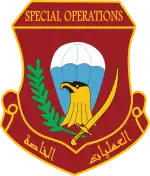 ISOF SSI | |
| Founded | April 2003 |
| Country |  Iraq Iraq |
| Branch | Iraqi Armed Forces |
| Type | Special Forces |
| Role | Air assault Airborne forces Close-quarters combat Counterinsurgency Counter-terrorism Direct action Desert warfare Forward air control Forward observer Hostage rescue Mountain warfare Special operations Special reconnaissance Unconventional warfare Urban warfare |
| Size | Classified |
| Part of |  Iraqi Counter Terrorism Service (reports directly to Prime Minister of Iraq) Iraqi Counter Terrorism Service (reports directly to Prime Minister of Iraq) |
| Nickname(s) | "The Golden Division" |
| Motto(s) | "Raise The Black" |
| Colors | Black |
| Engagements | Iraq War War against terrorism (2013–2017) Syrian Civil War |
| Website | https://www.isof-iq.com/ |
| Commanders | |
| Current commander | Abdel-Wahab al-Saadi[1] |
| Insignia | |
| ICTB Flag | |
| ISOF flag |  |
History
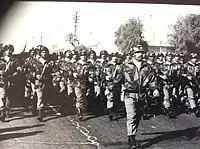
Special operations troops of the Iraqi Army were first established when Colonel Khaleel Jassim Al-Dabbagh built the first royal special units in the name of "Queen Alia Forces" in the mid-1950s. It consisted of Sunni and Shia Arabs, as well as other components of the Iraqi population. They were mainly used on an emergency basis to carry out special missions inside of Iraq and outside when the country was at war.
After the 2003 Invasion of Iraq, the Saddam Hussein-era Iraqi Army was disbanded by the occupation authorities. Because of that, the current Iraqi commando force was recruited from scratch, mostly from Shia, Sunni Arabs, Kurds, Assyrians and Turkmen.[3] In November 2005, after training in Jordan with Jordanian Special Forces and U.S. Army Special Forces ("Green Berets"), the Iraqi Special Operations Force had 1,440 men trained, composed of two combat battalions, considered equal in training and combat effectiveness to an average U.S. Army infantry battalion, and two support battalions.[4] By March 2008, the force consisted of a single brigade which in turn was made up of an Iraqi Counter-Terrorism Force (ICTF) battalion, three Commando battalions, a support battalion and a special reconnaissance unit.[5]
On April 18, 2010, ISOF troops, supported by U.S. troops, carried out a night-time raid on a terrorist safe house near Tikrit. The ISOF surrounded the building and called on them to surrender, but instead the terrorists fired on them. The ISOF returned fire and assaulted the building. The ISOF killed Abu Ayyub al-Masri and Abu Omar al-Baghdadi, the leaders of the Islamic State of Iraq, 16 others were also arrested.[6][7][8]
2016 Battle of Mosul
_training_April_2011.jpg.webp)
In the Battle of Mosul that began in October 2016, the special ops forces were the first division into the city of Mosul, which had been occupied by Islamic State of Iraq and the Levant since 2014.[9] After the fall of Mosul, the ISOF battalions increasingly took up an infantry role the Iraqi army and militias weren't able to provide during operations, a role the unit was unfamiliar with for most of the war against terror. This resulted in a greater number of casualties than in previous operations, which were smaller in scale and shorter in duration.
On 1 November 2016, the 1st Iraqi Special Forces Brigade fought its way into the Gogjali quarter of the city, becoming the first Iraqi unit to enter the city during the offensive, Also, they participated in Syrian civil war and supported Assad regime.[10] On 10 July 2017, the Iraqi prime minister declared the liberation of Mosul from ISIS.[11] By the end of the battle, CTS forces suffered a 40 percent casualty rate.[12]
Command structure
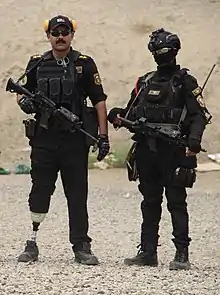
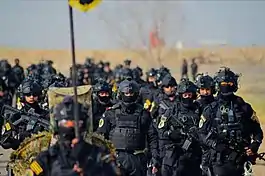
1st Special Operations Brigade (ISOF-1) - based in Baghdad often referred to as the Golden Division, and previously the Golden Brigade.[13]
- 1st Battalion (Commando) - former 36th Battalion
- 2nd Battalion (ICTF)
- 3rd Battalion (Support)
- 5th Battalion (Recon)
2nd Special Operations Brigade (ISOF-2) with units in Basra, Mosul, Diyala and Al Asad
- 6th Regional Commando Battalion
- 7th Regional Commando Battalion
- 8th Regional Commando Battalion
- 9th Regional Commando Battalion
3rd Special Operations Brigade was established in Basra by spring 2013, following an order by the prime minister in January 2012 that the forces expand by an additional brigade. It consisted of regional commando battalions in Basra, Diwaniya, Najaf, Maysan, Dhi Qar and Muthana provinces, a recon battalion, and a support battalion.[14] A Special Tactics unit is also maintained.[15]
Academia (formerly 4th battalion, 1st ISOF brigade). It is responsible for screening and training of new recruits for Counter-Terrorism Command (CTC).[16]
Weapons
_March_2020.jpg.webp)
Assault rifles and battle rifles
Sub-machine guns
Sniper rifles and anti material rifles
- HSR Cyclone sniper rifle[22]
- Steyr HS .50/AM50 anti-material rifle[23]
- M24 SWS
- ORSIS T-5000 sniper rifle[24]
- Barrett M82A1/M107 SASR
- K14 sniper rifle[25]
- Mk 14 Enhanced Battle Rifle
Handguns
- Beretta 92FS pistol
- Tariq pistol
- S&W M&P9 pistol[26]
- Glock 17 & Glock 19
- HS2000 pistol
Machine guns
- PKM
- M249 light Machine gun
- M240 GPMG
- DShKM heavy machine gun
- Browning M2HB
Launchers and grenade launchers
References
- Zhelwan Z. Wali. "PM Kadhimi returns prominent lieutenant to counter-terrorism forces". Rudaw. Retrieved 10 May 2020.
- Witty, David (2015). The Iraqi Counter Terrorism Service (PDF). Washington, D.C.: The Brookings Institution. p. 10. Retrieved 5 June 2016.
- "The reporter conducting the interview with Barwari noted that the 1st ISOF Brigade was composed of Sunnis, Shi’as, Kurds, Christians, and Turkmen"
- "Special Operations: Iraqi Special Operations Forces". StrategyPage. StrategyWorld.com. 17 November 2005. Retrieved 5 June 2016.
- Measuring Stability and Security in Iraq - March 2008 Report to Congress.
- Neville, Leigh, Special Forces in the War on Terror (General Military), Osprey Publishing, 2015 ISBN 978-1-4728-0790-8, p.226.
- "2 Most Wanted Al Qaeda Leaders in Iraq Killed by U.S., Iraqi Forces" FoxNews, 19 April 2010.
- Waleed Ibrahim. "Al Qaeda's top two leaders in Iraq have been killed, officials said Monday, in a strike the United States called a "potentially devastating blow" but whose impact analysts said may be limited". Thomson Reuters.
- Ramsay, Stuart (20 October 2016). "Elite troops strengthen battle for Mosul". Sky News. Retrieved 20 October 2016.
- "Iraqi Army enters Mosul: Live updates day 16".
- Reuters Editorial. "Iraqi PM declares victory over Islamic State in Mosul". Reuters. Retrieved 1 January 2018.
- https://comptroller.defense.gov/Portals/45/Documents/defbudget/fy2018/fy2018_CTEF_J-Book_Final_Embargoed.pdf
- Witty, David (2015). The Iraqi Counter Terrorism Service (PDF). Washington, D.C.: The Brookings Institution. p. 12. Retrieved 5 June 2016.
- Witty, David (2015). The Iraqi Counter Terrorism Service (PDF). Washington, D.C.: The Brookings Institution. p. 25. Retrieved 5 June 2016.
- "DVIDS - Images - Iraqi Special Operations Special Tactics Unit [Image 3 of 6]". dvidshub.net. Retrieved 1 January 2018.
- https://www.globalsecurity.org/military/world/iraq/counter-terrorism.htm
- "Remington R4s Reach Iraq". Silah Report. 18 April 2020. Retrieved 27 May 2021.
- "ISOF Arms & Equipment Part 1 – Personal Equipment – Armament Research Services". Retrieved 27 May 2021.
- "ISOF Arms & Equipment Part 1 – Personal Equipment – Armament Research Services". Retrieved 31 May 2021.
- "VHS K2 Bullpup in Iraq". www.thefirearmblog.com.
- "Korean K2C in Iraq, on both sides". www.thefirearmblog.com.
- "Iraq Loses Two Valued Snipers in the fight against IS". www.thefirearmblog.com.
- "Iraqi CT Sniper in Comfy Action". www.thefirearmblog.com.
- "Iranian AM50 and Russian ORSIS T-5000 rifles in Iraq". www.thefirearmblog.com.
- "Iraqi Special Operations Forces (ISOF) member armed with K14 sniper rifle and K2C Carbine". www.pinterest.com.
- "Iraqi Military using S&W M&P9 Pistol". www.thefirearmblog.com.
External links
 |
Wikimedia Commons has media related to Iraqi Special Operations Forces. |
| Military | |
|---|---|
| Law enforcement | |
| Intelligence | |
| Media | |