Islam in West Bengal
According to the (2021) estimation, the West Bengal state has over 31,144,763 Muslims, who form 30% of the state's population. The vast majority of Muslims in West Bengal are Bengali Muslims numbering around 2.6 crore and comprising 25% of the state population, but a notable section of non-Bengali Muslims also exist, particularly among Biharis, Hindustanis, Dawoodi Bohra and various Native communities such as Raj bongshi particular numbering around 6.2 Millions comprising rest 5% of the state population. [1][2][4][6] Muslims form the majority of the population in three districts: Murshidabad, Malda and Uttar Dinajpur.[7]
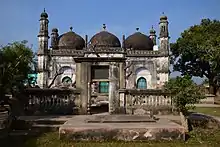 West Bengal's oldest Mosque located at Murshidabad district | |
| Total population | |
|---|---|
| 24,654,825 (2011 census) (27% of the state population)  [1][2][4][5] [1][2][4][5] | |
| Regions with significant populations | |
| Majority in Murshidabad with 66.3%, Maldah with 51.3%, Uttar dinajpur with 50%. Significant minority in Birbhum with 37.1%, South 24 Parganas with 35.6%, Howrah with 26.20%. | |
| Languages | |
| Bengali and Urdu |
Demography
| Year | Percentage (%) | Muslim Population  |
Total population |
|---|---|---|---|
| 1901 | 29.44 | 3,954,776 | 16,940,088 |
| 1911 | 26.31 | 2,955,098 | 17,998,769 |
| 1921 | 26.07 | 4,101,516 | 17,474,348 |
| 1931 | 26.65 | 4,521,313 | 18,897,036 |
| 1941 | 26.18 | 5,506,442 | 23,229,552 |
| 1951 | 19.85 | 5,102,330 | 26,299,980 |
| 1961 | 19.79 | 6,915,348 | 34,926,279 |
| 1971 | 20.46 | 9,083,963 | 44,312,011 |
| 1981 | 21.51 | 11,743,209 | 54,580,647 |
| 1991 | 23.61 | 16,050,000 | 68,077,965 |
| 2001 | 25.25 | 20,240,543 | 80,176,197 |
| 2011 | 26.99 | 24,654,825 | 91,347,736 |
History

Islam first came into Bengal in the year of 1204.[10] The entire Bengal region was under Mughal empire rule from 1576–1765 and was commonly known as Bengal Subah.[11] The Mughal Empire eventually controlled the region under its Bengal Subah viceregal province. The Mughal Emperors considered Bengal their most prized province. Emperor Akbar redeveloped the Bengali calendar.[12] The establishment of a single united Bengal Sultanate in 1352 by Shamsuddin Ilyas Shah finally gave rise to a "Bengali" socio-linguistic identity.[13] The Ilyas Shahi dynasty acknowledged Muslim scholarship, and this transcended ethnic background. Usman Serajuddin, also known as Akhi Siraj Bengali, was a native of Gaur in western Bengal and became the Sultanate's court scholar during Ilyas Shah's reign.[14][15][16] Alongside Persian and Arabic, the sovereign Sunni Muslim nation-state also enabled the language of the Bengali people to gain patronage and support, contrary to previous states which exclusively favoured Sanskrit, Pali and Persian.[17][18] The born-Hindu Sultan Jalaluddin Muhammad Shah funded the construction of Islamic institutions as far as Mecca and Madina in the Middle East. The people of Arabia came to know these institutions as al-Madaris al-Bangaliyyah (Bengali madrasas). The Pathan occupation of Bengal was limited to the region of Gauda, the rest of which was held in sway by different Bengali Hindu rulers. Islam religion gradually spread throughout the Bengal region, and many Bengali Hindus converted to Islam.[19] From 1200-1500 AD Sufism attained its 'Golden Age' in Bengal, being influenced by the diverse Sufi orders of Qadiriya, Chistia, Naqshbandi, Mujaddid, Suhrawardiyya etc. Sufis are held responsible for most of the conversion of native Bengalis into Islam through out the Bengal region.[20]
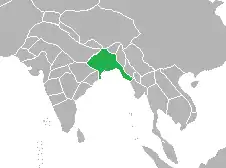
The list of the native Bengali Islamic empire of Bengal region are -:
Sultanates: Islamic rulers under the banners of Khilji Dynasty (1200 CE - 1230 CE), the Mamluk Sultanate (1227 CE - 1281 CE), the Tughlaq Sultanate (1324 CE - 1339 CE), the kingdom of Bengal Sultanate (1334 - 1578), the Suri Empire (1532 - 1555) Ruled Bengal.
Mughal Subahdars: Districts or Subahs were distributed among the allies and commandants of the Mughal Empire. Mughal emperors such as Akbar, Jahangir and Aurangzeb placed high regard for the Bengal province and were also aware of the riches this region had to offer.[21]
Population
| Year | Pop. | ±% |
|---|---|---|
| 1901 | 3,954,776 | — |
| 1911 | 2,955,098 | −25.3% |
| 1921 | 4,101,516 | +38.8% |
| 1931 | 4,521,313 | +10.2% |
| 1941 | 5,506,442 | +21.8% |
| 1951 | 5,102,330 | −7.3% |
| 1961 | 6,915,348 | +35.5% |
| 1971 | 9,083,963 | +31.4% |
| 1981 | 11,743,209 | +29.3% |
| 1991 | 16,050,000 | +36.7% |
| 2001 | 20,240,543 | +26.1% |
| 2011 | 24,654,825 | +21.8% |
| Source: [9] | ||
Partition and immigration
The Muslim population in West Bengal before 1947 partition was around 30%.[22] After partition of Bengal in 1947, some Muslims from West Bengal left for East Pakistan, (Present-Day-Bangladesh). Estimates show that 1,534,718 Muslim refugees from West Bengal settling permanently in East Pakistan during 1947–1951.[23]
Population by district (2011)
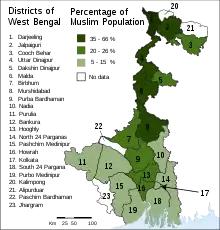
| # | District | Total population | Muslim population | % |
|---|---|---|---|---|
| 1 | Murshidabad | 7,103,807 | 4,707,573 | 66.88% |
| 2 | South 24 Parganas | 8,161,961 | 2,903,075 | 35.57% |
| 3 | North 24 Parganas | 10,009,781 | 2,584,684 | 25.82% |
| 4 | Malda | 3,988,845 | 2,045,151 | 51.27% |
| 5 | Bardhaman | 7,717,563 | 1,599,764 | 20.73% |
| 6 | Uttar Dinajpur | 3,007,134 | 1,501,170 | 49.92% |
| 7 | Nadia | 5,167,600 | 1,382,682 | 26.76% |
| 8 | Birbhum | 3,502,404 | 1,298,054 | 37.06% |
| 9 | Howrah | 4,850,029 | 1,270,641 | 26.20% |
| 10 | Kolkata | 4,496,694 | 926,414 | 20.60% |
| 11 | Hooghly | 5,519,145 | 870,204 | 15.77% |
| 12 | Purba Medinipur | 5,095,875 | 743,436 | 14.59% |
| 13 | Cooch Behar | 2,819,086 | 720,033 | 25.54% |
| 14 | Paschim Medinipur | 5,913,457 | 620,554 | 10.49% |
| 15 | Jalpaiguri | 3,872,846 | 445,817 | 11.51% |
| 16 | Dakshin Dinajpur | 1,676,276 | 412,788 | 24.63% |
| 17 | Bankura | 3,596,674 | 290,450 | 8.08% |
| 18 | Purulia | 2,930,115 | 227,249 | 7.76% |
| 19 | Darjeeling | 1,846,823 | 105,086 | 5.69% |
| ## | West Bengal (Total) | 91,276,115 | 24,654,825 | 27.01% |
Trends
| Census year | % of total population | Decadal growth | Increase |
|---|---|---|---|
| 1946 (Before partition) | 30.32%[22] | NA | NA |
| 1951 | 19.85% | 27.26% |
-10.47% |
| 1961 | 20% | 36.48% | +0.15% |
| 1971 | 20.46% | 29.76% | +0.46% |
| 1981 | 21.51% | 29.55% | +1.05% |
| 1991 | 23.61% | 36.89% | +2.1% |
| 2001 | 25.25% | 25.91% | +1.64% |
| 2011 | 27.01% | 21.80% | +1.76% |
| 2021 | 30%[2] | 26.30% | +2.99% |
| Census year | % of total population | Increase |
|---|---|---|
| 1901 | 29.44% | - |
| 1911 | 26.31% | -3.13% |
| 1921 | 26.07% | -0.24% |
| 1931 | 26.65% | +0.58% |
| 1941 | 26.18% | -0.47% |
Linguistic groups
.jpg.webp)
According to the 2021 census, there were around 31.14 million Muslims living in West Bengal. Nearly most of them (24% of state population), about 24.91 million are native Bengali Muslims, constituting around 80% of the total Muslim population in the state, and are mostly concentrated in rural and Semi Urban areas. The Urdu-speaking Muslims from Bihar and Uttar Pradesh constitute rest 6%, numbering around 6.22 million and are mainly concentrated in Kolkata,Asansol,Islampur Subdivision of West Bengal. [26][27][28]
Projections
West Bengal's Muslims percentage in the total population share have increased slightly, from 30.3% in 1946 (before partition) to again regaining the same share of percentage of 30% as per the last estimation conducted for 2021 census.[2][23] Based on the current growth rate, It has been estimated, that the percentage share of Muslim population in the state is approximately doubling in a span of 100 years starting from 19% in 1951 to 40% by 2061 as an prediction.[29]
Notable Muslims from West Bengal
Kolkata
- Begum Rokeya, Bengali Feminist thinker Writer,Philanthropists
- Altamas Kabir, former Chief Justice of India
- Mohammed Ali Qamar, boxer, medalist in Commonwealth Games
- Rupam Islam, musician
- Masudur Rahman Baidya, swimmer
- Mohammad Hamid Ansari, former Vice President of India
- Mohammed Salim (footballer)
- Mohammed Salim (politician)
- Firhad Hakim, Mayor of Kolkata, MIC Urban Development and Municipal Affairs
- Sultan Ahmed (politician), Indian politician and former Union Minister of State Tourism
- Nafisa Ali, actress, politician and social activist
- Sahil Khan, gymnast and model of India
Malda
- A B A Ghani Khan Choudhury, former Railways Minister (India)
- Mausam Noor former M.P of Maldaha Uttar
- Abu Hasem Khan Choudhury M.P of Maldaha Dakshin and Ex-State Health Minister
- Isha Khan Choudhury current M.L.A of Sujapur (Vidhan Sabha constituency)
- Abu Nasar Khan Choudhury Ex-M.L.A of Sujapur (Vidhan Sabha constituency) and Ex-Minister of Science and Technology
- Sabina Yeasmin current M.L.A of Mothabari and Minister of North Bengal Devlopment , Irrigation Department
- Rubi Noor former three times M.L.A of Sujapur (Vidhan Sabha constituency)
Murshidabad
- Murshid Quli Khan, the first nawab of Bengal
- Amina Begum, princess of the nawab family and mother of siraj ud-Daulah
- Siraj ud-Daulah, last independent nawab of Bengal
- Mir Afsar Ali, radio jockey, actor
- Abdul Alim, folk singer, songwriter
- Baby Islam, cinematographer and director
- Syed Mustafa Siraj, Bengali writer
- Mabinul Haq, Bengali writer
- Abul Bashar, Bengali writer
- Syed Badrudduja, freedom fighter, politician and former mayor of Kolkata
- Jahanara Imam, writer and political activist
- Zainal Abedin, politician and four time former MP of Jangipur
- Niamot Sheikh, M.L.A of Hariharpara, Hariharpara
Hooghly
- Muhammad Mohsin, (Bengali social reformer, Islamic scholar, Philanthropists, Daanvir)
- Abdul Mannan (West Bengal politician), politician
- Abbas Siddiqui (founder of Indian Secular Front)
- Nawsad Siddique, (West Bengal politician, and chairman of Indian Secular Front)
Bardhaman
- Kazi Nazrul Islam Bengali poet and music lyricist composer, writer known as Bidrohi Kobi. From Churuliya Asansol, West Bardhaman.
- Siddiqullah Chowdhury, politician, minister and president Of Jamiat Ulema-e-Hind
North 24 Parganas
- Titumir Bengali freedom fighter .
South 24 Parganas
- Abdur Razzak Molla, politician and former minister of land reforms
References
- https://www.indiaonlinepages.com/population/west-bengal-population.html
- "West Bengal assembly elections: Why getting Muslims votes could be tough for Mamata Banerjee". Times of India.
- https://www.indiacensus.net/states/west-bengal
- Census of India - Religious Composition
- "Census 2011 shows Islam is the fastest growing religion in India". Mint. 26 August 2015.
- Saibal Sen (26 August 2015). "Bengal beats India in Muslim growth rate".
- https://m.statisticstimes.com/demographics/india/west-bengal-population.php
- Nahid Kamal. "The Population Trajectories of Bangladesh and West Bengal During the Twentieth Century: A Comparative Study" (PDF).
- http://pu.edu.pk › historyPDF the diffusion of islam in bengal - Punjab University
- Lex Heerma van Voss; Els Hiemstra-Kuperus; Elise van Nederveen Meerkerk (2010). "The Long Globalization and Textile Producers in India". The Ashgate Companion to the History of Textile Workers, 1650–2000. Ashgate Publishing. p. 255. ISBN 9780754664284.
- Shoaib Daniyal. "Bengali New Year: how Akbar invented the modern Bengali calendar". Scroll.in. Retrieved 7 November 2016.
- Ahmed, ABM Shamsuddin (2012). "Iliyas Shah". In Islam, Sirajul; Miah, Sajahan; Khanam, Mahfuza; Ahmed, Sabbir (eds.). Banglapedia: the National Encyclopedia of Bangladesh (Online ed.). Dhaka, Bangladesh: Banglapedia Trust, Asiatic Society of Bangladesh. ISBN 984-32-0576-6. OCLC 52727562. Retrieved 10 December 2021.
- 'Abd al-Haqq al-Dehlawi. Akhbarul Akhyar.
- Abdul Karim (2012). "Shaikh Akhi Sirajuddin Usman (R)". In Islam, Sirajul; Miah, Sajahan; Khanam, Mahfuza; Ahmed, Sabbir (eds.). Banglapedia: the National Encyclopedia of Bangladesh (Online ed.). Dhaka, Bangladesh: Banglapedia Trust, Asiatic Society of Bangladesh. ISBN 984-32-0576-6. OCLC 52727562. Retrieved 10 December 2021.
- Hanif, N (2000). Biographical Encyclopaedia of Sufis: South Asia. Prabhat Kumar Sharma, for Sarup & Sons. p. 35.
- "What is more significant, a contemporary Chinese traveler reported that although Persian was understood by some in the court, the language in universal use there was Bengali. This points to the waning, although certainly not yet the disappearance, of the sort of foreign mentality that the Muslim ruling class in Bengal had exhibited since its arrival over two centuries earlier. It also points to the survival, and now the triumph, of local Bengali culture at the highest level of official society." (Eaton 1993:60)
- Rabbani, AKM Golam (7 November 2017). "Politics and Literary Activities in the Bengali Language during the Independent Sultanate of Bengal". Dhaka University Journal of Linguistics. 1 (1): 151–166. Archived from the original on 11 October 2017. Retrieved 7 November 2017 – via www.banglajol.info.
- "GlobalFront Homepage". www.globalfront.com. Archived from the original on 14 October 2007. Retrieved 13 May 2021.
- https://www.thedailystar.net/news/sufi-influence-in-bengal
- https://www.indiatoday.in/education-today/gk-current-affairs/story/history-of-bengal-324618-2016-05-20
- "Muslims of West Bengal" (PDF). core.ac.uk. Retrieved 16 March 2021.
- Chatterji, Joya (2007). The Spoils of Partition: Bengal and India, 1947–1967. Cambridge University Press. ISBN 978-1-139-46830-5.
- Population by religious community: West Bengal. 2011 Census of India.
- B.P. Syam Roy (28 September 2015). "Bengal's topsy-turvy population growth". The Statesman. Archived from the original on 10 September 2016.
- https://m.timesofindia.com/india/owaisis-entry-into-bengal-likely-to-unsettle-tmcs-sway-over-minorities/articleshow/79206288.cms
- https://www.freepressjournal.in/analysis/why-the-30-muslim-vote-share-is-crucial-in-bengal-explains-robin-roy
- https://m.timesofindia.com/india/west-bengal-elections-2021-mamata-banerjee-and-muslim-votes/articleshow/81700787.cms
- https://www.myind.net/Home/viewArticle/demographic-warning-west-bengal
|