Itbayat language
The Itbayat language, Itbayaten, also known generically as Ibatan, is an Austronesian language, in the Batanic group, spoken in the Batanes Islands.
| Itbayat | |
|---|---|
| Ibatan | |
| Itbayaten | |
| Native to | Philippines |
| Region | Itbayat Island |
| Ethnicity | Ivatan people Yami people |
Native speakers | (3,500 cited 1996 census)[1] |
Austronesian
| |
| Language codes | |
| ISO 639-3 | tao |
| Glottolog | itba1237 |
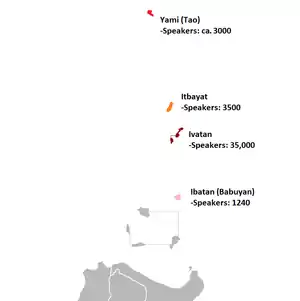 Itbayat and the other Batanic languages | |
Phonology
Vowels
/a, ɜ, i, o/
Vowels are contrasted between long and short vowels, for example as seen in the words tokod ('support') and tookod ('a kind of yam').[2]
Grammar
Pronouns
The following set of pronouns are the pronouns found in the Itbayat language.[2]
| Nominative free | Nominative bound | Genitive free | Genitive bound | Locative | |
|---|---|---|---|---|---|
| 1st person singular | yaken | ako | ñaken | ko | jaken |
| 2nd person singular | imo | ka | nimo | mo | dimo |
| 3rd person singular | – | – | niya / ña | na | dira |
| 1st person dual | – | ta | – | – | – |
| 1st person plural inclusive | yaten | ta | ñaten | ta | jaten |
| 1st person plural exclusive | yamen | kami | ñamen | namen | jamen |
| 2nd person plural | imiyo | kamo | nimiyo | miyo | dimiyo |
| 3rd person plural | sira | sira | nira | da | dira |
References
- Ivatan at Ethnologue (18th ed., 2015)
- Yamada, Yukihiro (2002), Itbayat–English Dictionary (PDF), ELPR Publications Series A3-006, hdl:10108/75457
Further reading
- Yamada, Yukihiro (2014). A Grammar of the Itbayat Language of the Philippines. Himeji, Japan.
This article is issued from Wikipedia. The text is licensed under Creative Commons - Attribution - Sharealike. Additional terms may apply for the media files.