JPEG XL
JPEG XL is a royalty-free raster-graphics file format that supports both lossy and lossless compression. It is designed to outperform existing raster formats and thus to become their universal replacement.[2]
 | |
| Filename extension |
.jxl |
|---|---|
| Internet media type |
image/jxl |
| Magic number | FF 0A or 00 00 00 0C 4A 58 4C 20 0D 0A 87 0A |
| Developed by |
|
| Type of format | Lossy/lossless bitmap image format |
| Extended from | |
| Standard | ISO/IEC 18181 |
| Open format? | Yes (royalty-free) |
| Website |
|
Name
- JPEG is the Joint Photographic Experts Group, which is the committee that designed the format.
- X is part of the name of several JPEG standards since 2000: JPEG XT, JPEG XR, JPEG XS.
- L means Long-term because the authors' intention for the format is to replace the legacy JPEG and last as long too.[3]
History
In 2017, JTC1/SC29/WG1 (JPEG) issued a Call for proposals for JPEG XL – the next generation image coding standard.[4]
The file format (bitstream) was frozen on December 25, 2020, meaning that the format is now guaranteed to be decodable by future releases.[5]
Features
- Improved functionality and efficiency compared to traditional image formats (e.g. JPEG, GIF and PNG);
- Image dimensions of over a billion (230-1) pixels on each side;[8]
- Up to 4100 channels i.e grayscale or RGB, optional alpha, and up to 4096 "extra" channels;[8]
- Progressive decoding (by resolution and precision);
- Lossless JPEG transcoding with ~20% size reduction;
- Lossless encoding and lossless alpha encoding;
- Support for both photographic and synthetic imagery;
- Graceful quality degradation across a large range of bitrates;
- Perceptually optimized reference encoder;
- Support for wide color gamut and HDR;
- Support for animated content,
- Efficient encoding and decoding without requiring specialized hardware
- In particular, JPEG XL is about as fast to encode and decode as old JPEG using libjpeg-turbo and an order of magnitude faster to encode and decode compared to HEIC with x265.[8] It is also parallelizable.
- Royalty-free format with an open-source reference implementation.[11]
Technical details
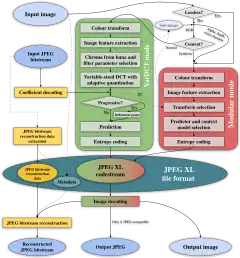
JPEG XL is based on ideas from Google's PIK format and Cloudinary's FUIF format (which was in turn based on FLIF).[12]
The format has a variety of encoding modes. On the legacy side, it has a mode that transcodes legacy JPEG in a more compact way for storage. On the more modern side, it has a lossy mode called VarDCT (variable-blocksize DCT) and a lossless/near-lossless/responsive mode called Modular which optionally uses a modified Haar transform (called "squeeze") and which is also used to encode the DC (1:8 scale) image in VarDCT mode as well as various auxiliary images such as adaptive quantization fields or additional channels like alpha. Both modes can use separate modeling of specific image features: splines, repeating "patches" like text or dots, and noise synthesis. Lossy modes typically use the XYB color space derived from LMS.[13]
Prediction is run using a pixel-by-pixel decorrelator without side information, including a parametrized self-correcting weighted ensemble of predictors. Context modeling includes specialized static models and powerful meta-adaptive models that take local error into account, with a signaled tree structure and predictor selection per context. Entropy coding is LZ77-enabled and can use both asymmetric numeral systems (ANS) and Huffman coding (for low complexity encoders or for reducing overhead of short streams).
It defaults to a visually near-lossless setting that still provides good compression.[8]
Animated (multi-frame) images do not perform advanced inter-frame prediction, though some rudimentary inter-frame coding tools are available:
Software
Codec implementation
| Initial release | December 27, 2019 |
|---|---|
| Stable release | 0.6.1
/ October 30, 2021 |
| Repository | https://github.com/libjxl/libjxl[17]  |
| Written in | C++ |
| Operating system | |
| License | New BSD License (previously Apache License 2.0) |
| Website | jpeg |
- JPEG XL Reference Software (libjxl)
- license: New BSD License (previously Apache License 2.0)
- contains (among others):
- coder
cjxl - decoder
djxl - tool for benchmarking speed and quality of image codecs
benchmark_xl - GIMP and Gtk pixbuf plugin
file-jxl
- coder
Official support
Unofficial support
- Qt / KDE apps[22] – via plugin
- Microsoft Windows[23] – via WIC plugin, i.e. for viewing in Photo Viewer, File Explorer etc.
- macOS[24] – via standalone app and Quick Look plugin
- GIMP[3] – raster graphics editor; plugin for GIMP 2.10 available
Preliminary support
- Chromium[25] – web browser; in testing (as Chrome Beta and Edge Canary)
- Firefox[26] – web browser; in testing (as Firefox Nightly)
Standardization status
| Common Name | Part | First public release date (First edition) | ISO/IEC Number | Formal Title |
|---|---|---|---|---|
| JPEG XL | Part 1 | under development, planned for 2021 | ISO/IEC FDIS 18181-1 | JPEG XL Image Coding System — Part 1: Core coding system |
| Part 2 | 13 October 2021 | ISO/IEC 18181-2 | JPEG XL Image Coding System — Part 2: File format | |
| Part 3 | under development, planned for 2022 | ISO/IEC DIS 18181-3 | JPEG XL Image Coding System — Part 3: Conformance testing | |
| Part 4 | under development, planned for 2022 | ISO/IEC DIS 18181-4 | JPEG XL Image Coding System — Part 4: Reference software |
References
- "fuif/README.md". GitHub. Retrieved 2019-04-04.
- "Can JPEG XL Become the Next Free and Open Image Format? - Slashdot".
- "Support for reading/Writing JPEG XL images (#4681) · Issues · GNOME / GIMP".
- "JPEG - Next-Generation Image Compression (JPEG XL) Final Draft Call for Proposals". Jpeg.org. April 23, 2018. Retrieved 29 May 2018.
- "v0.2 JPEG XL Reference Software". GitLab.
- "JPEG XL reaches Committee Draft" (html). JPEG Org. 3 August 2019. Archived from the original on 3 August 2019. Retrieved 3 August 2019.
The current contributors have committed to releasing it publicly under a royalty-free and open source license.
- "JPEG XL White Paper" (PDF). JPEG Org. 22 January 2021. Retrieved 17 March 2021.
- Sneyers, Jon. "How JPEG XL Compares to Other Image Codecs". Cloudinary.
- Jon Sneyers (2021-01-03). "JPEG XL as PSD transfer/storage alternative". Reddit.
- Jon Sneyers (2021-06-03). "Progressive Transcoding". GitHub.
- "jpeg / JPEG XL Reference Software". GitLab.
- "FLIF - Free Lossless Image Format".
- Alakuijala, Jyrki; van Asseldonk, Ruud; Boukortt, Sami; Szabadka, Zoltan; Bruse, Martin; Comsa, Iulia-Maria; Firsching, Moritz; Fischbacher, Thomas; Kliuchnikov, Evgenii; Gomez, Sebastian; Obryk, Robert; Potempa, Krzysztof; Rhatushnyak, Alexander; Sneyers, Jon; Szabadka, Zoltan; Vandervenne, Lode; Versari, Luca; Wassenberg, Jan (6 September 2019). Tescher, Andrew G; Ebrahimi, Touradj (eds.). "JPEG XL next-generation image compression architecture and coding tools". Applications of Digital Image Processing XLII. 11137: 20. Bibcode:2019SPIE11137E..0KA. doi:10.1117/12.2529237. ISBN 9781510629677.
- "JPEG XL reference implementation". GitHub. 3 December 2021.
- "JPEG XL reference implementation". GitHub. 3 December 2021.
- "JPEG XL reference implementation". GitHub. 3 December 2021.
- "PLEASE DO NOT OPEN NEW ISSUES HERE". Retrieved 27 May 2021.
- "ImageMagick".
- "0001845: JPEG XL - MantisBT".
- "GThumb Image Viewer 3.11.3 Adds JPEG XL (.JXL) Support [Ubuntu PPA] | UbuntuHandbook".
- "IrfanView PlugIns".
- "Qt-jpegxl-image-plugin". GitHub. December 2021.
- "Jpeg Xl Wic". GitHub. 27 November 2021.
- "JXLook". GitHub. December 2021.
- "1178058 - chromium - an open-source project to help move the web forward. - Monorail".
- "1539075 - (JPEG-XL) Implement support for JPEG XL (Image/JXL)".
External links
- Official website
- Reference implementation on GitHub
- builds:
- Nightly dev builds
- Windows Bin Builds (the page also contains many other programs)
- builds:
- Community website
| Raster |
|
|---|---|
| Raw | |
| Vector | |
| Compound | |
| Metadata | |
| |


