Jafar-e-Tayyar
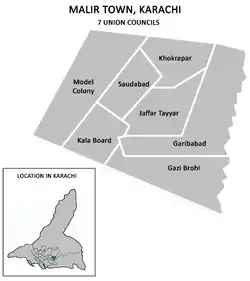
Jafar-E-Tayyar or Jaffar-E-Tayyar Cooperative Housing Society (Urdu: جعفر طیار) (J.T.C.H.S.) is one of the neighbourhoods of Malir Town in Karachi, Sindh, Pakistan.[1] The resident population is 99% Shia in Jafar-e-Tayyar. The ratio of educated people is quite higher in this area. Women study and work shoulder by shoulder to men.
Jafar e Tayyar
جعفر طیار سوسائٹی | |
|---|---|
 | |
 Map of Malir District | |
| Country |  Pakistan Pakistan |
| Province |  Sindh Sindh |
| Division | Karachi |
| Established | 1969 |
| Founded by | Haider Ali Rashid Mulji |
| Government | |
| • Deputy Commissioner | Gahanwer Khan Laghari |
| Website | Jafar e Tayyar Website |
History Of Jafar Tayyar
As Karachi's population grew, mourning also spread to different parts of the city. There is also a Jaffar Tayyar Society in these settlements. Jaffar Tayyar Society is located in Malir District and has a population of over 60,000. These include Hasnain Society, Ammar Yasir, Ghazi Town, and Bagh Asad. This entire population consists of believers and is now a regular union council of Malir District.
Malir was an agricultural area, therefore it was totally dependent on rainfall. As the rains receded, water problems continued to grow and as a result, farmers left the land and retreated. So the farmers started selling this vacant land. Jafar e Tayyar Society also consisted of farms. When the farms came to an end, it was bought by a capitalist Haider Ali Mulji in 1969 and he started plotting for the believers here. Initially, a 200-yard plot was sold for Rs 2,000 and a 96-yard plot for Rs 1,000. Thus the population began to grow slowly. The first house here belonged to the aunt of the forest, whose name was given to the forest aunt because she lived in this forest. It was the same three-story house in front of the Markazi Imambargah that collapsed in 2019. The population expansion of Jafar Tayyar Society started from F-South adjoining surveys like 640, 627 and 552 etc, and has grown to such an extent that today Jafar Tayyar Society is a Union Council of Malir District.[2]
The Beginning Of Mourning
It would be unfair not to mention the believers of F-South in narrating the history of mourning of Jafar e Tayyar Society. Mourning in Jafar e Tayyar Society had started even before the formation of Jafar e Tayyar Society. Because the settlement adjacent to Jafar Tayyar Society had become F-South. The believers living here were in dire need of a mosque and an imambargah. They acquired a piece of land in 1956 within the current Jafar e Tayyar Society's Survey No. 640, which was adjacent to F. South and was a complete forest. But some people did not like this at all and they insisted that the Imam Bargah should not be built in any way. Even the wall would be built from morning to evening and at night someone would tear it down and leave. In such a situation, 12 people showed their perseverance which is unparalleled. Among them were Izharul Hassan Rizvi (دروغاجی) and Ali Hassan Zaidi. When the wall collapsed several times, the same 12 people, including Izhar-ul-Hassan Rizvi, who was once a terrified man, put all of them on duty so that as long as the Imambargah was being built, everyone will take turns sleeping in their beds near the imambargah۔ Thus, a man would guard the Imambargah at night and sleep there. Thus the construction of the Imamia Mosque and the Imambargah was completed and prayers began in the mosque there. When the first Muharram came after the construction of the Imambargah, a series of regular majalis of men and women continued in the Imambargah throughout the days of mourning. In addition, it was decided that two processions would be taken out, one towards the Husseini Embassy (حسینی سفارت خانے) and the other via the national highway, ending at the Qaimiya Imambargah (قائمیہؑ امام بارگاہ) in the Malir Temple area.
Mosques And Imambargahs Of Jafar e Tayyar Society
Imamia Mosque And Imambargah
It is the oldest mosque and imambargah of the Jafar e Tayyar Society, built in 1956. We have already given the full details.
Hasnain Mosque
The Hasnain Mosque is also one of the oldest mosques in the Jafar e Tayyar Society and was built in the early 1970s. In the past, many big programs were held in Hasnain Mosque, but never continued.
Markazi Mosque And Imambargah
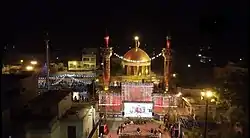
Not only is the name of the Central Mosque and Imambargah central, but these mosques and Imambargahs themselves are central to Jafar e Tayyar. All major mourning programs and large gatherings for Eid prayers are held here. Markazi Imambargah has a very beautiful building and a huge hall. The building of Markazi Imambargah has now become the identity of Jafar e Tayyar. When Markazi imambargah and mosque were built, its management was under the control of Anjuman-e-Jafaria. In 1982, a regular trust was formed to run Markazi Mosque and Imambargah, named Ghazi Abbas. The names of Hassan Abbas Zaidi, Muqdad Jafari and Dr. Shafaat are included in its making.
Mosque And Imambargah Bab Al-Hawaij
As the population of believers increased in Ghazi Town, there was a need for a mosque and an imambargah. In the late 1990s, the mosque and imambargah Bab ul Hawaij were built.The inauguration was done by senior islamic scholar maulana Syed Ghulam Hasnain Rizvi(late)
Khadija Al-Kubra Mosque And Imambargah Salman Farsi
417, is a cut-off survey of Jafar e Tayyar society, whose inhabitants used to travel long distances to reach the Imamia or Markazi Mosque for prayers. Now, in the late 2000s, two separate buildings, the Imambargah Salman Farsi and the Khadijatul-Kubra Mosque, have been erected.
Other Imambargahs
There are many more small imambargahs in Jafar e Tayyar Society. Notable among them are Zaidia Imambargah, Dargah Al-Abbas, Masjid Zahra and Imambargah of the Mr. Izzat(late).
The First Ten Days Of Mourning
Two or three days before the arrival of Muharram, the atmosphere of Jafar e Tayyar Society becomes mournful. Preparations for Muharram begin everywhere. As soon as the moon of Muharram is seen, black flags are hoisted on all sides and funeral homes are decorated. There are more than 300 women's majalis from morning to evening. Majalis of men also begin in the evening and continue till late at night. There is a gathering everywhere. Somewhere someone is coming from the Majlis and somewhere someone is going to the Majlis. On the main road connected to the Markazi Imambargah, there are stalls lined up in which large fairs are organized by various political parties and social organizations, there are also stalls for Islamic books. There are loud lamentations coming from all over which end only at the time of the meeting in the Markazi Imambargah. There is a strange atmosphere on the markazi road that cannot be written or described.
Decades Up To Ashura
The Decade Of Jafaria Movement
It is held at the Markazi Imambargah and has been held since 1983. It begins in the evening and ends before the call to prayer in the evening. The highlight of this decade is that whoever had the good fortune to address this member of Tehreek-e-Jafariah reached the heights of fame. Such as Maulana Jan Ali Shah Kazmi, Maulana Hassan Zafar Naqvi, Maulana Sajjad Dehlavi and Maulana Nazir Taqvi etc.
The Decade Of Mohibban e Aza
This is the biggest decade of Jafar e Tayyar which started in 1994 at the Markazi Imambargah and continues till today. For the first time this decade was held at 7 am in which Maulana Abdul Hakim Butrabi addressed. The second time it happened at eleven o'clock at night and it still happens at eleven o'clock today. Maulana Irfan Haider Abidi addressed this decade from 1995 till his death. Since then till now every year the great Zakirs have been addressing this decade and thousands gather in this decade.
The Decade Of Bazm e Fatima(S. A)
This decade is also held at Markazi Imambargah, which begins immediately after the Maghrib prayers. This decade began 7 years ago today. In the first decade, Maulana Zaki Baqari delivered a speech in which there was a sea of mourners.
Other Decades
Apart from this, there are some big decades, including the decade of Hasnain Mosque of Payam Wilayat Foundation, the decade of Anjuman-ul-Abbas, the decade of Imamia Imambargah, the decade of Dargah Bab Al-Hawaij and the ancient decade of Sachay Bhai.
Central Programs Till Ashura
From 1st Muharram to 4th Muharram, the residents of Jaffar Tayyar only attend Majalis, and give Princess Bibi Fatima Al-Zahra (SA) the parsa of her oppressed son (AS). Specific programs start from 5th Muharram.
The Procession Of Fifth Muharram
On 5th Muharram, an ancient procession is recovered from Imamia Imambargah Jafar Tayyar, which has been being taken out since about 1956. It passes through Jinnah Square and Mohammadi Dera on its scheduled routes and ends at the Qaimia Imambargah Malir Temple. This is the longest distance procession of Jafar Tayyar. The procession is attended by a large number of youths who end the procession at the Qaimia Imambargah and then return to Jafar Tayyar on foot. When the procession began, the Jaffar Tayyar Society itself was a field. At the end of the procession, a man would walk forward holding the gas lights that were burning in the procession, and the rest of the line would follow him through the fields and return to the Imamia Imambargah.
Procession On 6th Muharram By Residents of Shikarpur
The Jafar Tayyar Society is home to a large number of residents of the Indian city of Shikarpur who, according to their Shikarpur culture, hold special processions on 6th Muharram in which people from all over Shikarpur in Karachi participate. On the other hand, a large number of believers of Jafar Tayyar Society are also involved in this, in which the people of Shikarpur mourn by taking out the coffin in their own special way. Their style of mourning is very different.
Processions Of 7th And 8th Muharram
In the beginning, Hazrat Qasim's henna used to come out on the occasion of 7th Muharram, the practice of which has now diminished and only comes out at the end of a centrally majlis of Mohibban e Aza. But on the 7th and 8th of Muharram, many processions leave the small shrines (عزاخانے). Especially on 8th Muharram, there were innumerable processions which have now been organized and at night there is a procession in which alams (علم) are recovered from every mourning room inside Jafar Tayyar. The procession, patrolling through different streets, reaches Aun (A.S) and Muhammad (A.S) Chowk, where hundreds of alams (علم) join it. And what is special about it is that it contains alams (علم) according to the culture of every region of the subcontinent.
The Niaz Of Eight Muharram
From the evening of 8th Muharram, Niaz Hazrat Abbas (A.S) is provided in every house in every street of Jafar e Tayyar Society. The situation is that going from one street to another becomes a dilemma. Every man wants to grab people and take them to his home for niaz. Such large-scale, nazar and niaz rarely occur together.
Ashura Night
On the night of Ashura, the doors of every shrine (عزاخانے) are opened. There is a crowd in the whole Jafar Tayyar who is patrolling every street and burning candles in every shrine (عزاخانے). There are so many people coming and going on the main road that there is no place to sit all night. Women from nearby Sunni communities also turn to various shrines (عزاخانے) for mass prayers. It is a well-known fact, especially in the late Izzat's shrine (عزاخانے), that anyone who vows to marry his daughter will have it fulfilled next year. The night of Ashura ends with the Azan Ali Akbar (A.S) which takes place from the Markazi Imambargah.
Sham e Ghariban
On the day of Ashura, there is no big event in Jafar Tayyar Society. All the people go to Nishtar Park to participate in the main procession. And they start coming back at the time of starvation. Starvation is also practiced on a large scale in various places and in shrines (عزا خانوں ).
After the Maghrib prayers, the preparations for the Majlis-e-Sham Ghariban begin. Thus, the Majlis is held in different Imambargahs, but the central majlis of the Sham e Ghariban is held in Markazi Imambargah. In the Sham Ghariban majlis of the Markazi Imambargah, there is a sea of people. Hardly any Majlis Sham Ghariban is celebrated on such a large scale in Pakistan. At the end of the meeting, there is a lot of chaining (زنجیر زنی). There is also a great deal of mourning (ماتم داری) at the end of the chaining (زنجیر زنی).
Decades And Khumsa Majalis After Ashura
The Decade Of The ISO
This is known as the 12th Majalis of the Decade, which is held at the Markazi Imambargah. It has been going on since the 1990s. It was initially started by the ISO's Muhib unit, which is for children under matriculation. And undergraduates also used to come to addressing. Gradually, this decade majalis became organized, and then the ISO took over this. At present, it is counted among the great decades of the Jafar e Tayyar Society.
Decade Of Anjuman Jafar e Tayyar
This decade of Majalis began in the 2000s at the Central Imambargah. These majalis start on 21st Muharram and last till the end of the month of Muharram. Usually 5, 5 majlis are read separately by people in this decade. Allama Shahenshah Naqvi addresses the last 5 Majalis and the rush in his Majlis is more than any Majlis of Jafar Tayyar. The whole imambargah is filled with men and women and then there are some people in the main road. One more screen has to be set up outside the Imambargah to control the crowd.
Decade Of Anjuman Jawadia
Anjuman-e-Jawadia, which belongs to Korangi, has been conducting its decade at the Central Imambargah from the 1st to the 10th Safar since the early 1980s, and which has been addressed by eminent scholars and Zakirs. On 10th Safar, they take out the coffin of Bibi Sakina (S.A) in their own way by darkening the whole imambargah. In this coffin people from all over the city come to visit and offer their prayers.
Other Decades and Fives
In this way, in addition to these decade majalis, there are also decade majalis on large-scale , but they are not continuous, so they are not being mentioned. By the way, in the above mentioned mosques and Imambargahs, various khumsa majlis are held continuously, in which khumsa majlis of Al-Muntazar Academy is being held from 3rd Rabi-ul-Awal to 7th Rabi-ul-Awal in Hasnain Mosque since 2005. The Khumsa of Forough Uloom Aale Muhammad(SAWW) is held from 11 Safar to 15 Safar which has been held in the Central Imambargah since 2001 and the ancient khumsa of Anjuman Ghulaman e Alamdar is held in the Markazi Imambargah from 23 to 27 Safar. Apart from this, other khumsa majlis are also included.
Mourning Procession
Many mourning processions take place during the days of mourning in Jaffar Tayyar Society, some of which are central. Among them, the procession of 5th Muharram which has been mentioned earlier, besides the details of other major processions are given below.
Twelve Alams & Twelve Zul Jinnahs
The procession consists of twelve alams and twelve Zul Jinnahs which was started in the late nineties. It leaves Nadi Ali (A.S) Square every third Sunday of Muharram and ends at the Central Imambargah, patrolling various areas.
Procession Of Tauqeer Zaidi Shaheed
The procession starts from the early 80's and continues till today on the 24th of Muharram on the occasion of the martyrdom of Maula Imam Sajjad (A.S). Earlier, Tauqeer Shaheed used to take out this procession. Since his martyrdom in 1994, his brother have taken it out with the same splendor. Only Anjuman-e-Shabab-ul-Momineen mourns in this procession and sometimes such long circles are formed that mourning is taking place from their house to the limits of Markazi Imambargah. The procession departs at 11:00 pm and ends at 2 to 3 pm.
The Procession Of Ghancha Al-Abbas (A.S)
The procession leaves the Imamia Imambargah in the early 80's and ends at the Markazi Imambargah. It is a very different kind of procession because it is a children's procession and all the associations are for small children. This procession is so old that the children who started this procession are now old themselves. The procession includes not only Jafar Tayyar Society but also children's associations across Malir.
72 Coffin Procession
This is the most famous mourning procession of Jafar Tayyar in which people from all over Karachi participate. In this procession the coffins of 72 martyrs of Karbala are taken out. The procession was started in 1986 by Zamin Abbas Zaidi and his comrades and continues to this day. The procession starts from Mohibban Aza Chowk and passes through various routes and ends at the Markazi Imambargah.
References
- Malir Town - Government of Pakistan Archived 2006-02-19 at the Wayback Machine
- "A look at Jafar Tayyar's mourning and its history". 10 August 2021.