James Nicoll Morris
Vice-Admiral Sir James Nicoll Morris KCB (1763 – 15 April 1830) was a Royal Navy officer who served through the American Revolutionary War, French Revolutionary Wars, and Napoleonic Wars. He joined the Royal Navy in around 1778 and subsequently fought as a junior officer in the Leeward Islands in the battles of St Lucia, Grenada, and the Saintes. He was promoted to commander in 1790, commanding HMS Flirt in the Leeward Islands and then HMS Pluto on the Newfoundland Station. Morris was promoted to post-captain in 1793 and given command of HMS Boston, in which he became a successful prizetaker in the English Channel and off Spain over the ensuing four years. In 1798 he transferred to command HMS Lively but in April that ship was wrecked off Cadiz. His next command was HMS Phaeton in the following year. In Phaeton Morris fought in the Mediterranean, assisting the Austrian battles against French forces in Italy.
Sir James Nicoll Morris | |
|---|---|
| Born | 1763 |
| Died | 15 April 1830 (aged 66) Marlow, Buckinghamshire |
| Allegiance | United Kingdom |
| Service/ | Royal Navy |
| Years of service | c. 1778–1830 |
| Rank | Vice-Admiral of the Red |
| Commands held | HMS Flirt HMS Pluto HMS Boston HMS Lively HMS Phaeton Blackwater-Stour Sea Fencibles HMS Leopard HMS Colossus HMS Formidable |
| Battles/wars | American Revolutionary War |
| Awards | Knight Commander of the Order of the Bath Naval Gold Medal |
| Spouse(s) | Margaretta Sarah Somers Cocks |
Morris was unemployed during the Peace of Amiens but received in quick succession command of a group of Sea Fencibles, then HMS Leopard, and finally HMS Colossus in 1804. In Colossus he served in the English Channel and then off Cadiz, and in October 1805 he fought at the Battle of Trafalgar where Colossus was the most heavily engaged of the British ships, fighting three enemy ships of the line and receiving around 200 casualties. Morris himself was injured in the battle but after recovering he continued to serve in Colossus until 1808. He then commanded HMS Formidable in the Baltic Fleet from 1810 until he was promoted to rear-admiral in 1811. He stayed in the Baltic as third-in-command of that fleet until the end of the Napoleonic Wars, which was his last service in the navy.
Naval career
Early career
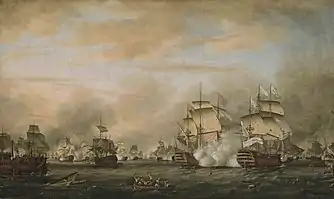
James Nicoll Morris was most likely born in 1763, the son of Captain John Morris, Royal Navy, who would be mortally wounded at the Battle of Sullivan's Island on 28 June 1776. Morris joined the Royal Navy some time before the death of his father, serving with him, but by 1778 he had transferred to the 74-gun ship of the line HMS Prince of Wales, which was the flagship of Rear-Admiral Samuel Barrington on the Leeward Islands Station.[Note 1] In Prince of Wales Morris subsequently fought at the Battle of St. Lucia on 15 December and Battle of Grenada on 6 July of the following year. On 14 April 1780 he was promoted to lieutenant, and staying on station after this he fought at the Battle of the Saintes on 12 April 1782, serving on board the 90-gun ship of the line HMS Namur.[3][4] Morris became a follower of Barrington and while he was not employed during the ensuing peace at the end of the American Revolutionary War, the admiral brought him to serve on the 100-gun ship of the line HMS Royal George during the Spanish Armament of 1790. Barrington had Morris promoted to commander on 21 September of the same year.[3]
Command
Morris was then given command of the 14-gun brig HMS Flirt in the Leeward Islands from September 1790, and he commanded her until December 1792 when he received command of the 14-gun sloop HMS Pluto.[3][2][5][6] In Pluto he sailed to serve on the Newfoundland Station on 16 May 1793 and, the French Revolutionary War having begun, he captured the French 16-gun privateer sloop Lutine on 25 July.[3][4][6] Morris spent little time in Pluto, because on 7 October of the same year he was promoted to post-captain and given command of the 32-gun frigate HMS Boston. He sailed Boston home to England and after initially serving in the English Channel he sailed to the Mediterranean Sea on 22 February 1796.[3][7] Here he served off Cape Finisterre and was very successful, capturing the Spanish privateer l’Enfant de la Patria, of 16 guns, on 16 April 1797, El Principe de Paz, of 20 guns, on 4 June, St. Bernardo, of 12 guns, on 16 June, and Hazard, of 8 guns, on 30 July.[4][7] In early 1798 Morris transferred commands, joining instead the 32-gun frigate HMS Lively.[3][4]
He continued on the same station in Lively but on the night of 12 April 1798 she was shipwrecked on Rota Point, near Cadiz.[3][8] Visibility at the time of the incident was very poor and Lively had accidentally gotten too close to the shore in the darkness. Boats from other British ships were sent in the morning to rescue the crew, and while one crewmember was killed by the fire of a French battery the rest were safely taken off and Lively was burned.[8] Morris was not deemed to be at fault for the loss of his ship, and in July 1799 he received command of the 38-gun frigate HMS Phaeton.[3][4][2][9]
In the autumn of the same year Morris conveyed in Phaeton Lord Elgin to Constantinople, where he was travelling to take up his post as ambassador. They left England on 4 September and arrived on 2 November.[4] After this Phaeton stayed in the Mediterranean with the Mediterranean Fleet, by May 1800 being stationed off Genoa.[3] At the time the French and Austrian armies were engaging each other in Genoa, and Morris in Phaeton was detached to assist the forces of Peter Karl Ott von Bátorkéz. As such, Phaeton was present off the coast when the French retreated from Alassio in May, and was able to fire on them. Subsequently Morris captured twenty ships carrying corn for the French army as well as a stockpile of arms, and continued to harry the French army as they retreated down the coast.[3][10] By October Morris had completed this duty, and he was serving off Malaga; on 28 October the boats of Phaeton successfully cut out the Spanish 14-gun polacca San Josef from under the guns of an enemy battery. In 1801 Phaeton moved from the centre of the Mediterranean to continue serving off the coast of Spain and on 16 May Morris sent his ship's boats, in tandem with those of the 32-gun frigate HMS Naiad, in to Marin where they captured the Spanish armed packet L'Alcudia and destroyed her compatriot El Raposo. Morris continued serving off Spain until the end of the year when he was sent home to England with dispatches from Admiral Lord Keith. He arrived at Portsmouth in March 1802 and paid off Phaeton.[3][11][9]
Trafalgar and later service
Morris stayed unemployed throughout the Peace of Amiens but upon the start of the Napoleonic Wars in 1803 he was given command of the Sea Fencibles located between Blackwater and the River Stour.[11] In September of the same year he was given command of the 50-gun fourth rate HMS Leopard as flagship to Commodore Charles Cunningham. Morris stayed in Leopard only until June 1804 because then he was instead given command of the 74-gun ship of the line HMS Colossus.[3][11][12] When Morris first joined Colossus her crew was sickly and "unpromising", but he worked to improve the ship while serving in the fleet of Admiral William Cornwallis off Brest, and the ship would go on to be described as an "excellent sailer" there.[2] He and Colossus served off Brest until 1805 when they were sent to join the fleet of Vice-Admiral Lord Nelson off Cadiz. As part of such on 21 October Morris fought in the Battle of Trafalgar.[3][11]
_-_The_Battle_of_Trafalgar%252C_21_October_1805_-_BHC0555_-_Royal_Museums_Greenwich.jpg.webp)
In the battle Colossus was the sixth ship in the leeward column, led by Vice-Admiral Cuthbert Collingwood. In the fighting that came after the two columns of Nelson's fleet had pierced the Franco-Spanish line of battle Collosus received the most damage and casualties out of any British ship in the battle with 40 men killed and 160 wounded.[3][11] Collosus initially engaged the French 74-gun ship of the line Swiftsure but was then also attacked by her compatriot, the 74-gun ship of the line Argonaute. It was while she was sandwiched between these two ships that Collosus took most of her punishment, fighting both ships for half an hour until Argonaute shied away after receiving over 200 casualties in the engagement. At one point Colossus was almost overwhelmed by a boarding party, but she was saved when her crew on the lower decks climbed up and fought off the attackers. After Argonaute had moved away Morris continued to engage Swiftsure until that vessel lost two of her masts and was described as nothing more than a hulk. Colossus afterwards moved on to attack the Spanish 74-gun ship of the line Bahama and Morris succeeded in destroying her mizzenmast before obtaining her surrender.[13][14] The ship was finally relieved in battle by the 74-gun ship of the line Orion after this, and it was she who finally forced Swiftsure to surrender.[14] Morris himself became a casualty during the fighting, receiving a severe wound to his thigh or knee, but he stayed on deck after applying his own tourniquet until the fighting had finished, at which point he fainted from a lack of blood and was carried below. Colossus then sailed for Gibraltar where he recovered from his injury.[3][11][13]
Morris, along with the other captains present at Trafalgar, was awarded with a Naval Gold Medal for his service and received the thanks of the Houses of Parliament.[3][11] He was also presented with a vase by Lloyd's Patriotic Fund.[13] He continued in command of Colossus after the battle, initially serving off Rochefort in the squadron of Rear-Admiral Sir Richard Strachan and then from 30 June 1808 in the Mediterranean until he left the ship in October of that year.[3][11][15] His next command came in March 1810 when he joined the 98-gun ship of the line HMS Formidable in the Baltic Fleet, and on 31 July of that year he was further rewarded for his services when he was made a Colonel of Marines.[3][16][17] On 1 August 1811 Morris was promoted to rear-admiral and upon the request of Vice-Admiral Sir James Saumarez who commanded the fleet, he stayed in the Baltic as third-in-command with the 74-gun ship of the line HMS Vigo as his flagship.[3][13][18] Morris spent his time in the Baltic escorting convoys and protecting against Danish attacks around the Great Belt and thus was not part of the force that fought at the Siege of Riga in 1812.[18][19] He did not receive any more postings after the end of the Wars in 1815, but in reward for his services was appointed a Knight Commander of the Order of the Bath on 2 January. Through seniority he continued to be promoted after this, becoming a vice admiral on 12 August 1819.[Note 2] Morris died at his home at Marlow, Buckinghamshire, on 15 April 1830, aged sixty-six.[3]
Family
Morris married Margaretta Sarah Somers Cocks, the daughter of the banker Thomas Somers Cocks and niece of Charles Cocks, 1st Baron Somers, on 25 October 1802.[3] Through this marriage he became brother-in-law to Admiral Sir William Hargood.[16]
Notes and citations
Notes
- Doubt has been cast on whether Morris ever actually served under his father in the navy, with the first concrete evidence of service only coming in 1778 on Prince of Wales.[1] However, Peter Hore portrays Morris as being present at his father's death in his biography.[2]
- Full dates of promotion: rear-admiral of the blue 1 August 1811, rear-admiral of the white 12 August 1812, rear-admiral of the red 4 June 1814, vice-admiral of the blue 12 August 1819, vice-admiral of the white 19 July 1821, vice-admiral of the red 27 May 1825.[20]
Citations
- Laughton (1894).
- Hore (2015), p. 158.
- Laughton & Morriss (2008).
- Marshall (1823), p. 489.
- Winfield (2007), p. 1488.
- Winfield (2007), p. 1670.
- Winfield (2007), p. 936.
- Grocott (2002), p. 57.
- Winfield (2007), p. 967.
- Marshall (1823), pp. 489–490.
- Marshall (1823), p. 490.
- Winfield (2007), p. 752.
- Hore (2015), p. 159.
- Sugden (2012), p. 820.
- Winfield (2008), p. 124.
- Marshall (1823), p. 491.
- Winfield (2007), pp. 159–160.
- Sullivan (2017), p. 201.
- Sullivan (2017), p. 207.
- Syrett & DiNardo (1994), p. 321.
References
- Grocott, Terence (2002). Shipwrecks of the Revolutionary & Napoleonic Eras. Caxton Editions. ISBN 1-84067-164-5.
- Hore, Peter (2015). Nelson's Band of Brothers: Lives and Memorials. Barnsley, South Yorkshire: Seaforth. ISBN 978 1 84832 779 5.
- Laughton, J. K. (1894). . In Lee, Sidney (ed.). Dictionary of National Biography. 39. London: Smith, Elder & Co.
- Laughton, J. K.; Morriss, Roger (2008). "Morris, Sir James Nicoll". Oxford Dictionary of National Biography (online ed.). Oxford University Press. (Subscription or UK public library membership required.)
- Marshall, John (1823). . Royal Naval Biography. 1, part 2. London: Longman and company. pp. 488–491.
- Sugden, John (2012). Nelson: The Sword of Albion. London: The Bodley Head. ISBN 9780224060981.
- Sullivan, James (2017). Man of War: The Fighting Life of Admiral James Saumarez. Barnsley, South Yorkshire: Frontline Books. ISBN 978-1-52670-651-5.
- Syrett, David; DiNardo, R. L. (1994). The Commissioned Sea Officers of the Royal Navy 1660–1815. Aldershot: Scolar Press. ISBN 1 85928 122 2.
- Winfield, Rif (2007). British Warships in the Age of Sail 1714–1792. Barnsley, South Yorkshire: Seaforth. ISBN 978-1-84415-700-6.
- Winfield, Rif (2008). British Warships in the Age of Sail 1793–1814. Barnsley, South Yorkshire: Seaforth. ISBN 978-1-84415-717-4.
Authority control  | |
|---|---|
| General | |
| National libraries | |