Siege of Riga (1812)
The Siege of Riga was a five month long siege of the Russian port city of Riga, the capital of the Governorate of Livonia.
| Siege of Riga | |||||||
|---|---|---|---|---|---|---|---|
| Part of the French invasion of Russia | |||||||
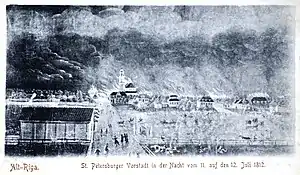 Siege of Riga depicted in a postcard | |||||||
| |||||||
| Belligerents | |||||||
.svg.png.webp) French Empire French Empire.svg.png.webp) Prussia Prussia |
 Russian Empire Russian Empire (naval support) (naval support) | ||||||
| Commanders and leaders | |||||||
Jacques MacDonald.svg.png.webp) Julius von Grawert Ludwig Yorck Julius von Grawert Ludwig Yorck |
Magnus G. von Essen Filippo Paulucci Ivan F. Emme Thomas Byam Martin | ||||||
| Units involved | |||||||
| X Corps |
Garrison of Riga Army of Finland | ||||||
| Strength | |||||||
| 31,000 men and 130 x siege guns | 27,000[1][2] | ||||||
Background
During Emperor Napoleon's Invasion of Russia, two corps were sent to towards the Baltic Sea via Courland and Lithuania in-order to secure his northern flank. One of the corps, Marshal Étienne MacDonald's X Corps was sent towards the Courland and subsequently began moving towards Riga.[3]
By mid July 1812, the Riga garrison had grown to around 14,000 troops. Soon after the Russian Army of Finland arrived with a further 10,000 troops shortly after the beginning of the siege.[3]
After the beginning of the siege, the French situation was precarious as Marshal MacDonald's 25,000 troops had to not only continue the siege, but control some 80 miles of the Dvina down to Dünaburg. This was further undermined as the 'allied' Prussian forces' loyalty was in increasingly dubious situation.[3][4]
Order of Battle
The order of battle of the forces involved was as follows (note: the nation of origin is listed behind units which came from said areas (other than French/Prussian/Russian)):
French X Corps
| French X Corps |
|---|
|


.svg.png.webp)

Riga Garrison
| Riga Garrison |
|---|
|

| Russian Reinforcements |
|---|
Reinforcements/Other Forces
|

British Baltic Fleet
| British Baltic Fleet |
|---|
|

Notes
- Clodfelter 1980, p. 175.
- Bodart 1908, p. 446.
- Chandler, pp. 1240–1241
- Chandler, p. 1192
- Smith, p. 408
- Smith, p. 408
- "Русская армия в июне 1812 года". www.museum.ru. Retrieved 2021-10-02.
- "Историческая справка по 1-й Артиллерийской бригаде". antologifo.narod.ru. Retrieved 2021-09-22.
- "Историческая справка по Артиллерийским ротам при Морских полках". antologifo.narod.ru. Retrieved 2021-09-22.
- Smith, p. 408
- "Русская армия в июне 1812 года". www.museum.ru. Retrieved 2021-10-02.
- "Русская армия в июне 1812 года". www.museum.ru. Retrieved 2021-09-24.
- "Sir Thomas Byam Martin". more than Nelson. Retrieved 2021-09-22.
- Winfield, pp. 327–328
- Winfield, pp. 440–441
- Winfield, pp. 672–673
- Winfield, p. 713
- Winfield, p. 647
- Winfield, p. 718
- Winfield, pp. 748–750
- Winfield, pp. 817–818
- Winfield, pp. 873–874
- Winfield, pp. 953–954
- Winfield, p. 1182
- Winfield, p. 1199
- Winfield, pp. 1027–1028
- Winfield, pp. 1157–1158
References
- Chandler, David G. (2009). The Campaigns of Napoleon: The Mind and Method of History's Greatest Soldier. New York City, New York, United States of America: Sribner. ISBN 978-1439131039. OCLC 1085168952.
- Winfield, Rif (2005). British Warships in the Age of Sail: 1793 – 1817: Design, Construction, Careers, and Fates. Barnsley, South Yorkshire, United Kingdom: Seaforth Publishing. ISBN 978-1844157174. OCLC 421815211.
- Smith, Digby (1998). The Greenhill Napoleonic wars data book. London Mechanicsburg, PA: Greenhill Books Stackpole Books. ISBN 978-1-85367-276-7. OCLC 37616149.
In popular culture
- The Commodore by C.S. Forester includes a fictional account of the siege.
