Joseon Army
The Joseon Army (Korean: 조선군대; Hanja: 朝鮮軍隊) was the army of the Korean dynasty of Joseon. Since the founding of Joseon, the army fought off the Jurchen raids in the north and conquering the entire Korean peninsula. They even fought alongside the Joseon Navy to suppress the piracy in Tsushima. However, Joseon's neo-confucianism disavowed military development. By the time of the Imjin War, the army was no match for the sheer numbers of the Japanese army armed with matchlock muskets; they made rapid reforms to repel two Japanese invasions. After the war, internal strife weakened the army making them vulnerable to two Manchu invasions that forced them under the suzerainty of the Qing. Despite this, Joseon kept strengthening the military until the 19th century, when western powers and the Japanese forced them to open doors and modernize the army.
| Joseon Army | |
|---|---|
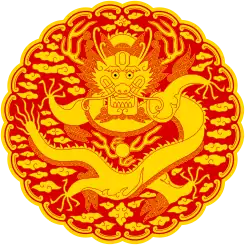 Coat of arms of Joseon | |
| Active | 14th century-1897 |
| Country |  Korea Korea |
| Allegiance | King of Joseon |
| Type | Army |
| Role | Land |
| Size | 50,000 84,500 (1592) |
| Insignia | |
| Ensign |  |
History
Early Period
The armed forces of the former Goryeo kingdom were Joseon's armed forces during the reign of King Taejo. However, the officials of the Joseon court commanded private armies from the previous kingdom. Yi Bang-won and his officers staged a coup against Taejo and his brother Jeongjong of Joseon, inciting the first and second strife of the princes. He advised Jeongjong to ban the ownership of private armies and become king in favor of having a central army. When Sejong ascended the throne, he created various military regulations to strengthen the safety of his kingdom, supported the advancement of Korean military technology, including the development of the cannon, mortars, fire arrows and the use of gunpowder.[1]
Joseon–Jurchen border conflicts
Like Goryeo, Joseon made the Jurchens in the area around Hamhung on the northeastern Korean peninsula submit as vassals. The Joseon Koreans tried to deal with the military threat posed by the Jurchens by using both forceful means and incentives and by launching military attacks. At the same time, they tried to appease them with titles and degrees, traded with them and sought to acculturate them by having Korean women marry Jurchens and integrating them into Korean culture. Despite these measures, fighting continued between the Jurchen and the Koreans.[2][3] The Ming Yongle Emperor was determined to wrest the Jurchens out of Korean influence and have China dominate them instead.[4][5] Korea tried to persuade Jurchen leader Mentemu (Möngke Temür) to reject the Ming overtures, but were unsuccessful since Möngke Temür folded and submitted to the Ming.[6][7][8][9] In 1433, Sejong sent Kim Jongseo (hangul: 김종서, hanja: 金宗瑞), a prominent general, north to destroy the Jurchens. Kim's military campaign engaged the Jurchen clans such as the Odoli, Maolian and Udige capturing several castles, taking control of Hamgyong and continued pushing north expanding Korean territory to the Songhua River. He then established 4 counties, 6 garrisons, and several border forts in the region to safeguard the people from the Jurchens shaping the modern borders of Korea around 1450.[10][11][12][13]
Oei Invasion
In 1419, King Sejong sent Yi Jongmu to raid the Japanese on Tsushima Island in the Oei Invasion as a response to Japanese Wokou raids on Korean coastal cities. Yi took 227 Korean ships and approximately 17,000 soldiers, landed, attacked, and plundered Japanese pirate settlements on Tsushima Island. The So clan, the ruling family of Tsushima, requested negotiations. In the diplomatic exchanges that followed, Korea permitted the So clan to continue trade with Korean coastal harbors under the condition that the clan suppresses the activities of Japanese pirates.
Japanese Invasions of Korea
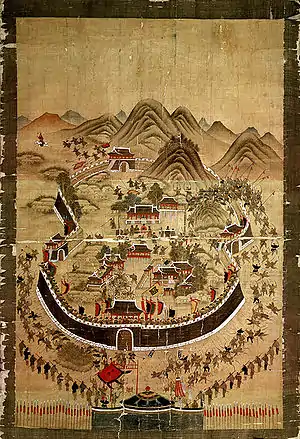
By the 16th century, the military became weak by the disavowment from Confucian scholars. When Japan invaded Korea, the Joseon army was no match for their sheer numbers armed with arquebuses and a combination of arms, and the Japanese pushed them north to Pyeongyang. With the renewed combined efforts of the army, navy, and the Righteous Army, they forced the Japanese back to Pusan. During the 1595–1596 Truce, Seonjo realized how important it was and tried to reform it with the help of Ming generals and established army training centers. He examined the reasons why the Japanese had quickly overrun them. Ryu Seong-ryong, the Prime Minister, spoke out about the Korean disadvantages. He pointed out that Korean castle defenses were feeble, a fact which he had pointed out before the war. He noted how Korean castles had incomplete fortifications and walls that were too easy to scale. He also wanted cannons set up in the walls. Ryu proposed building strong towers with gun turrets for cannons. Besides castles, Ryu wanted to form a line of defenses in Korea. In this kind of defense, the enemy would have to scale many walls to reach Hanseong (Seoul). Ryu also pointed out how efficient the Japanese army was since it took them only one month to get Hanseong and how well organized they were. He noted how the Japanese moved their units in complex maneuvers, often weakening their enemy with the use of arquebuses, then attacking with melee weapons. These reforms helped Joseon Army repel the second invasion of the Japanese army and win the war.
Yi Gwal's Rebellion
After the Injo Coup, the dissatisfied Yi Gwal who helped Injo ascend to the throne incited a rebellion against him for trying to arrest his son, Yi Jeon. He led 10,000 of his soldiers to occupy Hanseong and replace him with Heungangun, his royal relative as king. But the Joseon army led by General Jang Man retook the capital and crushed the rebellion. Yi Gwal's Rebellion weakened the military, making them vulnerable to Later Jin's attack.
Manchu Invasions of Korea
Conservative Westerners took hard-line policy toward the Jurchen-led Later Jin dynasty, keeping their alliance with the Ming dynasty. The Later Jin, who had remained primarily friendly to Joseon, began to regard Joseon as an enemy. Han Yun, who participated in the rebellion of Yi Gwal, fled to Manchuria and urged the Later Jin ruler Nurhaci to attack Joseon; thus, the friendly relationship between the Later Jin and Joseon ended.
Battle of Sarhū
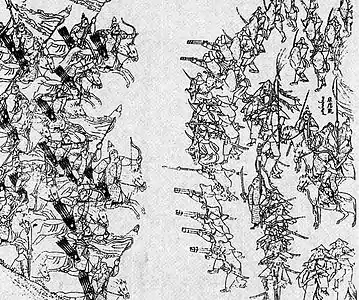
In 1619, the Joseon Expeditionary Force led Commander Gang Hong-rip to engage Later Jin with the Ming Army at the Battle of Sarhū. But the allied forces lost two-thirds of the Joseon Expeditionary Force. The Jurchen released the captives and allowed them to return to their homeland. Gang Hong-rip, however, was kept for his proficiency in the Jurchen language. Later on, General Gang would be led to believe that his family had died in the political turmoil during a coup in his native kingdom of Joseon. To exact his revenge on the Joseon court, he urged Jin to invade Joseon, which led to the First Manchu invasion of Korea in 1627. Only during the peace negotiations did he find out that he had been misled.
The Joseon musketeers being overwhelmed by the Manchu cavalry prompted a revision of military tactics in Korea. In previous decades, the Imjin War was seen as a demonstration of the dominance of the firearm, and Joseon adjusted military forces accordingly. Both sides of the war lacked effective shock cavalry to take advantage of the vulnerabilities of unsupported musketeers. After the defeat at Sarhū, the Joseon forces revised their doctrine to have spearmen supporting the musketeers.
Later Jin invasion of Joseon
In 1627, 30,000 Manchu cavalries under General Amin (阿敏) and former Korean General Gang Hong-rip invaded Joseon, calling for the restoration of Gwanghaegun and execution of Westerners leaders, including Kim Ja-jeom. General Jang Man again fought against Later Jin but could not repel the invasion. Once again, Injo fled to Ganghwa Island. Meanwhile, Jin had no reason to attack Joseon and decided to go back to prepare for war against the Ming, and peace soon settled. The Later Jin and Joseon dynasties were declared brother nations, and Later Jin withdrew from the Korean peninsula. However, most Westerners kept their hard-line policy despite the war. Nurhaci, who had generally good opinions toward Korea, did not invade Korea again; however, when Nurhaci died and Hong Taiji succeeded him as ruler, Jin again began to seek a chance for another war. King Injo provided refuge to Ming general Mao Wenlong and with his unit after they fled from Later Jin and came to Korea; this action caused Later Jin to invade Korea again.
Qing invasion of Joseon
In 1636, Hong Taiji officially renamed his dynasty the Qing dynasty and invaded Joseon personally. The Qing forces purposely avoided battle with General Im Gyeong Eop, a prominent Joseon army commander who was guarding the Uiju Fortress at the time. A Qing army of 128,000 men marched directly into Hanseong before Injo could escape to Ganghwa Island, driving Injo to Namhan Mountain Fortress instead. They ran out of food and supplies during the siege after the Manchu cut all supply lines. Injo finally surrendered to the Qing dynasty ceremoniously, bowing to the Hong Taiji nine times as Hong Taiji's servant and agreeing to the Treaty of Samjeondo, which required Injo's first and second son to be taken to China as captives. Joseon then became a tributary state to the Qing dynasty, and the Qing went on to conquer the Central Plain in 1644. Though they lost the wars, their performance left a strong impression on the Manchus. The first emperor of the newly declared Qing dynasty later wrote: "The Koreans are incapable on horseback but do not transgress the principles of the military arts. They excel at infantry fighting."[14]
Northern Campaigns
Hyojong rose the throne after Injo and Sohyeon's death, he began to reform and expand the military of Korea; first, he removed Kim Ja-jeom, who had corrupted politics and had greater power than the king himself. Then, he called Song Si-yeol (Hangul: 송시열 Hanja:宋時烈) and Kim Sang-heon to his court, who supported the war against the Qing Dynasty. His military expansion was massive, and he also built several border fortresses along Yalu River where Joseon and Qing shared a border. When a band of Dutch sailors, including Hendrick Hamel, drifted on Jeju Island, Hyojong ordered them to build muskets for the army, making it the first time to use firearms since the Imjin War. Hyojong could not implement his plan when his son Hyeonjong stopped him since Joseon had become a tributary state of the Qing Dynasty. The Qing dynasty continued to thrive, expanding quickly into the west after successfully conquering the Ming in 1644. Since the Manchus assimilated the massive Chinese army into their own, they became too mighty to resist. Although reformed and expanded, the Joseon military was no match against the combined Manchu and Chinese forces. Also, the Qing dynasty began to treat Joseon as its friend and closest ally.
The Naseon Jeongbeol (Hangul: 나선정벌 Hanja: 羅禪征伐), or "Suppression of the Russians") or the Northern campaign began when the expanded Joseon military was first put into action in 1654 when the Qing Dynasty called for help to fight against invading Russians. 150 Joseon musketeers, along with 3,000 Manchus, met the Russian army at the Battle of Hutong (Hangul: 호통 Hanja: 好通), present-day Yilan, which the Qing–Joseon allied forces won. In 1658, Hyojong sent troops once again to help the Qing dynasty against Russia. He dispatched 260 Joseon musketeers and cannoneers led by Shin Ryu to join the forces of Ninguta's Military Governor Sarhuda. The joint force sailed down the Hurka and Sungari Rivers and met the Russian troops under the command of an Amur Cossack, Onufrij Stepanov near the fall of the Sungari River into the Amur, killing 270 Russians and driving them out of Manchu territory. The battles against Russia proved that Hyojong's reform had stabilized the Joseon army, although they never put them into action again. Despite the campaigns, Russia and Joseon remained on good terms. After Hyojong died, Hyeonjong rose to the throne and continued his father's military expansion and reconstruction of the nation, devastated by the Seven-Year War and two Manchu invasions.
Foreign Incursions in Korea

By the 19th century, royal relatives controlled the royal court through weak kings causing the military to weaken further. Joseon's isolation policies allowed the military to fire on foreign ships. When the USS General Sherman arrived at Ganghwa Island, they requested the government to open for trade, but the army sank their ship and killed their crew. In 1866, the French launched a putative expedition on Ganghwa Island to demand the government release the catholic priests, but were repulsed by the Tiger Hunters. They spearheaded the defense of Ganghwa with the army behind them. The French left during the winter when they received news that the priests had escaped. In 1871, the Americans too launched a putative expedition to demand the government open for trade and apologize for the General Sherman Incident. The Tiger Hunters again spearheaded the defense, but the army and their coastal fortresses were no match for their superior firepower. 20 Koreans were captured as bargaining chips for the Americans but released the prisoners before they left after a diplomatic failure. These small victories and foreign diplomatic defeats made the Joseon Army blind to its inferiority to modern armies. Japan plundered and pillaged Ganghwa Island for firing on their gunboat Un'yō, finally forcing them to open doors to the world.
Modernization
In 1881, King Gojong and his consort Queen Min spearheaded the military modernization efforts. They invited the Japanese Army attaché Lieutenant Horimoto Reizō to serve as an adviser in creating a modern army. The Japanese gave military training to eighty to one hundred young men of the aristocracy establishing the Pyŏlgigun (Special Skills Force).[15] In January 1882, the government reorganized the existing five-army garrison structure into the Muwiyŏng (Palace Guards Garrison) and the Changŏyŏng (Capital Guards Garrison).[15] However, there was resentment towards the Pyŏlgigun on the part of the regular army soldiers. They envied the formation for better treatment and equipment. Additionally, the army discharged more than 1000 soldiers in overhauling the military; most were old or disabled. The army did not pay them in rice for thirteen months leading up to the Imo Incident which claimed the lives of some Japanese military advisors and the legislation and some Joseon officials. Daewongun returned to power momentarily to restore order.[16]
Under the joint patronage of Gojong and his Queen Consort, they established their first military factories and created new military uniforms in 1884. They requested the United States for more American military instructors to speed up the military modernization of Korea. Out of all the projects that were going on simultaneously, the military project took the longest. In October 1883, American minister Lucius Foote arrived to take command of the modernization of Joseon's older army units that had not started Westernizing. In April 1888, General William McEntyre Dye and two other military instructors arrived from the United States, followed in May by a fourth instructor. They brought about rapid military development. They established a new military school called Yeonmu Gongwon, and an officers training program to begin making the armies become more and more on par with the Chinese and the Japanese.

In January 1894, the modernized army was deployed against the Donghak Peasant Revolution but lost many battles in the beginning due to their sheer numbers and their innovative tactics. When Gojong requested help from the Qing to suppress the rebels, the Japanese sent troops to Seoul, demanding the Joseon Government to send the Qing back. The government refused, and Japan stormed Gyeongbokgung. Despite resistance from the modernized royal guards, Japan occupied the palace and replaced them with a pro-Japanese government beginning the Gabo Reform and the Sino-Japanese War.[17] Japan allied with the Joseon Army and finally suppressed the Donghak rebels in December 1895. Then the Japanese forced the Qing out of Joseon after winning the war. During the reform, the government under the direction of the Japanese established the Hullyeondae or the "Military Training Division." They are an elite regiment of royal guards trained and equipped by the Japanese and led old Korean Army members who hold pro-Japanese sentiments. Gojong ordered the deaths of pro-Japanese officials ending the Gabo Reform, prompting the Japanese to convince the officers of the Hullyeondae that the royal family was seeking help from the Russians and plotted to assassinate Queen Myeongseong. One thousand Hullyeondae troops stormed the palace and battled the royal guards to allow the ronin to assassinate her. [18][19][20] After her death, Gojong proclaimed Joseon the Korean Empire dedicating to modernizing the country and the army.
Organization

Central Army
Joseon Army consisted of 50,000 troops, and the king appointed their generals. They comprise infantry of ordinary soldiers and elite foot soldiers, the Pengbaesu, and the cavalry, the Gabsa. Their officers in the Joseon army came exclusively from the yangban, but they valued scholarship over war as something unworthy of a Confucian gentleman-scholar.[21] The quality of Korean generalship was very variable, with some Korean officers being able and others being men who had not devoted much time to the study of war, preferring archery, writing, practicing their calligraphy, and reading Confucian classics.[22] During the Imjin War, Joseon maintained only a few military units with no field army. Its defense depended heavily on the mobilization of the citizen soldiers in case of emergency.[23] During the first invasion, Joseon deployed a total of 84,500 regular troops throughout, assisted by 22,000 irregular volunteers such as the righteous army.[24]
Defense System
Joseon army mobilizes its troops through the Jeseungbangryak system. This system allows the central government military commanders to control assembled troops from the main army to the local and provincial armies. But, local officers could not individually respond to a foreign invasion outside their jurisdiction until a higher ranking general, appointed by the king's court, arrived with a newly mobilized army.[25][26] This arrangement was highly inefficient since the nearby forces would remain stationary until the mobile border commander arrived on the scene and took control.[26] Secondly, as the appointed General often came from an outside region, he was likely to be unfamiliar with the natural environment, the available technology, and manpower of the invaded region.[26] Finally, as the government never maintained the main army, new and ill-trained recruits conscripted during war constituted a significant part of the army. [26]
Military Training Agency
In September 1593, Seonjo established the Military Training Agency (훈련도감, alternately translated as Military Training Command). The agency carefully divided the army into units and companies. Within the companies were squads of archers, arquebusiers, swordsmen, and spear infantry. The agency set up army divisions in each region of Korea and garrisoned battalions at castles. The upper-class citizens and slaves were subject to the draft. All males had to enter military service to be trained and familiarized with weapons. It was also around this time that the military scholar Han Gyo (한교) wrote the martial arts manual Muyejebo, based on the book Jixiao Xinshu by the famous Chinese General Qi Jiguang. The agency, which initially had less than 80 troops, soon grew to about 10,000.
Equipment
Melee Weapons
The standard Korean sword was the hwando, a short and light curved sword commonly used by Joseon Soldiers during Peacetime. The standard Korean spear was the dangpa, a 7-8ft three-pronged trident with a spear tip in the middle used for close defensive combat to trap an enemy's sword between two of the three prongs.[27] Another polearm used in the army was the woldo, a 9ft curved-bladed polearm with a spike at the end of the handle and a tassel or feather attached to the blade. The woldo was mostly used by the Gabsa for its heavy striking power while on horseback. The infantry but mostly cavalry also used the pyeongon, a 1.5 metres (4 ft 11 in)-long flail made from hardwood stick, painted red, acting as the handle for a chain attached to a shaft with iron nails.[22]
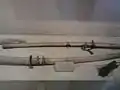 Hwando, standard sword of Joseon military
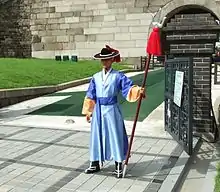 Dangpa, standard polearm of the Joseon Military
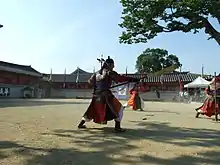 Woldo, a polearm wielded by mostly the cavalry
Armor
Korean foot soldiers wore hats called beonggeoji and helmets but no armor.[22] However, padded armor (eomshimgap, Hangul: 엄심갑, hanja: 掩心甲) was popular among the ordinary soldiers, as Joseon required peasant conscripts to provide their equipment and padded armor offered body protection at a low price. The Korean Dujeong-gap (두정갑) is the Korean equivalent of brigandine and was worn by the Pengbaesu, and the Gabsa. In the late Joseon dynasty, the Dujeong-gap became the primary form of Korean metallic armor and often reached below the knees when worn. The helmet assumes a conical shape and has three brigandine flaps that protect the sides and back of the head. The plates used within the brigandine are of either iron or leather (in which this brigandine worn by peasants was called pigabju).[28]
In 1867, there was an attempt to develop anti-ballistic armor called Myeonje baegab. It was made from 13 to 30 sewed sheets of textiles and cotton combined into a thick vest to the overwhelming firepower of rifles fielded by Western powers such as France and the United States. Although this attempt was partially in line with the current method of producing anti-ballistic vests, it does not appear to have proved effective.
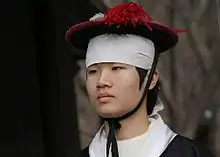 Jeonnip (전립), or called beonggeoji (벙거지), a Korean hat worn by military personnel during the Joseon period
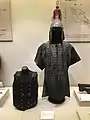 Sets of leather armor worn by peasant conscripts
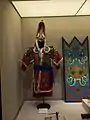 Brass scale armor worn by military officers
 Armor and helmet. Joseon period, 19th century. Musée Guimet.
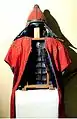 Joseon dynasty Dujeong-gap
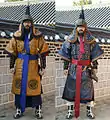 Modern reenactors wearing a complete Dujeong-gap set. While conventionally shown as red, the fabric could be a variety of different colors.
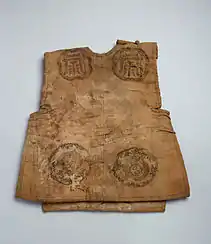 Front of the Myeonje baegab
Archery
Joseon foot soldiers often fought as archers with their bows which had a range of 450 metres (1,480 ft). [22] Archers also used the pyeonjeon, a short arrow, and the tongah to help guide it as part of the standard kit of Chosun era archers. Their quivers held 20 arrows and 10 pyeonjeon arrows. [29] They can fire at an extended range of 350 meters and flatter trajectories with a faster velocity and penetrating power than regular arrows.[30]
Gunpowder
In 1395, several weapons were in use: a series of cannons called the daejanggunpo, ijanggunpo, and samjanggunpo, a shell-firing mortar called the jillyeopo, series of yuhwa, juhwa, and chokcheonhwa rockets, which were the forerunners of the singijeon, and a signal gun called the shinpo.[31] These cannons improved during Taejong's rule. Among the people responsible for the developments was Choe Hae-san, son of Choe Mu-seon. The cheon "heaven" or "sky," Ji "earth," Hyeon "black," and Hwang "yellow" or "gold" names are not significant, being the first four characters of the Thousand Character Classic.[32] His son, Sejong, also made many improvements and increased the ranges of these cannons (called hwapo and later hwatong "fire tube" and chongtong "gun tube").[33] The seungja "victory gun," was a chongtong that serves as a standard Korean gun. It was a handheld shotgun-like cannon attached to a staff or a gunstock that fires a large arrow, a bullet, and 15 small pellets.[34] In the early 1500s, the bullanggi (불랑기/佛狼機), a breech-loading swivel gun, was introduced to Korea from Portugal via China. It was divided into sizes 1 through 5, in decreasing size. The small but powerful cannons of this era saw extensive use during the Japanese invasions of Korea (1592–98) by both the Joseon Army and the navy. Mortars used at this time were the chongtong-wan'gue, byeoldae-wan'gu, dae-wan'gu, jung-wan'gu, and so-wan'gu. These fired stones or the bigeukjincheonre a timed explosive shell. They were very effective against the weaker-built Japanese ships. But during the war, the Koreans seldom employed field artillery, mainly using the cannon in siege action and defending castles. There were only very few instances of Koreans employing artillery in the field, with largely ineffective results.[35] Some irregular Korean units with government-supplied weapons fired explosive shells from mortars, but this occurred only in isolated instances.[35] The Nanjung ilgi says that many captured and used by the Japanese realized their full potential. In 1596, the seungja were phased out in favor of Japanese-style muskets and arquebuses. The Koreans called these jochong (조총/鳥銃). The Hong'ipo (Korean: 홍이포; Hanja: 紅夷砲) was a cannon introduced from the Netherlands by Hendrick Hamel and others in the 1650s. Joseon also used this cannon during the 1866 French campaign against Korea, the 1871 United States expedition to Korea and the Ganghwa Island incident of September 20, 1875.
The Koreans use the hwacha – multiple rocket-propelled arrows. It could fire up to 200 singijeon, a type of rocket arrow, all at one time. The hwacha also has a variant that holds 5 rows of 10 gun barrels that fires bundles of 4 arrow-like projectiles, 50 bullets, or 575 small pellets from each barrel. The hwacha consisted of a two-wheeled cart carrying a board filled with holes into which the singijeon were inserted. The hwacha mainly was deployed during the Siege of Pyongyang in January 1593 and the Battle of Haengju in March 1593.
Modern Weapons
Modern weapons were imported from Japan and the United States in 1883.
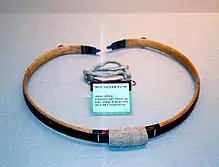 A Korean Bow (각궁, Gak-gung) that has not been strung
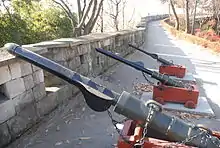 Three large chongtong at the Jinju Fortress museum. The closest is a cheonja-chongtong, the second is a jija-chongtong, and the third is a hyeonja-chongtong.
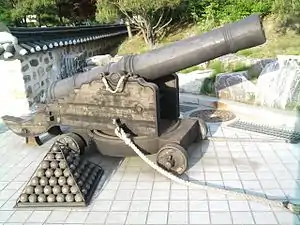 A hong'ipo cannon introduced from the Netherlands by Hendrick Hamel and others in the 1650s
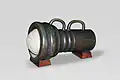 Large mortar with stone round.
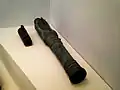 Breech-loading swivel gun.
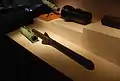 This Cheonja-chongtong is the largest size.
.jpg.webp) Jijachongtong, the second largest cannon in Mid Joseon Dynasty.
Jijachongtong, the second largest cannon in Mid Joseon Dynasty.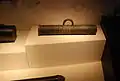 This Hyeonja-chongtong is middle-sized cannon.
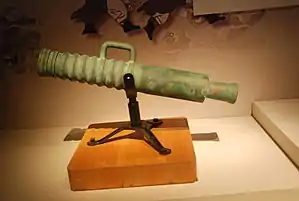 Byeolhwangja-chongtong, which was one of the more miniature cannons.
.JPG.webp) Seungja-chongtong, a hand cannon.
Seungja-chongtong, a hand cannon. Sipyeonjapo, the ten-barreled musket.
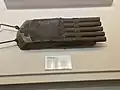 Oyeonjapo, the five-barreled musket.
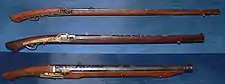 The Koreans called these muskets acquired from the Japanese jochong (조총/鳥銃).
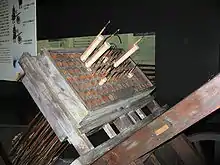 Hwacha launch pad, ignitors placed in the narrow section of each arrow to fire.
Tactics
Joseon's longtime foe, the Jurchens, adopted cavalry mobile warfare and made numerous raids on Joseon's Northern Borders. The Joseon army focused on developing anti-cavalry tactics to counter them. Their main battle tactic is to arm their infantry and cavalry with long-range weaponry to weaken their cavalry charge from a distance and then engage them quickly and fluently. But in an actual combat situation, the cavalry charges into the enemy's spearhead formation and the battle formation.[25]
During the Imjin War, when the army formed their battle positions like the Joseon cavalry formations against the Jurchens, they were withered down by a hail of Japanese arquebuses. Then, the Japanese ashigaru engaged in close-quarters combat. But what the Koreans lack in numbers can make up for it in topography and geography. The Righteous Army utilized stalling tactics to hamper Japanese supply chains on land, but the central army could not utilize them until the second half of the Imjin war.[25]
See also
References
- <<책 한권으로 읽는 세종대왕실록>>(Learning Sejong Silok in one book) ISBN 890107754X
- Seth 2006, p. 138.
- Seth 2010, p. 144.
- Zhang 2008, p. 29.
- John W. Dardess (2012). Ming China, 1368-1644: A Concise History of a Resilient Empire. Rowman & Littlefield. pp. 18–. ISBN 978-1-4422-0490-4.
- Goodrich 1976, p. 1066.
- Peterson 2002, p. 13.
- Twitchett 1998, pp. 286-287.
- Zhang 2008, p. 30.
- "21세기 세종대왕 프로젝트". Sejong.prkorea.com. Retrieved 22 February 2016.
- "한국역대인물 종합정보 시스템 - 한국학중앙연구원". People.aks.ac.kr. 2005-11-30. Retrieved 2016-02-22.
- <<책한권으로 읽는 세종대왕실록>>(Learning Sejong Silok in one book) ISBN 890107754X
- Haywood, John; Jotischky, Andrew; McGlynn, Sean (1998). Historical Atlas of the Medieval World, AD 600-1492. Barnes & Noble. p. 3.24. ISBN 978-0-7607-1976-3.
- Andrade, Tonio (2016). "The Gunpowder Age: China, Military Innovation, and the Rise of the West in World History." Princeton University Press. Page 187.
- Kim 2012, p. 289.
- Keene 2002, p. 372-373.
- "Outbreak of the war: Japan and China dispatch troops to Korea, fighting begins – Declaration of war". The Sino-Japanese War of 1894-1895: as seen in prints and archives. Japanese Center for Asian Historical Events and the British Library.
- Sterling Seagrave; Peggy Seagrave (2003). Gold Warriors: America's Secret Recovery of Yamashita's Gold. Verso. pp. 14, 264. ISBN 1-85984-542-8. Retrieved 2009-01-22.
Hullyondae.
- 훈련대 訓鍊隊 (in Korean). Empas / Britannica. Retrieved 2009-01-22.
- http://kordic.empas.com/dicsearch/view.html?k=sw&i=43631900
- Turnbull, Stephen The Samurai Invasion of Korea, 1592–98, London: Osprey, 2008 pp. 20–21.
- Turnbull, Stephen The Samurai Invasion of Korea, 1592–98, London: Osprey, 2008 p. 21.
- Caraway, Bill. "Korea in the Eye of the Tiger". Korea History Project. Archived from the original on 2008-09-17.
- Turnbull, Stephen. 2002, p. 109.
- Lee, Soon Ho (2011). Military Transformation on the Korean Peninsula: Technology Versus Geography. United Kingdom: University of Hull.
- Turnbull, Stephen. 2002, pp. 17–18.
- MartialArtSwords.com. "What Is the Dangpa?". MartialArtSwords.com. Retrieved 2021-09-08.
- "Home>전시안내>특별전시|국립고궁박물관". www.gogung.go.kr. Retrieved 2021-09-02.
- 최형국, and Hyeong Guk Choi. 2015. "18세기 활쏘기(國弓) 수련방식과 그 실제 -『림원경제지(林園經濟志)』『유예지(遊藝志)』射訣을 중심으로". 탐라문화. 50 권 권: 234.
- "Archery in Joseon Kingdom", 22 July 2014, The Korea Times
- Pak, Song-nae, "Science and Technology in Korean History: Excursions, Innovations, and Issues," December 30, 2005, pp 78–79.
- Turnbull, Stephen, "Fighting Ships of the Far East, Volume 2: Japan and Korea", Jan 25, 2003, p. 21.
- http://sillok.history.go.kr/viewer/viewtype1.jsp?id=kda_12703030_001&grp=&aid=&sid=4875529&pos=4; the Annals of the Joseon Dynasty in Korean.
- Turnbull, Stephen. 2002, pp. 36.
- "The Diary of a Militia" (향병일기; Hyangbyeong-ilgi), stored in the database of the National Institute of Korean History,