Kakori
Kakori is a town and a nagar panchayat in Lucknow district in the Indian state of Uttar Pradesh.[1] It is situated 14 km north of Lucknow. More widely known for its kebabs, Zardozi work and Dasheri mangoes, Kakori is also the centre of once flourishing Urdu poetry, literature and the Qadiriya Qalandari Sufi order. This city came into light of the world history after 9 August 1925 when Indian revolutionaries forcefully snatched the government's treasury from a train. The incident is called as Kakori train robbery or the Kakori conspiracy case of British period.Hindu and Muslim live happy in this town Such family was mainly Hindu caste such as Kayastha ( Nigam, Srivastava) and in Muslim Alavi and Abbasi families . Many old temples and historical monuments belong to their families
Kakori | |
|---|---|
Town | |
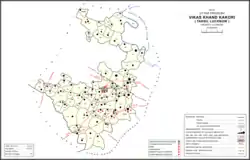 Map of Kakori CD block | |
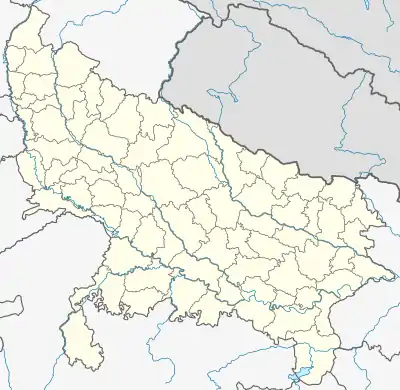  Kakori Location in Uttar Pradesh, India | |
| Coordinates: 26.88°N 80.8°E | |
| Country |  India India |
| State | Uttar Pradesh |
| District | Lucknow |
| Elevation | 121 m (397 ft) |
| Population (2011) | |
| • Total | 19,403 |
| Languages | |
| • Official | Hindi, Urdu |
| Time zone | UTC+5:30 (IST) |
| Vehicle registration | UP-32 |
Importance
Kakori is famous for producing hundreds of civil servants in British India who served all over the country. It was the leading town in Oudh along with Rudauli and Mahmoodabad that supplemented the culture of Lucknow.
Kakori is the main abode of two branches of the Kakorvi Shaikh community, namely Alavi and Abbasi, since the fifteenth Century. The Alavi (often spelt as Alvi) branch claim their lineage to Ali, the fourth Caliph and prophet Mohammed's cousin and his son-in-law. However, this branch claim their lineage to Ali through his son Muhammad bin Hanafiyah, with his wife Khaula-Al-Hanifiyah.
The Alavi of Kakori also referred as Moulvi Zadigan (Moulvis) or Makhdoom Zadigan (Makhdooms) depending whether they are descendant of Mulla Abu Bakr Jami Alavi, who settled in Kakori in 1460 or descendant of Qari Amir Saifuddin Alavi, who settled in Kakori in 1552. The Abbasi branch claims their lineage to Al-Abbas, an uncle of the prophet Muhammad.
The Abbasi of Kakori also referred as Qazi Zadigan (Qazi's), indicating that they are the descendants of Qazi Shaikh Klan (elder or Senior) Abbasi, who settled in Kakori after his appointment as the first Qazi of Kakori by the Royal Court of Delhi in 1490.
Kakori is famous for its mangoes, kebabs, palatial houses of Muslim gentry of Oudh and numerous mosques. The town is the seat of the Qadiria Qalandaria Sufi order and the Urs attracts thousands every year. The poet Mohsin Kakorvi, his son Noorul Hasan Nayyier, the compiler of Nurul Lughaat, one of the authentic Urdu Dictionary to date and the satirist Ghulam Ahmed Alavi 'Furqat Kakorvi' all belonged to this town.
Kakori conspiracy
The looting of a train near Kakori in August 1925 became known as the Kakori conspiracy. The revolutionaries comprised several people involved in the Indian independence movement. A memorial to those revolutionaries exists in the town.[2]
Geography
Kakori is located at 26.88°N 80.8°E.[3] It has an average elevation of 121 metres (396 feet).
Demographics
As of 2001 India census,[4] Kakori had a population of 16,731. Males constitute 53% of the population and females 47%. Kakori has an average literacy rate of 46%, lower than the national average of 59.5%: male literacy is 51%, and female literacy is 40%. In Kakori, 13% of the population is under 6 years of age.
Popular culture
Kakori has been used as a setting for various movies, of which Junoon (1978) and Umrao Jaan (1981) are two examples. Anwar (2007) also featured the town.
Villages
Kakori block contains the following 83 villages:[1]
| Village name | Total land area (hectares) | Population (in 2011) |
|---|---|---|
| Man Mauna | 186.6 | 1,043 |
| Thavar | 673.8 | 4,240 |
| Padra Thavar | 86.4 | 665 |
| Autrouli | 149.5 | 0 |
| Kusmari | 179.1 | 959 |
| Jagtapur | 53.8 | 659 |
| Allupur | 86.4 | 492 |
| Sirsa Mau | 415.4 | 2,317 |
| Raniya Mau | 131.9 | 839 |
| Godramau | 973.5 | 2,992 |
| Bighapur | 64.1 | 790 |
| Sarsanda | 277.5 | 1,523 |
| Banshigarhi | 443.2 | 1,499 |
| Kakrabad | 347.1 | 2,442 |
| Jehta | 674.1 | 5,774 |
| Saitha | 296.1 | 2.505 |
| Maura | 440.3 | 2,806 |
| Saraipremraj | 151.6 | 2,012 |
| Lalnagar | 97.9 | 971 |
| Sikrauri | 322.5 | 6,038 |
| Dashaari | 131 | 1,422 |
| Muhinuddin Pur | 55.5 | 798 |
| Chakdadanpur | 23.2 | 333 |
| Saidpur Gaheri | 159.6 | 2,089 |
| Paliya | 60.3 | 1,168 |
| Bithona | 91.5 | 796 |
| Muzaffar Pur | 110.6 | 1,196 |
| Raipur | 60.5 | 898 |
| Salempur | 420.9 | 5,992 |
| Mahipatmau | 150.1 | 5,722 |
| Kushmora Dhaluapur | 578.5 | 3,000 |
| Amethia Salempur | 515 | 6,618 |
| Pahia Ajampur | 101.8 | 1,844 |
| Kakori | 988.3 | 2,459 |
| Birahu | 143.6 | 977 |
| Dashdoi | 231.6 | 2,270 |
| Gohra Mau | 129.5 | 1,481 |
| Karjhan | 144.3 | 1,220 |
| Chiloki | 25.8 | 638 |
| Mubarakpur | 69.6 | 598 |
| Chakperva | 44.5 | 577 |
| Karimabad | 246.5 | 1,421 |
| Baragaon | 466.9 | 3,084 |
| Mahtava | 78.9 | 834 |
| Gvalpur | 63.5 | 531 |
| Shahpur | 243.2 | 1,969 |
| Bhatau Jamalpur | 477.4 | 1,784 |
| Kusmi | 136.4 | 858 |
| Bhaliya | 337.2 | 2,550 |
| Adampur Indwara | 368.5 | 484 |
| Gahalwara | 332.1 | 1,020 |
| Dona | 689 | 4,180 |
| Naktora | 75 | 414 |
| Jaliyamau | 336.9 | 2,398 |
| Ajmatnagar | 73.8 | 352 |
| Mahmudpur | 30.8 | 214 |
| Goshalalpur | 300.1 | 2,000 |
| Dariyapyr | 49.1 | 463 |
| Saiphalpur | 102.6 | 933 |
| Soodi | 62.7 | 118 |
| Sherpurmau | 145.1 | 1,286 |
| Sarai Alipur | 191.2 | 1,070 |
| Basrela | 192.9 | 1,535 |
| Khanpur Mau | 145 | 764 |
| Behru | 594.1 | 3,991 |
| Revari | 227.7 | 908 |
| Kathigera | 196.2 | 1,590 |
| Belwa | 115.3 | 772 |
| Sakra | 731.3 | 2,858 |
| Tej Krishna Khera | 387.5 | 1,392 |
| Ibrahim Ganj | 39.7 | 1,110 |
| Madarpur | 94.3 | 762 |
| Saraimuhib | 97.5 | 41 |
| Puraina | 132.8 | 1,447 |
| Kuda Eat Gaon | 428.3 | 2,811 |
| Barkatabad Jahangirabad | 489.9 | 1,939 |
| Shivari | 508.5 | 2,710 |
| Hardoiyalal Nagar | 276.6 | 1,870 |
| Tendava | 68.4 | 826 |
| Khushal Ganj | 382 | 4,337 |
| Fatehganj | 46.3 | 1,810 |
| Narona | 311.4 | 2,594 |
| Sarosa Bharosa | 671.9 | 5,585 |
The villages in Kakori block have a total population of 152,277, in 26,735 households.[1]
See also
References
- "Census of India 2011: Uttar Pradesh District Census Handbook - Lucknow, Part A (Village and Town Directory)". Census 2011 India. pp. 28–67, 148–65, 278–292. Retrieved 14 March 2021.
- Sinha, Arunav. "Tourist spot tag may uplift Kakori". The Times of India. Lucknow. TNN. Archived from the original on 16 September 2011. Retrieved 9 May 2013.
- Falling Rain Genomics, Inc - Kakori
- "Census of India 2001: Data from the 2001 Census, including cities, villages and towns (Provisional)". Census Commission of India. Archived from the original on 16 June 2004. Retrieved 1 November 2008.
