Karluk languages
The Karluk languages (also known as the Qarluq or Southeastern Common Turkic languages) are a sub-branch of the Turkic language family that developed from the varieties once spoken by Karluks.[1]
| Karluk | |
|---|---|
| Qarluq, Southeastern Turkic | |
| Geographic distribution | Central Asia |
| Linguistic classification | Turkic
|
Early forms | |
| Subdivisions |
|
| Glottolog | None uygh1240 (Eastern Karluk (Uyghur)) uzbe1247 (Western Karluk (Uzbek)) |
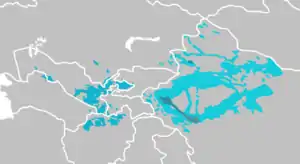 Uzbek Uyghur Äynu Ili | |
Many Middle Turkic works were written in these languages. The language of the Kara-Khanid Khanate was known as Turki, Ferghani, Kashgari or Khaqani. The language of the Chagatai Khanate was the Chagatai language.
Karluk Turkic was spoken in the Kara-Khanid Khanate, Chagatai Khanate, Yarkent Khanate and the Uzbek-speaking Khanate of Bukhara, Emirate of Bukhara, Khanate of Khiva and Khanate of Kokand.
Classification
Languages
- Uzbek – spoken by the Uzbeks; approximately 27 million speakers
- Uyghur – spoken by the Uyghurs; approximately 10 million speakers
- Ili Turki – moribund language spoken by Ili Turkis, who are legally recognized as a subgroup of Uzbeks; 120 speakers and decreasing (1980)
- Chagatai – extinct language which was once widely spoken in Central Asia and remained the shared literary language there until the early 20th century.
- Karakhanid – literary language of the Kara-Khanid Khanate that is considered a standard form of Middle Turkic.
- Khorezmian – literary language of the Golden Horde that is considered a preliminary stage of the Chagatai language.
| Proto-Turkic | Common Turkic | Karluk | Western | |
| Eastern |
Number of native speakers
The Turkic languages are a language family of at least 35 [2] documented languages, spoken by the Turkic peoples. The number of speakers derived from statistics or estimates (2019) and were rounded:[3][4]
| Number | Name | Status | Native speakers | Country |
|---|---|---|---|---|
| 1 | Uzbek | Normal | 27,000,000 |  Uzbekistan Uzbekistan |
| 2 | Uyghur | Normal | 11,000,000 |  China China |
| 3 | Äynu | Critically endangered | 6,000 | China |
| 4 | Ili Turki | Severely endangered | 100 | China |
| Total | Karluk languages | Normal | 38,000,000 |
References
- Austin, Peter (2008). One Thousand Languages: Living, Endangered, and Lost. University of California Press. p. 145. ISBN 978-0-520-25560-9.
- Dybo, A. V. (А. В. Дыбо) (2007). "Khronologiya tyurkskikh yazykov i lingvisticheskiye kontakty rannikh tyurkov" Хронология тюркских языков и лингвистические контакты ранних тюрков [Chronology of Türkic Languages and Linguistic Contacts of Early Türks] (PDF) (in Russian). Moscow. p. 766. Archived from the original (PDF) on 2005-03-11. Retrieved 2005-03-11.
- https://www.ethnologue.com/
- https://glottolog.org/
Authority control  |
|---|