Rohilkhand
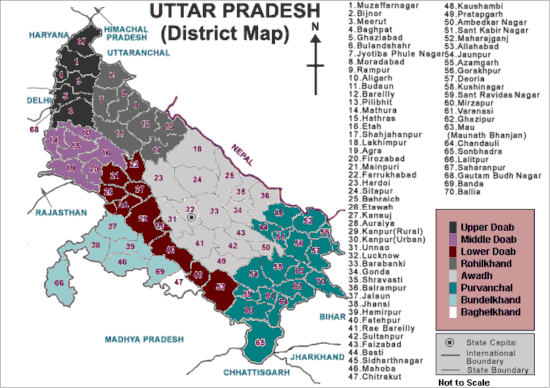
Rohilkhand (previously Rampur State) is a region in the northwestern part of the Uttar Pradesh state of India, centered on Rampur, Bareilly and Moradabad divisions. Part of the upper Ganges Plain, the region is named after the Rohilla tribe who are Pashtun (also known as Afghan or Pathan). The region was called Madhyadesh in the Sanskrit epics Mahabharata and Ramayana.[1]
| Historical region of North India Rohilkhand Madhyadesh | |
 | |
| Location | Uttar Pradesh |
| State established: | 1690 CE |
| Language | Kauravi dialect of Hindi, Standard Urdu, English previously Rohilla Urdu and Pashto |
| Dynasties | Panchalas (Mahabharata era) Mughals (1526–1736) Rohillas (1736–1858) |
| Historical capitals | Bareilly, Budaun, Rampur |
| Separated sube | Amroha, Bahjoi, Bareilly, Bijnore, Budaun, Kakrala, Khutar, Moradabad, Najibabad, Pilibhit, Rampur, Shahjahanpur |
Etymology
Rohilkhand means the "land of the Rohilla." The term Rohilla first became common in the 17th century, with Rohilla used to refer to the people coming from the land of Roh. Roh was originally a geographical term that corresponded with the territory stretching from Swat and Bajaur in the north to Sibi in the south, and from Hasan Abdal (Attock) in the east to Kabul and Kandahar in the west.[2] A majority of the Rohillas migrated from Pashtunistan to North India between the 17th and 18th centuries.
Geography
Rohilkhand lies on the upper Ganges alluvial plain and has an area of about 25,000 km2/10,000 square miles (in and around the Bareilly and Moradabad divisions).
The Ganges Doab to the south and west, Kumaon to the north, Nepal to the east, and the Awadh region to the southeast mark its borders.
Rohilkhand includes the cities of Amroha, Bahjoi, Bareilly, Bijnore, Budaun, Kakrala, Khutar, Moradabad, Najibabad, Pilibhit, Rampur, and Shahjahanpur.
History
The Rohilla Afghan leader Daud Khan lead the settlement in the Katehar region in northern India on order of the Mogul emperor Aurangzeb (ruled 1658–1707) as part of an effort to suppress the Katheria Rajputs uprisings. Rohilla Rajput's first king was Raja Ram Singh Katheria. These Rohilla Rajputs contains 18 reputed clans of Rajput Vansh. Some of these clans are Chauhan, Rathore, Gehlot, Sisodiya, Nikumbh, and Pundir. Originally, some 20,000 soldiers from various Pashtun tribes (Yusafzai, Ghori, Osmani, Ghilzai, Barech, Marwat, Tareen, Kakar, Naghar, Afridi and Khattak) were hired as soldiers by the Monguls. Aurangzeb was impressed with their performance and an additional force of 25,000 Pashtuns were recruited from modern Khyber Pakhtunkhwa and Afghanistan and were given respected positions in the Mogul Army. Nearly all of Pashtuns settled in the Katehar region and also brought their families from modern Khyber Pakhtunkhwa and Afghanistan. During Nadir Shah's invasion of northern India in 1739, lead by the general Ahmed Shah Abdali, a new wave of Pashtuns increased the population to over 1,000,000. Due to the large settlement of Rohilla Afghans, the Katehar region gained fame as Rohilkhand. Bareilly was made the capital of the Rohilkhand state and it became Pashtun majority city with Gali Nawaban as the main royal street. Other important cities were Moradabad, Rampur, Shahjahanpur, Badaun, and others.[3][4]
The Marathas were requested by Safdarjung, the Nawab of Oudh, in 1752, to help him defeat Pashtun Rohilla. The Maratha forces and Awadh forces besieged the Rohillas, who had sought refuge in Kumaon but had to retreat when Ahmad Shah Abdali invaded India.[5][6]
After the Third Battle of Panipat fought in 1761 between the Ahmad Shah Durrani and Maratha Empire, thousands of Pashtun and Baloch soldiers settled in northern India. These diverse ethnic, cultural and linguistic groups merged over the centuries to form the Urdu speaking Muslims of South Asia.
In 1772, Marathas, led by Mahadji Shinde, defeated Rohilla chieftain Zabita Khan, whose possessions lay waste to Rohilkhand. They subsequently destroyed the Rohilla tribal chief Najib-ul-Daula's grave, scattering his bones.[7] During 1772–73, Mahadji destroyed Pashtun Rohillas and captured Najibabad. After plundering Rohillakhand, Maratha proceeded towards Oudh. Foreseeing the same fate as Rohilla, Nawab made frantic calls to British troops in Bengal.
The British company knew Nawab of Oudh posed no danger for the British company, whereas the Maratha wanted to invade Bengal and Bihar after overrunning Oudh. The British dispatched 20,000 British troops on the order of the Viceroy of British India to free Rohillakhand from Maratha and give it to Nawab. The Maratha and British armies came face to face in Ram Ghat, but the sudden demise of the Peshwa and the civil war in Pune to choose the next Peshwa forced the Maratha to retreat. Rohilla decided not to pay, absent a war between the two states. The British made Oudh a buffer state in order to protect it from the Maratha, and from there on, British troops protected Oudh. The subsidy of one British brigade to provide protection to Nawab and Oudh from Maratha was decided to be Rs 2,10,000.[8]
Rohilkhand was under the rule of Rohillas with their capital in City of Bareilly until the Rohilla War of 1774–75. The Rohillas were defeated and driven from Bareilly by the Nawab of Oudh with the assistance of EEIC troops. The state of Rampur was then established under the Nawab of Oudh. In 1803, the British annexed Rohilkhand in Upper Doab.
Rulers
| Name | Reign Began | Reign Ended |
|---|---|---|
| Ali Mohammed Khan | 1719 | 15 September 1748 |
| Faizullah Khan | 15 September 1748 | 24 July 1793 |
| Hafiz Rahmat Khan – Regent | 15 September 1748 | 23 April 1774 |
| Muhammad Ali Khan Bahadur | 24 July 1793 | 11 August 1793 |
| Ghulam Muhammad Khan Bahadur | 11 August 1793 | 24 October 1794 |
| Ahmad Ali Khan Bahadur | 24 October 1794 | 5 July 1840 |
| Nasrullah Khan – Regent | 24 October 1794 | 1811 |
| Muhammad Said Khan Bahadur | 5 July 1840 | 1 April 1855 |
| Yusef Ali Khan Bahadur | 1 April 1855 | 21 April 1865 |
| Kalb Ali Khan Bahadur | 21 April 1865 | 23 March 1887 |
| Muhammad Mushtaq Ali Khan Bahadur | 23 March 1887 | 25 February 1889 |
| Hamid Ali Khan Bahadur | 25 February 1889 | 20 June 1930 |
| Muhammad Said Khan Bahadur | 5 July 1840 | 1 April 1855 |
| Regent | 25 February 1889 | 4 April 1894 |
| Raza Ali Khan Bahadur | 20 June 1930 | 6 March 1966 |
| Murtaza Ali Khan Bahadur – Nawabat abolished in 1971 | 6 March 1966 | 8 February 1982 |
See also
 |
Wikiquote has quotations related to: Rohilkhand |
References
- "Rohilkhand | historical region, India". Encyclopedia Britannica. Retrieved 27 April 2019.
- Gommans, Jos J.L. (1995). The Rise of the Indo-Afghan Empire: C. 1710-1780. BRILL. p. 219. ISBN 9004101098.
The designation Rohilla developed during the seventeenth century as a fairly broad notion of the people coming from Roh or Rõh, corresponding roughly with the mountainous terrain of the eastern Hindu Kush and the Sulaiman Range. Only in the seventeenth-century Indian and Indo-Afghan works is Roh used as a more specific geographical term which corresponded with the territory stretching from Swat and Bajaur in the north to Sibi and Bhakkar in Sind, and from Hasan Abdal in the east to Kabul and Kandahar in the west.
- An Eighteenth Century History of North India: An Account of the Rise And Fall of the Rohilla Chiefs in Janbhasha by Rustam Ali Bijnori by Iqtidar Husain Siddiqui Manohar Publications
- Imperial Gazetteer of India by W M Hunter
- Agrawal, Ashvini. Studies in Mughal History.
- Playne, Somerset; Solomon, R. V.; Bond, J. W.; Wright, Arnold. Indian States: A Biographical, Historical, and Administrative Survey.
- Rathod, N. G. The Great Maratha: Mahadaji Scindia.
- Chaurasia, Radhey Shyam (1947). History of Modern India: 1707 A.D. up to 2000 A.D.