Keio 8000 series
The Keio 8000 series (京王8000系) is an electric multiple unit (EMU) train type operated by the private railway operator Keio Corporation on commuter services in the Tokyo area of Japan since 1992.
| Keio 8000 series | |
|---|---|
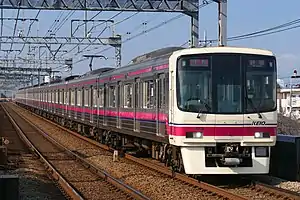 10-car set 8712 in November 2021 | |
| In service | 11 May 1992 – Present |
| Manufacturer | Nippon Sharyo, Tokyu Car Corporation |
| Replaced | 5000 series |
| Constructed | 1992 – 1999, 2009 |
| Refurbished |
|
| Number built | 245 cars (41 sets + 1 car) |
| Number in service | 244 cars (27 sets) |
| Number scrapped | 1 car (8728(I)), accident damage) |
| Formation |
|
| Fleet numbers |
|
| Capacity | 143 (end cars) 154/155 (intermediate cars) |
| Operator(s) | Keio Corporation |
| Depot(s) | Wakabadai, Takahatafudō |
| Line(s) served | KO Keio Line |
| Specifications | |
| Car body construction | Ivory painted steel (cab ends) Stainless steel (body) |
| Car length |
|
| Width |
|
| Height | 4,055 mm (car without pantograph) 4,100 mm (car with pantograph) |
| Entry | Level |
| Doors | 4 pairs of sliding doors per side |
| Wheel diameter | 860 mm[1] |
| Wheelbase | 2200 mm (motored bogie) 2100 mm (trailer bogie)[1] |
| Maximum speed |
|
| Weight |
|
| Traction system | Variable frequency (GTO/Si-IGBT/IGBT) |
| Traction motors |
|
| Power output | 150 kW x4 per motored car |
| Transmission | Motor mounted on bogie frame, Westinghouse-Natal joint, gear wheels (parallel-axis drive) Gear ratio: 85:14 = 6.07 |
| Acceleration | 3.3 km/h/s (after high acceleration modification) 2.5 km/h/s (as built) |
| Deceleration | 3.5 km/h/s (full-service braking) 4.0 km/h/s (emergency braking) |
| Auxiliaries | Electric air compressor Reciprocating type (HS-20D), 2,130 ℓ/min flow rate In most of remodeled 10-car sets: Rotary-screw type (RWS20J), 1,600 ℓ/min flow rate |
| Power supply | Static converter 4/6-car sets: 200 V AC, 130 kVA 8-car sets: 200 V AC, 190 kVA Remodeled 10-car sets: 200 V AC, 250 kVA |
| Train ventilation | One central rooftop air-cooling unit per car (42,000 kcal/h, 48.84 kW); heaters beneath seats |
| Electric system(s) | 1,500 V DC overhead catenary |
| Current collection method |
|
| UIC classification |
|
| Bogies |
|
| Braking system(s) | Electronically controlled pneumatic brakes with regenerative braking |
| Safety system(s) | Keio ATC |
| Coupling system | Shibata |
| Headlight type |
|
| Track gauge | 1,372 mm (4 ft 6 in) |
| Seating | Seating arrangement (intermediate cars): 4-7-7-7-4 on longitudinal bench seats (440 mm wide, bucket style) |
Technical details
- MT ratio
- 0 subseries: 10-car set: 6M4T (six motor cars and four trailer cars; each motor car has four motors)
- 20 subseries: eight-car set: 4M4T
- Motor output: 150 kilowatts (200 hp)
- Gear ratio: 6.07
- Drive mechanism: Parallel cardan
- Traction control system: GTO-VVVF
- Headlights: Sealed beam
- Destination indicators: roller-blind or 3-color LED
- Passenger information displays: 3-color LED (4 per car)
- Seating arrangement (intermediate cars): 4-7-7-7-4 on longitudinal bench seats
Body
The body is stainless steel. The front is steel.
Driver's cab
"T" shape one handle master-controller system. Analog (formerly digital) speedometer. TNS (Train Navigation System).
- Acceleration: 4 notch
- Deceleration: 7 notch + emergency
Formations
As of 1 April 2015, the fleet consists of 14 ten-car sets and 13 eight-car sets (244 vehicles in total), formed as follows.[2]
- c=Driver's cab; T=trailer, M=motor
0-subseries ten-car sets
← Shinjuku Keio-Hachiōji → | |||||||||||
| Designation | Tc | M | M | M | M | T | T | M | M | Tc | |
|---|---|---|---|---|---|---|---|---|---|---|---|
| Numbering | 8701 : 8713 | 8001 : 8013 | 8051 : 8063 | 8101 : 8113 | 8151 : 8163 | 8751 : 8763 |
+ | 8801 : 8813 | 8201 : 8213 | 8251 : 8263 | 8851 : 8863 |
| 8714 | 8014 | 8064 | 8114 | 8164 | 8514 | 8564 | 8214 | 8264 | 8864 | ||
20-subseries eight-car sets
← Shinjuku Keio-Hachiōji → | ||||||||
| Designation | Tc | M | M | T | T | M | M | Tc |
|---|---|---|---|---|---|---|---|---|
| Capacity (total) | 143 | 155 | 154 | 154 | 154 | 154 | 154 | 143 |
| Numbering | 8721 : 8733 | 8021 : 8033 | 8071 : 8083 | 8521 : 8533 | 8571 : 8583 | 8121 : 8133 | 8171 : 8183 | 8771 : 8783 |
Interior
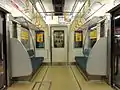
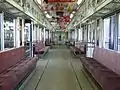 Interior of car in original condition
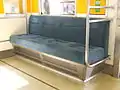 Priority seats of car in original condition
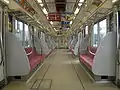 Interior of a refurbished car
 Priority seats of a refurbished car
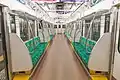 Interior of a renewal car
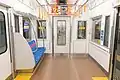 Priority seats of a renewal car
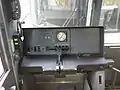 Driver's cab
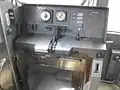 Driver's cab with analog speedometer
History
The first 8000 series trains were introduced in 1992.[3]
Six-car and four-cars sets (and occasionally a pair of four-car sets) used to be operated on splitting services which separated and re-joined at Takahatafudō Station until 2006. Now, all six- and four-car 0-subseries sets are permanently formed as 10-car trains.[3]
The 8000 series trains are used exclusively on Keio Corporation lines. Thus, unlike some other Keio trains, they do not continue past Shinjuku on to the Toei Shinjuku Line.
One 8000 series train was involved on the October 2021 Tokyo attack.
Special liveries
Set 8713 received a special all-over green livery in September 2009 evoking the livery carried by the former 2000 series trains.[4]
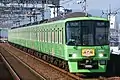 Set 8713 in special all-over green livery in November 2021
References
 |
Wikimedia Commons has media related to Keio 8000 series. |
- "TS-823A TS-824 / 京王電鉄8000系|台車近影|鉄道ホビダス" [TS-823A TS-8224 / Keio Electric Railway 8000 series]. rail.hobidas.com (in Japanese). Retrieved 7 October 2021.
- 私鉄車両編成表 私鉄車両編成表 2015 [Private Railway Rolling Stock Formations - 2015] (in Japanese). Japan: Kotsu Shimbunsha. 23 July 2015. ISBN 978-4-330-58415-7.
- 私鉄車両年鑑 2013: 大手15社営業用車両完全網羅 私鉄車両年鑑2013 [Japan Private Railways Annual 2013] (in Japanese). Tokyo, Japan: Ikaros Publications Ltd. 20 March 2013. p. 153. ISBN 978-4-86320-693-9.
- 高尾山をイメージしたラッピング車両を運行 [Train to run with wrapping livery with Mt Takao theme] (PDF). News release (in Japanese). Japan: Keio Corporation. 24 September 2015. Archived (PDF) from the original on 6 October 2017. Retrieved 6 October 2017.