Kemalist historiography
Kemalist historiography (Turkish: Kemalist tarihyazımı) is a narrative of history promoted by the political ideology of Kemalism and influenced by Atatürk's cult of personality. It asserts that the Republic of Turkey represented a clean break with the Ottoman Empire, and that the Republican People's Party did not succeed the Committee of Union and Progress (CUP). These claims have been widely rejected by scholars, notably by Taner Akçam, Erik-Jan Zürcher, Uğur Ümit Üngör and Hans-Lukas Kieser.[1][2][3][4][5][6][7][8][9][10]

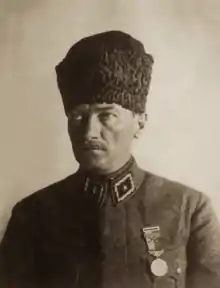
Orthodox Kemalist historiography views Ottoman traditions as an obstacle to the introduction of Westernising political reforms, and instead adopts the heritage of pre-Islamic Turks, which it considers to be naturally progressive, culturally pure and uncorrupted. The historiography magnifies Mustafa Kemal's role in the World War I and Turkish War of Independence, and some versions of Kemalist historiography consider the latter war as an anti-imperialist struggle against the Entente Powers, a view rejected by multiple contemporary scholars. The historiography omits or attempts to justify the suffering of religious and ethnic minorities during the late Ottoman Empire and the Turkish Republic, often viewing them as a security threat to the state, or rebels instigated by external powers.
Today, Kemalist historiography is embraced by Turkish neo-nationalism (Ulusalcılık),[11] and sometimes by anti-Kemalist conservatism and Islamism, especially in the case of Armenian Genocide denial.[12]
Historiography
Pre-Islamic Turkic people
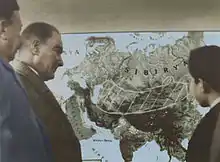
Starting with 1920s, the Kemalist regime envisioned a Western-style country, with one of the desired goals being an expansion of women's rights. Entrenched Islamic tradition was seen as an obstacle to introduce such reforms, and in order to subvert them, Turkish ideologue Ziya Gökalp composed a myth, suggesting that old Turkic people had the characteristics of a feminist society. According to him, women of this period had the same rights as their husbands, and were equally active in social life with men. He further asserted that women governed fortresses, participated in trade, and rode horses by themselves.[13]: 391–392 Concurrently, Gökalp thought that modernization and Westernization were not the same things, and that the key concepts of modernization were already rooted deep down in Turkishness. For this reason, he argued that Turkey did not necessarily need to become a part of the West, which he saw dangerously individualist and romanticist, but rather should turn back to their semi-mythical Central Asian origins.[14]: 147–148 Yeşim Arat, a Turkish political scientist specialized in gender politics, comments on the legitimacy of this thesis as such:
This period was idealized, if not invented, to legitimize the Western values of secularism, equality and nationalism that the Turkish project of modernity sought to adopt.[15]
In the 1930s, the Association for the Study of Turkish History (Türk Tarihi Tetkik Cemiyeti) was ordered to publish a history book called Türk Tarihinin Ana Hatları (Outlines of Turkish History) which reflected the nationalist mythical historiography.[16]: 11 Some nationalist historians of the Republican era claimed that Hittites were Turks, in an attempt to hearken back the origins of the Turks to prehistoric Anatolian civilizations, despite a wide academic consensus that tribal Turks migrated to Asia Minor during the 11th century.[14]: 147–148 The same historiography also attributed the roots of Sumerian, Akkadian, Celt, Mongol, Russian, Irish and Chinese people to Turkishness, to suggest that Turks were the ethnicity that spread 'civilization' to the rest of the world. [16]: 11
Ottoman Empire
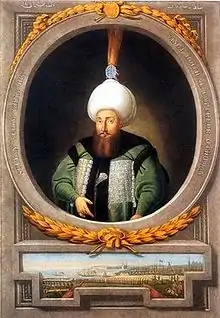
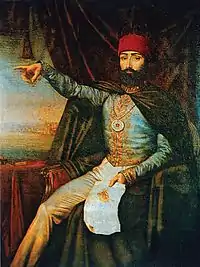
Anti-Western yet pro-Westernization, Kemalist historiography rarely uses Western primary, and secondary sources, as well as the sources that originate from non-Turkish languages of the Ottoman Empire. It describes the history of Ottoman Empire based on Turkish national identity, and often neglects the experiences of non-Muslims and minority groups of the late empire, especially on topics such as conscription, desertion, and forced labor; while also erasing the diversity of the early empire. The historiography therefore has a tendency to 'Turkify' the Ottomanist ideology that was present within the Muslim and non-Muslim subjects of the empire.[17]
The reforms that date back to Selim III and the Tanzimat period, is regarded as a "teleological history of modernization" that aims to facilitate "ideological mobilization", a view that thrived further in the early Kemalist Republic.[17] Erasing the memory and culture of the Ottoman Empire was therefore seen as a necessity by the Kemalist regime, in order to successfully implement said "ideological mobilization", that is to introduce modern Western political ideals into Turkey.[17]
World War I
The Kemalist narrative of the Great War (Cihan Harbi) puts the emphasis on the victories that took place on the Turkish mainland, thus excluding Balkan and Arab provinces. Therefore, it promotes the Battle of Gallipoli, led by Mustafa Kemal, and sidelines events such as the Siege of Kut, which took place in Mesopotamia. The historiography also downplays the importance of German officiers and Esad Pasha in the former battle, thus elevating Kemal; this is achieved by an extensive interview published in a newspaper called Yeni Mecmua, publicising him as the "hero of Anafartalar". Even though Kemalist historiography is critical of the Unionists' desicion to involve in the world war, the similarity of personnel and ideas between the CUP and the early Kemalist revolutionaries encouraged Kemalist Turkey to protect the legacy of CUP members; this was a tendency that lasted until the rise of the AKP in the early 2000s.[17]
Turkish War of Independence
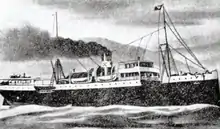
The official historiography of Turkish War of Independence is mostly based on the memoirs of Mustafa Kemal, overshadowing the internal conflict between and accomplishments of former CUP members during the war.[18] According to this narrative, the War of Independence was waged against the Allied Powers. This is rejected by Vahagn Avedian on the grounds that Turkish National Movement mostly fought against neighboring Christian nations in Anatolia, namely Greece and Armenia.[18]
Nutuk (The Speech) is a thirty-six hour speech delivered by Mustafa Kemal to the Turkish Grand National Assembly in 1927. Discussing the events between 1919 and 1923, it paved the ground for the foundation myths of Turkish Republic and the official historiography of the War of Independence.[16]: 10–14 British Historian Perry Anderson states that, "The speech he gave in 1927 that became the official creed of the nation dwarfed any address by Khrushchev or Castro. [It was] a record in the annals of autocracy."[19] Tanıl Bora, however, notes that the importance of Nutuk as a keystone in Kemalist historiography only emerged after the 1980 Turkish coup d'état. He points out that no new editions of Nutuk were printed between 1938 and 1950, and that after 1950 it was not regarded as a "holy book" for "a long time". Even when the emphasis on it grew after 1980, Bora states that Nutuk was not read very widely but was rather used as "iconological material".[20]: 124
In contemporary Turkey, Islamist, socialist, liberal, and Kurdish nationalist narratives challenge the official historiography of the war.[21] After the establishment of the Republic, Kazım Karabekir, a military officer during the war, Rauf Orbay, a statesman and Rıza Nur, a surgeon and politician, also disputed this historiography by writing and publishing their own memoirs. Karabekir's memoirs were burned by Kılıç Ali, a close associate of Mustafa Kemal, with only one copy surviving.[21]: 279–308
Some Kemalist writing has taken the position that as a struggle against imperialism, the War of Independence had set an example for the world to emulate. Left-wing nationalist Yakup Kadri Karaosmanoğlu saw it as "the first time when an unjust and cruel international hierarchy was shaken". This internationalist position was toned down by the government in the 1940s due to political concerns. A notable left-wing critic of this idea is Fikret Başkaya, who, in his book Paradigmanın İflası ("Failure of the Paradigm", 1994), disputed the proposition that the War of Independence had an anti-imperalist element, saying that it was not conducted against "the central powers of imperialism", but against Greece, which had been acting on its own nationalistic aspirations. Başkaya claimed that this narrative enabled the atrocities against non-Muslims and Kurds to be overlooked, and ended up being imprisoned for having written the book.[20]: 162–164
Armenian and Greek genocides
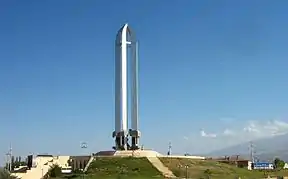
Kemalist historiography omits the grievances of Greek and Armenian minorities (see Armenian and Greek genocides), and memorializes the suffering of the Turkish people.[17] This narrative is not only embraced by admirers of the Kemalist past, however, as Conservatives and Islamists maintain the same approach to the events of 1915. To this day, the memory of the perpetrators of Armenian genocide is preserved in many place names, including schools, streets, and squares, both in Turkey and Northern Cyprus.[12]
In the late 1990s and early 2000s, the works of Taner Akçam challenged orthodox scholarship, which had also been adopted by scholars outside Turkey, such as Stanford Shaw. Largely because of this shift, followers of the orthodox historiography after the turn of the 21st century tend to minimize the suffering of Armenian people, instead of completely ignoring it. This, too, is regarded to be illegitimate by the wider academic consensus.[12]
Single-party period
In the year 1937–38, the Kemalist Republic tightened its control on Dersim in an effort to create a homogenous, centralized state. The forthcoming uprising resulted in a massacre of Kurdish Alevis, killing thirteen thousand people. The act was publicly justified as "disciplining and punishment" (tedip ve tenkil). It contributed to a Kemalist perception of Dersim and its populace, which characterises the province as unruly and defends violent state intervention. This narrative is encountered in Naşit Hakkı Uluğ's book The Feudal Lord and Dersim (Derebeyi ve Dersim), which depicts Dersim as a security threat to the Turkish Republic.[22] It was not until 2009 that the massacre was publicly acknowledged, and in recent years, oral history has been used as a method to study anti-civilian violence excluded from the official history of the event.[23]
Later interpretations
Multi-party period
.png.webp)
Towards the late 1970s, Turkey's attitude to its historiography underwent a process of rapid change, largely as a result of killings committed by the Armenian Secret Army for the Liberation of Armenia (ASALA) and the emergence of the Armenian genocide as a pressing foreign affairs issue. The state's reaction to this shift in global priorities was to create and memorialize its own historiography by way of state-sponsored publications and "public commemorations".[17]: 369–370
This attitude underwent a process of change for a second time after the 1980 Turkish coup d'état. The military, with the intention of social engineering, aimed to spread Kemalist values, which they preferred to refer to as Atatürkism (Atatürkçülük). During this period, the government purged a large number of left-wing scholars from higher education institutions, especially the ones who worked on disciplines such as economy, political sciences, and history, in order to reorganize academia. The military junta assigned loyal figures to the emptied posts. The excluded academicians either started to work on private sector or moved abroad. The ones who remained, founded scientific publishing houses such as Belge and İletişim, and associations such as Tarih Vakfı (the Foundation for History), as the military regime liberalized overtime. This trend ultimately led to foundation of private universities starting with the mid-1990s.[17]: 382
There was a third change in attitude towards the late 1990s and early 2000s. During these fifteen years, the number of publications on World War I flourished. Possibly due to the factors such as political and economical liberalization, and the rise of the AKP, works with alternative narratives that challenged Kemalist ones emerged. As a result of this, the military domination of research output and historical discourse was broken. However, as the AKP later allied with its former rivals, the historiography took another nationalistic turn.[17]: 369–370
Neo-nationalist narrative
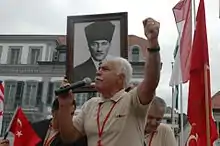
Ulusalcılık[lower-alpha 1] is a secularist (laik), neo-nationalist ideology in Turkey that is influenced by Kemalism. Until the late 20th century, the word had been used as an equivalent of 'nationalism'. However, in the mid-1990s, it transformed into a ideology led by left-wing nationalists Mümtaz Soysal and Doğu Perinçek.[24] As a reaction to the rise of a reformist, but staunchly conservative AKP in 2000s, Ulusalcıs came up with numerous conspiracy theories.
The central theme of these theories is a world-wide conspiracy to destroy Turkey, which is believed to be spearheaded by countries such as United States, EU member states, Greece, Israel, and Armenia, ethnicities such as Greeks, Arabs, and Armenians, and ideologies such as liberalism, anti-nationalist leftism, and Islamism.
To further consolidate their claims, the leaders of the ideology sought to 'historically prove' their theories, thus developing Kemalist historiography and radicalizing it. These theories were popularized by media outlets such as Sözcü, a staunch Kemalist and xenophobic[11][25][26] newspaper. According to Doğan Gürpınar, the theories are mostly popular among upper-middle-class secular Turks; however, he notes that there is a lack of definitive research on this area.[11]
Archives and journals
In Turkey, official military sources have dominated scientific publishing on military history since the 1920s. Askeri Mecmua (The Military Journal), which was first issued in 1882, was a prime example of this. The journal published sixty-two papers on World War I between March 1919 and March 1948. Starting with 1952, these papers were featured in Harp Tarihi Vesikaları (Documents on the History of War), which was later renamed to Harp Tarihi Belgeleri in 1973, and ultimately in Askerî Tarih Belgeleri (Documents of Militiary History) between 1978 and 2004.[17]: 372–373
In 1916, Ottoman Ministry of War created a department to gather and categorize the war documents. These documents, mostly consisting of war diaries, were stored in the Military Archives (Tarih-i Harp Şubesi). The recently created department operated under the General Staff. Today, after a series of name changes, this department is know as Askerî Tarih ve Stratejik Etüt Başkanlığı (ATASE, Directorate for Military History and Strategic Studies). Other archival documents are stored at Başbakanlık Osmanlı Arşivleri (BOA, Ottoman Archives of the Prime Ministry). As of 2021, many diaries of the officers of Turkish War of Independence, which are located at ATASE, have not been examined by scholars.[17]: 372–374 The inaccessible archives at ATASE are also believed to contain documents that will help shed light on the causes of the Armenian genocide.[27]
Footnotes
- Ulusalcılık, noun; Ulusalcı, adjective. Both originate from ulusal "national" or ulus "nation".
References
- Sönmez, Erdem (2020). "A past to be forgotten? Writing Ottoman history in early republican Turkey". British Journal of Middle Eastern Studies. 48 (4): 753–769. doi:10.1080/13530194.2020.1714428. S2CID 212765576.
- The Ottoman Empire in the Historiography of the Kemalist Era: a Theory of Fatal Decline (Büşra Ersanli, page 115) The Ottomans and the Balkans: a discussion of historiography eds. Fikret Adanır and Suraiya Faroqhi
- Edhem Eldem (2018). "Sultan Abdülhamid II: Founding Father of the Turkish State?". Journal of the Ottoman and Turkish Studies Association. 5 (2): 25. doi:10.2979/jottturstuass.5.2.05.
- Gurpinar, Dogan (2011). "Double Discourses and Romantic Nationalism: The Ottoman Empire as a 'Foreign Country'". Int. J. Turkish Studies. 17 (1–2).
- Akturk, Ahmet Serdar (2010). "Arabs in Kemalist Turkish Historiography". Middle Eastern Studies. 46 (5): 633–653. doi:10.1080/00263206.2010.504553. S2CID 145675272.
- Eissenstat, Howard (2003). "History and Historiography: Politics and Memory in the Turkish Republic". Contemporary European History. 12 (1): 93–105. doi:10.1017/S096077730300105X. ISSN 0960-7773. JSTOR 20081142. S2CID 154502242.
- Zürcher, Erik Jan (2014). "Monologue to Conversation: Comparative Approaches in Turkish Historiography". Turkish Studies. 15 (4): 589–599. doi:10.1080/14683849.2014.987906. S2CID 143152800.
- Göçek, Fatma Müge (2007). "Turkish Historiography and the Unbearable Weight of 1915". The Armenían Genocíde Cultural and Ethical Legacies. Routledge. ISBN 978-1-315-13101-6.
- Ter-Matevosyan, Vahram (2019). "Problems of Definition and Historiography of Kemalism". Turkey, Kemalism and the Soviet Union: Problems of Modernization, Ideology and Interpretation. Springer International Publishing. pp. 7–39. ISBN 978-3-319-97403-3.
- Göçek, Fatma Müge (2011). "Reading Genocide: Turkish Historiography on 1915". In Suny, Ronald Grigor; Göçek, Fatma Müge; Naimark, Norman M. (eds.). A Question of Genocide: Armenians and Turks at the End of the Ottoman Empire. Oxford University Press. pp. 42–52. ISBN 978-0-19-979276-4.
- Gürpinar, Doğan (2013). "Historical Revisionism vs. Conspiracy Theories: Transformations of Turkish Historical Scholarship and Conspiracy Theories as a Constitutive Element in Transforming Turkish Nationalism". Journal of Balkan and Near Eastern Studies. 15 (4): 412–433. doi:10.1080/19448953.2013.844588. S2CID 145016215.
- Anderson, Perry (2008-09-25). "After Kemal". London Review of Books. 30 (18). ISSN 0260-9592. Retrieved 2021-11-30.
- Kasaba, Reşat, ed. (November 2009). Cambridge History of Turkey. 4. Cambridge University Press.
- White, Jenny B. (2003). "State Feminism, Modernization, and the Turkish Republican Woman". NWSA Journal. 15 (3): 145–159. doi:10.2979/NWS.2003.15.3.145. ISSN 1040-0656. JSTOR 4317014. S2CID 143772213.
- Arat, Yeşim (2000). "From Emancipation To Liberation: The Changing Role of Women in Turkey's Public Realm". Journal of International Affairs. 54 (1): 107–123. ISSN 0022-197X. JSTOR 24357691.
- Üngör, Uğur Ümit (2011). "The Calm after the Storm: The Politics of Memory". Making of the Modern Turkey. Oxford University Press. ISBN 9780199603602.
- Toumarkine, Alexander (2021). "Coming to Terms with the Imperial Legacy and the Violence of War: Turkish Historiography of World War I between Autarchy and a Plurality of Voices, 1914–2019". In Cornelissen, Christoph; Weinrich, Arndt (eds.). Writing the Great War: The Historiography of World War I from 1918 to the Present. Berghahn Books. pp. 368–408. ISBN 9781789204544. JSTOR j.ctv1tbhq0p.15.
- Avedian, Vahagn (2012). "State Identity, Continuity, and Responsibility: The Ottoman Empire, the Republic of Turkey and the Armenian Genocide". European Journal of International Law. 23 (3): 797–820. doi:10.1093/ejil/chs056.
The ‘War of Independence’ was not against the occupying Allies – a myth invented by Kemalists – but rather a campaign to rid Turkey of remaining non-Turkish elements.
- Anderson, Perry (2008-09-11). "Kemalism". London Review of Books. 30 (17). ISSN 0260-9592. Retrieved 2021-12-09.
- Bora, Tanıl (2017). Cereyanlar: Türkiye'de Siyasî İdeolojiler (in Turkish). Istanbul: İletişim Yayınları.
- Aktürk, Şener (2012). "Politics of History in Turkey". The Convolutions of Historical Politics. Central European University Press.
- Astourian, Stephan; Kévorkian, Raymond (eds.). "Physical and Epistemic Violence against Alevis in Modern Turkey". Collective and State Violence in Turkey: Construction of a National Identity from Empire to Nation-State. Berghahn Books.
- Orhan, Gozde (2020). "REMEMBERING A MASSACRE: HOW DID THE RISE OF ORAL HISTORY AS A METHODOLOGY IMPROVE DERSIM STUDIES?". Wrocławski Rocznik Historii Mówionej. doi:10.26774/wrhm.249.
- "ulusal". Nişanyan Sözlük. Retrieved 2021-11-20.
- Polat, Ferihan; Subay, Özlem Özdeşim; Ulutürk, Ahu Sinem (2018-10-31). "Reading Xenophobia in Turkish Media Through Syrian Refugees: Samples of Yeni Akit and Sözcü Newspapers". Avrasya Sosyal ve Ekonomi Araştırmaları Dergisi. 5 (10): 135–146.
- "Interrupted Social Peace: Hate Speech in Turkish Media". The International Academic Forum (IAFOR). Retrieved 2021-12-07.
- Der Matossian, Bedross (2015). "Explaining the Unexplainable: Recent Trends in the Armenian Genocide Historiography". Journal of Levantine Studies. 5 (2): 156. ISSN 2222-9973.