Ken Calvert
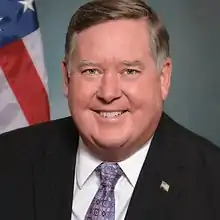
Kenneth Stanton Calvert (born June 8, 1953) is the U.S. representative for California's 42nd congressional district, and previously the 44th and 43rd, serving since 1993. He is a member of the Republican Party. The district is part of the Inland Empire of Southern California.
Ken Calvert | |
|---|---|
 | |
| Member of the U.S. House of Representatives from California | |
| Assumed office January 3, 1993 | |
| Preceded by | New Constituency (Redistricting) |
| Constituency | 43rd district (1993–2003) 44th district (2003–2013) 42nd district (2013–present) |
| Personal details | |
| Born | Kenneth Stanton Calvert June 8, 1953 Corona, California, U.S. |
| Political party | Republican |
| Residence | Riverside County, California, U.S. |
| Education | Chaffey College San Diego State University (BA) |
Early life, education, and business career
Calvert was born in Corona, California, to Marceline Hamblen and Ira D. Calvert, Jr.,[1] and still lives in Corona. In 1970, shortly after high school, he joined the Congressional campaigns of former state Assemblyman Victor Veysey. Calvert worked in Veysey's Washington, D.C., office as an intern after a 1972 victory. He graduated from Corona High School in 1971.
Calvert received an Associate of Arts degree from Chaffey Community College in 1973 and a Bachelor of Arts degree from San Diego State University in 1975. After graduation, he managed his family's restaurant in Corona, the Jolly Fox, for five years. He then entered the real estate industry and ran Ken Calvert Real Properties until he was elected to Congress.
U.S. House of Representatives
Elections
In 1982, the 29-year-old Calvert ran for the United States House of Representatives to represent a newly drawn district. He narrowly lost the Republican primary to Riverside County Supervisor Al McCandless, who was the choice of the Republican establishment. McCandless won the general election.
Calvert was first elected to the House in 1992, when McCandless was reelected in a different district. Calvert won the general election with 47% of the vote, defeating Democrat Mark Takano by 519 votes. In 1994, he was defeated Joe Khoury in the Republican primary, 51% to 49%. He was reelected in the 1994 general election with 55% of the vote, again defeating Takano.
In 1996, Calvert was reelected with 54% of the vote, defeating Democrat Guy Kimbrough. In 1998 he defeated Democrat Mike Rayburn with 55% of the vote. Calvert won again in 2000 with 74% of the vote, facing no major-party opposition.
Calvert was reelected in 2002, defeating college administrator Louis Vandenberg with 64% of the vote. He defeated Vandenberg again in 2004 with 61% of the vote, and in 2006 with 60% of the vote.[2]
In 2008, Calvert had a surprisingly close race, defeating Democratic nominee Bill Hedrick with 52% of the vote.[3] He declared victory immediately, but Hedrick waited three weeks before conceding, due to unusually high turnout prolonging the vote-counting process.[4]
In 2010, Hedrick ran against Calvert again. While most pundits such as Larry Sabato expected him to lose again,[5] sources such as The New York Times ranked the race more competitive. The New York Times re-ranked this race from solid Republican to leaning Republican.[6] Calvert won by ten percentage points.[7]
The National Journal's Cook Political Report named Calvert one of the top 10 Republicans most vulnerable to redistricting in 2012, largely due to his district's rapidly growing Hispanic population.[8] Despite this, Calvert defeated opponent Michael Williamson with 61% of the vote.[9]
Tenure
- 111th and 112th Congress
On June 10, 2009, Calvert introduced H.R. 2788, the Distinguished Flying Cross National Memorial Act. This Act designates a national memorial at March Field Air Museum in honor of current and former members of the armed forces who have been awarded the Distinguished Flying Cross. Calvert worked to assemble a bipartisan group of 48 cosponsors for this legislation. On March 19, 2010, H.R. 2788 unanimously passed the House of Representatives.[10] Calvert introduced H. Res. 377, a bill recognizing Armed Forces Day and the exemplary service of the members of the United States Armed Forces on April 29, 2009. This bill received 70 bipartisan cosponsorships and passed the House unanimously on May 14, 2009.[11]
On March 25, 2010, Calvert introduced H. Res. 1219 to support the designation of a National Child Awareness Month to promote awareness of children's charities and youth-serving organizations across the country. He assembled 40 bipartisan cosponsors for this bill and on July 19, 2010, the bill passed the House with unanimous support.[12]
Calvert is a member of the Republican Main Street Partnership.[13]
In December 2017, Calvert voted in favor of the Tax Cuts and Jobs Act,[14] calling it "the most pro-growth tax policy our country has seen in decades." He also said that it would provide "lower taxes, more jobs, and higher wages."[15]
In December 2020, Calvert signed onto the lawsuit seeking to overturn the 2020 presidential election.[16] The Supreme Court refused to hear the case on December 11. In January 2021, Calvert voted with six other California representatives to reject the certification of Arizona's and Pennsylvania's electoral votes.[17][18] He questioned the results of the election, saying: "during difficult and divisive times in our nation I believe we must follow the Constitution. That's why today I lent my voice to the millions of Americans and my constituents who are deeply concerned by the integrity of the election ... I remain especially troubled by constitutionally questionable changes of voting rules in some states by authorities other than state legislatures."[18]
- E-Verify
Calvert is the original author of the E-Verify law, the only employment verification program available to employers to check the work authorization status of newly hired employees. In 1995, he introduced H.R. 502, which was later included in the immigration reform bill, H.R. 2202.[19] The immigration reforms were later wrapped into the FY1997 Omnibus Appropriations Act.[20] The original program, known as the Basic Pilot Program, was only available to five states and employers used a call-in system. In the 12 years since its implementation, the Basic Pilot Program, now known as E-Verify, has expanded nationwide and is used by over 100,000 employers. Arizona and Mississippi have made use of E-Verify mandatory. In the 111th Congress Calvert again introduced legislation to make use of E-Verify mandatory.[21]
- CALFED
As Chairman of the Resources Subcommittee on Water and Power, Calvert introduced H.R. 2828, The Water Supply, Reliability, and Environmental Improvement Act, which reauthorizes the CALFED Bay-Delta program. The CALFED Bay-Delta Program is a unique collaboration among 25 state and federal agencies that came together with a mission to improve California's water supply and the ecological health of the San Francisco Bay/Sacramento-San Joaquin River Delta.[22] H.R. 2828 provides a long-term federal authorization for the western region for water supply and reliability. The bill became Public Law 108-361[23]
- The NASA Reauthorization Act of 2005
In the 109th Congress, Calvert chaired the Space and Aeronautics Subcommittee, which oversees NASA. As chair, he introduced and passed into law the NASA Authorization Act of 2005 (P.L. 109-155), the first reauthorization bill of civilian space and aeronautics agency in five years. The reauthorization provided NASA with the direction and tools to implement President George W. Bush's vision for space exploration while stressing the importance of NASA's earth and space science and aeronautics work.[24]
Committee assignments
Caucus memberships
Legislation sponsored
The following is an incomplete list of legislation Calvert sponsored:
- Distinguished Flying Cross National Memorial Act (H.R. 330; 113th Congress) – a bill that would designate a memorial at March Field Air Museum in Riverside, California, as the Distinguished Flying Cross National Memorial, in honor of current and former members of the Armed Forces who have been awarded the Distinguished Flying Cross.[28]
Political positions
Abortion
Calvert opposes federal funding for abortions and late-term abortions. He also supports efforts to ensure that teenagers have their parents' permission before securing an abortion.[29]
Gas and energy
Calvert supports efforts to standardize gasoline formulas so they meet California state standards. He also supports hydrogen as an alternative energy source.[29]
Guns
Calvert opposes the creation of new gun laws.[29]
Health care
Calvert opposes the Affordable Care Act ("Obamacare").[29]
Immigration
Calvert opposes amnesty for undocumented immigrants living in the US. He supports improving security at the Mexico-US border.[29]
LGBT rights
Calvert opposes same-sex marriage and in 2008 said, "We can practice tolerance while still holding true to cultural values that protect the institution of marriage as a union between only a man and a woman."[29]
Marijuana
Calvert has a "C" rating from NORML for his voting history regarding cannabis-related causes. While in favor of further research into the use of medical marijuana, Calvert opposes veterans having access to medical marijuana if recommended by their Veterans Health Administration doctor and if it is legal for medicinal purposes in their state of residence.[30]
Controversies
Real estate investments
Calvert's May 2005 financial disclosure statement showed that he owned eight parcels of land, most in Riverside County, as of December 31, 2004.[31] In 2005, Calvert and Harpole paid $550,000 for a 4.3-acre (17,000 m2) parcel just south of March Air Reserve Base. Calvert's real estate firm, where Calvert's brother, Quint, is the president,[32] and Harpole is vice president, received brokerage fees from the seller, Rod Smith of Greeley, Colorado, for representing both buyer and seller in the deal. Less than a year later, Calvert and Harpole sold the property for nearly $1 million. During the time he owned the land, Calvert used the earmarking process to secure $8 million in federal funds for a freeway interchange 16 miles (26 km) from the property, and an additional $1.5 million to support commercial development of the area around the base.
In early summer 2005, Harpole bought property with a group of investors at 20330 Temescal Canyon Road, a few blocks from the site of what was then a proposed interchange at Cajalco and I-15. The purchase price was $975,000. Within six months, after the bill passed that provided federal funding for the interchange, they sold the parcel for $1.45 million. Calvert's firm took a commission on the sale.[31]
On May 19, 2006, The Riverside Press-Enterprise editorialized that The Los Angeles Times got the facts wrong and in fact, there was no impropriety on Calvert's part.[33] Calvert has stated that all requests for federal funding come from local entities.
Jurupa Community Services District
In the spring of 2006, Calvert and Harpole purchased 4 acres (16,000 m2) of land from Jurupa Community Services District (JCSD), a water and sewer district in northwestern Riverside County, for $1.2 million, along with five investment partners who jointly had a one-third interest. A newspaper investigation reported in August 2006 that the district apparently never first offered the land to other public agencies, a requirement of state law intended to provide more recreational land. The district's general manager said other agencies were notified, but representatives of those agencies said they received no such notice. The district could not provide evidence of the notification, saying relevant files had been misplaced.
The community services district did not advertise or list the land for sale, a practice required by counties and many other public agencies seeking top dollar on behalf of taxpayers. District general manager Carole McGreevy, who was stepping down from that position in late 2006 and retiring in late 2007, said the district proclaimed the land surplus in the early 1990s after it was no longer needed for flood control. The record of that decision was among the missing documents, as was the updated appraisal that McGreevy said was done in May 2005.
The Calvert partnership planned to build a mini-storage business.[32] In August 2008, the Jurupa Area Recreation and Parks District (JARPD) filed a lawsuit against JCSD, alleging fraud in the sale of the land. In August 2009, the FBI was looking into the lawsuit. A spokeswoman for Calvert said he had not been contacted by the FBI or a grand jury and did not believe that he was a focus of any investigation.[34]
The JCSD and JARPD settled the dispute on October 7, 2010, and the agreement stated that Stadium Properties, of which Calvert is one-third silent partner, had no knowledge that the JCSD had not properly noticed the sale of land.[35]
Sex with known prostitute
In 1993, two Corona, California, police officers found Calvert with a prostitute in his car. He told the police that he and the woman were "just talking". The Press-Enterprise later went to court to force the Corona police to release the police report.[36] After the report was released, Calvert admitted to having sex with the woman in his car; the police did not have enough evidence to arrest him, as there was no witness to any exchange of money.[37][38][39]
References
- "Kenneth Stanton "Ken" Calvert". RootsWeb.
- California Secretary of State, 2006 general election results Archived June 11, 2007, at the Wayback Machine, U.S. Congress District 44. Retrieved November 14, 2006.
- California Secretary of State, 2008 general election results, U.S. Congress District 44. Retrieved December 8, 2008.
- Ben Goad (November 28, 2008). "Calvert challenger in 44th Congressional District concedes defeat". The Press-Enterprise. Riverside. Archived from the original on December 4, 2008. Retrieved December 8, 2008.
- "California (44) House 2010". Sabato's Crystal Ball. University of Virginia Center for Politics. August 9, 2010.
Bill Hedrick faces an uphill battle to defeat Ken Calvert....
- "Fund-Raising in the Most Competitive Races". The New York Times. July 16, 2010.
- Ben Goad (November 3, 2010). "HOUSE: Region's congressional incumbents complete clean sweep". The Press-Enterprise. Riverside. Archived from the original on November 7, 2010. Retrieved November 6, 2010.
- David Wasserman and Julia Edwards (April 15, 2011). "Top 10 Republicans Most Vulnerable to Redistricting". Cook Political Report. National Journal. Retrieved April 25, 2011.
- "Archived copy" (PDF). Archived from the original (PDF) on December 24, 2012. Retrieved 2014-10-16.CS1 maint: archived copy as title (link)
- Calvert, Ken (March 22, 2010). "Actions – H.R.2788 – 111th Congress (2009–2010): Distinguished Flying Cross National Memorial Act". www.congress.gov.
- Calvert, Ken (May 22, 2009). "Actions – H.Res.377 – 111th Congress (2009–2010): Recognizing Armed Forces Day and the exemplary service of the members of the United States Armed Forces". www.congress.gov.
- Calvert, Ken (July 19, 2010). "H.Res.1219 – 111th Congress (2009–2010): Expressing support for designation of September as National Child Awareness Month". www.congress.gov.
- "Members". Republican Mains Street Partnership. Archived from the original on August 26, 2018. Retrieved September 22, 2017.
- Almukhtar, Sarah (December 19, 2017). "How Each House Member Voted on the Tax Bill". The New York Times. Retrieved January 3, 2018.
- "Riverside Co. Reps At Odds Over Trump's Tax Plan". Temecula, CA Patch. December 19, 2017. Retrieved January 3, 2018.
- McAllister, Toni (December 11, 2020). "Rep. Ken Calvert Signed Brief That Backed Trump, Texas Lawsuit". Murrieta, CA Patch.
- Yourish, Karen; Buchanan, Larry; Lu, Denise (January 7, 2021). "The 147 Republicans Who Voted to Overturn Election Results". The New York Times. ISSN 0362-4331. Retrieved January 8, 2021.
- "GOP Rep. Calvert Explains Why He Rejected AZ, PA Election Results". Lake Elsinore-Wildomar, CA Patch. January 7, 2021. Retrieved January 8, 2021.
- 1996 Congressional Quarterly Almanac
- Pub.L. 104–208 (text) (PDF): Omnibus Consolidated Appropriations Act, 1997
- H.R. 19: To require employers to conduct employment eligibility verification
- About CALFED
- H.R. 2828: Water Supply, Reliability, and Environmental Improvement Act
- Pub.L. 109–155 (text) (PDF): National Aeronautics and Space Administration Authorization Act of 2005
- "Members". House Baltic Caucus. Retrieved February 21, 2018.
- "Members". Congressional Western Caucus. Retrieved June 27, 2018.
- "Our Members". U.S. House of Representatives International Conservation Caucus. Archived from the original on August 1, 2018. Retrieved August 1, 2018.
- "H.R. 330 – Summary". United States Congress. Retrieved October 30, 2013.
- "Ken Calvert - Candidate for U.S. President, Republican Nomination - Election 2012". Wall Street Journal. Retrieved January 3, 2018.
- "California Scorecard". NORML. Retrieved January 2, 2018.
- Tom Hamburger, Lance Pugmire and Richard Simon, "Calvert's Land of Plenty: He has earmarked funds for Riverside County projects near properties he sold for a profit", Los Angeles Times, May 15, 2006 Archived July 27, 2006, at the Wayback Machine
- David Danelski and Sandra Stokely, "Sale of park site draws questions" Archived September 27, 2011, at the Wayback Machine, Press-Enterprise, August 17, 2006
- "False Alarm" (PDF). The Press Enterprise. editorial. Riverside. May 19, 2006.
- Susan Crabtree. "Calvert denies he's subject of FBI investigation". The Hill.
- Sandra Stokley; Ben Goad (October 8, 2010). "JURUPA: Lawsuit triggered by land deal settled". The Press Enterprise. Riverside. Archived from the original on November 20, 2010.
- Robinson, Jack. "Two years have brought Calvert crises, lessons". The Press-Enterprise (Riverside). November 3, 1994. p. B01.
- Tom Gorman, "Scandal Imperils Young Political Career : Politics: After months of denial, a Riverside congressman admits sexual relations with a known prostitute. 'I was feeling intensely lonely,' he says", Los Angeles Times, April 27, 1994
- Howie Klein, Contributor (December 6, 2017). "Rep. Ken Calvert Is an Embarrassment to California — Should He Step Down?". huffpost.com.
- JULIET EILPERIN (October 2006). "Running for Their Lives". theatlantic.com.
External links
 |
Wikimedia Commons has media related to Ken Calvert. |
- Congressman Ken Calvert official U.S. House website
- Ken Calvert for Congress
- Ken Calvert at Curlie
- Biography at the Biographical Directory of the United States Congress
- Profile at Vote Smart
- Financial information (federal office) at the Federal Election Commission
- Legislation sponsored at the Library of Congress
- Profile at SourceWatch
- Appearances on C-SPAN
Authority control  | |
|---|---|
| General | |
| National libraries | |
| Other | |