Kerala model
The Kerala model of development refers to the economic practices adopted by the Indian state of Kerala. It is characterised by results showing strong social indicators when compared to the rest of the country such as high literacy and life expectancy rates, highly improved access to healthcare and low infant mortality and birth rates. Despite having a lower per capita income, the state is sometimes compared, at all metrics, to developed countries.[1] These achievements along with the factors responsible for such achievements have been considered characteristic results of the Kerala model.[1][2]

More precisely, the Kerala model has been defined as:
- A set of high material quality-of-life indicators coinciding with low per-capita incomes, both distributed across nearly the entire population of Kerala.
- A set of wealth and resource redistribution programmes that have largely brought about the high material quality-of-life indicators.
- High levels of political participation and activism among ordinary people along with substantial numbers of dedicated leaders at all levels. Kerala's mass activism and committed cadre are able to function within a large democratic structure, which their activism has served to reinforce.
.png.webp) Human Development Index- Various Indian States, 2018
Human Development Index- Various Indian States, 2018
History
The Kerala model originally differed from conventional development thinking which focuses on achieving high GDP growth rates, however, in 1990, Pakistani economist Mahbub ul Haq changed the focus of development economics from national income accounting to people centered policies. To produce the Human Development Report (HDRs), Haq brought together a group of well-known development economists including: Paul Streeten, Frances Stewart, Gustav Ranis, Keith Griffin, Sudhir Anand, and Meghnad Desai.[3][4]
Economists have noted that despite low income rates, the state had high literacy rates, healthy citizens, and a politically active population. Researchers began to delve more deeply into what was going in the Kerala Model, since human development indices seemed to show a standard of living which was comparable with life in developed nations, on a fraction of the income. The development standard in Kerala is comparable to that of many first world nations, and is widely considered to be the highest in India at that time.[5]
Despite having high standards of human development, the Kerala Model ranks low in terms of industrial and economic development. The high rate of education in the region has resulted in a brain drain, with many citizens migrating to other parts of the world for employment. The job market in Kerala is forcing many to relocate to other places.
Human Development Index
From 1990 onwards, the United Nations came with the Human Development Index (HDI). This is a composite statistic used to rank countries by level of "human development" and separate developed (high development), developing (middle development), and underdeveloped (low development) countries. The statistic is composed from data on Life Expectancy, Education and per-capita GDP (as an indicator of Standard of living) collected at the national level using a formula. This index, which has become one of the most influential and widely used indices to compare human development across countries, give Kerala Model an international recognition. The HDI has been used since 1990 by the United Nations Development Programme for its annual Human Development Reports. From the starting of this index, Kerala has scored high, comparable to developed countries.[6][7]
The state again tops the HDI among the Indian States with a score of 0.782, according to the Global Data Lab[8]
Health care
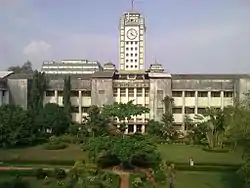
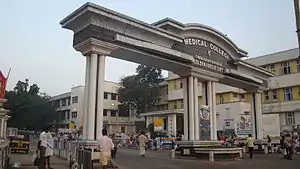
The basis for the state's health standards is the state-wide infrastructure of primary health centres. [11] There are over 9491 government and private medical institutions in the state; they have about 38000 beds for the total population, making the population bed ratio of 879 one of the highest in the country.[12][9] Almost all mothers are taught to breast-feed and a state-supported nutrition programme for pregnant and new mothers is active, and about 99% of the total deliveries/child births are institutional/hospital deliveries,[13] leading to infant mortality in 2018 being 7 per thousand,[14] compared to 28 in India, overall[15] and 18.9 for low- middle income countries generally[16].The birth rate is 40 per cent below that of the national average and almost 60 per cent below the rate for impoverished countries in general. Kerala's birth rate is 14.1[17] (per 1000 population)and decreasing. India's rate is 17[18] and that of the U.S. is 11.4.[19] Life expectancy at birth in Kerala is 77 years compared to 70 years in India[20] and 84 years, in Japan,[21] one of the highest in the world. Female life expectancy in Kerala exceeds that of the male, similarly to that in developed countries.[22] Kerala's maternal mortality ratio is the lowest in India at 53 deaths per 100,000 live births.[20]
| Medical Colleges | 34 |
| Hospitals | 1280 |
| Community Health Centres[9] | 229 |
| Primary Health Centres[9] | 933 |
| Sub Centres | 5380 |
| AYUSH Hospitals/Dispensary | 162/1473 |
| Total Beds | 38004 |
| Blood Banks | 169 |
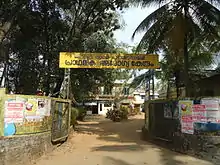
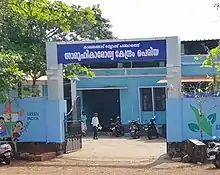
District-wise Hospital Bed Population Ratio as per the 2011[23]
| District | Population Census(2011) | Number of beds | Population Bed Ratio |
|---|---|---|---|
| Alappuzha | 2127789 | 3424 | 621 |
| Ernakulam | 3282388 | 4544 | 722 |
| Idukki | 1108974 | 1096 | 1012 |
| Kannur | 2523003 | 2990 | 844 |
| Kasaragod | 1307375 | 1087 | 1203 |
| Kollam | 2635375 | 2388 | 1104 |
| Kottayam | 1974551 | 2817 | 701 |
| Kozhikode | 3086293 | 2820 | 1094 |
| Malappuram | 4112920 | 2503 | 1643 |
| Palakkad | 2809934 | 2622 | 1072 |
| Pathanamthitta | 1197412 | 1948 | 615 |
| Thiruvananthapuram | 3301427 | 4879 | 677 |
| Thrissur | 3121200 | 3519 | 887 |
| Wayanad | 817420 | 1367 | 598 |
| Total | 33406061 | 38004 | 879 |
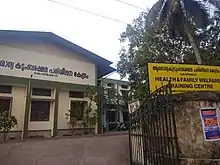
The Health Index, ranking the performance of the States and the Union Territories in India in Health sector, published in June 2019 by the NITI Ayong, Ministry of Health and Family Welfare, Government of India and The World Bank has Kerala on top with an overall score of 74.01.Kerala has already achieved the SDG 2030 targets for Neonatal Mortality Rate, Infant Mortality Rate, Under-5 Mortality rate and Maternal Mortality Ratio.[24][25][26]
The Economist has patted the Kerala Government for providing palliative care policy (It is the only Indian state with such a policy) and funding for community-based care programmes. Kerala had pioneered universal health care through extensive public health services.[27][28] Hans Rosling also highlighted this when he said Kerala matches United States in health but not in economy and took the example of Washington, D.C. which is much richer but is less healthy compared to Kerala.[29][30]
Key Health Development indicators- Kerala & India
| Health Indicators | Kerala | India |
|---|---|---|
| Life expectancy at birth (Male)[20] | 74.39 | 69.51 |
| Life expectancy at birth (Female)[20] | 79.98 | 72.09 |
| Life expectancy at birth (Average)[20] | 77.28 | 70.77 |
| Birth rate (per 1,000 population) | 14.1[17] | 17.64[18] |
| Death rate (per 1,000 population) | 7.47[17] | 7.26[18] |
| Infant mortality rate (per 1,000 population) | 7[14] | 28[15] |
| Under 5-Mortality rate(per 1,000 live births)[13] | 10 | 36 |
| Maternal mortality ratio (per lakh live births)[20] | 53.49 | 178.35 |
| Indicators | 2020 | 2019 |
|---|---|---|
| Children in the age group 9-11 months Immunised(%) | 92 | |
| Notification rate of Tuberculosis per 1,00,000 population | 75 | 71 |
| HIV Incidence per 1,000 uninfected population | 0.02 | 0.03 |
| Suicide rate (per 1,00,000 population) | 24.30 | |
| Death rate due to road accidents per 1,00,000 population | 12.42 | |
| Institutional deliveries out of the total deliveries reported (%) | 99.90 | 74 |
| Monthly per capita out-of-pocket expenditure on health (%) | 17 | |
| Physicians, nurses and midwives per 10,000 population | 115 | 112 |
Education
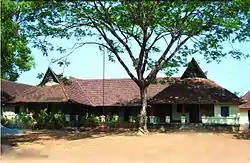
The Pallikkoodam, a school model started by Buddhists was prevalent in the Malabar region, Kingdom of Cochin, and Kingdom of Travancore. This model was later imbibed by Christian missionaries initiated by the then Archbishop of Verapoly, Bernardo (Giuseppe) Baccinelli, O.C.D., paved the way for an educational revolution in Kerala by making education accessible to all, irrespective of caste or religion. Christian missionaries introduced Western education methods to Kerala. Communities such as Ezhavas, Nairs and Dalits were guided by monastic orders (called ashrams) and Hindu saints and social reformers such as Sree Narayana Guru, Sree Chattampi Swamikal and Ayyankali, who exhorted them to educate themselves by starting their own schools. That resulted in numerous Sree Narayana schools and colleges, Nair Service Society schools. The teachings of these saints have also empowered the poor and backward classes to organize themselves and bargain for their rights. The Government of Kerala instituted the Aided School system to help schools with operating expenses such as salaries for running these schools.
Kerala had been a notable centre of Vedic learning, having produced one of the most influential Hindu philosophers, Adi Shankaracharya. The Vedic learning of the Nambudiris is an unaltered tradition that still holds today, and is unique for its orthodoxy, unknown to other Indian communities. However, in feudal Kerala, though only the Nambudiris received an education in Vedas, other castes as well as women were open to receive education in Sanskrit, mathematics and astronomy, in contrast to other parts of India. Tirunavaya was a centre of Vedic learning in early medieval period. Ponnani in Kerala was a global centre of Islamic learning during the medieval period.
The upper castes, such as Nairs, Tamil Brahmin migrants, Ambalavasis, St Thomas Christians, as well as backward castes such as Ezhavas had a strong history of Sanskrit learning. In fact many Ayurvedic Physicians (such as Itty Achudan) were from the backward Ezhava community and Muslim community (such as the father of renowned Mappila Paattu poet Moyinkutty Vaidyar). Vaidyaratnam P. S. Warrier was a prominent Ayurvedic physician. This level of learning by non-Brahmin learning was not seen in other parts of India. Also, Kerala had been the site of the notable Kerala School which pioneered principles of mathematics and logic, and cemented Kerala's status as a place of learning.
The prevalence of education was not only restricted to males. In pre-colonial Kerala, women, especially those belonging to the matrilineal Nair caste, received an education in Sanskrit and other sciences, as well as Kalaripayattu, a martial art. This was unique to Kerala, but was facilitated by the inherent equality shown by Kerala society to females and males, since Kerala society was largely matrilineal, as opposed to the rigid patriarchy in other parts of India which led to a loss of women's rights.
The rulers of the princely state of Travancore (were at the forefront in the spread of education. A school for girls was established by the Maharaja in 1859, which was an act unprecedented in the Indian subcontinent. In colonial times, Kerala exhibited little defiance against the British Raj. However, they had mass protests for social causes such as rights for "untouchables" and education for all. Popular protest to hold public officials accountable is a vital part of life in Kerala.[31]
The following table shows the literacy rate of Kerala from 1951 to 2011, measured every decade:[32]
| Year | Literacy | Male | Female |
|---|---|---|---|
| 1951 | 47.18 | 58.35 | 36.43 |
| 1961 | 55.08 | 64.89 | 45.56 |
| 1971 | 69.75 | 77.13 | 62.53 |
| 1981 | 78.85 | 84.56 | 73.36 |
| 1991 | 89.81 | 93.62 | 86.17 |
| 2001 | 90.92 | 94.20 | 87.86 |
| 2011 | 94.59 | 97.10 | 92.12 |
State policy
In 1957 Kerala elected a communist government headed by EMS Namboothiripad, introduced the revolutionary Land Reform Ordinance. The land reform was implemented by the subsequent government, which had abolished tenancy, benefiting 1.5 million poor households. This achievement was the result of decades of struggle by Kerala's peasant associations. In 1967 in his second term as Chief Minister, EMS again pushed for reform. The land reform initiative abolished tenancy and landlord exploitation; effective public food distribution that provides subsidised rice to low-income households; protective laws for agricultural workers; pensions for retired agricultural laborers; and a high rate of government employment for members of formerly low-caste communities.
Hunger
According to the India State Hunger Index, Kerala is one of the four states where hunger is only moderate. Hunger index score of Kerala is 17.66 and is next only to Punjab. Nation hunger index of India is 23.31.[33]
Opinions
British Green activist Richard Douthwaite interviewed a person who remembers once saying that "in some societies, very high levels – virtually First World levels – of individual and public health and welfare are achieved at as little as sixtieth of US nominal GDP per capita and used Kerala as an example".[34]: 310–312 Richard Douthwaite states that Kerala "is far more sustainable than anywhere in Europe or North America".[35] Kerala's unusual socioeconomic and demographic situation was summarized by author and environmentalist Bill McKibben:[36]
Kerala, a state in India, is a bizarre anomaly among developing nations, a place that offers real hope for the future of the Third World. Though not much larger than Maryland, Kerala has a population as big as California's and a per capita annual income of less than $3000. But its infant mortality rate is very low, its literacy rate's among the highest on Earth, and its birthrate's below that of America's and falling faster. Kerala's residents live nearly as long as Americans or Europeans. Though mostly a land of paddy-covered plains, statistically Kerala stands out as the Mount Everest of social development; there's truly no place like it.[36]
References
- Parayil, Govindan (2000). "Introduction: Is Kerala's Development Experience a Model?". In Govindan Parayil (ed.). Kerala: The Development Experience : Reflections on Sustainability and Replicability. London: Zed Books. ISBN 1-85649-727-5. Retrieved 16 January 2011.
- Franke, Richard W.; Barbara H. Chasin (1999). "Is the Kerala Model Sustainable? Lessons from the Past, Prospects for the Future". In M.A. Oommen (ed.). Rethinking Development: Kerala's Development Experience, Volume I. New Delhi: Institute of Social Sciences. ISBN 81-7022-764-X. Retrieved 16 January 2011.
- "Kerala Model & development". Dawn.com. Archived from the original on 13 April 2010. Retrieved 17 July 2010.
- "KN Raj passes away". Oman Tribune. Archived from the original on 15 July 2011. Retrieved 17 July 2010.
- Parayil, Govindan (December 1996). "The 'Kerala model' of development: Development and sustainability in the Third World". Third World Quarterly. 17 (5): 941–958. doi:10.1080/01436599615191. ISSN 0143-6597. PMID 12321040.
- "Human Development Index rose 21 per cent; Kerala tops chart". CNBC. 21 October 2011.
- "HDI in India rises by 21%: Kerala leads the race". FirstPost. 21 October 2011.
- "Sub-national HDI - Subnational HDI - Global Data Lab". globaldatalab.org. Retrieved 13 September 2021.
- "Hospitals in the Country". pib.gov.in. Retrieved 14 September 2021.
- "Government Medical College,Thiruvananthapuram". tmc.kerala.gov.in. Retrieved 14 September 2021.
- "MISSION AND VISION – dhs". Retrieved 14 September 2021.
- State Health Profile, National Health Authority, Government of India (January 2021). "State Health Profile-Kerala, National Health Authority, Government of India" (PDF). pmjay.gov.in/.
- PARTNERSHIPS IN THE DECADE OF ACTION, SDG INDIA INDEX AND DASHBOARD 2020-2021 (4 March 2021). "SDG INDIA INDEX AND DASHBOARD 2020-2021-PARTNERSHIPS IN THE DECADE OF ACTION, NITI AYOG 2021" (PDF). www.niti.gov.in.
- "Reserve Bank of India - Publications". m.rbi.org.in. Retrieved 13 September 2021.
- "Mortality rate, infant (per 1,000 live births) - India | Data". data.worldbank.org. Retrieved 13 September 2021.
- "Mortality rate, neonatal (per 1,000 live births) - Low & middle income | Data". data.worldbank.org. Retrieved 14 September 2021.
- Report 2018, Government of Kerala, Annual Vital Statistics (2019). "ANNUAL VITAL STATISTICS REPORT – 2018, Vital Statistics Division Department of Economics & Statistics Thiruvananthapuram, Kerala 2019" (PDF). www.ecostat.kerala.gov.in.
- "Death rate, crude (per 1,000 people) - India | Data". data.worldbank.org. Retrieved 13 September 2021.
- "Birth rate, crude (per 1,000 people) - United States | Data". data.worldbank.org. Retrieved 14 September 2021.
- "GBD India Compare | IHME Viz Hub". vizhub.healthdata.org. Retrieved 13 September 2021.
- "Countries with highest life expectancy 2019". Statista. Retrieved 14 September 2021.
- "Kerala: A case study". Bill McKibben.
- Government of Kerala, Health at a Glance 2018 (2018). "Health at a Glance, 2018- Department of Health, Government of Kerala" (PDF). dhs.kerala.gov.in/.
- Report on ranks of States and Union Territories, June 2019, Healthy States Progressive India (June 2019). "Healthy States Progressive India- Report on the Ranks of States and Union Territories, June 2019" (PDF). social.niti.gov.in/.
- "Kerala: the community model (Page No 24)" (PDF). The Economist. Retrieved 25 July 2010.
- "'The Economist' hails Kerala model". The New Indian Express. Retrieved 25 July 2010.
- "Universal healthcare: the affordable dream". the Guardian. 6 January 2015.
- Kapur, Akash (1 September 1998). "Poor but Prosperous". The Atlantic.
- Rosling, Hans. "Transcript of "Asia's rise -- how and when"". www.ted.com.
- "The Enigma of Kerala".
- "How almost everyone in Kerala learned to read". 2005.
- "Education". Kerala Government. Archived from the original on 26 July 2010. Retrieved 17 July 2010.
- "The India State Hunger Index: Comparisons of Hunger Across States" (PDF). 2008. Archived from the original (PDF) on 14 February 2009.
- Douthwaite R (1999). The Growth Illusion: How Economic Growth has Enriched the Few, Impoverished the Many, and Endangered the Planet. New Society Publishers. pp. 310–312. ISBN 0-86571-396-0. Retrieved 11 November 2007.
- Heinberg R (2004). Powerdown: Options And Actions for a Post-Carbon World. New Society Publishers. p. 105. ISBN 0-86571-510-6. Retrieved 11 November 2007.
- (McKibben 2006).
- Chandran, VP (2018). Mathrubhumi Yearbook Plus - 2019 (Malayalam Edition). Kozhikode: P. V. Chandran, Managing Editor, Mathrubhumi Printing & Publishing Company Limited, Kozhikode.